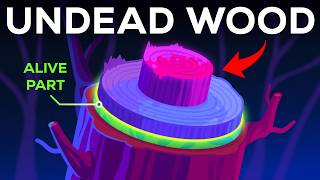

Trees Are Mostly Dead
43sReveals the shocking fact that the living part of a tree is just a thin strip, sparking curiosity and awe.
▶ Play Clip"The title 'Trees Are So Weird' is accurate and intriguing, matching the video's exploration of their bizarre biology."
Trees are mostly dead, with only a thin layer of living cells. They evolved lignin to grow tall, use negative pressure to lift water over 100 meters, and have a unique transport system of xylem and phloem. This makes them potentially immortal.
The living part of a tree is just a paper-thin strip of cells; the vast majority of biomass is dead.
Lignin, a rigid and waterproof macromolecule, gave plants the strength to grow tall and compete for sunlight.
Around 385 million years ago, plants developed wood, allowing the first trees to reach 20 meters high.
The cambium is a thin layer of stem cells that produce xylem inward, which become hollow dead tubes for water transport.
Evaporation from leaves creates tension that pulls water up to 100 meters, generating negative pressure equivalent to dozens of atmospheres.
Phloem cells sacrifice their nuclei to become living pipelines for sugar and signals, maintained by companion cells.
Outward-growing cells die to form bark, protecting the living layer from damage and invaders.
Trees don't age like animals; they can grow nearly forever unless stopped by external factors.
Trees are a remarkable evolutionary success, using dead structures and extreme physics to dominate land. Their unique biology allows them to grow tall, transport water efficiently, and potentially live indefinitely.
What is the living part of a tree called?
The cambium, a razor-thin circular zone of stem cells.
03:13
What macromolecule gave plants the strength to grow tall?
Lignin, a rigid, tough, waterproof macromolecule.
01:34
How high can transpiration pull lift water in trees?
Over 100 meters.
04:53
What happens to xylem cells as they mature?
They hollow themselves out, shedding their living contents, becoming hard empty tubes.
03:40
What is the function of companion cells in phloem?
They connect to sieve cells via tiny channels, sending energy, instructions, and repairing them.
07:05
How does transpiration create tension in water columns?
Evaporation from leaves creates a pull on the sticky water molecules, lifting the entire column.
04:41
What is the negative pressure inside a tree equivalent to?
Dozens of atmospheres, as much as hundreds of meters deep in the ocean.
05:09
Why can't human machines pull water higher than 10 meters?
Because the negative pressure required makes water boil.
05:22
What is heartwood?
Old xylem cells that fill with resins and turn into a dense, chemically fortified core resistant to decay.
05:52
How do trees potentially achieve immortality?
They don't age like animals; their growth system of mostly dead structures can continue nearly forever unless stopped by external factors.
08:49
Trees are mostly dead
Reveals the surprising fact that the living part is just a thin strip.
00:02Lignin breakthrough
Key evolutionary innovation that enabled trees to grow tall.
01:34Transpiration pull power
Explains the extreme physics behind water transport in trees.
04:53Sieve cell sacrifice
Describes the dramatic self-destruction of cells for transport.
06:35Potential immortality
Highlights the unique aging process of trees.
08:49[00:02] It turns out the alive part of a tree is just a tiny, paper thin strip of cells, Trees are some of the most extreme beings on earth with one of the most unique strategies in
[00:19] nature – on top of being mostly dead stuff, they forge their body out of thin air, they mercilessly crush rocks with acid, and they have an internal negative pressure that would kill you instantly. Let’s go back…to the beginning.
[00:36] For over a billion years the ancestors of plants only inhabited the sun drenched surfaces of the oceans. Their bodies were thin and delicate and absorbed water straight through
[00:49] Forging sunlight, carbon dioxide and water into sugar. But about 470 million years ago they decided to conquer a hostile alien planet: the land.
[01:03] Like green rugs with ambition these plant ancestors began clinging to But now, with solid ground beneath and no ability to float around a new dimension became a place of intense warfare: up.
[01:19] The higher they grew, the more sun they would get, while starving their competition below. Height became a deadly weapon. The battle for the sky had begun. Until now, plants were built mostly from cellulose, which was great for shape,
[01:34] Over dozens of millions of years of evolutionary warfare, a group of plants developed one of life's greatest breakthroughs: lignin. Lignin is a macromolecule made of ring-shaped structures.
[01:48] It is rigid, tough, waterproof, and incredibly hard to break down. It filled gaps between cellulose threads, stiffening and locking everything into place. Lignin gave plants the strength to grow taller and claim the sun for themselves.
[02:04] which must have been really annoying for them. So as more millions of years passed, some plants just went all in on lignin and produced more and more of it, becoming stiffer, harder and stronger.
[02:18] Until one day, around 385 million years ago they got the biological equivalent of steel reinforced concrete: wood. More on it later, but with this magic material the first trees emerged.
[02:32] shooting up to 20 meters high into the sky – and they only got bigger from here. But this enormous size created extremely hard problems:
[02:45] How do you get water from the ground up to the green parts that do the actual photosynthesis? And how do you get the sugar they produce down to the cells that keep you up there? On the scale of a cell a distance of a few meters is like you’re working
[02:58] in Britain while your lunch box is in Egypt and your drink in New York. So trees came up with one of the most amazing ways any organism grows, and became nearly immortal by accident.
[03:13] Let us slice an ancient tree in half and get to the heart running it all: the cambium, a razor-thin, circular zone, just a few stem cells wide.
[03:25] These stem cells grow inward and outwards, turning into two groups of specialists. The inward specialists are on a conveyor belt of death, the xylem. making the tree thicker the older it gets.
[03:40] As the xylem cells mature their lignin production goes into overdrive, and they become hard and stuffy, like a muscle slowly transforming into bone. They begin to hollow themselves out, shedding everything that once made them alive.
[03:53] What’s left is a corpse, a hard, empty tube. As the tree grows year after year, new corpses are layered on old corpses, A graveyard of trillions of plant bones.
[04:09] Stacked together they form a giant network of pipes that stretches the whole length of the tree. and a few other tricks to move it with incredible efficiency.
[04:24] Water molecules are, for a lack of a better word, sticky, like tiny magnets, When one moves, it pulls the next along with it, like pulling on a rope. In trees this rope starts in the roots and ends in the leaves that bathe in the warmth from the sun.
[04:41] Here the heat from the sun evaporates 95% of releasing a constant invisible mist of water molecules around the crown of the tree.
[04:53] This process, called transpiration in plants, creates tension on the rope of water molecules, stretching and lifting the entire column upwards, all the way from the roots to the leaves. This pull is so insanely strong that it can lift water over 100 meters,
[05:09] dozens of atmospheres – as much as the crushing pressure hundreds of meters deep in the ocean. Nothing humans have ever built comes even close to this power.
[05:22] Even our best machines can’t pull water higher than about 10 meters, because the negative pressure required to pull hard enough makes it boil. But the water pipes of trees are so tiny and narrow, almost perfectly airtight that
[05:35] despite the insane suction pressure inside a tree, water stays liquid and reaches the top. As the tree ages old xylem cells eventually stop working and fill Slowly they turn into heartwood, a dense,
[05:52] chemically fortified core that is extremely resistant to decay. But water is only one half of the story. The sugar produced in the sky needs to be transported to nourish cells down below.
[06:07] and exchange information about damage and growth. This is the job of the cambium stem cells that grow outwards: the phloem.
[06:19] As the Cells of the phloem grow outwards they separate into three teams and make a brutal compromise. The first group are Sieve cells and their grim fate is to become a living transport system.
[06:35] As they mature they start to destroy themselves, digest their organelles and even their nuclei that houses their genetic code. connecting to the sieve cells above and below them.
[06:51] This goes on until they are a sad shadow of living beings. A drooling, living tool without a brain or arms, unable to support themselves. Only the second group, their companion cells, keeps them alive.
[07:05] They connect with the crippled Sieve cells via tiny channels and start maintaining them. Sending over energy, instructions or repairing them if needed. Running along the entire tree, these two teams form a tiny and very thin
[07:19] layer of living sugar pipelines and signal cables that stretch throughout the entire body. Providing food and information wherever it is needed in the tree. workers of the tree that are carrying out essential labor in the background.
[07:35] sugars or water that the tree uses to survive the winter, when it is unable to produce food. Others are like mini healers that can repair damage, while some go onto the
[07:47] offensive and create toxins and anti fungal bio weapons to kill intruders. On top of the phloem sits another layer of stem cells. They are producing a second conveyor belt of death, moving outside.
[08:00] Special cells grow from this layer and as they mature, just like the xylem cells in the center, they kill themselves for the team, turning into a hard guard wall – the bark. Just like your skin, it protects the tiny living layer from damage, parasites and invaders.
[08:17] The living part of the stem is really just this extremely thin and tiny layer, a few millimeters thick, sitting on a thick mountain of cell corpses, The vast majority of the biomass of a tree is dead.
[08:35] it seems you are only doing a little damage, you are actually killing the living part of the tree. But unless a tree is stopped by droughts, diseases, storms or a human axe,
[08:49] this system of being mostly dead kind of makes trees potentially immortal. They don’t age like we do, in principle they could grow this way nearly forever. Egyptians started building their first pyramid, 5000 years ago.
[09:06] Trees are not a real biological category but one of the most successful ideas life has ever had, These plants won the battle for the sky, solved every challenge that had kept
[09:22] plants small and fragile and they took over the planet in a few million years. Even today three trillion of them cast their majestic shadows. and the root system – one building the tree from air, another mining
[09:40] minerals with acid and involved in complex communications with fungi and other trees. There’s so much more to talk about, so we’re already working on the next part - stay tuned!
[09:53] disappearing fast and we’re running out of time to protect what’s left. Planet Wild is a community-based nature protection organization
[10:07] Every month, their community of over 15,000 members funds a new mission to restore nature. That’s why we love that Planet Wild documents all their missions in video
[10:23] reports right here on YouTube so you can see what your contribution helped achieve. Take their underground forest mission in Tanzania: While you think this desert is dead, there’s actually life still here.
[10:36] Beneath the surface, underground forests are just waiting to grow. If you would like to help our planet’s ecosystems, consider joining Planet Wild.
[10:48] You can give any amount that feels right to you – every dollar counts. KURZGESAGT11 will get their first month paid for by us! Just scan the QR code or click the link in the description.
[11:02] Make a tree friend, and join the Planet Wild community – today. If you want to see them in action first, check out their underground forest mission here.



⚡ Saved you 0h 11m reading this? Transcribe any YouTube video for free — no signup needed.