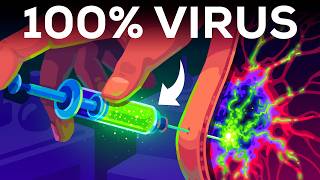

Doctor Injects Viruses Into Her Own Cancer
45sThe shocking premise of a scientist self-experimenting with viral therapy immediately hooks viewers.
▶ Play Clip"Title promises a daring story and delivers exactly that—detailed, factual, and engaging account of a real medical experiment."
This video tells the remarkable story of Dr. Beata Halafi, a Croatian virologist who, facing stage 3B breast cancer, engineered and injected her own anti-cancer viruses (measles and VSV) directly into her tumor. It explains how oncolytic virotherapy works, the accidental discovery behind it, and why it remains a challenging but promising cancer treatment.
A virologist with breast cancer, after failed chemo and recurring tumors (stage 3B), decides to treat herself by injecting lab-grown viruses directly into her cancer, bypassing standard medical safety protocols.
In the early 20th century, doctors noticed tumors shrank when patients had viral infections like influenza or measles, sparking interest in virotherapy.
Normal cells fight viruses by slowing down, calling the immune system, and self-destructing; cancer cells lack these defenses because of the mutations that make them cancerous, making them easy prey.
Using viruses to kill cancer is difficult due to tumor heterogeneity, the need to kill all cancer cells, prior chemo weakening the immune system, and the complexity of the three-way battle between virus, cancer, and immune system.
She decided to skip further chemo to keep her immune system strong, engineer her own virus mix, and perform virotherapy on herself, something never attempted before.
Viruses are produced in labs by infecting cell cultures, but clinical grade purity is required for human use; Beata accepted the risk of using a less-purified mix.
She selected a weakened measles vaccine strain, safe and tested in humans, to attack her cancer.
After initial injections, the tumor swelled (due to immune influx), then shrank dramatically as the virus infection broke the cancer's protective shield and triggered a massive immune response.
To overcome immunity to measles, she switched to VSV (vesicular stomatitis virus). Total virus dose exceeded 18 million. After two months, the tumor shrank 53%, stopped invading tissue, and was surgically removed. Six years later, she remains cancer-free.
Her actions drew criticism from medical ethicists because she used unapproved viruses/methods, highlighting the trade-off between safety (slow, expensive trials) and progress (faster but riskier). Current trials mostly target late-stage cancers, which weakens trial efficacy.
Accidental Discovery
Explains the historical foundation of virotherapy.
01:54Radical Self-Experiment
Dr. Halafi's plan and reasoning for skipping chemo.
04:40Successful Outcome
Tumor shrank by 53% and she remained cancer-free for six years.
10:46Ethical Trade-off
Highlights the debate between safety and medical progress.
11:32[00:00] A sharp needle breaks skin and pierces the firm, dark tumor. Millions of viruses invade deep into the deadly cancer, kick-starting an experiment that had never been attempted before,
[00:13] bypassing some of the most sacred safety nets in medicine. This is the story of Dr. Beata Halafi, an expert virologist from Croatia who decided to cure her own cancer.
[00:25] Thanks to her help, she can tell it as accurately as possible. It has been a few years since Beata had been diagnosed with breast cancer, a pretty bad one. After a surgery to remove as much of the cancer as possible, she went through four cycles of pretty harsh chemotherapy.
[00:41] The goal was to eliminate every last cancer cell that was still hiding in her body. And the chemo did its job. All rapidly dividing cells in Beata's body died on that. The cells of her immune system, hair and mucosa, and digestive tract died in drugs.
[00:57] We'll spare you the details, but it wasn't fun. Beata was sure that if this harsh treatment would not destroy the cancer completely, then nothing would. Unfortunately, at least one cell survived.
[01:10] After two years, it came back again and was removed again. And again, it came back, stronger, bigger, and now even more dangerous than before. A hard, dark mash that had begun invading Beata's muscles and skin, getting ready to spread all over her body.
[01:27] Stage 3B. If it was allowed to succeed, her chances of survival were very slim. This is where Beata decided to take care of this cancer herself with the support of her colleagues,
[01:39] because they actually had a unique mix of expertise and resources. Her plan was as simple as it was daring. They would read viruses that they were deeply familiar with from her lab and inject them directly into her cancer.
[01:54] Why viruses love cancer. Like many medical advances, this one was discovered by accident. In the early 20th century, baffled doctors observed that the tumors of some cancer patients shrank when they got virus infections like influenza or measles, which makes perfect sense if we understand how both work.
[02:14] When regular cells are infected with a virus, they fight back hard and without compromise. First they slow down, calming their internal machinery so the virus has a harder time taking them over and making copies of itself.
[02:28] Then they screen the immune system to send antivirus killers, which usually means that they'll be killed themselves. And if they can, they push their self-destruct button and take the virus with them.
[02:40] Cancer cells are unable to use any of these defenses exactly because of the corruption that makes them cancer. unhinged and hyperactive, eating and reproducing feverishly, unable to slow down.
[02:53] Cancer cells also can't really call the immune system to help them out because it's trying really hard to kill them. Successful cancers actually build a protective zone around them that hides them from immune cells or even kills them.
[03:06] And lastly, their self-destruct button is broken. So, viruses are a horrible enemy for cancer cells, slaying them effortlessly. But much worse, once the virus starts killing, all of the ensuing death, virus and tumor particles
[03:22] attack the immune system, which then happily joins the massacre. Viral therapy became an active field of research and a big hope for beating cancer. Unfortunately, it turns out that using viruses to kill cancer is way harder than initially thought.
[03:37] You've got three very complex players trying to kill each other, fighting inside a living human being that somehow has to survive Cancer is also very much not cooperative in its own destruction and often very hard to reach especially if it already stretched around the body And in the end you need to kill every last cell to really slay it
[03:57] Cancer is also a living, evolving entity, and does not look exactly the same in two people. So it's extremely difficult to find virotherapies that work in many different patients. On top of all that, cancer is typically treated with chemotherapy first, often with incredible
[04:13] result and great survival rate. The author of this video is only alive because of chemo, so we're not talking it down at all. But one of its most brutal side effects is that it can severely weaken your immune system. And without your immune system at its aching,
[04:28] virotherapy can't work properly because it's doing most of the slaughter. As an expert virologist with extensive experience, Dr. Hannity knew all of this. So she developed a plan. She
[04:40] would take her chances, forego another round of chemo, and keep her immune system ready to fight. Beata would engineer her own anti-cancer virus mix and do her own virotherapy.
[04:52] Nobody had done anything like this before. Even with all of her experience and resources, this was not going to be easy. Viruses might actually be part of the solution here, but online, we prefer they stay far,
[05:07] far, far, far, far away from us. and NordVPN is our weapon of choice against them. Go to nordvpn.com slash kurzgesagt to make sure malicious websites are blocked,
[05:19] web trackers stopped, and scam webshops identified. NordVPN's next-generation antivirus scans files during downloads, removes malware, and blocks ads automatically,
[05:31] and they warn you of scam calls before you answer. NordVPN also protects you during travel season by encrypting your connection when you connect to unknown Wi-Fi stations in hotels, airports or cafes.
[05:43] You can choose from thousands of servers in 224 locations around the world to access your home content from abroad. You can also book hotels or rental cars more cheaply thanks to the price difference in different countries,
[05:55] regardless of whether you're surfing with a computer, tablet or smartphone. NordVPN is compatible with all major platforms and can be used on 10 devices simultaneously. If you want to discover all the services NordVPN offers, go to nordvpn.com slash kotzgesagt to get four months extra on a two-year plan.
[06:14] All risk-free with NordVPN's 30-day risk-free refund guarantee. Great, that's sorted. Now back to useful viruses. The artist's viruses.
[06:26] In labs, viruses are usually produced by injecting them into cell cultures, letting them multiply and then purifying the mix. creating a liquid with mostly viruses but also some cell debris and garbage.
[06:39] This is good enough for most lab experiments but would never be allowed to be used in humans. Anything that goes into our bodies has to be clinical grade, way more pure to be as safe as possible.
[06:51] Beata decided the risk was acceptable for her. So, her next big question was which virus to inject. The main thing she was looking for was a virus that specifically attacked the cell types the cancer emerged from. Ideally, it shouldn't cause a serious disease, because surviving cancer doesn't help if you
[07:08] then die of Ebola. And this virus had to have been clinically tested in humans before. So, for her first virus, Beata and her colleagues chose measles. Not the wild, dangerous type that killed about 100,000 people in 2024.
[07:23] The weakened and pathetic version we've been using in the measles vaccine for over 40 years. The artist went to work and together with her team produced her first dose The range filled with about 600 measles viruses The plan was to get an injection every few days for the next few weeks and monitor closely what would happen to the cancer
[07:43] And so the experiment began. The needle was pushed directly into her cancer. A dark, hard tumor growing and thriving. At first, nothing seemed to be happening. But after the second dose of tens
[07:57] and thousands of viruses, the tumor suddenly exploded, almost doubling in size, and became more spiky, aggressive-looking. After two more injections, the tumor began to shrink and constrict. What was happening inside Beata's body? Let's go back in time. After the first
[08:15] injection, the viruses couldn't believe their luck. They'd found the most amazing hunting grounds, and they went to work, infecting, killing, multiplying. Cancer cells were screaming in panic and dying by the minions. The tumor turned into a battleground, leaking the broken
[08:32] parts of dead cells and countless newborn viruses. Until this moment, the cancer had been protected by a chemical defense zone around itself, hiding from the immune system. No anti-cancer cell could cross it, but the measles massacre shattered the protection.
[08:48] There's nothing that makes your immune system more aggressive than evidence of cells being killed. Death is always an emergency, and with that much death and virus parts leaking into healthy tissue, the art of the immune system suddenly jolted away in shock. Not
[09:03] only was there an enormous virus infection that somehow had been able to fester, no, there was something else. A hidden R-genome, suddenly ripped from the shadows and without protection. The art of the immune system chose violence. Like angry angels of death, millions
[09:20] of immune cells invaded the tumor furiously fighting and killing viruses and cancer. This sudden influx of cells is what caused the artist's tumor to swell so explosively. What followed was an epic and unhinged massacre. Viruses killed defenseless cancer cells, virus
[09:37] hunter cells gobbled up viruses, and cancer killers exploded cancer cells left and right, while cancer cells still fought back and deactivated immune cells where they could. Every few days, fresh injections followed, saturating Beata's cancer with at least 18 million viruses in total, keeping the massacre going.
[09:56] There was one problem, though. The immune system was too good at its job. Soon, Beata would be totally immune against measles and likely eradicate the virus, which might end the therapy before it finished.
[10:08] So after a few weeks, Beata started injecting a second virus, VSV, a pretty harmless relative of rabies that causes mild flu symptoms in extremely rare cases the human catches it.
[10:20] Within a day after the first VSV injection, Beata fell ill with a fever and chills. But amazingly, these would remain her only side effects during the entire experiment. Her immune system was freshly offended
[10:32] and once again hurled itself into the tumor with newfound anger. The massacre continued as unhinged as before. After two months of injections, the tumour was only a shadow of its former self.
[10:46] 53% smaller, it had turned soft and lost its density. And critically, it had completely stopped any advances into the muscle and skin tissue. Now surgeons removed the weakened tumour and examined it in the lab.
[11:00] Half of its mass was immune cells, angrily bashing cancer cells to death. Beata had beaten her own cancer. To be sure no survivors could throw back, her doctors treated her with additional anti-cancer drugs for a year, but at the time of the making
[11:15] of this video it been six years and her cancer has not returned It seems that Dr Harafi has cured herself for good Why don we treat patients more often this way Beata decision to inject herself with viruses earned her much admiration and applause
[11:32] but also a ton of criticism from medical ethicists, mostly because the viruses and methods she used were not approved for use in humans, which begs the question, why is it so hard for patients like her to access experimental treatments?
[11:46] Well, the reality is that many things in life are not really right or wrong, that exists on a trade-off slider. There's no correct decision, just which payoffs do you want to accept. In this case, if you make medical trials easy, fast, and cheap,
[12:01] then there'll be experiments that will seriously harm a few people, but on average you'll make more progress faster, which will potentially save more lives in the end. If you make medical trials hard, very slow, and expensive,
[12:13] on average you'll harm fewer people and can be pretty confident the new therapies are pretty safe. But you also hugely slow down medical progress and even completely prevent some new therapies.
[12:26] In today's world, the cider is firmly on this side. So, as a result, many novel cancer therapies are usually only given to people who've exhausted all other conventional therapies and whose cancer is very advanced.
[12:40] As a last resort of sorts, at the time of making this video, over 100 studies are actively testing viruses against cancer in humans, but the vast majority are restricted to late-stage cancers. And this slows down progress because it means that new therapies are tested in people
[12:56] whose body and immune systems are already severely weakened, while their cancer is at the height of its strength. So perhaps it's time to give viruses a chance earlier in the process, when the cancer
[13:08] is only getting started and the body is not yet weakened by more aggressive treatments. To be crystal clear, virotherapy is not and won't be the cure to cancer. Cancer is hundreds of different diseases,
[13:21] and the best therapy depends on the type, location, and how far it has spread. But in the best case, virotherapy could be much less toxic and as effective or better than chemo,
[13:33] especially in combination with other therapies. Another weapon in our arsenal. So, what can we take away from Dr. House's story? Her goal was to save her own life in the face of a terminal threat.
[13:45] It was not without risk, but she succeeded. And in the process, she hoped to inspire more research on virotherapy as early options for patients to save other lives like hers.
[13:57] But she was also in a pretty unique position to try this experiment, and since she was doing it on herself, she didn't need to go through the processes that would usually have slowed it down or forbidden it. In 2026, six years after Beata's treatment, over a dozen studies are underway to test viruses as early-stage cancer therapies.
[14:16] And in our book, this is hugely great news. If you want to keep learning about biology and science, we've got the perfect poster series for you. Fill your walls with knowledge every aspiring scientist should have at a glance, from our periodic table poster to our world map poster.
[14:34] or dive into complex topics like evolution and human history packed with fascinating details you'll keep discovering over time. Every poster is created in collaboration with leading experts and meticulously designed right here at Kurzgesagt.
[14:49] You can now build your own educational poster wall and get 25% off. Exclusively available on the Kurzgesagt store. You want to listen to the beautiful soundtrack without my annoying voice?
[15:03] Well, it's up to you. Just select the audio track Interlingua down here and watch the video again as a music video.

⚡ Saved you 0h 15m reading this? Transcribe any YouTube video for free — no signup needed.