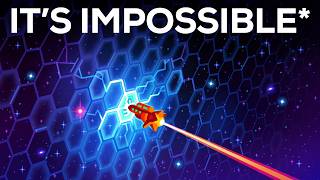

The Invisible Barrier Trapping Us in the Solar System
47sThe hook immediately introduces a mysterious, mind-blowing concept that challenges viewers' understanding of space exploration.
▶ Play Clip"Delivers on the promise of explaining a cosmic barrier, but padded with sponsor and merch segments."
This video explores the fundamental physical barriers that may prevent humanity from ever exploring deep space, despite our technological ambitions. It explains the vast distances involved, the speed limits imposed by the dangers of interstellar dust and particles, and the disappointing reality of nearby star systems.
There may be millions of alien civilizations, but none can venture into deep space meaningfully due to fundamental physics.
The fastest humans traveled at 40,000 km/h, while the Parker Solar Probe reaches 635,000 km/h, covering Earth-Moon distance in 36 minutes.
At Parker Solar Probe speed: Moon in 2 weeks, Pluto in a year, heliopause in 2 more years, Oort cloud edge in 2,500 years.
Nuclear fusion or antimatter could theoretically propel a ship to 20% the speed of light (60,000 km/s), reaching Alpha Centauri in 20 years.
Space is not empty; hitting atoms, dust, or pebbles at high speed is catastrophic. A grain of dust at 20% light speed is like a grenade; a golf-ball-sized rock has Hiroshima-level energy.
Within 8 light-years (40-year travel time), most destinations are deadly or uninhabitable. Even promising planets like GJ1061 d offer no guarantees.
Space is the greatest challenge humanity will face; current technology is hopelessly underpowered. We need transformative technology, and predicting the future is risky (NYT 1903 editorial).
The video concludes that deep space exploration may be fundamentally limited by physics, but history shows that predictions about technology are often wrong. The future might lie not in outward expansion but in other directions, yet to be explored.
What is the fastest speed achieved by a human-made object?
The Parker Solar Probe at 635,000 km/h.
01:38
How long would it take to reach the edge of the Oort cloud at Parker Solar Probe speed?
2,500 years.
02:34
What speed could a fusion or antimatter propulsion achieve?
20% the speed of light (60,000 km/s).
03:34
What happens when a spaceship hits a grain of dust at 20% light speed?
It's like running into a grenade, causing a tiny detonation.
06:24
What is the energy equivalent of hitting a golf-ball-sized rock at 20% light speed?
The energy of the Hiroshima nuclear bomb.
06:41
What is the realistic travel time limit for humans?
40 years, allowing travel up to 8 light-years away.
08:39
How many stars are within 0.02% of the Milky Way (stellar neighborhood)?
34 stars and 6 brown dwarfs.
09:23
Parker Solar Probe Speed
Sets a concrete benchmark for human engineering speed.
01:3820% Light Speed Potential
Shows theoretical propulsion could drastically reduce travel times.
03:34Dust as Grenade
Vividly illustrates the danger of interstellar dust at high speeds.
06:24NYT 1903 Editorial
Highlights the folly of predicting technological progress.
11:55[00:00] Now available on the kurzgesagt Shop. Nobody alive today will. Locked in by an invisible barrier, impossible to overcome for carbon based animals like us.
[00:20] And not just us – there may be millions of alien civilizations in the universe, none of them ever able to venture into deep space in a meaningful way. Ok but how can this be? We've made countless videos imagining how the
[00:35] exploration of the galaxy and beyond should just be a question of time. Sort of mandatory for civilizations at a certain point. But there is a catch: We are pushing up against fundamental physics.
[00:47] What is this barrier, made of dust and nothingness? And why is it so hard to overcome? We Don’t Either. Conceptualizing the size of space is impossible for our ape brains
[01:03] that evolved to understand distances like “right here” and “over the next hill”. Space is so absurdly huge that we just check out and just hear “very far”. “Very far” and “A million times very far” feels the same but it is not.
[01:21] To help our brains, let us start with what makes us cross distances: speed. The fastest a human ever traveled in space were Astronauts at 40,000 km/h, Not bad, but way too slow.
[01:38] The fastest thing humans have ever built by far is the Parker Solar Probe, hurling around the gravity well of Venus, accelerating to get closer to the sun. the probe is shooting through space at a breathtaking 635,000 km/h.
[01:56] or to cover the distance from Earth to the moon in 36. So let’s pretend we had a spaceship that fast, with a human crew ready to explore the universe!
[02:08] but our new spaceship covers the distance in just two weeks! Pretty good! The next stop is Pluto which we will reach after about a year – ok much longer,
[02:21] but still ok! It only takes two more years to pass the heliopause and one more to pass Voyager II, which traveled over 50 years to get this far. The next stop is the end of the Oort cloud,
[02:34] the true edge of the solar system where open space begins! We reach it in… 2,500 years. Not only did we travel for the amount of time it took to get from the founding of
[02:48] the Roman Republic to the present day, there is NOTHING out here. The barrier of nothingness that might trap us in the solar system forever.
[03:00] There is a place that is very far away but with human ingenuity and billions of dollars we can get there! Then you zoom out one more time and all hope leaves your body. Why don’t we just go faster?
[03:17] Well we don’t know of a non-magic way to travel faster than light, teleport or freeze people. But things like a propulsion system that uses nuclear fusion or antimatter, are in the realm of the physically possible.
[03:34] Ignoring the technical details and various problems that these energy sources have, can get a spaceship to fly at around 20% the speed of light! Which is extremely fast – 60,000 kilometers per second, 216 million kilometers per hour.
[03:52] Fast enough to reach the edge of the solar system in just 3.5 days Alpha Centauri, the closest star system to our own in 20 years!
[04:04] We don’t have internet! Wait, what? Just kidding – but our sponsor Saily can help YOU with that problem while travelling.
[04:17] Saily is the eSIM service app from the creators of NordVPN. You can choose from a wide range of affordable eSIM plans for over 200 destinations, so you’ll never be without an internet connection while traveling.
[04:29] Just download the app, pick a data plan, use the code “kurzgesagt” for a 15% discount on your first data package, and install the eSIM in advance. It’ll activate automatically when you arrive, and you can start browsing right away.
[04:42] You can also use Saily to feel like a local – it now comes with an app-based phone number for voice calls and SMS that stays the same everywhere. Perfect for local apps, shops and travel companions – and to keep your real number private.
[04:57] With just one app download, you’ve solved your internet problem while traveling once and for all, Download Saily and use the code “kurzgesagt” at checkout or go to saily.com/kurzgesagt
[05:12] go back to solving our trickier travel problems. Everything should be sorted out now, right? Well..there is only one small issue:
[05:24] Space Hates You: The Barrier of Dust Unfortunately we will run into a few obstacles on the way. Because while space is very empty, it is not actually empty.
[05:38] There are energetic particles, gas, dust and things bigger than dust. if you are going really fast and smash into something, you have a huge problem.
[05:50] this is true even if the thing you are smashing into is just an atom. An individual iron atom that hits your spaceship at this speed Over time its hull would be riddled with microscopic bullet holes, which is not great.
[06:09] Of course our engineers knew this and created a shield for our ship. A sort of protective sail that absorbs or at least slows down most molecules we smash into. there are things floating around in space that are larger than atoms.
[06:24] Running into a single grain of dust at 20% the speed of light is like running into a grenade, causing a tiny detonation as the dust explosively evaporates, grinding away our protective shield. Like a small rock, the size of a golf ball.
[06:41] the energy of the nuclear bomb that was dropped over Hiroshima. Atoms, dust and pebbles are dangerous enough.
[06:54] We might have reached our natural speed limit here – besides the fact all of the damaging effects of hitting stuff floating around in the void get much worse fast.
[07:07] our spaceship should be able to survive traveling through space at roughly 20% the speed of light long enough to get to at least nearby stars in a reasonable amount of time!
[07:21] Almost Everything in Space that's Close is Super Lame The first proper target outside the solar system is the Alpha Centauri System.
[07:33] more realistic ship but only 20 years with our super fast fictional ship! So let’s cram a few unlucky humans into a tiny box for 20 years and send them
[07:46] on their way and assume they somehow make it without murdering each other! People around the globe gather together and hold their breath, eager to listen to it:
[07:59] “We arrived! Alpha Centauri and its planets are very pretty up close! Unfortunately they are all super deadly and uninhabitable. But we are doing extremely cool astrophysics and are learning a LOT, which is pretty exciting!
[08:13] We are getting kind of tired of freeze dried food and desperately need new shows to watch though. The thing with space is that almost all “close destinations”,
[08:25] if close means something different from what it usually means, are pretty lame. Not from a scientific perspective of course! It would be an absolute dream to have the privilege to set foot on foreign planets and marvel at the wonders of our universe!
[08:39] But if 20% of the speed of light might be our speed limit, and we give humans a realistic travel time of say, 40 years, we could reach things that are up to 8 light years away. None of the targets remotely within this range, within a human lifetime, may be worth traveling
[08:53] dozens of years in a tiny box, through one of the deadliest environments imaginable. Our solar system is a bit unlucky in that regard, we are in a relatively empty pocket of the galaxy. This might change in a few million years as we move through the galaxy, and there might be small,
[09:08] localized star spanning civilizations – we discussed this in another video. Let’s say that we could go much further, to any of the stars within our stellar neighborhood, 0.02% of the milky way by the way.
[09:23] This tiny bubble is currently inhabited by 34 stars, and 6 brown dwarfs. But one of them is actually the sun and another one is Alpha Centauri A.
[09:37] planets that vary from deadly to super deadly. There are a few planets in the habitable zones of their stars, where water can be liquid. But, Mars is also in the habitable zone of the Sun and it is really bad.
[09:53] Even the planets that we think look most like Earth, like GJ1061 d, come with no guarantees. Imagine traveling your entire life and then arriving at a Mars. There are a few stars that would be interesting targets
[10:10] and may have actual habitable planets – planets with oceans and atmospheres that are breathable, which probably would mean that they have some form of microbial life, if not more. It would be extremely interesting and definitely worth it to check them out!
[10:24] But they could be dozens, if not thousands of light years away. even at a large fraction of the speed of light. technologically way more advanced than us and very motivated could find solutions.
[10:42] Maybe they have solved biological aging and a travel time of a few hundred years Maybe they could send AI spaceships with embryos or some version of that into space. to make sure they don’t choose star systems that are deadly and empty.
[10:59] But it is still hard to imagine without real science fiction technology, how they could build and sustain a connected civilization. The longer you think about deep space, the less it makes sense.
[11:12] The distances are too vast, there is a deadly speed limit and even if we could solve these issues almost all destinations even remotely reachable may not be worth the trip. Space is the greatest challenge humanity will ever face.
[11:27] Rockets, computers and even nuclear fusion reactors are hopelessly underpowered. We need technology that is overwhelmingly transformative.
[11:39] Something as wild to us as flying to the moon would have been to a hunter gatherer. We genuinely don’t know. there are few things that make you look dumber than predicting the future of technology.
[11:55] In 1903 the New York Times published an editorial, "Flying Machines Which Do Not Fly” that confidently predicted it would take humans one to ten million years to achieve powered flight. 69 days later the first successful flight happened.
[12:11] So we really hope this video will seem as dumb as this article in a hundred years. And there is another option entirely – maybe our thinking about all this is just completely wrong.
[12:25] Maybe the future is not out there, but deep down – but we’ll explore that in another video… The latest LTD. Edition Pin is here, continuing the Cosmic Time Collection.
[12:39] But this device offers you a rare glimpse into the end of the Universe. Spoiler: one by one, all the stars will die, until everything is swallowed by darkness.
[12:51] Wear this animated, lenticular pin as a reminder that you exist right now, with stars and light and there is so much left to discover.
[13:03] You are exactly where you belong in cosmic time and the Universe. Only 10,000 Vanishing Stars Pins exist, and each one is individually numbered. Add it to your collection, or start a new one while supplies last.
[13:16] And while humanity may still be confined to a tiny corner of the cosmos, To celebrate these milestones, we created our Cosmic Milestones Poster Collection, featuring the first Moon landing, the Mars rover Curiosity, and the Wilson Observatory,
[13:32] Get your favorite, or better, all of them and create a gallery wall that will inspire you every day and remind you of what humanity is capable of.
[13:44] – get your special piece of kurzgesagt and the cosmos now.


⚡ Saved you 0h 14m reading this? Transcribe any YouTube video for free — no signup needed.