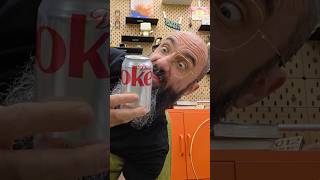

Diet soda warning paradox
45sThe surprising contradiction that diet sodas warn about an ingredient they don't actually contain sparks curiosity and challenges common assumptions.
▶ Play Clip"Delivers a clear, engaging explanation of a common label mystery, though it could be shorter."
The video explains why American diet sodas carry a phenylalanine warning despite containing no free phenylalanine. It clarifies that the warning stems from aspartame, a sweetener that breaks down into phenylalanine during digestion, and compares labeling practices between the US and UK.
US diet sodas warn they contain phenylalanine, but actually contain zero free phenylalanine molecules. UK labels say 'contains a source of phenylalanine,' hinting at the real reason.
Phenylalanine is an essential amino acid our bodies need but cannot synthesize. About 1 in 12,000 people have phenylketonuria (PKU), an inability to metabolize it, leading to brain development issues, seizures, and mood disorders. Warnings save lives.
Aspartame is about 200 times sweeter than sugar but has the same calories per gram. A diet soda needs only 0.2 grams of aspartame versus 39 grams of sugar, making it essentially calorie-free.
When consumed, aspartame undergoes hydrolysis: bonds break and water molecules donate parts to create aspartic acid, methanol, and phenylalanine. Thus, the warning refers to phenylalanine produced during digestion, not present in the drink.
The US and Brazil require aspartame-containing products to say they contain phenylalanine, but the UK's phrasing is more accurate since the drink contains no free phenylalanine, only a precursor that becomes it in the body.
The phenylalanine warning on diet sodas is technically about aspartame's breakdown product, not the drink's content. The UK's labeling is more precise, highlighting a philosophical difference in how regulators describe chemical precursors.
Label warning paradox
Reveals a surprising fact that challenges common assumptions about food labels.
PKU prevalence
Provides a concrete statistic (1 in 12,000) that underscores the importance of warnings.
00:30Aspartame sweetness ratio
Explains why diet sodas are calorie-free using a clear comparison.
00:58Hydrolysis breakdown
Clarifies the chemical process that creates phenylalanine in the body.
01:33Regulatory labeling philosophy
Highlights a philosophical difference in how regulators describe chemical precursors.
02:13[00:00] Have you seen that warning they put on diet sodas? Phenylketonurix contains phenylalanine. Why do they put phenylalanine in this? Well, that's what's weird. They don't. You do. Every single one of these sugar-free sodas from America carries a warning that it contains phenylalanine.
[00:14] And yet, none of them do. If you carefully sorted out all of their molecules, the number of phenylalanine molecules you would find would be zero. But in the United Kingdom, they use a different warning that hints at what's really going on. This is a diet coke I bought in London, and it says, contains a source of phenylalanine.
[00:30] Phenylalanine is an essential amino acid. Our bodies need it to live, but cannot synthesize it from scratch, so we have to get it through our diets. It's found in foods that contain protein, but one in about every 12,000 people are born with phenylketonuria,
[00:43] the inability to metabolize phenylalanine. When they consume it, they can't turn it into the neurotransmitters their brain needs, which can lead to altered brain development, seizures, disordered mood, memory, and focus, treatments include taking special supplements and following strict diets.
[00:58] It saves lives to warn people if your product contains phenylalanine. But this doesn So why does it say it does Well the answer is that it contains a different molecule aspartame Gram for gram aspartame contains the same number of calories as cane sugar or high fructose corn syrup but it about 200 times sweeter So while a regular
[01:18] soda needs to be sweetened with 39 grams of sugar or high fructose corn syrup, which is equivalent to about 36 gummy bears, a diet soda only needs to be sweetened with about two tenths of a gram of aspartame, making it essentially calorie-free. This is what
[01:33] a molecule of aspartame looks like. When you consume it, enzymes in your body cause it to go through hydrolysis, which means it involves water. Now during the chemical reaction, this bond right here breaks, and a water molecule donates
[01:45] its parts to create this molecule, aspartic acid. But also, this bond breaks and another water molecule donates some parts to create methanol, and this molecule right here. What is this one?
[01:57] Well, this is phenylalanine! So we've got a bit of a philosophical problem on our hands. America and Brazil require products that contain aspartame to say they contain phenylalanine. But I gotta say, I feel like Great Britain is being a bit more accurate here.
[02:13] These do not contain free molecules of phenylalanine. Instead, they contain marble blocks that microscopic sculptors in our bodies can chisel into phenylalanine, and it is neurotoxic to some.




⚡ Saved you 0h 02m reading this? Transcribe any YouTube video for free — no signup needed.