[00:00]
Artificial intelligence is about to hit science, big time. After it has taken over mathematics, it’s now coming for physics. And that is having a very interesting start.
[00:12]
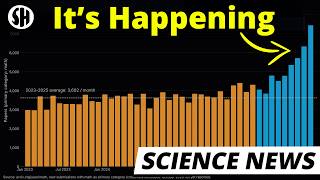
There have now been so many AI-derived proofs that I have lost track. At this point no one can deny any more that AI can deliver new and correct mathematical proofs. The arXiv is being flooded with AI generated maths papers. Mathematicians are complaining that AI proofs
[00:29]
are incomprehensible and inelegant slop while they weep into their notepads. Then, last week, OpenAI released a new batch of proofs, one that makes steps towards resolving a long-standing physics problem: whether Yang-Mills theories exist.
[00:46]
How relevant is this? Well, Yang-Mills theories are a type of theory that we use in the standard model of particle physics. So you may reasonably ask, OK, how can they possibly not exist given that the standard model works so well?
[01:01]
The reason is that what mathematicians mean by “existence” is not the same that scientists, or indeed everyday people mean. For a scientist something exists if it is a useful description
[01:14]
of nature. For a mathematician it means to prove that an object with certain mathematical properties can consistently be defined. It might totally be that the mathematical object of a
[01:26]
Yang-Mills theory does not exist, but that the calculations that physicists have derived from the idea of Yang-Mills theories still work in the sense of making correct predictions. You would then expect that the standard model is technically something close to Yang-Mills theory.
[01:43]
OpenAI didn’t actually settle the case, at least that is my understanding of the situation, as they haven’t told us just exactly what they did. But physicists went and complained immediately that it’s got no relevance for physics. And just like
[01:57]
mathematicians reacted to the Navier-Stokes proof, I think they aren’t quite honest. Because if this result had been put forward by a human being, they’d have celebrated it. Meanwhile physicists themselves have made good headway on dismantling their own discipline. You
[02:15]
see, for decades, those physicists who work in the foundations have been publishing bullshit papers. By this I mean not papers that are wrong, though some of them are. But I mean papers that are irrelevant, mathematical fiction that teaches us nothing about reality. They
[02:30]
invent new particles or forces or, indeed, entire universes, and pretend it’s science. it is simple and you can get it published and that’s a job. This nonsense paper production has
[02:46]
completely stalled progress in the field. But because it’s mathematically simple and doesn’t require much creativity, it is something that AI can do now. It’s no longer hypothetical. One physicist has used AI to write 100 papers about the
[03:03]
one detection of a potential dark matter candidate, just for fun. One group has put forward a custom AI to cook up new particle physics theories. Another group did the same for modified gravity and dark matter. New theories on demand. And yet someone else has
[03:19]
used AI to write a new physics paper a day. And the thing is, these papers are now by technical standards basically indistinguishable from all the other nonsense that gets published. What happens next, then, is going to be interesting. This sudden oversupply of
[03:36]
irrelevant papers will force physicists to acknowledge that most of their own work is also irrelevant. They will then have to come up with new quality standards. And this could finally, finally move the field forward. Maybe the first sign of
[03:51]
physical superintelligence will be an AI that refuses to generate another dark matter model. What quality standards? Well, I explained in my book Lost in Math what would be a useful strategy,
[04:03]
namely, to focus on resolving mathematical inconsistencies. This is also why I think that the OpenAI Yang Mills result, whatever exactly that is, might eventually turn out to be useful for physics as well.
[04:16]
But this also makes clear where the current bottleneck is. It’s that in contrast to mathematics, physicists don’t have clearly defined problems of inconsistency that you
[04:28]
can feed into an AI. They instead have a lot of ill-defined pseudo-problems. Like for example the question of why the fine structure constant is what it is. We just recently saw an AI-generated paper about this problem. It puts forward a super
[04:44]
contrived numerical construction. The thing is though, in terms of explanatory power it is very difficult to beat a constant of nature. Yes, the fine structure constant is actually energy-dependent but that doesn’t matter for my point. My point is that if your explanation
[05:00]
is more complicated than the thing you are trying to explain, it is not good science. This paper about the fine structure constant is interesting nevertheless, not because of its content but because of its origin. It comes from Alexander Wissner-Gross,
[05:16]
that’s the guy who coined the phrase math is cooked. “Math is cooked” He has a PhD in physics and with two dozen other physicists, he is running an institute for physical superintelligence. Their mission is to bring us the second golden era of physics.
[05:33]
Nice idea. The problem is though, that AI has been trained on decades of mistakes in the foundations of physics. And it’s being prompted by people who have made these mistakes. That’s not a good starting point. However,
[05:47]
I also know that Claude has been trained on my book “Lost in Math” because Anthropic admitted to violating my copyright. This is why I remain hopeful and on standby for the second golden
[05:59]
era of physics. Maybe they should start by figuring out why the first golden era ended. Mathematics is beautiful and that should be true not just for the meaning but also for the type
[06:12]
setting. If you want beautiful equations for your papers, slides or videos, I recommend you use Radical Pie from today's sponsor. Radical Pie is an editor for equations where what you see is what
[06:25]
you get. It produces instant professional results that rival and often exceed the output quality of LaTeX. But it's so much easier to use. Every feature is available through the user interface
[06:37]
where you find a huge variety of mathematical and scientific symbols. And you can adjust all the fine details like spacing, line thickness, the shapes of arrows, and even how much an integral leans forward. But wait, there's more. Radical Pie also has tools that let you draw lines and
[06:54]
shapes directly inside your equations. It's an amazingly simple to use yet powerful tool. And the best thing, it's not a subscription model. You buy it once and it's yours. Go to radicalpie.com
[07:07]
to download a free trial. And if you use my promo code SABINE, you'll get 15% off your personal copy that works forever. So go and check this out. Thanks for watching. See you tomorrow.