[00:02]
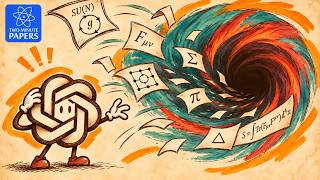
galaxies to the atoms in your body, is governed by forces we don't fully understand. We have equations that describe the strong nuclear force with incredible accuracy. But there is a problem. We cannot prove that they don't
[00:17]
fall apart when we zoom closely into the fabric of reality. The problem is so difficult. If you solve it, you get $1 million. Enough for two GPUs. Now, in
[00:30]
the age of AI, I wonder if we can finally get a solution to this, which we call the young mills existence and mass gap problem. This is the existence part where the goal is to prove that the strong nuclear force still makes sense
[00:45]
if we zoom in like crazy. Let's start at the part human scientists came up with. We start with a grid that represents space and time. This grid has grid points connected by lines along which we evaluate how the force behaves and
[01:01]
evaluate how the force behaves and interacts. Now of course this is not reality. This is an approximation of reality. The results for this are not conclusive. So now the next idea is to make the grid denser. More grid points
[01:16]
give us a finer approximation hopefully closer to the solution. and then make it even finer and continue this until it becomes infinitely fine. If we can prove
[01:28]
that the theory works at this limit, we have made a huge step towards solving the problem. This is where a technique called Balaban's approach comes in giving us a way to see what happens if we change the grid size. So coarse grid
[01:43]
we have an approximation of how this force behaves. Of course, it's not perfect. Now let's make the grid finer and finer still. Now hold on to your papers fellow scholars. And oh my, are
[01:58]
you seeing what I am seeing? We have a huge problem here. As we zoom into smaller and smaller scales, we start seeing more and more changes in the force field. These are called quantum fluctuations. And that is a huge
[02:14]
problem. Why? Because making the grid finer doesn't automatically bring us closer to the solution. No, it makes the problem increasingly difficult, eventually spiraling out of control. That is bad news and we have no proof
[02:31]
that everything will settle down with a meaningful answer. So the question is, as we are entering the age of AI, can AI help solve this? Solve something that no human has ever done? Dear fellow scholars, this is two minute papers with
[02:46]
scholars, this is two minute papers with Dr. Koa Eher. And here is the clever part. Open AAI's AI system builds on Bellaban's approach, but it tracks not Bellaban's approach, but it tracks not just one grid, but multiple grids at the
[02:59]
same time. Why? Well, because it can then calculate how tiny changes on the finest grids affect the coarser ones. And by tracking how changes at one scale
[03:12]
affect the others, the AI can calculate their combined effect and show that finally for the first time the mathematics does not spiral out of control. Okay, but hold on. How do we know if the solution is correct? Well,
[03:28]
the AI wrote this in lean, a language in which the logic can be checked step by which the logic can be checked step by step. And the checks passed. Nice. But we are scientists here. For us, that is not enough. What if the AI
[03:43]
proved something different from what we wanted? And now, fellow scholars, that's where we need humans to check the proof. A group led by Nobel Prizewinning physicist David Gross is on the case and is reviewing it. So, what do they say?
[03:59]
Well, despite what you hear in some of the headlines and some videos, it's not done yet. The review is still underway. But I'll give you some info on this. The initial results are encouraging, but I don't envy these folks. Why is that?
[04:15]
Well, because they are dealing with utter chaos. The code contains about 250,000 declarations. Think of these as small definitions and mathematical results. That's okay, sort of. But here is the
[04:30]
That's okay, sort of. But here is the crazy part. 60% of these declarations are not even needed in the final proof. And some of them are called cake and cookie. And I wish I was kidding. I am not.
[04:44]
Now unused code doesn't mean the proof is wrong. No, it means that it is incredibly challenging to understand. So on one side, I am just a student. I am here to learn and I am really excited for new knowledge, to learn new things.
[05:01]
And look, I am not in any kind of relationship with OpenAI. They don't even answer my emails. This is an authentic channel where we talk about good and bad. So, at the same time, I kind of feel that OpenAI is dumping a
[05:15]
bunch of spaghetti onto the science world and asking them to untangle it. I don't know. So, this is a proposed solution of the young meal's existence problem. The mass gap part also remains unsolved. So, the milliondoll millennium
[05:30]
problem is not fully solved yet. But we are living in an incredible time where the impossible becomes possible. What a time to be alive. I use Lambda to reproduce AI research papers often in minutes. It's great to train your own
[05:46]
models, fine-tune an existing one, run inference, text to image, or video. Easy peasy. Running a Deep Seek chatbot or agent. Super fast, super reliable.
[05:58]
Lambda gives you powerful Nvidia GPUs to run your own experiments. I test ideas run your own experiments. I test ideas from papers I cover and moments later, results. Love it. Seriously, try it out now at lambda.com/papers.