[00:00]
Artificial intelligence has eaten maths and now it's coming for physics. And the interesting bit is no one's talking about it. So, let's talk about it. In maths, things have been happening so fast I've given up trying to keep you updated. Since we last talked about it,
[00:17]
Claude Fable 5 helped find a counter example to the Jacobian conjecture, which I never heard of, but can now tell you that it had been open since 1939. Then OpenAI announced 10 results from its
[00:31]
still unreleased Astra model, each of which either solved or advanced a long-standing open problem. At least that's what they say. Another group used Chad GPT to disprove a 30-year-old conjecture that
[00:43]
no one had heard of previously either. And earlier this month, Anthropic announced that Claude had made a major advance on the Riemann Zeta function. So working towards the Riemann hypothesis,
[00:55]
finally a topic that even I have heard of. I think at this point most mathematicians have accepted that large language models are now capable of serious math. It seems likely to me that mathematics will be entirely automated in the near future and especially young people just
[01:12]
entering the field are caught between depression and anger. Graduate student Tasmin Chu thinks that mathematics is in an existential crisis and calls for a moratorium on using LLM to prove
[01:26]
novel mathematical theorems. Assistant professor Max Weinreich has written a preprint in which he makes the case for total opposition to the use of artificial intelligence in mathematics. Postdoc
[01:39]
Alexis Marchand argues that LLMs are evil because they contribute to the climate crisis and PhD student Kirwin Hampshire thinks he's going insane and is suffering a profound spiritual crisis
[01:52]
due to these developments. Mathematicians have independently derived the same existential crisis by four different methods. Assistant Professor Daniel Litt, meanwhile, has given a more or less
[02:05]
serious talk about the end of mathematics in which he belabours that AI will lead to the production of mathematically correct results that no one will read, no one will care about, and no one will
[02:17]
benefit from academic business as usual. But what about physics? If AI is now good enough to lead maths proofs, then it should also be good enough to do physics calculations. In fact, it is. I know
[02:29]
this because I've tried. I also know that a lot of theoretical physicists are now doing the same thing, taking research ideas that they haven't had time to follow through and put them into AI
[02:41]
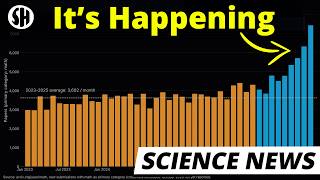
to see what comes out. And sometimes the result is verifiably good enough for publication. Peter Woit has looked at the number of submissions to the arXiv preprint server in the category hep-th,
[02:54]
that's high energy physics theory, and finds that it's up about 30% in May and June compared to previous years. One of the recent examples comes from quantum physics. Physicists in this area have
[03:08]
long wondered if there's an easier way to create some complicated entangled states. Gerardo Adesso at the University of Nottingham has now proved that the answer is no. And he did so with the
[03:20]
help of ChatGPT 5.6 about which he says the AI made a central contribution to developing the proof strategy. He then checked every step of the final proof himself. Another recent example goes
[03:33]
all the way back to James Clerk Maxwell. Imagine a collection of electric charges in random places. There will be some places where their electric forces exactly cancel kind of like Lagrange points
[03:46]
in gravity. Maxwell proposed a rule for how many such places you could get from a given number of charges. Three researchers have now shown that Maxwell's rule is wrong and their paper says the idea behind this construction was suggested again by Chad GPT 5.6. Those two examples are
[04:04]
still very mathematical. So here is one involving an experiment. These two researchers were studying how tiny silicon membranes behave if you shine on them with a laser. For this they did measurements
[04:16]
and developed a model about which they write that it was derived with the help of Claude Fable 5. The model has excellent agreement with the observations. I could go on like this for
[04:28]
a while. There's a paper in high energy physics that use several large language models to carry out the symbolic and high precision numerical computations. Another paper in quantum physics used claude for numerical calculations. Another team had Claude write software for moving
[04:45]
ions around inside a quantum computer and in fusion research Chad GPT agent was put in charge of deciding which stellarator designs to try next. Physicists have clearly picked up on the LLM maths
[05:00]
revolution, but it's happening in a completely different way. They just organically integrate the models as tools and move on. I also haven't yet seen the same desperation as I have seen
[05:12]
among young mathematicians. Mathematicians see artificial intelligence and ask whether mathematics will survive. Physicists ask whether it can finish the calculation by Friday. A few
[05:25]
years ago, I received some ugly letters from a debt collection company. They threatened to sue me for ordering something online and then not paying it. Turned out that someone had stolen
[05:40]
my private data. I managed to get out of this, but since then I've become very protective of my personal information, which is why I've signed up to Incogn who've been sponsoring this video. Each
[05:52]
time you open a website, it'll try to collect data about who you are and where you are and what other websites you've visited. Many firms then make money by selling your private information to data
[06:05]
brokers. Most countries have laws against that and you can ask for your data to be removed. But doing this takes up a lot of time. Incogn automates the process of getting you out of those databases.
[06:18]
You sign up and they'll contact the big sinners request that your personal details be removed. They'll keep on doing that and if you want send you updates about the progress they're making.
[06:30]
They now also have a custom removal feature where you can submit specific websites. I'll be using this a lot. And Cognney has really made my life better. If that sounds like something you
[06:44]
could need to use my link, Zabina or the custom link in the info because the first 100 people to use it will get 60% off. Stay safe. Thanks for watching. See you tomorrow.