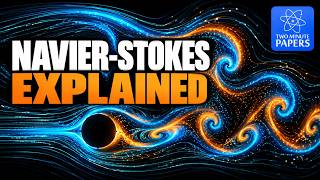

Historic Math Breakthrough?
45sOpening with disbelief and a historic claim grabs attention immediately, making viewers curious about the unprecedented event.
▶ Play Clip"The title promises a historic mathematical breakthrough and delivers, though the video includes some promotional content and personal commentary that slightly dilutes the core message."
This video discusses the purported solution to the Navier-Stokes existence and smoothness problem, a famous unsolved problem in physics and mathematics, reportedly achieved by an OpenAI AI system. The presenter, a research scientist, explains the Navier-Stokes equations, the nature of the problem, and the implications of the solution, while also addressing controversies and the broader impact of AI in mathematics.
The Navier-Stokes existence and smoothness problem has been 'very likely solved' by an OpenAI AI system, marking a historic moment in mathematics.
The presenter clarifies he has no relationship with OpenAI and does not receive early access to their systems, ensuring objectivity.
Two scientists made progress on a related problem, and OpenAI's AI extended their work. The presenter acknowledges their contribution and raises concerns about data usage.
OpenAI officially stated that while unlikely, they cannot rule out that de-identified data from product usage helped improve their models, highlighting privacy concerns.
The equations describe fluid motion and consist of three terms: advection, pressure, and diffusion, plus external forces and an incompressibility condition.
The presenter shares his research source code for free, enabling others to create fluid simulations for various applications like wind tunnel tests.
The problem asks if smooth fluid flows can break down mathematically over time. The answer is yes, with the AI finding a case where velocity grows without bound.
The OpenAI model solved the problem in about 3.5 days, and the presenter explains why AI excels at math: it's verifiable, allowing for massive automated evaluation.
The presenter discusses the potential to cure all diseases in 10 years if problems are made verifiable, and emphasizes the need for AI safety and alignment.
The video presents a groundbreaking AI-driven solution to a long-standing mathematical problem, explaining the underlying physics and highlighting AI's rapid advancement in verifiable domains. It underscores the need for careful consideration of data privacy and AI safety as these capabilities grow.
Historic Mathematical Breakthrough
The claim of solving a century-old problem is unprecedented and could reshape mathematics.
OpenAI's Data Usage Acknowledgment
This statement has significant implications for user privacy and AI training practices.
01:57Why AI Excels at Math
The verifiability of math enables massive automated learning, explaining AI's rapid progress.
07:18Potential to Cure All Diseases
The idea that making problems verifiable could lead to breakthroughs in medicine is inspiring and thought-provoking.
08:13[00:00] I did not think I would live to see the day when this mathematical problem get solved. And I just did, likely. So, I am kind of sitting here in disbelief. Something that nobody has ever been able to prove.
[00:14] The Navier-Stokes existence and smoothness problem has been very likely solved, opening I says. This is history in the making. And there is going to be one even bigger surprise at the end.
[00:27] I will note that I have no relationship of any kind with OpenAI. Never had. They don't even send me things for early access. And they send out a lot of those. Not for me.
[00:39] Now, there is controversy. I am a research scientist and this is very uncomfortable for me. But I have to make note about it because it is external context for the work that you should know about.
[00:52] Then we talk about the part that almost nobody is talking about. So, two scientists had made meaningful progress on a related problem, and according to legendary mathematician Terence Tao,
[01:06] they got to the point where their solution could likely be extended to solve Mavier's folks. And then, after hearing the rumors, opening eye fired up an AI system that is more powerful than Astra,
[01:19] that came up with a solution. Whoa! Now, this is two-minute papers where we celebrate science and scientists, and I do not know what kind of attribution these two scientists outside Opening Eye will be given, so as a thank you for their work, here is our attribution to them.
[01:38] and I also want to say a big thank you for their work. One more note. These scientists also used proprietary MLMs like CatGPT and Cloud extensively, and they were looking for verification that OpenAI did not reuse this data in their systems as training data or otherwise.
[01:57] And to this, here's the answer. One sentence, officially from OpenAI. While unlikely, we cannot rule out that de-identified data derived from the usage of our products helped improve our models.
[02:11] Yes whatever you enter in a chatbox for a proprietary AI can be used for training I keep saying this over and over again that this cannot happen if you run free and open AI systems yourself Why Because the prompt never leaves
[02:30] your machine. Okay, Navier-Stokes, finally I get to talk about science. I am not an expert on this, I am just a student. But I have a little experience in this area as I did a few years of research and
[02:43] wrote my thesis in this area. Now, what are the Navier-Stokes equations? These are equations that describe fluid motion. But, what? I mean, that sounds crazy. Look at this absolutely beautiful
[03:00] nature footage. I remember looking at this and saying, you want to understand and confuse this? Are you crazy? This is unfathomably complex. Well, it turns out, with the power of science,
[03:12] It isn't. The Navier-Stokes equation teaches us that you just need to understand three terms, and you understand all of this. First, advection. This is the heart and the bane of every fluid simulation.
[03:27] Here's the good news. If you drop an object into a river, it will follow the flow. Goodbye! This is advection. Bad news. The fluid also advects itself too. This is described with the directional derivative in the first term.
[03:43] Second ingredient. Pressure. Yummy. It's a bit like people on the bus, where there are a lot of people. There is a lot of pushing each other, which starts outward movement. Third ingredient.
[03:56] Diffusion. Haha, crowd favorite. This means that differences average out over time. If you add a drop of ink into water, you immediately see where it is.
[04:09] Of course. However, if you come back in a few minutes, you see that it has spread perfectly. And the whole glass of liquid is now the same color. That is diffusion.
[04:21] Also, the liquid reacts to external forces. If you go on it, it moves. Of course it does. Done with a beautiful, simple addition. I did not count this as a term. You also need to add a second equation the incompressibility condition that says that volume remains constant over time We don lose or add liquid out of thin air
[04:45] And what I love to do is to discretize this kind of equation onto a grid. And these expressions are very simple to evaluate on a grid. For instance, advection means that you take some fluid density out from where you are and add it to the appropriate layer.
[05:02] Diffusion means averaging. So simple. With this, you can write a computer program that kind of simulates reality. That is mind-blowing. Fun liquid simulations?
[05:14] Yes, please. Wind tunnel tests for a new aircraft? Yes, please. Karoys writing up crazy simulations to control the fluids of the world? Yes, please. You can write a simulation like that, too.
[05:28] My source code for all my research is always available. free of charge for everyone, with the papers too. Links in the video description. Okay, so what is the question to be solved here?
[05:40] Well, the question is, if you start with a smooth fluid flow and run these equations forever, does the mathematics eventually break down? Dear fellow scholars, this is Two Minute Papers with Dr. Károly Zsónai-Sahir,
[05:53] and I am happy to report to you, fellow scholars, that the answer is not 42, as some of you say. The million-dollar answer is yes. The mathematics can break down.
[06:06] The equations are not guaranteed to behave nicely forever. OpenAI starts the solution from rest and uses carefully created external forces.
[06:18] You see, if you create a vortex that spirals inward, stretches, and its velocity grows without bound within a finite amount of time, while his total amount of energy remains finite,
[06:33] then the mathematics breaks down. So, there are mathematical cases that are hairy. Does this happen in Mother's nature? Well, not that we know of. If it did, molecular level physics would take over.
[06:47] Don't use Navier's talks for that. And once again, I am just a student who is trying to learn here. I may be wrong but I am trying my best Now another surprise How long did it take take OpenAI model to find out Have they been running it for a year or longer in stealth
[07:04] Nope. Now, hold on to your papers, fellow scholars, because it took about three and a half days. Goodness. And one more thing. People don't really understand why an AI is so good at math.
[07:18] Let's look at pros. If you ask an AI to write an article in your style, so it does. What do you do? You read it and evaluate it by hand. Was it good or was it not? Well, you read it and evaluate maybe a hundred of those per hour.
[07:34] But with mathematics, not so much. Math is verifiable. That is the key. You can check if it's good or not automatically. So, you can do it a hundred million times per hour.
[07:47] 100 lessons versus 100 million lessons per hour. There is a big difference. This is why NEI is improving incredibly quickly at mathematics,
[07:59] and it will keep getting a heck of a lot better than this, which is hard to imagine, but likely true. And since NEI is getting so powerful, I believe we need a heck of a lot more coordination for safety and alignment.
[08:13] Also, when Nobel laureate Sir Denis Hassabis tells me that we could cure all disease in 10 years, then I fall off the chair. Why and how? Well, at the risk of extending his argument, well, let's make disease a verifiable problem, like mathematics.
[08:32] If we can do that, we might be able to cure all disease in 10 years. What a time to be alive! Alright, subscribe and hit the bell if you like this. A lot more is coming. I use Lambda to reproduce AI research papers, often in minutes.
[08:48] It's also great to train your own models or fine-tune an existing one. Run inference or text-to-image or video easy-peasy. Running a deep-seek chatbot or agent super-fast, super-reliable.
[09:02] Lambda gives you powerful NVIDIA GPUs to run your own experiments. I test ideas from the papers I cover and moments later, results. Love it. Seriously, try it out now at lambda.ai slash papers.

⚡ Saved you 0h 09m reading this? Transcribe any YouTube video for free — no signup needed.