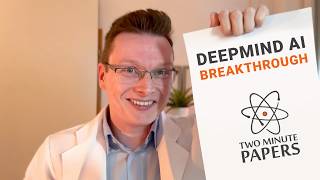

AI Solves Math Olympiad Gold
52sHighlights an impressive AI achievement that resonates with competitive problem-solving enthusiasts.
▶ Play Clip"The title is slightly hyperbolic but the video genuinely covers a groundbreaking AI that can do novel research."
DeepMind's new AI, Aletheia, can conduct research and write the core content of scientific papers, solving novel problems that push humanity forward. The system uses a generator-verifier approach with three key innovations: separating thinking from verification, optimizing compute efficiency by 100x, and enabling the AI to search and synthesize cutting-edge research. It has autonomously solved open math problems and contributed to publishable research papers.
DeepMind's new AI agent can do research and write research papers, but previous attempts produced poor papers.
DeepMind is releasing their AI research secrets for free, surprising given their previous secrecy.
Aletheia solves novel problems, which is harder than mathematical olympiad problems because real problems are unpolished and may be unsolvable.
The AI uses a generator to create candidate solutions and a verifier to filter junk, iteratively polishing good solutions.
AI hallucinations cause fake papers; frontier research has no training data for verification.
Using natural language, the AI hides its messy train of thought from the verifier to avoid blind agreement.
The model is as smart as 6 months ago but uses 100x less compute due to a stronger base model.
The AI can read and combine techniques from dozens of cutting-edge papers without hallucinating.
Aletheia autonomously solved 4 open math problems by legendary mathematician Paul Erdős.
The AI wrote core content for a paper on arithmetic geometry and helped write 4 other papers, verified for correctness and novelty.
Level 0-1: negligible to somewhat novel work. Level 2: publishable research with human help. Levels 3-4: groundbreaking work still out of reach.
DeepMind's Aletheia represents a milestone where AI has created core parts of novel, impactful research for the first time. Given the rapid pace of progress, groundbreaking levels may be reached within months.
What is the name of DeepMind's new AI that can do research?
Aletheia
01:55
What are the three key steps that made Aletheia successful?
1. Separate thinking from answer to avoid blind agreement. 2. Optimize longer thinking to use 100x less compute. 3. Enable search and synthesis of cutting-edge research papers.
04:53
How many Erdős problems did Aletheia autonomously solve?
4
07:00
What is the main challenge of using natural language for verification?
The AI tends to blindly agree with its own writing, similar to humans.
04:53
What improvement in efficiency did the optimized model achieve?
It is as smart as the model from 6 months ago but uses 100 times less compute.
05:45
What are the two factors that make it difficult for AI to do frontier research?
Hallucinations (making up fake papers) and lack of training data for unknown problems.
04:02
What level of novelty did Aletheia achieve according to the video?
Level 2: it can help a person create publishable-level research.
08:33
AI can invent something fundamentally new
Establishes the core claim that an AI can push humanity forward by doing novel research.
00:33Generator-verifier mechanism
Explains the simple yet powerful concept behind the AI's ability to filter junk solutions.
03:03Separating thinking from answer
A clever solution to the problem of AI blindly agreeing with itself, applicable to human cognition too.
04:53100x compute efficiency improvement
Demonstrates dramatic efficiency gains, making advanced AI more accessible.
05:45Solved Erdős problems
Concrete evidence that the AI can solve open problems that were ignored by experts for years.
07:00Levels of novelty
Provides a framework to understand the current capabilities and future potential of AI research.
08:33[00:00] I appeared on camera for an interview not so long ago. And I was really surprised by how many of you Fellow Scholars said that you would like to see more. So first of all, Second, I thought let's try this and hope that you will enjoy it. Dear Fellow Scholars, this is Two
[00:20] Minute Papers with Dr. Károly Zsolnai-Fehér. Look, it only took 1,000 episodes. Now, I have an amazing paper for you because scientists at DeepMind did something pretty insane. Our
[00:33] question today is can an AI invent something that is fundamentally new and pushes humanity forward? Well, they said that their new AI agent can actually do research and even write research
[00:48] papers. Most of the core content anyway. Is that insane? Well…it’s not. A lot of other people have tried it and the only insane thing about it was how many poor papers they wrote.
[01:03] You see, I visited the research group that is behind this work last year. I flew to Mountain View into this crazy lab, and a grumpy guard didn’t even want to let me in first.
[01:18] Crazy town. So I was very surprised that they are guarding these secrets and they take them very seriously. What is even more surprising is that now they give some of those secrets
[01:30] away to all of us for free. Now that is insane! More on that in a moment. So I talked to these scientists, this was the research group of Quoc Le. They are brilliant.
[01:43] They wrote an AI that was able to do a gold medal worthy performance on the mathematical olympiad. This is serious business. Then they released this technique, anyone who is made out
[01:55] of money bags and pays for the Gemini Advanced can use it, it is called Deep Think. And now, this AI is even better than that. They call it Aletheia. Now that, once again is insane.
[02:11] Okay, so what does it do? Well, it promises that it does research. It solves novel problems. This is something that could push humanity forward. Now that is so much harder than the mathematical olympiad. Why is that? Well, in these contests,
[02:29] you have a not that huge piece of core knowledge you are supposed to have, and every problem can be guaranteed to be solved by those small set of tools. Every problem is nice, shiny, and polished. Tough,
[02:46] but polished. You know what is not polished at all? Real life problems. With these open problems, we don’t even know if they are solvable at all. Maybe they are impossible, or maybe possible, but not with our current tools. That’s the point: no one knows.
[03:03] When this technique is given a problem, the generator starts working on it, creates a candidate solution, and now here is one of the important parts of the paper. The verifier. This takes a look, and says, okay bro this is junk. Start again. This is essentially
[03:22] a filter. You know, that’s actually good life advice. Sometimes it’s good to have a filter, so you don’t just shoot those hot takes out there into the ether. Now every now and then,
[03:35] the solution looks pretty good, and could maybe pass with a few modifications. Then, it gets polished for another round of reviews, and so it goes. Sounds simple…maybe even trivial
[03:50] right? So what is so scientific about this? Why doesn’t every system do that? Well, that’s easier said than done. In fact, it is almost impossible to pull off. Why?
[04:02] One, when the AI is doing something fundamentally new, unfortunately, hallucinations still happen. Yup. It just makes stuff up. Fake papers, fictitious authors, you name it. All kinds of junk comes out.
[04:17] Two, when you want to compute 1+1 or other simple things, you have tons of training data about it out there. You can verify that easily. But if
[04:29] you want to do frontier research? There is no training data on what we don't even know yet. Of course there isn’t! You are trying to invent things no one understands yet.
[04:41] These two factors make it extremely difficult to get an AI to do something fundamentally new and useful. So how did they pull it off? With three key steps.
[04:53] First, Alethia does not use this formal rigid math language to check its own proofs. It uses natural English language. That is notoriously hard, because when the AI checks its own writing,
[05:07] it just blindly agrees with it. We humans do that too! Now here, the researchers found a way to separate the thinking part from the answer part. So the
[05:19] messy train of thought is hidden from the verifier, it cannot trick itself into just blindly agreeing with itself. Brilliant. Our brains would need something like that too.
[05:32] Then, two they let the computer think longer. That’s not new. However, they added some optimizations to this, so much so that the model they have now is
[05:45] just as smart as the one from 6 months ago. But hold on to your papers Fellow Scholars, because yes, same smarts, but it uses a 100 times less compute. What! Crazy. They trained
[06:00] a much stronger base model which made it more efficient at reasoning. So this one, even without internet access, beats the mathematical olympiad gold AI easily. About
[06:13] 65% was improved to 95%. Wow. It went from a bit better than a coinfip to destroying the tasks made for some of the best human minds. All this in just a few months. I am out of words.
[06:27] Now three, they gave the AI the ability to search for stuff. We are talking about Google after all. Once again, that is easy. However, getting the AI to read and combine techniques from dozens and dozens of cutting-edge research
[06:43] papers without losing its mind. Now that is hard. You saw it earlier, this really happens! They heavily trained this AI to be able to use these tools and research works that are out there. That was what finally stopped it from making up junk.
[07:00] Okay, so how good is it? First I saw that it solved a few of these Erdős problems. It autonomously found the answer to 4 open math puzzles left behind by a legendary Hungarian
[07:14] mathematician. Is that insane? I asked a mathematician friend. He told me yeah, that’s pretty good, but there are so many of these problems out there, and not a ton of people work on them. In other words, they are fairly easy,
[07:29] they were just ignored by experts for years. So not nearly as good as I thought. But then, it stepped up its game and wrote the core contents of a research paper. On something new. Note that the final paper is written up by a human scientist.
[07:47] They had one paper on calculating constants in arithmetic geometry. And then it helped human scientists write 4 other papers, like finding new limits for interacting particles.
[07:59] Well, they are submitted for peer review and that’s going to take quite a while. So, many of them independent scientists. They checked it for correctness and novelty,
[08:16] and it checks out man. I think for the first time ever, an AI created core parts of a research work that is new, it has impact, it is useful. That is…wow. What a time to be alive!
[08:33] So I told you there is levels to this game. So where are we now? Level 0 is negligible novelty work, it can do that. Level 1 is somewhat novel work,
[08:45] it can do that too. But now, it can help a person create publishable-level research. Levels 3 and 4, those are groundbreaking works, these are out of reach,
[09:00] but I ask you Fellow Scholars, given the pace of progress, for how long? For 6 more months? And I think that is something that needs to be talked about more. Research helping the people live a better life. Love it.
[09:15] And thank you so much to all of you Fellow Scholars for watching us over the years. We can only exist because of you Fellow Scholars. I really hope that you enjoyed this. It allows me to talk about papers where there is not a lot of visual content,
[09:31] and I really wanted to share this with you. Let me know in the comments if we should do more.


⚡ Saved you 0h 10m reading this? Transcribe any YouTube video for free — no signup needed.