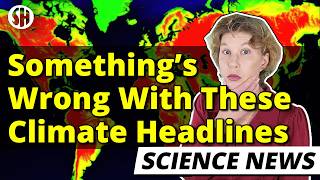

Everywhere is warming faster?
50sThe hook challenges a viral claim with humor, sparking curiosity and debate about climate headlines.
▶ Play Clip"Title is catchy but the video delivers a solid explanation, though it includes a sponsor segment."
The video investigates a series of headlines claiming various regions are warming faster than the rest of the world, questioning their validity. It explains that while the headlines are based on real scientific papers, they are misleading due to a misunderstanding of 'faster than average' versus 'faster than the rest.' The core reason is that oceans, covering 70% of Earth, warm slower than land, making most land areas appear to warm faster than the global average.
A compilation of headlines from past years claims 'Everywhere is warming faster than the rest of the world,' which seems impossible. Examples include New England, Europe, Canada, Israel, Australia, China, Africa, Middle East, South Pole, and Finland.
The headlines are real and correspond to peer-reviewed papers or government reports, though the journals are of mixed quality. This leads to contradictory studies and alarming headlines.
The explanation has two parts: first, the headlines mean 'faster than average' not 'faster than the rest' (i.e., the fastest). Second, the global average includes oceans, which warm slower than land.
Using a forest analogy: if tree heights are normally distributed, half grow faster than average. Saying a tree grows faster than the rest implies it's the fastest, not just above average. So many countries warming faster than average is expected.
New Zealand is the only place not found warming faster in headlines. It's surrounded by water, and ocean temperature strongly influences its climate. Oceans warm slower because they circulate heat downward.
NASA data shows hotspots hovering over land areas, confirming that land warms faster than oceans. The headlines are not wrong but misleading; the natural interpretation is incorrect.
The fastest warming land region is the South Pole, and among populated regions, Europe is the fastest warming. The video ends with a humorous note about Europe winning a competition.
The headlines are technically accurate but misleading because they compare land warming to the global average, which includes slower-warming oceans. The real takeaway is to interpret such claims carefully, understanding that most land areas warm faster than the ocean-dominated average.
What is the main reason most land areas appear to warm faster than the global average?
Oceans cover about 70% of Earth's surface and warm slower than land because they circulate heat downward, so the global average is dragged down by ocean temperatures.
04:38
What does 'faster than the rest of the world' colloquially imply versus what it actually means in the headlines?
Colloquially it implies being the fastest, but in headlines it means 'faster than the global average', which is a lower bar.
02:01
Which region is the fastest warming land region on Earth?
The South Pole.
05:32
Which populated region is the fastest warming?
Europe.
05:32
Why is New Zealand not warming faster than the global average?
New Zealand is surrounded by water, and ocean temperature strongly determines its climate, so it warms slower.
04:12
Average vs. Fastest
Clarifies the statistical misunderstanding behind the headlines.
02:18Oceans Warm Slower
Key fact explaining the phenomenon.
04:38Fastest Warming Regions
Provides concrete answers to the implied question.
05:32[00:00] I recently came across a compilation of headlines from the past years according to which quote "Everywhere is warming faster than the rest of the world." This can't possibly be, can it? Unless the
[00:13] rest of the world has left and I mean who knows have you checked on Uzbekistan lately? In any case, let's have a look. First let's see whether these headlines actually exist. New England is
[00:26] warming up faster than the rest of the world. Europe is warming twice as fast as the rest of the planet. Canada warming twice as fast as the rest of the world. Israel warming up almost twice
[00:38] as fast as rest of world. Australia is heating up faster than the rest of the world. Car park behind Walmart is warming faster than the rest of the known universe. Just checking if you're listening.
[00:50] China is warming faster than a global average. Africa is warming more and faster than rest of the world. Middle East heating nearly twice as fast as global average. South Pole warming three times faster than the rest of Earth. Finland is warming faster than the rest of the world and so on. Okay,
[01:07] so the headlines are all real. The next thing to check is whether the headlines are about real papers. The answer is yes. For each of these headlines, there's a scientific publication
[01:20] that's been peer-reviewed or a report from some government institution. The journals are of rather mixed quality, but either way, it seems like contradictory studies are being published in the
[01:34] scientific literature, leading to unnecessarily alarming headlines which claim every part of the world warms faster than the other. That's what it might seem, but there's something else going on,
[01:48] and it's a two-step explanation. First, I asked the question of what the headlines actually mean. Most of the headlines say is, "warming faster than the rest of the planet" or in some cases,
[02:01] "faster than the global average". The media takes these two things to mean the same, but colloquially we don't interpret them the same. Suppose you have a forest with trees that are growing. The trees don't all grow at exactly the same speed. Some grow a little faster,
[02:18] some a little slower. If the height is normally distributed, you expect half of the trees to grow faster than average. Okay? But if you pick a particular tree and say it grows faster than the rest of the trees, you'd mean it's actually the fastest, not just faster than average. So
[02:35] this is the first problem with the headlines. They write "faster than the rest" and mean "faster than average". It's then not very surprising that so many countries warm faster than the rest. It's like saying half of Americans are more intelligent than average because that's how averages work.
[02:53] Environmental destruction affects us all. But luckily, we can do something about it together, you and I and my friends at Planet Wild. Planet Wild is a community-based environmental protection
[03:05] organization. They're funding the restoration of ecosystems to preserve our nature and wildlife by partnering with different organizations every month. I've been part of their community for years now and I've been really impressed by their work. They document all their projects with video
[03:23] reports that you can find right here on YouTube. This way you get to see the immediate impact of your contribution. And that's what I find so great about Planet Wild. They don't leave me wondering
[03:35] where my money goes. In one of their recent missions, they bought an abandoned fish farm in Poland and turned it into a beaver paradise to restore the local biodiversity. This is a lovely
[03:47] example of the lowcost, high impact work that Planet Wild is doing. Joining Planet Wild is a simple yet effective way to help this planet. And to give you a little more encouragement,
[04:00] I'll cover the first month of your subscription if you're among the first 100 people signing up with my code. And now back to the science news. Still, you might say, "Okay, but then which are
[04:12] the other half of places that are warming slower than average?" Pretty much the only place I could not find warming faster in the headlines was New Zealand. And indeed, that gives you a clue. New
[04:25] Zealand is surrounded by water and the temperature of the water very strongly determines the climate in New Zealand. The thing is that when climate scientists speak of the global average temperature
[04:38] that includes the temperature of the oceans but most of the surface of Earth about 70% is covered by oceans and the oceans warm slower than land basically because they're better at circulating
[04:50] the heat down. So the basic reason that every country seems to be warming faster than the rest of the world is that the rest of the world is water and land is warming faster than the water. This video from NASA data is a good summary. You can see basically how the hotspots hover over the
[05:07] land areas. Not entirely, of course, but mostly. I'm not sure exactly what lesson to draw from this. The headlines are not wrong exactly, but misleading. The way we would naturally interpret
[05:19] them is not the correct meaning. If I read "this region warms faster than the rest of the world", I'd interpret this to mean "this region is the fastest warming region of land" and not that "it
[05:32] warms faster than the oceans". But then which region of land is the one that does warm the fastest? That would be the South Pole. And if you look only at populated regions, the fastest warming one is Europe. at least one competition Europe still winning at. Don't forget to check out
[05:50] Planet Wild through the link in the description or by scanning the QR code. If you want to learn more about them, first check out their Beaver mission here. Thanks for watching. See you tomorrow.




⚡ Saved you 0h 06m reading this? Transcribe any YouTube video for free — no signup needed.