
Can You Reverse a Rainbow?
40sCuriosity about reversing a rainbow sparks immediate interest.
▶ Play Clip"The title perfectly matches the content: the video demonstrates the experiment to recombine a rainbow into white light, explaining the physics and history."
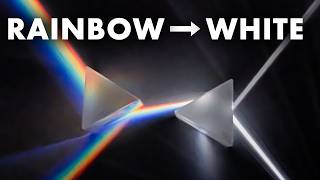
The video explores the physics challenge of recombining a rainbow into white light, explaining why simply using two prisms doesn't work. It delves into the principles of refraction, dispersion, and Newton's historical experiment that proved white light is composed of all colors.
Placing a flipped second prism immediately after the first does not recombine the rainbow; instead it produces a parallel rainbow beam.
Light slows down when entering glass; the amount of bending depends on wavelength: blue bends more, red less.
Newton's 'Opticks' (1704) reveals the solution: use a convex lens to focus the rainbow to a point before the second prism.
After the lens, the rainbow converges to a point; the second prism unbends each color so all emerge overlapping and in the same direction.
Why does placing a second prism immediately after the first fail to recombine the rainbow into white light?
Because each wavelength enters the second prism at a different point, resulting in all colors being parallel but not overlapping, so they stack vertically instead of combining into white light.
04:06
What is the key physical reason light bends (refracts) when entering glass, and why do different colors bend by different amounts?
Light slows down when it enters glass, and the change in speed causes it to change direction. The amount of bending depends on the wavelength, with shorter wavelengths (blue) bending more than longer ones (red).
02:48
What optical element did Newton use to recombine the rainbow, and where is it placed relative to the two prisms?
The prism is a convex lens that focuses the diverging rainbow into a single point, so that all colors enter the second prism at the same location.
07:34
In what year was Newton's book 'Opticks' published?
In 1704.
06:43
Why did Newton want to recombine the spectrum into white light?
To prove that white light is composed of all colors of the rainbow, overturning the belief that white light is pure and prisms 'stain' it.
07:20
How did the presenter compensate for the large brightness difference between the two ends of the ray table in the camera?
By using a gradual neutral density filter (grad ND) turned sideways, which evens out the brightness gradient across the scene.
10:05
Light slows in glass; shorter wavelengths bend more
This explains the core physics behind refraction and dispersion that creates rainbows.
02:48Newton's solution: convex lens to focus rainbow
Demonstrates the historical experiment that proved white light is composed of all colors.
07:34Successful recombination into white light beam
Shows the complete, working setup with two prisms and a lens, producing a sustained white light beam.
11:01[00:00] You know, when I look at a rainbow, I always think I want to be as possible to reconvene that back into white light. Sorry, why am I here? They just like you being in videos. Well, I like you in the last one. I don't know. Obviously I'm
[00:15] not talking about plucking a rainbow out of the sky, but as you probably know, Newton was able to make rainbows with prisms. Basically, Newton drilled a hole in his
[00:28] lines, put a big prism in the middle of the room, and when a beam of sunlight hit the prism, it turned into a rainbow. But I want to see if I can do the reverse
[00:40] and turn a rainbow into a beam of white light. You might think that I could just take a second prism, flip it the other way, and put that in front of the rainbow, and that would turn the rainbow back into a beam of white light. But that doesn't
[00:54] work. That's the first challenge. The second challenge is, well, this is just VFX. That's why I didn't actually put the prism there, because I mean, how would you get that right in VFX? Don't have the budget for that. Point is, you wouldn't actually
[01:06] get a beam of white light in the air, and you wouldn't see a rainbow in the air. You don't see the rainbow projected onto the screen. But for this video, I wanted you to be able to see the whole journey of the light from beginning to end. So that's
[01:24] why I need a ray table. You might have played with one science center. It's basically a vertical shaft of light, and so you can put things in front of it, you know, like optical elements, lenses, and mirrors, and things like that. But
[01:41] importantly, this vertical shaft of light is fanning out a little bit vertically. So there's always some part of the beam hitting the table, and so you can see the path of the light and how it changes as it interacts with
[01:57] different optical elements. It looks a bit rubbish at the moment, but after a lot of fapping about, I got it looking really nice in the camera. And because I couldn't figure out how to do it in VFX, here's what actually happens when you put a flipped
[02:09] prism immediately after the first prism. It doesn't work. I'm pretty sure there's a solution though, but actually why doesn't this work? To find out, let's return to our old friend, Sir Isaac Newton. That's not the conceit though. What do you mean?
[02:23] No, I'm not Isaac Newton. Now like in the last bit, I was saying, Isaac Newton did this, Isaac Newton did that. Do you know what I mean? Like the conceit is I'm Steve Mold dressed as Isaac Newton. That's a bit weird though. Yeah, I agree. The reason
[02:35] you need more than just a second prism is because of the way light bends when it goes from air to glass. This is refraction. This is what we need to understand. There's more and more way to explain why light bends when it goes from air to glass, but it
[02:47] always comes down to the fact that light slows down when it enters the glass. But why does that lead to the light bending? Well, my favourite way of looking at it is in terms of wavefronts. So we've got these wavefronts approaching the glass at an angle. Now
[03:02] consider just one point on one of those wavefronts and see that it slows down when it enters the glass. But now see what that looks like when we reintroduce all of the other points from all of the other wavefronts. And look, that's quite clear. If we
[03:17] assume that light always travels perpendicular to the wavefront then, well, clearly the light has bent. So light slows down when it goes from air to glass and that changes its direction.
[03:29] But crucially, the amount by which the light slows down depends on the wavelength of the light. So blue light with a short wavelength is bent more and red light with a longer wavelength
[03:42] is bent less. And so the white light fans out into a spectrum and then it fans out even more when it goes from glass back to air. You might be wondering why different wavelengths bend different amounts. It's actually just really cold. But actually, it's beyond the scope of this
[03:58] video and in fact Grant did a great explanation over on 3 blue, 1 brown linked to that video in the description. So when the light leaves the prism, it's in a kind of fan shape. That means when
[04:10] it hits the second prism, each wavelength of light has its own unique spot along that boundary between air and glass. The flipped prism will bend all those different wavelengths of light by just
[04:24] the right amount so that they end up parallel with each other when they leave the prism. But because they entered the prism in different locations, all these different colors won't be on top of each
[04:36] other. In other words, we end up with a parallel rainbow beam instead of a beam of white light. You know, with some videos, a lot of the process is just solving procurement problems like finding a lens that's tall enough, finding an Isaac Newton costume, etc, etc. And inevitably I end up with
[04:53] loads of browser tabs open. If you find yourself in that situation, can I recommend tab islands from the sponsor of this video opera? See, if I just drag one tab over another, it creates a tab island
[05:07] and I can put all the shopping tabs in there. And so now I've got all these different tab islands. Like this one is for explanation related things. This one's about production and post-production. And look, I can collapse and expand them as needed and even choose a color and a name for them,
[05:23] which is pretty cool. But actually, if there's one reason to download opera, it's to try tab traces. Like when you have lots of tabs open, you can spend a lot of time just searching for that one specific
[05:35] tab that you need. And what tab traces do is give you a kind of visual, hot or cold. Where works is the darker the underscore, the more recently you've visited that tab. So it just helps me to zero in
[05:47] on the one I'm looking for. You have to try it really. It's like magic. A couple more features I'll show you. There's the detachable music player, which you can basically put anywhere. It could be inside the browser, outside the browser. And crucially, if you start watching a YouTube video,
[06:02] the music pauses automatically. It works with Spotify, Apple Music, a whole bunch of others. And if you're anything like me, you like to tweak things so that they're just so. And fortunately, with opera, the UI is endlessly customizable. My favourite theme at the moment is this one, because
[06:19] I mean, just look at it. It's super easy to give it a try. So click the link in the description to download opera today. Okay, but what about this parallel rainbow beam problem? How do we solve that? Well, what we really need is to take the mirror image of this side. We need the rainbow to be converging
[06:36] to a point when it enters the second prism. So how do we do that? Well, I think the answer is in this book, Newton's Optics, published in 1704. I think this is a first edition actually.
[06:49] You see Newton had a problem. He needed to prove everyone wrong because the prevailing wisdom at the time was that white light was pure. Light coming from the sun. Well, of course it was pure. It was
[07:05] coming from the heavens. And if light changed colour, like if sunlight passed through a stained glass window, it's because the stained glass window was literally staining the light. And prisms were
[07:18] simply devices that stained the pure white light, the whole rainbow of colours. To prove them wrong, Newton really wanted to be able to take the spectrum of all colours and recombine them into a beam
[07:33] of white light. And look, on page 156, there it is, a convex lens. To show you this in action, I just need to fix my rubbish setup a little bit. Firstly, these optical elements have a chamfer at the bottom
[07:49] so every time we introduce a new element to this red table, the shadow cast by this chamfer gets longer until it's kind of unusable. So I've laser cut some holes in this white board for the
[08:02] optical elements to sit in and that just kind of removes the chamfer so there's no more dead spots. Also, the prisms that come with this red table are rubbish. They're too short for a start. Also,
[08:15] they're not the optimum way to bend light. I've gone for these ones. They're a bit taller and they're made of flint glass. Flint glass bends light a lot, but more importantly, the amount it bends blue and red differs by a larger amount so you get a wider fan. And then the lens that came with the
[08:33] red table kit, that's too short, so I ended up getting this one. This is really nice. The focal length is 75 millimeters, meaning parallel rays would be focused at 75 millimeters, but I want the object
[08:48] and the image to be the same distance from the lens, which means I need to double that, so I need a separation of 150 millimeters. And so look on the other side, the rainbow is now focused back to
[09:00] a point. And look what happens if I put a little screen there and slowly move it backwards. Eventually, all those colors are combined to form white light. But we're not satisfied with that, because look, if I keep moving the screen back, well, it turns back into a rainbow again, but I want a
[09:18] straight beam of white light. And for that, I think we need another upgrade because, well, the light source just isn't strong enough. I tried a few things. I tried to make a massive light box. The best
[09:30] solution in the end was to fit a bulb in here that's actually overrated for this enclosure. We're pumping out 50 watts instead of 20, so we just have to not run it for too long. One bit of nearly
[09:43] detail I think you'll like about filming this thing is when you're looking at it in person, you're taking in the whole scene, your eyes looking over here, your eyes looking over here, your eyes are constantly adjusting for how much light is coming in. But the reality is that
[09:59] this end is much brighter than this end, which looks kind of rubbish in the camera. So I put this special filter over my camera lens. It's typically used when you want the sky in a scene, not to be
[10:12] overexposed. But by turning it sideways, I was able to roughly even out the amount of light coming into the camera. Okay, so the convex lens focuses the rainbow to a point. That's where we put the
[10:24] second prism, which unbends each wavelength of light by the exact amount that the first prism bent the light in the first place. And so coming out of that second prism, we have all the different colors
[10:38] all moving in the same direction and they're all on top of each other. And so there you go, we have our beam of white light back again. I mean look, I can put the screen all the way over here and it's
[10:50] still working. How cool is that? And I mean, I've got to say, looks flipping beautiful, doesn't it? And the reason I wanted to get this experiment working is because it was the defining experiment that proved Newton right, the experimental cruises by combining the spectrum into white light. He overturned
[11:09] the prevailing wisdom that white light from the sun was pure. And of course, as we now know, white light is made up of all the colors of the rainbow.
⚡ Saved you 0h 11m reading this? Transcribe any YouTube video for free — no signup needed.