
The Mind-Bending Sugar Water Stripes
44sThe visual of colorful diagonal stripes in sugar water is immediately captivating and sparks curiosity.
▶ Play Clip"The title promises an optical mystery and delivers a solid, if brief, explanation of the physics involved."
This video explores the fascinating optical phenomenon of colored diagonal stripes observed when polarized white light passes through a dense sugar water solution. The presenter explains the underlying physics involving polarization rotation, frequency-dependent twisting, and scattering, and notes how this simple mystery leads to deeper questions in optics.
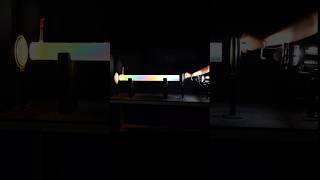
A tube filled with dense sugar water, when illuminated with white light through a polarizing filter, displays colored diagonal stripes.
Polarized light passing through sugar water has its polarization direction twisted by interaction with sugar molecules.
Higher frequency light (purple) twists faster than lower frequency light (red), causing different colors to have different polarization angles at the tube's end.
Even without a second polarizer, color separation is visible from the side because scattering of light depends on polarization direction; more light scatters perpendicular to polarization.
The diagonal nature of the stripes results from the circular geometry of the tube and the bending of light at different angles as it exits the water, through glass, and into air.
The presenter created a series of videos exploring fundamental optics concepts such as the origin of light and why light slows down in glass, showing how a simple mystery leads to broader understanding.
What causes the polarization direction of light to twist in sugar water?
Interaction with sugar molecules.
00:26
How does the twisting rate depend on light frequency?
Higher frequency light twists faster than lower frequency light.
00:40
Why is color separation visible from the side without a second polarizer?
Because scattering depends on polarization direction; more light scatters perpendicular to the polarization.
01:34
What explains the diagonal orientation of the stripes?
The circular geometry of the tube and the bending of light at different angles as it exits the water, through glass, and into air.
02:14
Frequency-Dependent Twisting
This is the core mechanism that separates colors in the sugar water tube.
00:40Polarization-Dependent Scattering
Explains why the effect is visible without a second polarizer, a non-obvious insight.
01:34Curiosity-Driven Learning
Shows how a simple observation can lead to a deeper understanding of fundamental optics.
02:26[00:01] Optical phenomena I think I've ever seen right here is a tube that's full of a very dense sugar water mixture when you shine in white light through a polarizing filter into this mixture you notice these colored diagonal Stripes
[00:14] fully explaining these Stripes is really challenging but here's the basic idea when you have sugar water and you shoot polarized light through it meaning the light wave is wiggling up and down in Just One Direction as it passes through
[00:26] the mixture interaction with those sugar molecules causes this direction of polarization to slowly twist as it goes down the tube so for example if it time it gets to the end of the tube it might be polarized horizontally or at
[00:40] some other Angle now critically the rate at which it twists depends on the frequency of the light higher frequency light like purple is getting twisted faster than lower frequency light like red so if you shine white light in at
[00:55] end of the tube all of the different directions of polarization now you wouldn't be able to notice this just by the light still looks white because it contains this mixture of all the
[01:09] frequencies so one of the big Mysteries here even if you're an expert in Optics is why you see any evidence of that color separation looking at it from the side because it's not like we're passing the light through another polarized
[01:21] filter it's still white light in the middle of that tube the idea there is you know the water molecules air molecules sugar molecules anything like that and comes towards your eyee the direction that it bounces is not
[01:34] uniformly random in all possible directions it depends on the polarization direction of that light there's a lot more light that scatters perpendicular to that polarization Direction and in an idealized situation
[01:47] no light is scattering along the direction of that polarization so for some point in the middle of the tube light with a certain color like red line of sight meaning you're more likely to see more red while of other
[02:00] frequencies like purple might be at different directions more aligned with would scatter towards you this explains the variation in color as you scan your eyes from left to right along the tube but that would seem to imply the stripes
[02:14] should be vertical the fact that they diagonal tells us there's also variation as you scan your eyes up and down this depends on the fact that the tube is circular and that the light is getting bent at different angles as it goes from
[02:26] the water through the glass tube and into the air last year I got sucked explaining each component of this mystery and the result was a collection of videos about certain fundamental ideas in Optics like the very origins of
[02:39] what causes light or what exactly we mean when we say light is slowing down when it goes through glass or water and why that would depend on color and I just love this how you can start with a seemingly simple mystery but if you tug
[02:51] on that thread with enough curiosity it kind of forces you to wrap your mind to all sorts of other Mysteries that you might encounter



⚡ Saved you 0h 03m reading this? Transcribe any YouTube video for free — no signup needed.