
Why Do Humans Stop Growing?
53sReveals a surprising biological difference between humans and animals like alligators that keeps viewers curious.
▶ Play Clip"Delivers a clear, scientific explanation of a common curiosity—no fluff, exactly what the title promises."
Humans stop growing taller around age 20, while most vertebrates grow throughout their lives. This video explains the biological mechanisms behind growth plates and the metabolic trade-offs that limit human height, contrasting us with animals like alligators.
Most vertebrates grow bigger throughout life, but humans stop growing taller by around age 20.
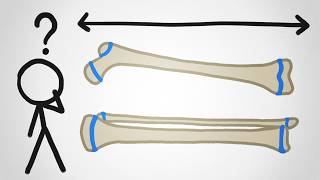
Bones have growth plates—layers of cells that divide and become new bone. In alligators, these remain active; in humans, they harden after puberty.
After puberty, hormones cause growth plates to harden permanently, stopping longitudinal bone growth.
People like Robert Wadlow grew to 9 feet tall because a condition prevented growth plate hardening.
Humans have fast metabolisms that produce heat. As size increases, volume (heat production) grows faster than surface area (heat dissipation), risking overheating.
Alligators have slow metabolisms, so they don't overheat even when large, allowing continuous growth.
Humans stop growing to avoid overheating; while being larger has benefits, our metabolism limits size.
The video is sponsored by Tab for a Cause, a browser extension that raises money for charity (e.g., animal welfare) with each new tab.
Human growth stops due to metabolic constraints—our fast metabolism generates excess heat that would be dangerous if we grew larger. In contrast, animals like alligators with slow metabolisms can grow indefinitely.
What are growth plates?
Layers of cells on bone ends that divide and form new bone.
00:38
What happens to human growth plates after puberty?
Hormones harden them permanently, stopping further growth in height.
00:53
Why do alligators continue to grow throughout life?
They have slow metabolisms that don't overheat as they grow larger.
01:55
How does metabolism relate to human growth limits?
Fast metabolism produces heat; as size increases, heat production outpaces heat dissipation, so limiting growth prevents overheating.
01:22
Name a person who grew unusually tall due to a condition that prevented growth plate hardening.
Robert Wadlow.
01:06
Growth plate hardening
Key mechanism that stops human bone growth after puberty.
00:53Metabolic constraints on size
Explains the evolutionary trade-off between size and heat dissipation.
01:22Alligators' slow metabolism
Contrasts with human metabolism to show why some animals grow indefinitely.
01:55We can't take the heat
Memorable conclusion summarizing the core reason humans stop growing.
02:22[00:00] almost all vertebrates– get bigger throughout their lives; Then, there are humans, who, by the age of 20 or so, just stop getting bigger… or at least taller.
[00:14] Hi, I'm Cameron, and this is MinuteEarth. growing –like a lot of other questions about the world around us– in two ways.
[00:26] what actually stops our bones from getting longer at some critical moment? why do humans stop growing at a certain point, while other animals don’t?
[00:38] Many bones have special layers of cells on each end known as "growth plates"; these cells are constantly dividing and turning into brand-new bone. And for the alligator, that growth continues throughout its life.
[00:53] But in humans, once puberty is complete, our bodies release hormones that harden our growth plates permanently, turning them into "no-more-growth" plates. imbalance– will block this normal process from happening;
[01:06] like nine-foot-tall Robert Wadlow, reach their towering heights. the hardening of your growth plates means you can’t get any taller. Now, here's where –if you're thinking what I'm thinking– you're contemplating that bigger
[01:22] question of why this whole growth-stopping process happens at all in us humans. and birds– are energy-hungry critters. Our fast metabolisms allow us to run –or swim or fly– long distances,
[01:38] but they require a lot of energy to sustain, even when we’re at rest. And if you recall, as an animal grows, its volume, and therefore the amount of heat it produces, increases much faster than its surface area does – surface that's needed to vent that heat outward.
[01:55] sense that there’s a biological process that limits our growth. much slower metabolisms that don’t burn much energy most of the time.
[02:08] Even as they grow bigger – and their relative surface area decreases – they’re And since being big does confer a lot of benefits, they might as well keep on getting bigger throughout life.
[02:22] After all, it would be nice to be able to reach the highest fruit Unfortunately, we just can't take the heat.
[02:35] it’s the ridiculous amount of browser tabs I have open at any one time. But that’s alright because I use Tab for a Cause, a simple browser extension that lets users raise money for charity for free just by opening browser tabs.
[02:48] to help end animal cruelty in factory farms. and every tab you open will raise money that will go toward improving the lives of animals.



⚡ Saved you 0h 03m reading this? Transcribe any YouTube video for free — no signup needed.