
The Math Symbolism in Life of Pi
40sReveals how the number pi symbolizes the film's core theme of infinite truth and interpretation.
▶ Play Clip"Delivers an in-depth, symbol-by-symbol analysis of the film, exactly as the title promises."
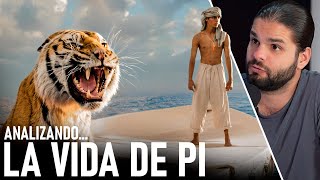
This analysis delves into the symbolic layers of the film 'Life of Pi', exploring how the protagonist's journey mirrors the tension between reason and faith. The video argues that the true meaning lies in the stories we choose to believe, which give us the strength to endure suffering.
Pi's nickname references the irrational number pi, which is infinite and never repeats. This symbol represents the film's core idea: no single story or religion can fully capture truth.
Pi explores Hinduism, Christianity, and Islam, seeing them as different languages pointing to the same deep reality. His father represents reason, his mother faith.
Pi tells the writer that faith is a house with many rooms, and doubt is useful because it keeps faith alive. A faith untested is not strong.
Pi as an irrational number symbolizes that no representation—whether mathematical, religious, or narrative—can fully exhaust the truth it points to.
Human experience is infinitely richer than words can capture. Stories are imperfect translations that help us make sense of reality.
Humans aspire to high ideals but remain grounded in their animal nature. The film explores this duality through Pi's coexistence with Richard Parker.
In the second story, the zebra, hyena, orangutan, and tiger represent a sailor, cook, Pi's mother, and Pi himself. The tiger symbolizes Pi's wild survival instinct.
Pi admits that without Richard Parker, he would have died. The tiger represents the fear and purpose that kept him alive.
The carnivorous island symbolizes a crossroads: Pi can either give up to a comforting illusion or choose to fight for life. Finding the human tooth prompts his decision to leave.
The film asks why we shouldn't choose the story that gives life meaning—even if it's not factually true. Faith is a willingness to trust in something greater.
Ultimately, 'Life of Pi' suggests that both facts and meaning are necessary for a fully human life. The story we choose to believe can transform how we bear suffering, making it bearable.
What does the number Pi represent in the film?
An irrational number that symbolizes infinite truth that cannot be fully captured.
03:54
What are the three religions Pi practices?
Hinduism, Christianity, and Islam.
00:40
In the second story, what does the zebra represent?
The sailor with a broken leg.
13:50
Who does the hyena represent in the second story?
The cruel cook.
13:50
What is Richard Parker's original name?
Thirsty.
01:42
How many days was Pi adrift at sea?
227 days.
19:42
What does Pi's father say about seeing emotions in animals' eyes?
You only see your own emotions reflected there.
01:56
According to Pi, what does faith consist of?
Continuing to seek light in darkness; it is not absence of doubt.
23:18
What does the island represent in the film?
A turning point between resignation and fighting; a choice between comfortable illusion and painful reality.
19:04
What is the key step in the manual for taming Richard Parker?
Blow a whistle and urinate to mark territory, associating the sound with seasickness.
09:44
Pi as Symbol of Infinite Truth
This insight reveals the film's central metaphor: every representation is partial, whether in math, religion, or storytelling.
03:54The Second Story Reveals the Tiger as Survival Instinct
It explains the entire symbolic structure and shows that the tiger represents Pi's wild side, essential for survival.
13:36The Island as a Moral Crossroads
It demonstrates the choice between a comforting illusion and the hard fight for life, a universal human dilemma.
19:04Why Choose the Better Story?
It articulates the film's core philosophy: faith and stories provide meaning where reason falls short, and that choice is valid.
24:37The Story We Choose Shapes Our Ability to Live
This concluding insight emphasizes that narratives don't change facts but can transform our relationship with suffering.
27:50[00:01] inspiration and hears about a man in Canada with such an extraordinary story that it would make him believe in God. Intrigued, he goes to meet Pin, who, before starting, warns him that he will have to decide for himself what to
[00:14] believe. Pin was born in a zoo in Pondicherry, owned by his father, in French India. They named him Pisin after an elegant French swimming pool, but his colleagues nicknamed him Pissing. Fed up with the teasing, he managed to get everyone to call him
[00:27] Pi, writing hundreds of digits of Pi on the blackboard from memory. Pi describes himself as a Hindu Catholic. His mother, who drew colams on the floor, taught him the Hindu faith as a child. While his skeptical father trusted
[00:40] science more. At age 12 he discovers Christianity. At first he struggles to understand why an innocent person should die for the sins of others. But the more he hears about God's love and Jesus' sacrifice, the more fascinated he becomes by that
[00:52] story. Pi came to faith through Hinduism and found God's love through Jesus, but God was not finished with him. He is then also presented through Islam, whose sound and meaning of words bring him closer to it,
[01:04] giving him serenity and brotherhood. During a meal, his father tells him that believing in everything is equivalent to believing in nothing. The mother intervenes, saying that she is young and is looking for her own way. The father replies that he cannot find it without
[01:16] choosing one and advises him to start with reason. The mother agrees, but adds that science teaches what's out there , not what's in the heart. In the present, Pi tells the writer that faith is a house with
[01:29] many rooms and on each floor there is space [music] for doubt. Doubt is useful; it keeps faith alive, and you don't know its strength until it is tested. Back in the past, a hunter takes a tiger to the zoo that was
[01:42] originally named Thirsty. P, disobeying his father, goes to But just as the animal is about to take her, the alarmed father appears and warns her that the tiger is an animal, not a playmate. He believes that
[01:56] animals have souls and that he has seen them in their eyes. The father replies that you only see your own emotions reflected there. To prove it, he sends for a goat and makes his children watch as the tiger catches and
[02:09] devours it. After Apa's lesson, the world loses some of its charm for Pi. He grows up searching tirelessly for something to give meaning back to his life until he meets Anandy. He takes her to the zoo and introduces her to Richard Parker, describing him
[02:21] as the most magnificent creature they have ever had there. Meanwhile, APA abroad, and if the city council withdraws its support, it's unclear where they will end up. That's why they're announcing that they'll sell the zoo and move to Canada.
[02:36] Before leaving, Pi and Anandi say goodbye with broken hearts. The family embarks on the journey with their animals on a Japanese freighter. One night, while passing over the deepest part of the ocean, an electrical storm hits the ship.
[02:49] While his family sleeps, Pisale goes on deck and finds the ship battered by the waves and about to capsize. When he tries to call his parents again, he for his family, but they push him into a lifeboat. He resists to avoid being let
[03:02] go until a zebra jumps into the boat and pulls him free. In the sea where the ship has almost sunk. He spots a figure in the distance and throws a life preserver, but it turns out to be Richard Parker who jumps into the boat. With no other
[03:15] option, Pis crawls to the stern and clings to a post to survive the night. At dawn, Richard does not appear. Suddenly, a wave bursts from inside the boat and Pi, terrified, grabs an oar to defend himself. Luckily, the full one
[03:29] is dizzy. P then sees the orangutan Orange Juice floating nearby, rescues him and is now stranded at sea with three animals. As night falls, the henna turns its attention to the wounded zebra. Pi protests, but can only watch in
[03:42] horror as he kills her. To avoid becoming its next victim, it takes refuge in the stern once again. Here I'm going to start with the analysis, and I'm telling you right now that it's going to be good, so I need you to pay close attention. Pi's nickname
[03:54] holds the key to the entire movie. It is worth pausing for a moment to consider what pi means in mathematics. Pi is an irrational number, that is, an infinite number whose decimals never end and never repeat. However, all
[04:08] that infinity is represented by a tiny symbol. A single Greek letter is capable of pointing to something that can never be completely exhausted. Mathematics, perhaps the most exact language we have created, needs to resort to a
[04:21] symbol to refer to something it cannot fully express. The entire film revolves around that same operation. Pi is a boy who, from a young age, felt a huge dedication. Thanks to his mother's stories
[04:34] search soon led him to Christianity and Islam as well. What's interesting religions as rivals. While the adults criticized him for not choosing one, he seemed to be looking for something different. What interested him
[04:48] was not deciding who possesses the absolute truth, but getting closer to the truth that they all try to point to. For P, the different traditions are like different languages trying to describe the same deep reality.
[05:00] Each one offers a different image of God, a different metaphor and a different story. None of them manages to encompass it completely, but each one reveals something. And here we can already see a correspondence with the number pi. We can write 3.14,
[05:14] 3.141 or millions of decimal places, but no representation exhausts what pi really is. Similarly, no religion completely exhausts what it attempts to name. Each one functions as a partial approximation to something that
[05:28] exceeds it. But the film goes even further because there is something else that also seems to escape our descriptions, and that is the human experience. Pi understands that human beings use stories to make sense of what we
[05:41] experience. We do not experience reality in a pure and objective way, but we constantly organize it through narratives and symbols. memories and interpretations. So, just as the concept of a penis can never
[05:54] be fully captured by a finite sequence of numbers, no experience can be fully captured by words. Every story is an imperfect translation, memories are a reconstruction, and
[06:07] narratives are an interpretation. Words are finite, while experience is infinitely richer. That's why two people can experience the exact same event and tell completely different stories
[06:20] about it. The same experience can be narrated in many ways. With this understanding, Pi tells the story of the tiger and the impossible coexistence between man and beast, because that narrative allows him to give shape to a
[06:33] profoundly traumatic experience, too big, painful and complex to be told directly. The extraordinary story functions as a symbol, and like all symbols, it does not seek to replace reality, but rather to bring us closer to a
[06:47] truth that cannot be expressed in any other way. Later we'll see exactly what pi is trying to bring us closer to, but I don't want to get ahead of myself just yet. Now, however, there is a second dimension to the symbol pi. Pi, as
[06:59] we said, is a mathematical concept, that is, it belongs to the realm of logic and reason. However, its nature is irrational and infinite. In other words, in that symbol, reason and that which exceeds it coexist. And that tension runs throughout
[07:15] the entire film. Reason, logic, and pragmatism versus faith, spirituality, and idealism. That tension is everywhere. It is present in the drawings that the mother draws on the ground. These geometric figures are
[07:29] mathematical constructions, but they also have a spiritual and ritual function. Mathematics and spirituality coexist in the same figure. It is also present in their parents. The mother is a woman of faith, while APA is a man of
[07:42] science. But it's important to clarify this because Apa wasn't always like this. She also had her own spirituality, curiosity, and imagination, as well as a extraordinary stories. Just remember the origin of the name Pis. An honorary uncle
[07:55] told him for years about a French swimming pool so wonderful that AP ended up falling in love with a place he had never seen, to the point of naming his son after it. It was illness that tested his faith. He felt that God was
[08:07] indifferent to his suffering and began to tell himself the story that God became a pragmatic and secular man. And it is that same test that the shipwreck will put in front of you when the pain becomes almost impossible to
[08:20] bear. Survival forces him to act in ways he never imagined, and it seems as if God has abandoned him. Will he continue to cling to his faith or will he end up next day, knowing that he could not remain idle, Piuvada.
[08:38] temporarily leave the boat with the orangutan, but the full force suddenly emerges . Orange Juice confronts her to protect Pi and knocks her down. Pi celebrates, but the full moon rises immediately and kills him. Furious, P wants to avenge him when
[08:51] suddenly Richard appears and ends the full. Aerrado, Pi pushes the raft into the sea and jumps onto it, safe for now. Later, while Richard Parker sleeps, Pis sneaks back into the boat, finds several cans of
[09:04] food, and takes the raft aside. Hungry, he opens one and starts eating, but discovers a rat whose squeaks wake Richard up. The tiger tries to attack him but cannot stay upright on the canvas. Desperate, Pile throws the rat,
[09:17] which Richard devours in one bite, and jumps back onto the raft. The tiger eats the zebra's carcass and at night stands on the edge of the boat staring intently at Pi, his next prey. Pi bursts into tears. If it moves away from the boat, it loses
[09:31] its food. If he stays, the hungry tiger will devour him. The next day he throws a can into the sea with a note asking for help and prays, surrendering himself to God as his instrument and asking him to show him what is to come.
[09:44] Then read the manual that recommends telling stories and, above all, never tame Richard. According to the instructions, you first have to choose a to stabilize it, and blow a whistle. Then turn him sideways to the
[09:58] waves and keep blowing so that Richard Parker associates the sound with seasickness and discomfort. But the key step comes later. Pis gets on the boat and urinates to mark his territory, but Richard Parker responds by urinating on his face.
[10:11] Although the plan fails, Pino gives up, shares his fresh water with Richard, and tries to fish to feed him, because if the tiger gets too hungry, it will attack him. After days without success, Richard jumps into the sea, catches nothing, but then
[10:23] starts swimming towards P. Terrified, he pulls the rope, jumps into the boat just in time and onto the raft, leaving the tiger stranded in the water. He raises an axe to finish him off, but when he looks him in the eyes he is unable to do it. At
[10:36] nightfall, to prevent Richard Parker from drowning, he moves the food to the raft, returns it to the sea, and lowers a plank for the tiger to climb onto the boat while he returns to the raft. Thus, man and tiger continue their journey. Now,
[10:49] there is another layer that adds to the focus on reason and faith, and together they form what for me is the true core of the film. Because it seems that the discussion between reason and faith is merely an entry point to a much deeper question about what it
[11:03] means to be human. The film is based on the 2001 novel of the same name , written by Jan Martell, who describes it as an adventure of the body and , human beings aspire to very high things such as religion,
[11:19] justice, or the search for meaning, but at the same time we remain rooted in our animal condition. We constantly live between those two worlds. The different scenarios and elements. For example, in the zoo itself. On one
[11:34] hand, it is the animal kingdom, the world of instincts and survival. But Pin was born in that same place and raised by a father who represents reason and a mother who represents faith. The animal, the rational, and the spiritual
[11:47] coexist in the same space. P's own journey embodies that same idea. A deeply religious boy trapped in a lifeboat next to a wild animal. Perhaps what the film is trying to tell us is that
[12:00] Pi will only be able to survive if he manages to learn to balance these three dimensions. Ultimately, we are bodies that struggle to survive and, at the same time, consciousnesses that need to believe that this survival has some
[12:13] meaning. One day P catches a big fish in his net and kills it with hammer blows. He cries, vegetarian, but he thanks a Hindu god for coming in the form of a fish to save them and throws the prey to Richard. That night the sea fills with
[12:27] bright jellyfish, but behind the beauty lurks danger. A whale suddenly surfaces, flips the raft, and drags all of P. Pi's food away. Pi climbs into the boat and Richard prepares to attack. When a huge school of fish appears flying towards
[12:41] them, a tuna falls into the boat. The tiger goes for him, but Pi pushes him away with a stick and Richard settles for a smaller fish . That night Pi eats the tuna, risk his life every time he goes up for supplies. Richard may not be
[12:55] tamed, but he can be trained. With the stick, Pi offers him a piece of fish. After eating it, the tiger asks for more and Pi throws him another one. He seems trained, although Pin doesn't let his guard down and returns to the raft. She reflects that she never imagined that a
[13:08] presence of Richard Parker could bring her so much peace. Remember that Richard Parker has just as little real-world experience as he does. Both were raised in the same zoo by the same master and now orphans face
[13:22] the supreme master together. Without Richard, P would have already died. Fear keeps him alert, and attending to his needs gives him a purpose. Now we can ask ourselves what's up with this Pi story about Richard Parker. Those who have already
[13:36] tells a second, much more brutal version of his story, without animals or extraordinary elements. In that second story, the animals turn out to be people who also survived the sinking of the ship. The zebra is the
[13:50] wounded sailor, Laena is the cook, the orangutan is Pi's mother, and Richard Parker is Pi himself. The cook is a nasty, violent, and cruel man. The sailor had broken his leg during the fall. The wound becomes
[14:02] infected and the cook decides to sacrifice him to use him as bait and corresponds to the scene in which the filly kills the zebra. Later, P's mother confronts the cook to defend her son. Then he kills her and throws
[14:17] her body into the sea, where Pi watches as the sharks devour her. This coincides with the scene in which the full kills the orangutan. And then something very interesting happens in the alternate story. Pi kills the cook and then eats him. And
[14:32] in the story of the animals we saw how Richard Parker seemed to be but right after the orangutan's death he suddenly appeared to kill the hen. And that detail is extremely important because if Richa Parker
[14:45] represents Pin, then her appearing at that specific moment tells us something. And we can understand that when we remember that at that moment the boy had to do something that was morally unacceptable to him. P is deeply
[14:57] love and respect for life. But after seeing how the cook murdered his mother, impulses of hatred, rage, violence, and desires for revenge awoke within him that did not fit with the image he had of himself. And at that moment
[15:09] Richard Parker appeared and we understand then that the function of the tiger within the story is to represent the wild side that Pi had to awaken in order to survive. side capable of killing the cook, hunting animals, eating
[15:23] considered unthinkable, but that circumstances demanded in order to stay alive. It is the animal dimension we were talking about earlier. What's present that dimension as something necessarily negative. On more than one
[15:37] occasion, P acknowledges that without Richard Parker he would probably have died. So, the coexistence between the two can be understood as the representation of P's internal conflict. A boy trapped with himself, forced to
[15:49] live with a wild side of himself that he had never known because he was caged in a zoo, a side that he fears because it could consume him completely, but that he also needs to survive. From here we can read
[16:02] Richard Parker in a different way. At first he wanted to make it harmless, but then he realized that was impossible. A tiger is still a tiger. The only thing I could do was learn to live with it. And viewed symbolically, that is
[16:14] very interesting. Pino can suppress his survival instincts because in the middle of the ocean those instincts are necessary. But what you can do is recognize them, set limits on them, and learn to live with them without
[16:26] all, as the novel says, all living beings contain a dose of madness that drives them to act in strange, sometimes inexplicable ways. That madness can be a saving grace; it is an essential part of the ability to
[16:39] adapt. Without it, no species would survive. It is also interesting to Richard Parker both go hungry and grow weak at the same time. liked the most is that Richard Parker was originally called Thirsty, that is
[16:54] , thirsty. And that name also describes Pi. Pi has been a boy thirsty for stories, for meaning, for God and for transcendence. Suddenly, PID excited when he sees a ship beyond the dolphins. He fires flares into the sky,
[17:09] but after several shots, the ship doesn't notice the signal and disappears from sight, leaving him without hope. That night he and Richard Parker contemplate the sea and the stars in peace, and Pi reflects that he no longer distinguishes between fantasy, dream, and
[17:23] reality. Then the sky turns stormy and the waves crash against the boat, which to her seems like a manifestation of God. He cries out to heaven, "Praise be to God, then he cries out that he has lost his family
[17:36] and everything else, asking her what more he wants. Man and tiger huddle under the tarp until the sea calms down, but the stored food has been lost again. Later, both are on the verge of death, very weakened. Pis sos
[17:48] lovingly holds the tiger in his arms and cries in frustration. After more than 100 days adrift, he can't take it anymore. He thanks God for his life and tells Him he is ready. But upon waking, he discovers that they have arrived on
[18:00] an island. He gets out of the boat and, seeing the vegetation, begins to devour it. Upon entering, he is astonished. The island is teeming with meerkats and surrounded by pools of water. Exhausted, he happily jumps into the water while Richard feasts on the
[18:13] meerkats. Piata, a root, the necklace his girlfriend gave him, and with so much food, he considers staying. But he soon discovers that the island is carnivorous. By day the pools provide fresh water, but at nightfall a chemical process turns them into
[18:26] acid that dissolves the fish, sends the meerkats into the trees, and returns Richard Parker to the boat. Upon opening a bright flower, P finds a human tooth inside and understands how his life would end if he were left alone and
[18:39] forgotten. He then decides to return to the world or die trying. The next day he gathers food and water and blows his whistle. To his surprise, Richard comes running when he hears it. He asks for the present, reflecting that no one has seen that
[18:52] island since then and that, however, if he had not found it, he would have died and if he had not discovered the tooth, he would have been lost there forever. Although God seemed to abandon him and be indifferent to his suffering, in reality He was
[19:04] watching him. And when he had lost all hope of salvation, He gave him rest and then a sign to move forward. What could this moment on this island represent? I think it represented a turning point. Notice how it
[19:17] happened right after Pi, weakened, seemed to have resigned himself to his fate. The island can then be seen as a kind of crossroads, as the moment when P had to decide whether to continue clinging to life or to let himself
[19:30] die. She could have stayed there living a comforting illusion while waiting for the end, but when she found the tooth she realized the truth and then made the decision to keep fighting. Returning to the ocean meant returning to
[19:42] uncertainty and danger, but it also meant continuing to fight. Thus, Man and Tiger set off again and 227 days after the shipwreck, P finally reaches a Mexican coast so exhausted that he collapses on the sand. Richard Parker looks somewhat
[19:57] recovered. The tiger stretches out and walks into the jungle, but stops right at the edge. P thinks he will turn around to look at him and say goodbye, but Richard does n't look back and disappears. Hours later, Pie is rescued and cries like
[20:11] a heartbroken child because the tiger abandoned him without a second thought. In the present, Pi tells the writer that his father was right. Richard never saw him as a friend and after everything that had happened, he didn't even look at him. Even so,
[20:24] Pierra only saw his own reflection. I prove it. He lost a lot: his family, the zoo, India, Anandi. And it supposes that in the end, all of life is an act of letting go. But what hurts the most is not
[20:37] taking a moment to say goodbye. He was never able to thank his father for everything he taught him, without which he would not have survived. It seems he's crying because the tiger didn't say goodbye, but if Richard Parker is representing a part of himself,
[20:50] in another way. P was watching that which he needed to accompany him back to normality. She experienced her departure as a mourning for the loss of a part of herself. And perhaps Richard Parker's disappearance without
[21:04] allowing him to say goodbye also reflects how P never had the opportunity to say goodbye to his family. Perhaps the tiger's departure hurt him so much because he was simultaneously facing all the goodbyes he never
[21:18] meant facing everything he had also lost in the ocean. The much food for thought in order to decipher its meaning. Pi asks why it would have to mean something. The writer replies that some parts are
[21:33] hard to believe. He explains that because he was the only survivor of the shipwreck, the Japanese company sent two men to talk to him in the Mexican hospital wanted to know why the ship sank, but they didn't believe Pi's story
[21:45] and asked him for a more plausible one, so he told them another. Four survived the shipwreck. Pi, the cook, a sailor and his mother, who managed to climb up a nasty man; they had food
[21:58] rat. But it was also useful. It was his idea to build the raft for fishing. days. The sailor had broken his leg in the fall. It became infected and the cook pressured for amputation. He would take care of it , but P and his mother had to hold him down
[22:12] next morning, the cook caught a dorado, and the mother realized that she had bait. But the cook didn't stop there, he ate it afterwards. Another day she confronted him for defending her son and he killed her and threw her body into the water,
[22:26] where Pio, like sharks, devoured it. The next day, Pió told the cook, who offered no resistance, aware that he had gone too far. He was an evil man, but the worst thing is that he brought out the evil in
[22:38] P. P himself. He was left alone in the boat and survived. After hearing the story, the Japanese didn't thanked them, and left. And in their final report they chose the story of the Bengal tiger. The writer discovers the equivalences. The sailor was the zebra,
[22:53] the filly that killed the zebra and the orangutan was the cook. The orangutan, his mother, and Pi the tiger. P tells him that he has told him two stories about what happened in the ocean. None of them explain the sinking, nor can they be proven
[23:05] true or false. And in both, the ship sinks, his family dies, and the boy suffers. So, which one do you prefer? The writer replies that it's the one about the tiger because it's the best story. Pi thanks him and concludes. It is the same with
[23:18] God. The experience of standing in the sea seemed to be a journey destined to appear when everything is going well, but precisely when it seems there is nothing left to hold on to. Some believe that faith is the absence of doubt or
[23:31] despair, but it is not. Faith consists of continuing to seek the light, even and perhaps especially in the midst of darkness. As I suggested earlier, P did not survive solely thanks to reason or his survival instinct.
[23:43] reason to keep going, because she retained the ability to imagine that there was something greater than her suffering. Reason allowed him to resources, but faced with the pain and brutality of what he was experiencing,
[23:57] that was no longer enough. As the novel says, if I had considered my surely have given up and let go of the oar, hoping to drown before being devoured. Reason showed him
[24:09] a practically impossible reality. a boy alone in the middle of the ocean, without enough food, without enough water, and without any guarantee of rescue. If one simply most reasonable conclusion was despair. And when reason was no longer enough
[24:23] , imagination, faith, and meaning appeared to give him back the hope he needed to move forward. Therefore, the discussion about true one was never the point of the film. The real question is,
[24:37] why not believe Richard Parker's story ? [music] Why not open ourselves up to interpretations of the world that go beyond verifiable facts? Martel poses it this way: why not believe that there is someone who loves you in a
[24:50] transcendental way? Why not believe it? So why not live that possibility that the principle governing the universe is love? Why not believe it? Meanwhile, remain reasonable, continue using reason
[25:03] reason is no longer enough, why not believe in that grand plan, that great cosmic plan where ultimate fulfillment consists in this immense act of love? stated, "I choose to believe that life
[25:17] merely a chemical or purely earthly meaning. For me, that makes the experience of living richer." It's true? Is it objectively true? I don't know, but nobody who has any kind of faith knows for sure. When you have
[25:31] faith in something, it's about a willingness to open up, to trust, and to move forward in that suffering more bearable. If you believe that in some way that you do n't yet fully understand and that may not make logical sense, things have
[25:45] a meaning, then suffering becomes a small part of a much larger canvas that you cannot fully see. That doesn't lessen the suffering, but it does place it within a context. That seems to be the message
[25:58] story of P. Faith does not consist of denying reason, but in recognizing its the world works, it can help us understand many things, but it cannot definitively answer why
[26:13] tell us what the meaning of suffering is. It cannot fully explain how to move on after losing someone we love or what the point is of loving knowing that one day we will have to say goodbye. And it is in
[26:26] that space where stories are born. Stories are the bridge we meaning, between what happens and what we do with it. As Pi showed us by food alone, we also live by interpretations, symbols, and stories. We
[26:41] who we are, about why we suffer, about what is worthwhile, about what we have lost, and about what we still hope to find. As I said before, there are many ways to represent PI in mathematics. We can write
[26:54] 3.141 or 3.1416 with millions more decimal places. No single performance fully exhausts it, but none come close. approach what some call God,
[27:07] experience, and many possible stories to name what we live through. And the shaping our existence. Of course, not all stories are the others can destroy those around us. But as long as a story
[27:22] helps us find meaning, endure pain, and move forward without harming anyone, it may possess a value that transcends the simple question of whether it can be objectively proven. There are truths that belong to facts and
[27:35] meaning. A fully human life may require both. When life suffering seems unbearable or reality becomes too brutal to fully comprehend, we will all end up facing the question
[27:50] story we choose will not change what happened, but it can change our happened, but it can change our ability to continue living with it.
⚡ Saved you 0h 27m reading this? Transcribe any YouTube video for free — no signup needed.