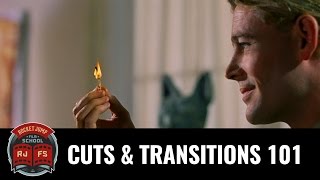

What Are Jump Cuts?
37sQuickly explains jump cuts with memorable examples like baseball montages, making it easy to understand and share.
▶ Play Clip
[00:00] The most basic edit you can do is the cut, which is simply going from one shot to another, changing perspective, advancing the story. Now, I'm going to be showing you a series of examples that help illustrate the types of cuts that I'm about to mention.
[00:16] A lot of these cuts are so common and feel so natural that you don't even think about it. Whoa, what the f*** happened there? Doesn't matter. You can do whatever you want. But if you want to make your cuts a little less jarring, let's begin with a technique that's used all the time.
[00:29] Cutting on action. Now all this means is cutting from one shot to another while the subject is still in motion. It doesn't always have to be on a punch, or a kick. It could be something as simple as a character turning, or throwing something, or a character going through a door, or another door, or another door.
[00:54] Then there's the cutaway, which I can best describe as cutting to an insert shot of something and then back. The insert could exist in the same space as the characters.
[01:08] You want the moon? Like this. Just say the word and I'll throw a rattle around and pull it down. Hey, that's a pretty good idea. Or you can use the cutaway to get inside the head of the character.
[01:31] Crosscutting. This is when the editor intercuts back and forth between locations. For example, most phone conversations are usually crosscut, and when used effectively, crosscutting can certainly amp up the tension and suspense of a sequence.
[01:44] This technique is also used to show what's going on inside the character's head.
[02:01] Jump cuts are when the editor cuts between the same shot
[02:16] And they are often used to deliberately show the passing of time And that looks like this So you can naturally find these in montages Here's a few examples
[02:31] Jump cuts are also used to add a level of urgency to the scene.
[02:48] And there a lot of jump cuts in baseball Now let move on to the match cut Match cuts look like this
[03:09] Match cuts are often incorrectly referred to as jump cuts. However, there is a difference. A match cut cuts from one shot to a similar shot by either matching the action or the composition.
[03:27] Match cuts are mainly used as scene transitions because you're often jumping from one place to another, which is most likely why there's confusion on the matter. Match cuts don't always have to be visual either. There's also verbal match cuts, like this.
[03:40] That looks just like an enormous... Wayne! Pay attention. Oh, it's exactly like an enormous flying... Willie! Yes? What's that? Wow, it looks like a giant...
[03:52] Johnson! Yes, sir! Now let's move on to transitions. Starting off with fade in, fade out. We've seen this a thousand times and it's just dissolving either to or from black. Pretty self-explanatory.
[04:04] Now, a dissolve is when you blend one shot into another. And that could look something like this. These are commonly used in montages as well and also can represent a passing of time.
[04:18] © BF-WATCH TV 2021
[04:48] Smash Cut! Smash cuts are abrupt transitions.
[05:02] The obvious example is someone waking up from an intense dream or a nightmare. Stop! Going from something intense to quiet, or quiet to intense.
[05:20] I shot my way out. Everybody starts shooting, so I blast my way out of there. Hold the gun and pop them.
[05:33] Another transition is the iris. Now the iris used to be an in-camera effect back in the day when you can manually open and close your iris to transition from black. Nowadays it's used as a stylistic choice. And a lot of these transitions you may often find within a theme
[05:56] Some other transitions include the wiper. And the wiper's a wipe. Look at that, it wipes. Oh look, there's another. Okay, moving on. Oh, no, there's more wipes? Oh, there are many types of wipes.
[06:13] Then there's the invisible cut. Invisible cuts are used to give the impression of a single take, however cuts are hidden in blackness, like in Hitchcock's Rope, or Evil Dead 2, and most recently Birdman.
[06:37] Cuts are also hidden within whip pans, where you can hide the cut on the motion of the camera movement. Here are a few examples.
[06:54] An editor might also hide a cut with an object crossing the frame. Or you can hide a cut when the subject leaves the frame. This is my favorite example because it's pretty seamless unless you know what you're looking for.
[07:06] Just like any good magic trick. So there's an invisible cut hidden right here. This shot was cleverly designed to make it appear as if Paul Newman was actually doing those card tricks.
[07:20] But really, he can't. Now let's move on to something else. The Elka is an audio-based transition. This is when the audio from the current shot carries over to the next shot.
[07:40] Now keep in mind, this doesn't have to just be for scene transitions. This is used all the time, even when characters are just talking to each other.
[07:57] The J-cut is when the audio from the next scene starts before you get to it. I can't! I gotta go home!
[08:11] So you hear what's going on before you see what's going on. These are very subtle editing techniques that people might not even notice.
[08:23] And that's the point. The J-Cut and the L-Cut are designed to specifically create a seamless flow. A seamless transition from one scene to another. With audio guiding the way.
[08:36] Hey, Gordon, I got some friends. This my friend is for you That all it is They like the police department for wise guys
[08:51] The J-Cut is also great for revealing a new element within a scene. It's like you can't take them underwater. And if you do... Me.
[09:03] Once you know all the types of cuts available to you, then you can start mixing and matching them. The graduate does this match cut. into a J-cut. Ben, what are you doing?
[09:19] Or there's the match J-cut. If you could find anyone, who would you find? Fight my boss, probably. And here's a verbal match J-cut. And the line goes...
[09:33] Rawr! Here's a cross-cutting cutaway. Try not to think of the word fear. Mad Max does this cutaway jump cut. Let's just take a look at that one again.
[09:45] They cut from Max to his vision, cut back, and they jump cut the impact to really sell the hit. Here it is again at full speed. Here's the jump cut cross cut smash cut. That's funny. Okay we over here. No, okay we over here.
[10:00] We'll go shrugging this one. Freeze! You're white snowing. I'm going to die! Gladiator has a great cross-cutting, match-cut thing going on in this sequence.
[10:21] The Green Lion also has a great match-cross-cutting sequence. Ah! Ah! Then there's the matched dissolve.
[10:43] And here's another example. Saving Private Ryan does this morph matched thing.
[10:57] So that's about it. Now you know the kinds of cuts and transitions you can use. Next is to ask yourself when and why you would use them for telling your story. And I'm sure I've left out plenty of other great examples, so I encourage you to share some of your favorite cuts in the comments below.
[11:11] Share some of your work in our forums, and if you're curious about which movie that clip was from, just turn on closed caption. Okay, that's enough. I'll talk to you next time.
[11:27] If you want to see more editing videos, click over here. If you want to see more video essays, click right there. And if you're interested in filmmaking, just subscribe. And we're also on Twitch every Thursday. We do live demos and commentaries.
[11:39] Okay, bye.
⚡ Saved you 0h 11m reading this? Transcribe any YouTube video for free — no signup needed.