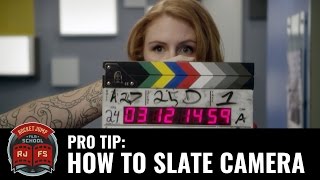

Why Movie Clappers Are Essential for Sound
57sExplains a key filmmaking mystery in a simple, visual way that appeals to both film enthusiasts and curious general audiences.
▶ Play Clip"Title promises a tutorial and delivers exactly that—clear, practical instruction with examples, though some repetition of examples pads the runtime."
Tom explains how to use a film slate for syncing sound and organizing shots, covering the essential information displayed on the slate, proper clapping techniques, and common mistakes to avoid.
The main purpose of a slate is for syncing sound. The visual clap aligns with the audio spike in the waveform, which editors match in post-production.
A slate displays roll (card/reel), scene, and take. 'MOS' indicates no sound is recorded, signaled by placing a hand in front of the slate so the editor knows not to look for audio.
Multiple shots in a scene are numbered sequentially (1A, 1B, 1C). Use clearly identifiable words for letters (e.g., Apple, Alpha, Armageddon) and always skip I's and O's to avoid confusion with 1 and 0.
For close-ups, avoid clapping hard as it can disrupt the actor. Instead, call 'soft sticks' and do a gentle clap, so the editor knows to listen carefully for that slate.
If the slate isn't clearly visible in the frame when clapped, call 'second sticks' to redo it. This signals to the editor that the first clap was a false one and the second is the sync point.
Tom demonstrates correct slating for various scenes, including 'One awesome take one A mark' and 'Scene two take six pick up', showing how to announce scene, take, and any notes.
He shows bad examples like 'Four six echo one' and '35 bromance, take one', highlighting unclear or inconsistent announcements that confuse the editor.
If you don't have a slate, a simple clap works fine for syncing sound, especially in casual or friend-made movies.
Mastering the slate is crucial for efficient filmmaking, ensuring sound sync and clear communication with the editing team. Even without a slate, a simple clap can serve the purpose.
Slate's core purpose
Establishes the fundamental reason for using a slate, which is essential for any filmmaker.
Numbering system
Provides a clear, practical method for organizing multiple shots, a key skill for on-set efficiency.
00:38Soft sticks technique
Shows a considerate approach to close-ups, balancing technical needs with actor performance.
01:17Second sticks protocol
Explains how to handle a common error, ensuring the editor always has a reliable sync point.
01:36Low-budget alternative
Makes the technique accessible to amateur filmmakers, broadening the video's applicability.
03:15[00:00] Hi, I'm Tom and I'm going to teach you how to slate. So the main purpose of a slate is for syncing sound. So you can see, visually, you can see the slate clicks together
[00:12] and in the waveform you can see the spike. So you would match those two things up in post. Now, there's a lot of information on a slate. You have your roll, which is which card or which reel of film you're on. You have your scene, which is which scene of the film you're shooting.
[00:26] Take, which is which take you're using. If it's MOS, it means there is no sound being recorded. And you would slate by putting your hand in here so that the editor can tell, oh, there's no sound. I don't need to look for it.
[00:38] It's not lost. And everyone is kind of on the same page all at once. Now a lot of times there's many more shots in a scene than just one. So you would start numbering. You do 1A, 1B, 1C, and just kind of continue through the alphabet.
[00:51] And you want to use a word that is clearly identifiable as that letter. Apple, Alpha, Armageddon, Aliens. You always want to skip I's and O's because just at a quick glance an I can look like
[01:04] a 1 and an O can look like a 0. So it could look like scene 11 or scene 10. And you just want to make it super easy for everyone to read the slate. So you always just skip I's and O's. So sometimes you'll be filming and it's a close up and you need to get the slate in
[01:17] there and you have to kind of bring it close to the actor's face. What you don't want to do is clap hard. I just took him out of his moment. You don't want to do that. What you want to do is call soft sticks and then a nice little light clap. You call soft sticks so that way the editor knows that he needs
[01:36] to really listen for that slate. The most important thing is to make sure that the slate is clearly visible in the frame when you clap it which that was not So I will call second sticks and make sure that the cameraman gets it You do that so that way the editor knows that when he going through that first clap was a false clap and the second one is the one that you should use to sync the sound
[01:57] And here's some examples of how to slate four different scenes. One awesome take one A mark. Scene one take three A mark. Business take one A mark. Two casualties take one A mark. Scene two take six pick up. Ten accused take one A mark.
[02:12] 18 take one mark. 25 basement take one mark. 47 cats take one A B mark. 25 conscience take one mark. 25 crying take two A mark. Three determined take one A mark.
[02:24] Three finances take one A mark. Three limousine take one A mark. Nine Alaska take one A B mark. 47 Articuno take two mark. Articuno. And here's some examples of how not to slate for scenes.
[02:36] Four six echo one. So do you want to give me the line I meant? Mark! Are you rolling? I'll do it all, I'll be down here. You rolling? Mark!
[02:48] 4-6 delta one. 4-6 delta two. 4-6 delta three. Echo two.
[03:02] 35 bromance, take one. 27, F-2. Once again, you're here to get. Now, if you're making movies with your friends, or sometimes we do this as well, if you don't
[03:15] have a slate, just use a clap. And that works just as fine. This does not work. Goodbye.

⚡ Saved you 0h 03m reading this? Transcribe any YouTube video for free — no signup needed.