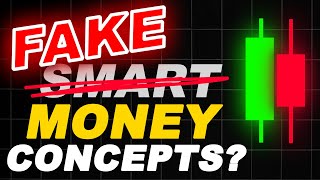

Smart Money Concepts is dumb
44sStrong controversial opening hook that challenges a popular trading strategy, sparking debate and curiosity.
▶ Play Clip"The title accurately reflects the video's content: a thorough debunking of SMC as rebranded price action."
This video critically examines Smart Money Concepts (SMC), arguing that it is merely classic price action rebranded with unnecessarily complicated terminology. The creator contends that SMC confuses beginners and can delay their path to profitability, while the underlying strategies are identical to traditional price action methods that have existed for decades.
The creator states that Smart Money Concepts is one of the dumbest things they have seen, but acknowledges a blind following among SMC traders.
The creator initially delayed the video because no one was getting hurt, but later saw Patreon supporters confused by SMC's misleading advertising.
The earliest SMC post found was from 2010 on Babypips, but experienced traders noted it was just classic price action. Price action books date back to 1932.
A Reddit user suggests that renaming price action to SMC is clever marketing because 'price action trading course' no longer sells, but 'Smart Money Concepts' makes millions.
New traders lack experience and believe SMC gurus, drawing meaningless lines. With experience, they realize most patterns are classic price action.
SMC traders profit because they are actually trading classic price action, not because SMC is special.
A Reddit user named Bill spent 4 months studying SMC, initially feeling enlightened, but later realized SMC terms like 'Institutional Orderflow' are just trend trading and 'Institutional Sponsorship' is support/resistance.
The SMC community is toxic, strongly believing in SMC as a secret and disliking criticism or alternative strategies.
Over 60% of trading success is psychology and money management. Entry strategy plays a minor role. Beginners improve over time regardless of the method.
A so-called Million Dollar Trader teaching SMC says in his first line that 'SMC is price action by a different name.'
Step 1: Identify trend using higher highs/lows (classic price action). Step 2: Identify 'Order Block Zones' which are just resistance areas. Step 3: Take a trade at the zone.
Terms like 'Strong Low' and 'Break of Market Structure' are just basic swing highs/lows and breakouts, but are presented as new concepts.
SMC claims a small pullback swing low is strong and a larger pullback is weak, which contradicts common sense. The creator argues larger pullbacks are more visible and thus stronger support.
Retail traders create low volume; institutions trade in large quantities. SMC's premise that retail traders' positions matter is mostly false.
Smart Money Concepts is essentially classic price action wrapped in confusing jargon and flawed logic. Beginners would benefit more from learning simple price action directly, as it is clearer and leads to profitability faster.
What is the earliest known post about Smart Money Concepts and where was it found?
Around 2010 on Babypips.
01:12
What book from 1932 is considered an influential work in price action?
Technical Analysis and Stock Market Profits by Richard Schabacker.
01:41
According to the video, what percentage of trading success is based on psychology and money management?
More than 60%.
07:24
What does SMC call a simple resistance area?
Order Block Zone.
09:46
What is 'Break of Market Structure' (BMS) in SMC actually referring to?
A normal breakout.
10:51
Why does the creator argue that a larger pullback swing low is actually stronger than a smaller one?
Because more people can see it and react to it, making it a stronger support.
12:32
What does the creator say about retail traders' impact on the market?
Retail traders create very low volume and most of the time institutions don't care about their positions.
13:46
SMC is Dumb
Strong opening statement that sets the critical tone of the video.
Clever Marketing
Explains why SMC is popular despite being rebranded price action.
02:06Psychology Over Strategy
Key insight that entry strategy is less important than psychology and money management.
07:09Million Dollar Trader Admits
Even SMC proponents acknowledge it's just price action with different names.
08:33Flawed Logic
Demonstrates a specific logical inconsistency in SMC teachings.
11:04[00:00] and Smart Money Concepts, or SMC in short, is one of the dumbest things I have seen. Unfortunately, Smart Money Concepts has a blind mob-like following. So,
[00:14] if you tell SMC traders that they are wrong, you might get kidnapped and thrown off a bridge. But you guys bullied me into making this video, and SMC traders are wrong. The only reason I was delaying this video is because, even if Smart Money Concepts are mostly crap,
[00:29] no one was getting hurt. But I was wrong. I saw multiple Patreon supporters get confused by SMC because it's advertised in a very misleading way. Look at this Reddit user, for example. They think SMC is different from Price Action even though it's not.
[00:44] Since I traded Price Action Only for thousands and thousands of hours, when I first heard about Smart Money Concepts, my reaction was something like this.
[00:59] I bet most price action traders also had a similar reaction because SMC really is just classic price action rebranded as an overcomplicated thing. At one point, I even saw someone say Smart Money Concepts came first,
[01:12] and Price Action traders copied them. It's true that Smart Money Concepts have existed for more than 10 years now. The earliest Smart Money Concept Post I could find was from around 2010 on a site called Babypips. But even on this site, experienced traders were quick
[01:27] to point out that it's just classic price action with a different name. That's because Price Action Strategies have been seen in books published more than 50 years ago. Richard Schabacker's "Technical Analysis and Stock Market Profits" was published
[01:41] in 1932. This book is considered an influential work in the price action field. It shows various patterns and market indicators and shows how to analyze price movements without the use of additional indicators.
[01:54] The price action technical analysis that we are more familiar with today became more popularized from around the 1970s onwards. That was way before most Smart Money Concept traders were born. So,
[02:06] no, Price Action did not copy the Smart Money Concepts; it's most likely the other way around. According to this Reddit user, it's clever marketing. If you name something a price action trading course, no one will buy it nowadays because people already know
[02:19] it. But renaming the courses to Smart Money Concepts and other dumb things makes millions. But why do some SMC traders strongly believe it's different than price action? I spent hours gathering data and found that many beginner traders who started trading
[02:35] after the year 2020 had a higher-than-normal chance of stumbling upon Smart Money Concepts instead of Classic Price Action. This is because SMC, like many other concepts, gained more attention when interest in trading increased overall after
[02:51] the lockdowns. Even your neighbor's dog was day trading during this time. Then, more people started remaking SMC videos, resulting in more attention. They explained Smart Money Concepts as if they show something smart,
[03:05] But do you remember when you were 3 years old, new to the game of life, and believed Santa was real? Pull his beard, kid; it's the same grandpa you see every day.
[03:18] Just like that, when we are new to the game of trading, we believe many things trading gurus tell us. We draw stupid lines everywhere because we lack trading experience, and everything looks like support resistance to us. This same lack of trading experience can make many beginner
[03:34] traders believe that some of these drawings show smart things, like mentioned in Smart Money Concepts. Once you gain enough experience, it becomes very clear that most of these patterns are total crap made up by your mind, and the rest are all classic price action patterns.
[03:49] But then why do some traders say that Smart Money Concepts work for them? It's simple! Since SMC traders are just trading the classic price action, in the end, it's the classic price action that's working for them. If you name your boat a plane,
[04:04] This makes SMC sound good, but remember, the whole problem with SMC is that it is hurting some beginner traders because of the unnecessarily complicated names
[04:16] used. Calling a car "a car" is much easier to understand than giving it a misleading name. Meet this Reddit user who spent 4 months studying Smart Money Concepts. Let's call
[04:31] trading strategies and found many people making profits with SMC. But that's not the main thing that got their attention. It was the higher accuracy analysis SMC traders were doing.
[04:44] Then, Bill found more people who claimed to have made money with SMC. After looking at all these positive reviews, Bill decided to try it! Even though Bill struggled initially,
[04:56] But most importantly, Bill felt like a blindfold was removed and they were seeing how the markets really moved for the first time. It was like, "I understand
[05:08] every movement now." That was the case until they gained 4 months of experience with it. realised Institutional Orderflow was oddly similar to just regular trend trading.
[05:23] Institutional Sponsorship was pretty much just strong levels of Support Resistance. Terms like "Internal External runs" were just sudden price moves and pullbacks in lower timeframes. "Low resistance liquidity runs," which are the soul of Smart Money Concepts,
[05:40] Then, Bill did some more research and realized that most of the Smart Money Concepts are truly normal concepts with different names.
[06:10] "Breaker Blocks" are literally just support turning into resistance. They also found how toxic the SMC community is. They saw how strongly some people believe in the smart money concept like it's a secret thing only they know. The community also doesn't
[06:26] like when people point out they are wrong and when others use different strategies. patterns even though they themselves use the same thing with different names.
[06:41] Bill thinks that if you show a chart to an SMC and a normal price action trader at the same time, they both would likely take the same entries, but a normal price action trader will call it a "bullish engulfing entry at support", and an SMC trader would say, "they saw institutions
[06:56] manipulate equal lows grabbing liquidity to fill their orders followed by a propulsion block that creates displacement and returns to fill remaining orders and reach for liquidity."
[07:09] I know some of you guys had a positive experience with SMC and are ready to say how wrong this Reddit user is. But I want to show you that you are most likely profitable with smart money concepts because you yourself have become smarter than when you started trading.
[07:24] Most of us agree that more than 60% of trading success is based on psychology, money management, etc. The entry strategy and concepts like these play very little role in your profitability. In the beginning, most of us don't
[07:38] really have any clue what's important. But over time, with more trading experience, you slowly get your trading psychology and money management right, resulting in better results. It doesn't matter if you start with classic simple price action or complicated smart
[07:53] money concepts. As long as you get better at the trading psychology part, But if you start with something good and simple, that profitability point in your trading journey
[08:05] might come much faster. If you start with something unnecessarily complicated, it might take a while to figure out that complicated thing, pushing the profitability point further away. I'm oversimplifying here, but it doesn't make any sense to use unnecessarily overcomplicated things.
[08:21] So, before starting to write this video, I was going through as many different views on SMC as I could. One of the posts I found was from a so-called Million Dollar Trader and
[08:33] Number 1 Forex Trading Coach. I'm not sure about the number one Coach part, but he claims to run a trading firm. Anyway, what I found interesting is that, even though he is teaching Smart Money Concepts here, his first line literally says,
[08:47] "SMC is price action by a different name." Then, he goes on to say that even though SMC traders use foreign names like "liquidity grabs" and "mitigation blocks," it's basically the same thing people have already been using for a while now. If more people taught SMC with a
[09:03] neutral view like this, I bet beginners wouldn't be confused and think that it's something new. Some SMC traders are probably thinking, "I'm being too harsh on Smart Money Concepts. If I
[09:17] just try learning it properly, I would see how less complicated and smart it is." So, I gave SMC trading a serious try, and here's what happened. They look at 3 things before entering the trade.
[09:32] Step 1 in the Smart Money Concept entry is to identify the trend of the market using the Higher Highs and Higher Lows Price Action Pattern. I don't see anything wrong with this, actually, because they are just saying to use classic price action to identify the trend.
[09:46] But then, in step 2, they say to Identify Key Order Block Zones from the Smart Money Concepts because these zones are areas with a significant imbalance between supply and demand. On a chart, the order block looks like this. And this is where every price action trader says, "Hey,
[10:02] I have seen this one," because it's been called a simple resistance area for more than 50 years. The third step is to basically take a short trade when the price comes in this order block zone. So far, from a price action perspective, Smart Money Concepts has said to wait for the price to
[10:18] come inside a resistance area in a downtrend. Other than the unnecessary order block word, it's simple. But then it said something really interesting. "A Strong Low is The Low that Causes Manipulation and Break Structure."
[10:36] I was super confused by this line. What Manipulation are you talking about? I scrolled down and saw this chart. But still couldn't see the Manipulation. from a price action perspective, all I see are basic swing highs and lows.
[10:51] If you are wondering what this BMS word is, it just means a normal breakout. It's one of those things that is used to trick new traders into thinking it's something new. Then Smart Money Concept said that this swing high in a downtrend is a strong resistance.
[11:04] And this swing low in an uptrend is a strong support. But based on what I have learned by trading price action in the live market for around 8 years, this just looks wrong. Pullback Swing lows like these are actually weak support
[11:17] because they are often not visible on higher timeframes in a good uptrend. So far, Smart Money Concepts has not said anything smart. In fact, I would argue that it said some things really dumb. But things got even dumber. Because it
[11:30] said that if the price makes this pattern, it's a weak low. But wait a minute, if I put the previous smart money drawing next to it, didn't it say this pullback swing low was strong? And now, it's saying if the price breaks below that strong support to give a bigger pullback,
[11:46] the new swing low is a weak support. That doesn't make any sense. How is the smaller pullback in a trend a strong swing low, and a bigger pullback in the same trend a weaker low? There was no reason given behind this smart logic. But I think this Smart Money Concept is guessing
[12:01] that if the previous swing low is broken in an uptrend, it can be the start of a new downtrend, which could look like this in the future. In that case, the swing low can be weaker since swing lows are usually weaker in a downtrend. But what if the price does this instead? So,
[12:17] this pattern is not a clear confirmation of a downtrend. From my experience, it mainly means that the uptrend is slowing down. After that, the price could go up again, or sideways, or down. Nothing strongly says this should be a weaker swing low than the
[12:32] previous one, which SMC previously said was strong for some reason. There is another flaw in the SMC logic. If the price gives a bigger pullback like this, previous one. If more people can see it, then more people can react to it. For example,
[12:50] when the price comes near it again, they can buy, calling it a support trade. In other words, this bigger swing low that Smart Money Concepts said is weak can actually act stronger.
[13:04] While showing how to take a short trade near a simple resistance, SMC not only rebranded the same things into confusing names, but it also made up nonsense logic. To be fair, the Classic Price Action also contains a lot of bad logic,
[13:17] but it's far less compared to SMC's logic. Price Action is also much simpler to understand. Is it possible that since I started as a Price Action trader, everything I'm saying is biased?
[13:32] Maybe! But I spent over around 3 weeks researching this topic, taking different views into account, and still, Smart Money Concepts looked like a rebranded, unnecessarily overcomplicated thing with a lot of nonsense logic.
[13:46] The funny thing is that we retail traders, people who trade on their own accounts, create very low volume in the market most of the time. Big banks and other institutions on the other hand, buy sell in quantities that are way bigger than ours. But according to SMC logic,
[14:08] Now I agree, sometimes retail traders create positions that big players care about. But most of the time, no one gives a crap about us.
[14:20] This Reddit user said it in a rude but funny way. SMC traders do not trade like a bank. They do not trade differently from any other retail trader. They are not doing anything worldbreaking. They are trading basic price action
[14:38] I have used in my 8 years of trading journey.
⚡ Saved you 0h 14m reading this? Transcribe any YouTube video for free — no signup needed.