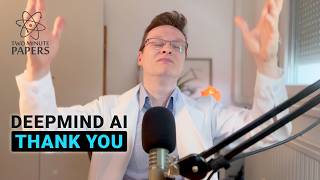

AI You Can Run Offline Forever
45sHighlights the frustration of losing AI access and offers a free, offline alternative, tapping into user fears of vendor lock-in.
▶ Play Clip"Title is accurate: Gemma 4 is indeed a free, open AI gift, but the video also covers limitations, so not 100% hype."
Google DeepMind released Gemma 4, a free and open family of AI models that can run on devices with minimal hardware, including phones and even a Nintendo Switch. This video explores four surprising aspects of Gemma 4: its performance, agentic capabilities, context window, and permissive license, highlighting how it empowers users to own and run AI locally without reliance on proprietary cloud services.
Users of Claude AI lost access due to 'heavy workloads', highlighting the risk of relying on cloud-based, subscription AI services.
Google DeepMind's Gemma 4 is a free, open family of models. The smallest models require only a few GB of memory and run on devices like phones and Nintendo Switch without internet.
The 31B parameter dense model beats models 10-20 times larger on some benchmarks, despite being dense (all parameters active) rather than mixture-of-experts.
1) Highly curated training data; 2) Hybrid attention (sliding window + global); 3) Better image understanding (no squishing); 4) Shared KV-cache for efficiency.
Gemma 4 excels at tool use, local coding, and agentic tasks like booking flights or summarizing news, making it a viable free alternative to proprietary assistants.
The context window is doubled to 256k tokens, allowing processing of long documents, though it's computationally expensive.
Gemma 4 uses Apache 2.0 license, removing restrictions present in Gemma 3. It allows modification, commercial use, and derivative models with minimal friction.
No live database; can be confidently incorrect; struggles with highly complex tasks and images with fine details like thin structures or grass.
Gemma 4 is a significant gift to humanity, providing free, open, and locally-run AI that cannot be taken away. It empowers individuals and small developers, reducing dependence on big tech companies.
What is the main problem with proprietary AI services according to the video?
Users can lose access to the service (e.g., Claude AI subscriptions revoked) and are dependent on the company's goodwill.
What is the smallest Gemma 4 model size and what hardware can it run on?
The smallest is a 2 billion parameter model that runs on devices like phones and Nintendo Switch with minimal memory.
01:06
How does the 31B Gemma 4 model compare to larger models?
It beats models 10-20 times larger on some benchmarks, despite being a dense model.
02:50
What is a dense model versus a mixture-of-experts (MoE) model?
Dense models activate all parameters for every query, while MoE splits the model into experts and only activates a subset (e.g., top 2-8) per query.
03:24
What are the four key improvements in Gemma 4?
1) Curated training data; 2) Hybrid attention (sliding window + global); 3) Better image understanding (no squishing); 4) Shared KV-cache.
04:41
What is hybrid attention?
It combines local sliding window attention (for details) with global attention (for overall context), used simultaneously.
05:09
What is the context window size of Gemma 4?
256k tokens, double that of Gemma 3.
07:51
What license does Gemma 4 use and why is it significant?
Apache 2.0 license, which is permissive and allows modification, commercial use, and derivative models with few restrictions.
08:07
What are two limitations of Gemma 4?
It has no live database (cannot browse) and can be confidently incorrect; also struggles with highly complex tasks and fine visual details.
09:07
Risk of Proprietary AI
Highlights the vulnerability of relying on cloud AI services that can revoke access arbitrarily.
Gemma 4 Runs on Nintendo Switch
Demonstrates the extreme efficiency of the model, running on outdated hardware with limited resources.
01:0631B Model Beats 10x Larger Models
Challenges the assumption that bigger models are always better, showcasing the effectiveness of dense architecture with good data.
02:50Curated Training Data
Emphasizes the importance of data quality over quantity, a principle applicable beyond AI.
04:41Apache 2.0 License
Marks a shift towards true open-source AI, enabling broad commercial and research use without restrictions.
08:07[00:00] Google DeepMind gave an amazing gift to humanity. And it is full of surprises. Here’s why. Today, we are living in the age of AI where these smart assistants and agents can do things
[00:13] we could only dream of 10 years ago. But. Many of these solutions are proprietary, require a subscription, and run in the cloud. And then this happens. Yup, some OpenClaw users
[00:28] reported losing access to their Claude AI subscription citing “heavy workloads”. Now, maybe they did something unsavory, I don’t know. I also understand you pay a fixed rate,
[00:40] you can’t eat all you want. I respect that. However, this is the point. We have to rely on the goodwill of these companies for our workflows. So this is why I keep saying over and over that we
[00:53] should always look for options where you we own these AIs and run them on our own systems for free, forever. No one can take them away. NVIDIA came out with their Nemotron 3 Super,
[01:06] which has super capabilities…but its hardware requirements are also super. Not so much with Google DeepMind’s new AI, Gemma 4. This is a free and open family of models,
[01:20] and yes, finally, the smallest ones require only a few gigabytes of memory. No need for an expensive GPU. So much so that I wanted to wait a bit before publishing this
[01:33] video to see how you Fellow Scholars use it in practice. And…look at that! It runs on your phone without an internet connection. And folks are already using it in practice to
[01:47] create offline translation and summarization apps. Also, real time image classification running in your browser while talking like a bard? No problem. You can already fine tune it
[02:01] with Matt’s work. It is so good, it has a little ecosystem around it already in just a few days. Because of the brilliance of you Fellow Scholars. Nice work.
[02:16] But it gets better. You see, the smallest Gemma is so small, it runs on…oh my. Look…I love that. It runs even on an old beat up nintendo switch, first generation. Not exactly something with
[02:34] a lot of memory or processing power. Still runs the 2 billion parameter Gemma 4 model. Now that is a gift to humanity. But it gets really strange from here on out. Here are 4 things that I found really surprising. Dear Fellow Scholars,
[02:50] One, they also have a bigger, 31B model which was the #3 best open model, and now hold on to your papers Fellow Scholars, because it beat some models
[03:07] that are 10 times larger. And still competitive with some that are 20 times larger. On some measurements. And it is a dense model. What? What is going on here?
[03:24] You see, many of the modern AI systems you encounter are what they call mixture of experts models. MoE. These are huge AI models with many parameters,
[03:36] and to make sure we don’t burn down all of our hardware using them, it splits up this big brain into many small ones. If you have a biology question, it chops it up into small parts, and routes them to the parts of the brain that it thinks are the best experts at processing it.
[03:53] Typically, to the top 2 to 8 experts. Only ask them. Yes, with that, we only activate one small part of a brain at a time. It makes sense, right? It’s not a simple process,
[04:08] but it is possible. This enables us to create huge intelligent models that are still efficient. Dense models, however, just light up every parameter of the system. These are not new,
[04:23] and in some ways, these are very inefficient. You light up all the 31 billion parameters in the brain all the time, no matter how simple or complex the question is. But this one…this one is somehow magically good. How?
[04:41] They did four amazing things: one, Google didn’t just dump half the internet into it to learn about us. They apply super strict filters to give it only highly curated
[04:53] training data. That is actually good advice for our thinking too. Don’t let everything in, curate your information diet. There is lots of noise out there - ignore it. That is excellent.
[05:09] Two, they use an interesting attention mechanism that has a sliding window and also global attention at the same time. What does that mean? Well, when you read a book,
[05:23] you read it line by line to finish a page. That is a local sliding window. With that, you get all the details. But sometimes you want to zoom out and ask, okay, what book are we reading? Which chapter
[05:39] is this? That is global attention. Here, they use both, and call the mechanism hybrid attention. Three, it is better at understanding images. You know, Gemma 3 had weird glasses on,
[05:54] and its image understanding was kind of a lie. If you gave it a landscape image, it squished it back to a square image before processing it, losing some information. It
[06:06] squishes everything into its own preconceived box. Not good. Gemma 4 understands the image as-is, and the difference really shows on any benchmark that has to do with images.
[06:20] Four, it has a shared KV-cache. KV-cache is short term memory for what you are currently talking with it, documents, questions. Now the layers of this neural network like to recompute their fresh memory from scratch. This one doesn’t,
[06:37] it essentially borrows the memory already computed by earlier layers. Less work, nearly the same result. This is one of those ideas where we are wondering why we didn’t always do it like this.
[06:52] Okay, and all this was just part of my first surprise. Second surprise. It is fantastic at agentic workflows. This is where we don’t just have an AI assistant that spits out a bunch of
[07:06] text, this is when we give it arms and legs and ask it to do stuff. Tool use, local coding, and a ton more. Plug it into OpenClaw and it can book a plane ticket. Look for news and summarize it
[07:21] in a more unbiased way. Or write silly emails to Károly from Two Minute Papers. That sort of thing. It is really good at that. So when any company decides that you can’t use their system anymore,
[07:38] that’s alright. Just plug in Gemma 4, and you are good to go. For free. People find that if you give it custom instructions, sometimes you don’t even notice the difference. That is huge.
[07:51] Surprise number three, the context window was improved to 256k, twice as big as Gemma 3 had. This is pretty expensive to compute, so don’t take it for granted. Here, you are not going
[08:05] to chuck gigabytes of movies into it, but for a few long documents, it is perfectly fine. Four, the license. Oh my, the license. This one gets overlooked so much. Gemma 3 came with
[08:20] a Gemma license. In other words, it comes with strings attached. The model comes with handcuffs, if you will. If you use it to create training data for a derivative model. Yup, that one inherits the
[08:36] handcuffs too. But, with Gemma 4, not anymore. Look, Apache 2.0 license. Now we’re talking,
[08:48] yes! This license is true to the open source spirit. You can modify it, sell it, deploy it commercially with almost zero friction. Make derivative models, do a ton of stuff with far fewer restrictions. This is huge. Thank you so much!
[09:07] Now, not even this technique is perfect. For instance, the model does not have a live database. Without an agent harness, it cannot browse or look up stuff. Meaning? Well,
[09:20] meaning that it can be confidently incorrect. The internet special. Also for highly complex, open-ended tasks - it’s not great at that. Or,
[09:33] when you have images with lots of high-frequency visual details, thin structures, blades of grass, or a fence from far away. Not great at that, it’s going to need even better glasses.
[09:47] But, adding this all up, this is an amazing gift to humanity, one that cannot be taken from us. This is not for Mr moneybags, this is for the little man, and it is free,
[09:59] for all of us, forever. Hugely appreciated. Absolutely loving it. What a time to be alive! Also, I waited with this video because I did not just want to take the marketing messaging
[10:14] and copy-paste it to you. I wanted to see how you Fellow Scholars are actually using it in practice. Read through your experiences with it. Does it really work in practice? Super important. That’s what we are here for, not the copy-pasted media headlines.
[10:32] That needs time. Trying to explain all this in simple words also takes time. I don’t have a team here, I do everything from the writing to recording, video editing. I am trying my best
[10:47] here. But it gives you more accurate information, and that is the most important for me. So, now, after 10 million downloads in the first week and more thorough testing. My
[11:00] opinion is that yes, this thing rocks. I would like to send a big thank you to every single scientist who worked on this! And hold on to this one for dear life because a frontier model
[11:14] just got locked down for a few select clients. You know, it’s a big club. And we ain’t in it. If you enjoyed this, consider subscribing and hitting that bell.

⚡ Saved you 0h 11m reading this? Transcribe any YouTube video for free — no signup needed.