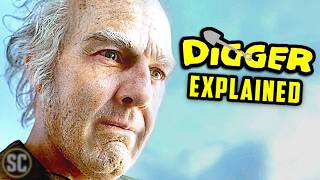

Why Digger Has Everyone Divided
44sImmediately addresses the controversy and divisive reception, tapping into curiosity and debate.
▶ Play Clip"Title promises a breakdown of a controversial movie, and that's exactly what you get—no bait, just analysis."
Digger is a divisive film that uses a play-within-a-movie structure to deliver a climate change parable. The review breaks down the twist, the theatricality, and Tom Cruise's dual performance, arguing that the film's bluntness is intentional and effective.
The film's first 20 minutes are praised for their performances, urgency, comedy, and suspense, setting up a darkly comedic disaster movie about greed and power.
The twist reveals that the story is a play called Fossil Fools, performed in a dystopian future where the real Digger caused environmental catastrophe.
Tom Cruise plays both Digger, the oil tycoon, and Markson, a stage actor in the future, giving two performances that represent the cause and the consequence of the catastrophe.
The film's bluntness is intentional because it's a play performed by people who already know the ending, making the obvious messaging part of the joke.
Digger's speech turns the accusations back on the audience, highlighting the contradiction of condemning oil while relying on it for everyday comforts.
The film reveals the dystopian world through casual details: gas masks, armed robots, flooded streets, and an underground theater, all consequences of Digger's actions.
The film stacks audiences—the play's audience, the actors, and us—making us the only audience that still has control over the future, though the reviewer admits it's probably too late.
The film's divisiveness mirrors its message about division and hypocrisy, with a 52% Rotten Tomatoes score at the time of recording.
The reviewer believes Cruise deserves a Best Actor nomination and John Goodman should be considered for Best Supporting Actor, with Digger deserving a Best Picture slot in a ten-film lineup.
Digger is a deliberately theatrical climate parable that uses its divisiveness as a mirror for our own inaction. Whether you love it or hate it, the film's message about complicity and consequence is impossible to ignore.
Coping with Trauma Through Humor
Explains why the film's dark comedy is intentional, not a flaw.
05:15Rotten Tomatoes Score
Provides a concrete data point on the film's divisive reception.
12:44Breaking the Fourth Wall
Highlights the film's deliberate artifice as a storytelling device.
08:31The Contradiction of Complicity
Articulates the film's central moral challenge about personal responsibility.
06:59[00:00] Digger has moviegoers divided, much like the very subject matter of the film is tackling. So, let's break down the movie, discuss why it's so controversial, explain the ending with the masks and the armed robots, and, oh man, we have got to talk about that twist.
[00:14] Hey, welcome back to Screen Crush, I'm Colton Einburn, and Digger is a movie that I have really been looking forward to. I had very high expectations, and, oh, I'm apparently in the minority on this one, I really dug Digger.
[00:26] Now, the response to this movie has been incredibly divisive, to the point that the movie itself has started embracing that divide in its marketing campaign. You just drive rich!
[00:39] And, after seeing some of the criticisms, I feel like I watched a completely different movie than some of these critics. But hey, film is subjective, we don't all have to like the same shit, but I'll tell you, if you didn't like it, you're wrong.
[00:51] Fun, fun, fun! Now, before we go any further, I should probably disclose something. I am a massive Tom Cruise fan. Part of the reason why is, obviously, because I love his movies, but I also just love how much he loves movies. Tom Cruise, he is a movie nerd. He loves watching them, he loves talking about them, and he, of course, loves making them. And that enthusiasm that he has for film is just contagious, and I think it's a huge part of why he has remained one of the biggest movie stars in the world for as long as he has.
[01:20] I think Cruise is remarkable in this movie. I think John Goodman did really great as well. In fact, a little later, we're going to talk about how I think this movie will perform come Oscars time. But first, let's talk about the film itself.
[01:32] So, those first 20 minutes or so of this movie are just really damn good. The performances, the urgency, the comedy, but also the dread and suspense. It's all so good. And it feels like this massive, darkly comedic disaster movie about greed, power,
[01:47] and this eccentric oil tycoon who is about to help destroy the world, but who is also the protagonist of the film. Now, after those first 20 minutes, you realize we haven't been watching a movie about an oil tycoon causing the end of the world.
[01:59] We're actually watching a movie about a direct rehearsal for a play about an oil tycoon who caused the end of the world. The story that we have been watching, it is actually a play called Fossil Fools, and the play is being performed by people living in this dystopian future
[02:13] that the real Digger caused. Digger and the catastrophes surrounding him are historical events to these people in the play, as well as the audience who will come to watch it. Their world has already lived through the consequences of what happened,
[02:26] with the drilling, the ice caps, the flooding, and the massive changes to the playness that followed. And I love that because when you find out that it's a play, it doesn't take away from the severity of the situation, because, if anything, it makes it more disturbing,
[02:40] because the actors in this world who are doing this play are doing it about a real-world event in their own history. We are getting to see Tom Cruise play both the oil tycoon Digger,
[02:52] but we're also watching him play Markson, a stage actor and father, living in this dystopian future that Digger helped create. So Cruise is essentially giving us two performances at the same time. There's the huge theatrical performance as Digger,
[03:06] and then there's this much smaller, more human performance as Markson. One guy represents the people who caused the catastrophe, and the other is somebody generations later who has inherited the consequences of it.
[03:18] And shout out to my wife, by the way, who is actually a stage actress. She leaned over to me in like, I don't know, the first ten minutes of the movie, and she whispered, this feels like a stage play. And then, boom. Bang, bang, bang! Now, one of the biggest criticisms I've seen leveled at Digger
[03:31] is that the movie insists upon itself. It's preaching. It's too obvious. It's this incredibly on-the-nose, over-the-top, environmentalist message about drilling and climate change, but I didn't really take the movie that way at all.
[03:43] Don't get me wrong, Digger is absolutely sending a message about the dangers of climate change, and it obviously has the intent of giving us a reality check about our own situation and where things are likely headed. It acknowledges the fact that oil tycoons
[03:57] and their companies lie and cover up their nefarious damage to the planet all just to make money And while I appreciate the message of Digger the message is not what made the movie work for me Tom Cruise stellar performance is what made it work for me
[04:10] John Goodman's stellar performance, the overall filmmaking, the writing, the camera work, everything about this movie I just really enjoy. Jesse Plemons is in it as well. Love Jesse Plemons. When I hear people complain that this movie is too over the top or too on the nose,
[04:25] I think they're overlooking something pretty important, and that is that it's supposed to be. We are watching a play called Fossil Fools. Subtlety isn't exactly the mission statement here. This is an intentionally heightened theatrical retelling
[04:39] of a catastrophe being performed by people who already know the ending. These people aren't wondering whether Digger's actions are going to have consequences. They are living in those consequences. And I'm, of course, talking about the audience watching the play.
[04:52] So, of course, the play is blunt. Of course, the characters are exaggerated. Of course, the messaging is obvious. That's the joke. That's the intent. It's the whole point. And there is another layer to this that I think is really interesting, because we are watching people in the future simplify their own history into a story with obvious heroes, obvious villains, and an obvious moral compass.
[05:15] And it is all presented as a dark comedy, because that's what we as humans tend to do. We cope with trauma through humor. We laugh, because if we don't, we'll cry. This story feels obvious because it is supposed to feel that way.
[05:30] When you're looking backward on an event, everything seems obvious. Of course that was a terrible idea. Of course that person was wrong. Of course somebody should have stopped this. It's really easy to identify the moment that everything went wrong when you're the one sitting decades into the future with the benefit of knowing exactly what happened.
[05:47] But it's a lot harder when you're actually the ones living through it. And I think one scene that demonstrates that better than almost anything else in the film is when Digger gives this speech, he essentially turns the accusations on him
[05:59] back around onto everyone else. Look, I don't want to speak for all of you, but I think it's safe to say that a lot of us, we do want to talk about the dangers of drilling and how we need to move away from that. We need to pursue renewable energy.
[06:11] We need to acknowledge the dangers that climate change presents. And we'll talk and talk about how something needs to change. But then the question becomes, what are we actually willing to personally give up? Because, listen, babe, carpooling and composting, that's all great, and when we all do our part, it can make a dent, but the truth is, it's just a dent.
[06:32] Your air conditioning, your cell phones, the technology, just everyday luxuries and conveniences that make our everyday lives comfortable, they're powered by the oil industry. And, as Digger says, supply, demand.
[06:45] And to be clear, that doesn't make Digger right, but it does show us that he is smart enough to understand the contradiction. He knows people hate what he represents, but he also knows that the modern world is incredibly dependent on the thing he is selling.
[06:59] It's almost as if we are able to sleep at night as long as we pin the guilt on, you know, the Digger of the situation, when in reality, we're the ones that got the AC down on 68. And I think this scene is what makes Digger all the more frightening than if he were just some idiot billionaire destroying the planet
[07:15] because he doesn't care or doesn't even realize he's doing it. Digger, he understands the system perfectly, and he knows how to use our participation in it as his defense. He knows that despite people having critical rhetoric against him, they're still using the oil that he provides.
[07:31] So, we can recognize the problem. We can condemn the people contributing to it. We can talk about how something has to be done, but how much are we actually willing to change about our own lives? And the answer, unfortunately, is very little.
[07:45] And the moment in the film where Digger gives that speech, that is when you realize that this eccentric oil tycoon isn't a clown, he's a calculated evil. And this play, it isn't just about condemning Digger, it's about condemning us, those
[08:00] who stood by and let it happen Which also makes the title Fossil Fools more interesting because who exactly are the fools Is it Digger and these absurd billionaires who thought they could exploit the planet forever without consequences
[08:13] Or is it everybody else who knew what was happening, hated the people responsible for it, but continued participating in the system anyway? Probably both. Now, there's another element of this movie that I absolutely loved, and that is the way that it continually plays with the boundary between the play and the movie that we are watching.
[08:31] There are shots where you can see the audience sitting out of focus in the background, or during the dress rehearsal, there are empty chairs in the background where there would be a wall. They are literally breaking that fourth wall.
[08:43] And during that speech we were just talking about, you can see that some of the people that Digger is talking to, some are extras, but a lot of them are mannequins. The movie isn't trying to hide the artifice from you anymore, and they don't try to hide that away,
[08:55] but somehow you still find yourself getting sucked right back into the story of Digger, and for brief moments you forget that it's a play. But when you do remember it's a play, nothing is taken away from that because you know that the events they're depicting in some way, shape, or form did really happen
[09:10] and that these actors and the crowd are both living in that world that Dicker created. And the movie takes this idea one step further by making what's happening outside the play increasingly important,
[09:22] like with Markson's daughter being on a plane and Markson becoming terrified that she's in danger because of the severe weather that has become increasingly common because of the catastrophe that unfolded decades back.
[09:34] Suddenly, the stuff happening backstage is scarier than the apocalypse happening on stage. Because it becomes pretty clear early on that we know how the play ends, the characters know how the play ends, the audience watching the play, of course, know how the play ends.
[09:48] Digger drills, the environment collapses, the world changes, and we understand pretty quickly that Digger does end up taking his own life. That's the history. That's what happened. But Mark's in the after playing Digger.
[10:00] He doesn't know if his daughter is going to be okay. That is happening right now, and it is a consequence of the very material that they are doing a play on. And I think that's really important because it's not just some gimmick. It actually contributes to the story that the after playing Digger isn't just some detached performer playing a part.
[10:17] He is a victim of the very character that he is playing. The consequences of Digger's story aren't confined to fossil fools. They are sitting backstage, and every time he goes to his dressing room and contacts his wife to get an update on his daughter.
[10:31] Hell, we learn the entire theater is underground because it is so unsafe up on the surface. We see that the audience have to wear these big gas masks just to go outside. They have robots with guns patrolling the streets.
[10:43] And those very streets are flooded with water from the rising tide. And that is the world that the actors and the audience are living in. And I love how casually the movie reveals a lot of this stuff. It doesn't stop and give us a giant exposition dump explaining exactly how society functions now.
[10:59] These little clues that we are getting throughout the movie aren't just cool pieces of dystopian imagery. They are the punchline to Fossil Fools. Inside the theater, Digger and everything he represents, that can be mocked.
[11:11] And Digger can be turned into this ridiculous theatrical villain. And everybody can laugh at how stupid and greedy all of these people in the past were. But then everybody has to put on their masks and walk outside into the world that those people created.
[11:23] And that brings me back to us, another audience who is watching an audience watch a play. And that's something I really like about the structure of the film. There are basically audiences stacked on top of audiences. There's the audience watching Fossil Fools, there's Markson and the other actors looking back at their own history and how they're interpreting it and presenting it.
[11:41] And then there's us, sitting in a theater, watching all of them going through something that could very well be our own future. We're watching an audience watch a story about people who failed to prevent something that their audience now has to live with.
[11:54] And we're the only audience in that chain that still has any control over what happens next. Or at least that's what the movie wants us to think. And sure we the audience that still has a chance maybe to avoid this becoming our reality But in all honesty and to be a downer it probably too late It going to happen But to quote George Lucas So you can absolutely dislike
[12:16] the execution of this movie. That's fine. Film is subjective. The theatricality isn't going to work for everybody. And I think that's actually where the real disagreement surrounding this movie can be found. It's not necessarily whether you agree with the film's message.
[12:29] I think it's more so whether you're buying into the way that the movie is selling it. Because this is a weird movie. It's loud. It's theatrical. It's deliberately artificial. It pulls the rug out from under you like 20 minutes in, and then basically asks you to watch the rest of the movie differently than you had expected.
[12:44] For me, it worked. I loved it. As for others, well, at the time of this recording, Digger is sitting at a 52% Rotten Tomatoes score. And while that is a rotten score, it does mean that a slight majority, very slight,
[12:57] but a slight majority of critics did like it. And honestly, there's something kind of sitting about a movie about division, hypocrisy, and our inability to collectively agree on how to address the problem, becoming now this very divisive movie itself.
[13:11] So before we go, let's talk a little Tom Cruise. Again, massive Cruise fan, so take this for what it's worth, but I think it could legitimately be his chance at winning Best Actor. Or at least that's what I thought, you know, before we saw that, like, half the critics didn't like the movie.
[13:25] But then again, critics aren't the ones who vote. The Academy votes, so we'll have to see. But as for Cruise, for someone who has spent so much of the latter half of his career becoming synonymous with enormous action movies and increasingly insane practical stunts,
[13:37] the movie does give Cruise an opportunity to remind the world just how good of an actor he is. Because we're used to watching Cruise, you know, hang off planes and jump motorcycles off of mountains and fly fighter jets and sprint for three consecutive business days.
[13:50] You know, Tom Cruise stuff. But Digger isn't asking him to save the movie by nearly killing himself. It is actually asking Tom Cruise to perform. and not only perform, but give us two performances that are both really well executed.
[14:03] Digger, he is enormous. He's charismatic and ridiculous and funny and terrifying. And he's a guy who can walk into a room and make everybody look at him. Whereas Markson, on the other hand, he's a method actor. He is like hiding behind the persona of Digger.
[14:16] He's scared. He's vulnerable. He's a dad worrying about his daughter. And he's just a guy trying to live in a world that somebody like Digger left behind for him. And there is something I really love about Tom Cruise, arguably the movie star of the last several decades
[14:29] and one of the biggest advocates for theatrical films. I love seeing him play an actor in this tiny underground theater at the end of the world. There's almost something weirdly appropriate about that. In this world we find marks in living in, it's changed.
[14:42] Society has collapsed and people are living underground, but here they are still putting on a show that people want to come out and see. They're still telling stories. They're still gathering in a room to watch somebody perform, despite the fact that they're living in this advanced future with advanced tech as we saw before.
[14:58] They're not streaming it back to their homes. They're actually wanting to get out and watch it together. It's almost as if this movie is just as much about climate change as it is a movie about the current state of the movie theater industry and its bounce back following COVID.
[15:11] And I think Cruise is the perfect actor to have involved with that. I think he should get a Best Actor nom. And I think John Goodman should be in the conversation for Best Supporting Actor as well. As for Best Picture, look, if we still lived in the era where there were only five Best Picture nominees,
[15:26] I'm not sure Digger would make the cut, but we don't have five nominees anymore. We have ten, and in a ten-film Best Picture lineup for 2026, yeah, I do think Digger deserves to be on that list. And I know a lot of people are going to disagree with me on that, but maybe that's appropriate,
[15:40] because if there's one thing that everybody seems to agree on about Digger, it's that nobody can agree on Digger. Alright, well those were just my thoughts. Let me know yours down in the comments below. If you're new here, be sure to subscribe, hit the bell to get notified every time we upload a new video.
[15:52] Also, feel free to check me out on my personal channel, link in the description below. For Screen Crush, I'm Colton Ogden.



⚡ Saved you 0h 16m reading this? Transcribe any YouTube video for free — no signup needed.