

The Distributed Transaction Nightmare
45sHigh stakes: what happens when payment succeeds but shipping fails? Viewers immediately relate to the tension of system failures.
▶ Play Clip"Delivers a concise, accurate explanation of distributed transactions, though the title is generic."
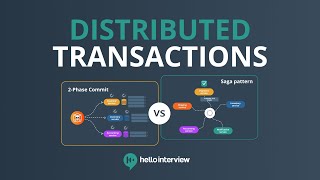
This video explains the challenges of handling transactions across multiple services in distributed systems, contrasting the traditional single-database approach with the complexities of distributed transactions. It introduces two primary solutions: the two-phase commit protocol and the saga pattern, highlighting their trade-offs and practical implications.
In a single database, transactions provide all-or-nothing atomicity, ensuring that either all operations succeed together or none do.
At scale, services like inventory, payment, and shipping use separate databases, so a failure in one (e.g., shipping) after another succeeds (e.g., payment) creates inconsistency.
A coordinator asks all services if they can commit, then waits for unanimous agreement before committing. However, services are locked during the wait, and if the coordinator crashes, they remain stuck holding locks indefinitely.
Because of the locking and coordinator crash risk, almost nobody uses two-phase commit in production.
Instead of one atomic operation, each service performs its steps independently. If a later step fails, compensating actions undo earlier steps (e.g., refund payment, restock inventory).
Sagas avoid the coordinator bottleneck but introduce a window where the system is partially incomplete. Distributed systems don't get atomicity for free.
Distributed transactions require choosing between the blocking risks of two-phase commit and the eventual consistency of the saga pattern, with the latter being the practical choice in most production systems.
What is the main advantage of a single database for transactions?
It provides all-or-nothing atomicity, ensuring either all operations succeed together or none do.
00:01
What problem arises when services use separate databases?
A failure in one service (e.g., shipping) can occur after another succeeds (e.g., payment), causing inconsistency.
00:15
How does two-phase commit work?
A coordinator asks every service if it can commit, then waits for all to say yes before anyone commits.
00:29
Why is two-phase commit rarely used in production?
Services are locked while waiting, and if the coordinator crashes, they are stuck holding locks forever.
00:42
What is the saga pattern?
Each service performs its steps independently, and if a later step fails, compensating actions undo earlier steps.
00:56
What is the trade-off of the saga pattern?
There is a window where the system is partially incomplete, but it avoids the coordinator bottleneck.
01:10
Two-Phase Commit Explained
Clearly explains the protocol and its fatal flaw, making it a key concept for distributed systems.
00:29Saga Pattern as Alternative
Introduces the practical alternative used in production, highlighting the trade-off of eventual consistency.
00:56Atomicity Not Free
Summarizes the core principle that distributed systems cannot achieve atomicity without cost.
01:10[00:01] handle transactions when an operation spans multiple services. this. When everything lives in a single database, it's really straightforward. all or nothing atomicity by transactions. Either every right
[00:15] succeeds together or none of them do. But at scale, inventory, payment, and with separate databases. So, what if payment succeed, but the rights of a shipping database fails? You have two options. Option one is called a
[00:29] two-phase commit. A coordinator asks every service, "Can you commit?" and then waits for all of them to say yes before anyone actually commits. The problem is that every service is locked and waiting. If the coordinator
[00:42] crashes, they're all stuck holding locks forever. Almost nobody uses this in production for that reason. Option two is the saga pattern. Instead of one big atomic operation, each service does its own steps independently. If a later step
[00:56] fails, you can run what's called a compensating action to undo for the earlier ones. Shipping fails, refund the payment, restock the inventory, etc. coordinator bottleneck. The trade-off is that there's a window where your system
[01:10] is partially incomplete. But that's the real world. Distributed systems don't get atomicity for free. Learn more at hellointerview.com.

⚡ Saved you 0h 01m reading this? Transcribe any YouTube video for free — no signup needed.