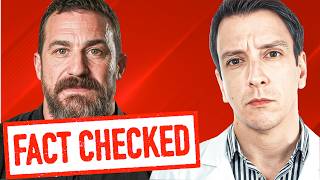

Testosterone supplement from rat studies?
53sReveals a popular testosterone booster has only been tested on rats with toxicity concerns, sparking safety debate.
▶ Play Clip"Delivers exactly what the title promises: a doctor objectively fact-checks Huberman's claims with clear evidence and nuance."
Dr. Andrew Huberman's health claims are scrutinized by a doctor, who evaluates the evidence behind testosterone supplements, cold plunges, caffeine timing, and AG1. The analysis reveals that many popular recommendations lack robust human data or are misrepresented.
Andrew Huberman, a Stanford professor and popular podcaster, has faced criticism. This video objectively examines his most controversial claims.
Huberman recommends Tongkat Ali and Fadogia Agrestis for testosterone. Tongkat has some clinical evidence, but Fadogia was only tested in rats for 5 days, with safety concerns at human-equivalent doses. Anecdotes lack control groups.
Huberman claims cold exposure increases dopamine by 250%, citing a study. However, plasma dopamine does not cross the blood-brain barrier, so it cannot explain mood effects. The study used 1-hour exposures, whereas Huberman recommends 1-5 minutes.
Huberman suggests waiting 90 minutes after waking before caffeine. Researchers argue adenosine clears within minutes, and the theory lacks biological plausibility and evidence.
Huberman promotes AG1 despite weak evidence. A recent trial found no significant benefits over placebo. It costs ~$80-$99/month. Other supplements offer similar nutrients at a fraction of the cost.
Huberman excels at motivating healthy lifestyle changes, but some claims are based on weak or no evidence. Viewers should differentiate strong science from anecdotal or speculative advice.
While Andrew Huberman's content has many evidence-based recommendations, several popular claims—like testosterone supplements, cold plunge dopamine effects, and caffeine delay—lack solid human evidence and may be misleading.
What is the main issue with Huberman's claim about cold exposure increasing dopamine?
The dopamine measured was in plasma, which does not cross the blood-brain barrier, so it cannot explain mood or reward effects associated with brain dopamine.
06:54
How long was the cold exposure in the study Huberman cites for dopamine?
One hour in 14°C water.
12:21
What evidence exists for Fadogia Agrestis increasing testosterone in humans?
None; it was tested only in rats for 5 days, with toxicity seen at higher doses.
01:43
According to researchers, why does delaying caffeine not prevent an afternoon crash?
Adenosine clears within minutes of waking, and caffeine takes time to absorb, so adenosine is already gone before caffeine acts.
14:49
What did the largest randomized trial on AG1 find?
No significant positive changes in blood safety biomarkers or other metrics; it did not negatively impact health either.
18:59
What is the approximate annual cost of AG1 if taken daily?
About $1,000 per year (assuming $80-$99 per month).
19:46
Fadogia lacks human evidence
Key example of a supplement promoted based solely on rat data and anecdotes.
01:43Plasma vs brain dopamine distinction
Highlights a common misinterpretation in science communication.
06:54Caffeine timing theory debunked
Researchers explain why the adenosine logic is biologically flawed.
14:49AG1 cost vs evidence
Expensive supplement with no proven benefit over cheaper alternatives.
19:46Difficulty for viewers to differentiate
Core criticism: blending strong and weak evidence misleads audiences.
21:37[00:00] Dr. Andrew Huberman is a Stanford professor and one of the most famous scientists and podcasters in the world. With over 7 million subscribers on YouTube alone, his podcast racks up millions
[00:14] of regular listeners. But he has been the target of criticism over the years from some scientists and several hit pieces have appeared in the media. Now, to some extent, this is normal. Once you reach a certain level of visibility, you're going to have some haters. And
[00:29] some of the pieces are more about his personal life than anything he does professionally. So, we're not going to get into any of that. I think most people just want to know, is the content reliable or is it bro science? So today we take an objective look at some of Andrew Huberman's most
[00:46] controversial claims spanning caffeine, dopamine, testosterone, cold plunges, the AG1 supplement, and much more. Are the claims based on strong evidence or not so much? First up, testosterone
[01:02] supplements. So Huberman recommends a couple of supplements to boost testosterone with interesting names. Tongkat Ali and Fadogia Agrestis. Now, for people that aren't getting prescribed TRT but want
[01:15] the increase in testosterone, there are these plant compounds like Tongkat Ali and another one which is very interesting. It's a Nigerian shrub called fadogia aggrestis and it mimics luteinizing
[01:27] hormone which is the hormone that comes out of the hypothalamus that stimulates the testes if you got those and your ovaries if you've got those to make more testosterone or estrogen. And so those two herbal supplements together can give a significant boost in free and active testosterone.
[01:43] So, tongkat has some clinical evidence for it, but fadogia was shown to increase testosterone in a study from Nigeria where they gave it to rats for 5 days. As far as I can tell, it's never been
[01:57] tested in human beings or shown to work. He's also talked on different platforms about stories of people who say they took these supplements and their testosterone went up. I think he even talks about his own anecdote, but the problem with anecdotes is always the same. There's no control
[02:11] group. So, we don't really know what's causing what, especially because people are usually taking more than one supplement and there's other things going on. Just hard to tell. Okay. So what, right? So, people can try the supplement for themselves and if it increases their testosterone,
[02:25] great. If it doesn't, they wasted some money, maybe some time. No big deal, right? Well, the other problem with random supplements is safety. Because adverse effects, including serious ones,
[02:37] happen all the time with supplements, including natural supplements. And in fact, in the same rat studies, they show that if you extend the exposure for a few weeks, they see toxicity at the level of
[02:50] the testes, the liver, and the kidneys. the doses at which they start seeing toxicity roughly correspond to the doses that a lot of people are using to supplement Fadogia and some
[03:02] of the doses that Andrew Huberman talks about. Fadogia is usually taken at about 600 milligrams. So when we do the conversion, there's some equations to do this and I ran this real quick. And this 600 milligrams a day dose corresponds roughly to 50 mg per kilo per day in the rats. And
[03:23] that's a dose at which they report toxicity in the rats. Now obviously there's question marks here, biological differences between rats and humans. Maybe it's totally safe in the humans, we don't
[03:35] see the toxicity that we see in the rats. Or maybe we do. That's the point. We don't know. Now, I did notice that Andrew acknowledged on his podcast that we don't really know what happens safety-wise with Fadogia. the side effect profile of Fadogia aggrestis hasn't really been documented. So,
[03:52] it's a little unclear. I just want to emphasize that anytime someone's going to start taking supplements that or modifying sexual hormones, getting blood work done is extremely important.
[04:04] it for safety reasons and also just to know whether or not things are working. So I think that's good to state that caveat. It's better than not doing it. I would still have lots of concerns because what if you have damage somewhere in your body that doesn't show up in the blood work
[04:18] that you happen to run or what if it causes some irreversible damage? So you see something wrong or you feel something wrong, you stop the supplement but it never reverses completely. So this is why in medicine we do things pretty carefully and we don't recommend supplements to millions of people
[04:35] before there are some clinical trials in human beings, right? Just because it worked in rats in Nigeria once and there's some stories from friends, it's not really compelling. And let's not forget we don't know the safety profile, we also don't know the efficacy side, right? It's
[04:51] not like we know that it works we just don't know if it's safe, we don't know either one in human beings. I just want to emphasize guys, Huberman has many other recommendations on testosterone that are based on very strong evidence. So, he talks about maintaining low body fat. He talks
[05:06] about resistance training. He talks about the importance of sleep. He emphasizes lifestyle, that you're going to get most of your results from the basics, a healthy diet and exercise. And these supplements are going to give you maybe a small nudge. So, that's an important clarification. And
[05:22] he does that very clearly. So, I'm not trying to tell you that everything he says is bunk. Not at all. Right? He says lots of things that are solid. This is more random and maybe because it's random, it's become more famous and more controversial and people ask about it. Personally, I wish he would
[05:37] have kept it out, but that's me. By the way, I posted all of this breakdown, everything that I'm talking about in this video on X and I tagged Andrew and I asked him a number of questions and I asked him to comment. I haven't heard back, but if he ever wants to talk about any of this or has
[05:54] different arguments or disagrees or has seen different evidence, happy to chat anytime. Next, cold plunges and dopamine. So, this is another famous one. Andrew often talks about a study
[06:06] where cold exposure increased dopamine levels by 250%. The subjects also experienced a 250% increase in dopamine concentrations. And I do believe that these documented effects in humans
[06:22] explain much of the enhancement of attention and of feelings of well-being and mood that people typically experience after doing deliberate cold exposure. So this is technically true. This is referring to a study where they took 10 young men and they exposed them to baths,
[06:40] water of three different temperatures and the lowest one which was 14° C caused their baseline dopamine level to go up 2.5 times so 250%. But there's a number of problems with the
[06:54] implications here because this level of dopamine was measured in the plasma, in their blood, and dopamine doesn't cross the blood brain barrier. So it doesn't go from the plasma into the brain.
[07:06] So the dopamine that's produced and acts in the brain and the dopamine that's produced in the body and that's in the plasma, we say peripherally, these are two different compartments and they have different physiological functions. This dopamine in the body and the plasma is part
[07:23] of a stress response. So cold is a stressor. It fires up your sympathetic nervous system, kind of your fight or-flight response, and that causes some of these hormones to be produced by
[07:35] your adrenal glands that sit at top your kidneys: adrenaline, noradrenaline, and dopamine. And they have all kinds of physiological functions in the body. They regulate the muscle of the artery
[07:49] walls to contract and dilate. They also regulate kidney function and metabolism in general. So, it's a response to stress in the body. But this is completely different from the actions of dopamine in the central nervous system, which is what we typically associate with dopamine, the reward
[08:06] and the motivation and the pleasure, right? We normally think of dopamine as the pleasure hormone or the pleasure neurotransmitter. To me, it's a huge logical leap to associate these plasma
[08:18] levels of dopamine to these mood effects that we associate with dopamine in the nervous system. Here he is suggesting that connection again. What's interesting about deliberate cold exposure, you know, cold plunge or what have you, is that people generally report feeling very good almost
[08:36] like a mild euphoria for many hours afterwards, elevated focus many hours afterwards. And that maps beautifully onto the I can see those images in the the paper now of the you know the big dopamine increase and the norepinephrine increase and I think it's three graphs set above
[08:50] one another vertically in that paper where I mean this is long arcs of dopamine release way above baseline. Now, alertness and feeling awake after cold exposure, yeah, we would expect
[09:02] that even from the sympathetic nervous system stimulation. But as for any of these mood related, the euphoria, the pleasure, the drive, the motivation that we associate with dopamine in
[09:15] the central nervous system, I wouldn't conclude any of that link from this. And the first time I heard him suggest this, I thought this was too obvious of an oversight, that maybe I'm missing
[09:27] something and somebody would have said something. Turns out somebody did. Professor Steven Quartz, who has researched dopamine, he had a similar reaction, but he worded it much more strongly. He wrote, "These are obviously false and misleading statements. Plasma dopamine, so blood dopamine,
[09:43] cannot be used to infer central dopamine levels." By central, he's talking about central nervous system. Huberman even establishes this parallel between cold exposure and stimuli like nicotine
[09:57] and chocolate and sex and cocaine on the basis that all of them increase dopamine dramatically, like several fold, and even suggests that cold has an advantage because all these other stimuli,
[10:10] the effect on dopamine is transient. So it goes up a lot but it comes down pretty quickly. Whereas with cold he suggests the effect is maintained. Dopamine levels started to rise somewhat slowly
[10:22] and then continue to rise and reach levels as high as 2.5 times above baseline. That's a remarkably high increase. Remember if we go back to our examples of chocolate,
[10:36] sex a doubling above baseline, nicotine two and a half times above baseline, cocaine the increase in dopamine from cold water exposure of this kind was comparable to what one sees from cocaine except,
[10:51] except in this case it wasn't a rise and crash. It was actually a sustained rise in dopamine that took a very long time, up to three hours to come back down to baseline, which is really remarkable.
[11:05] And I think this explains some of the positive mental and physical effects that people report subjectively after doing cold water exposure. Now, I couldn't find the sources for these other claims
[11:18] on his podcast, in the description to the YouTube video or the website, but typically where we see this response, this big spike in dopamine that is transient, these are measurements in the brain of
[11:30] animals in the lab, typically rodents, rats or mice that have micro capillaries implanted into their brain and they're measuring dopamine levels in specific areas of the nervous system like the
[11:43] nuclear accumbens which is a part of the brain that plays an important role for dopaminergic signaling. So this has nothing to do with this paper in humans looking at plasma levels upon
[11:55] exposure to cold, completely different universes. So I think this all came from, there's all these stories of people saying they feel great and they feel euphoric after cold plunges or ice baths or
[12:08] whatever. And then someone found this increase in dopamine upon cold exposure. Ah, dopamine must explain the mood changes. But scientifically, I don't find this argument compelling at all.
[12:21] Another important thing to point out is this study with the cold exposures, they're long exposures, one hour in the cold water, whereas a lot of these protocols for ice baths and cold exposure that
[12:33] people are using are really short. In fact, Huberman recommends really rapid sessions, one to five minute sessions. So again, this has nothing to do with that paper. There's no reason to think that the changes they saw there would be seen with this type of protocol. So if you
[12:50] like ice baths or cold plunges, why not, go for it. And there are other demonstrated benefits. It's anti-inflammatory, speeds up recovery after intense exercise. Athletes use it. So
[13:02] there's other reasons to do it. This argument of the dopamine and the mood and the reward, I don't find it compelling. Next, the caffeine delay. This is one of Huberman's most popular and controversial claims. It's the idea that you want to wait after you wake up for an hour and a
[13:19] half to two hours before you have some caffeine to avoid the afternoon crash. Here he is explaining it. And there's actually a trick to avoid the daytime uh the afternoon crash. It's not a trick, it's biology. Caffeine is an adenosine antagonist. It basically as the longer you're awake, adenosine
[13:36] builds up in your bloodstream. It's what makes you feel fatigued. Caffeine essentially blocks the adenosine receptor, but then when caffeine wears off, the adenosine that's still around binds to that receptor and you crash. You feel really sleepy. So, one thing that you can do is when you
[13:51] wake up in the morning, don't ingest caffeine for the first 90 minutes or so. Like really push that off so that the adenosine and adenosine receptor interactions can all take place and dissipate. Then you drink caffeine. And what you'll find is that if normally you would crash around
[14:05] 2 or 3 in the afternoon, you don't experience that crash anymore because caffeine wears off, make perfect sense. Adenosine makes you tired, makes you sleepy. Caffeine inhibits adenosine.
[14:20] So if we wait a little bit in the morning before we have caffeine, it gives our body time to clear the remaining lingering adenosine so that later on in the day when the caffeine wears off,
[14:32] there's no adenosine around to make us tired in the afternoon. Seems to make perfect sense. But the reality is this is completely speculative and it's never been shown in humans to work this way. And researchers in this field have pointed out the logic he lays out there doesn't even make sense
[14:49] biologically. They write "changes in adenosine upon waking occur on the order of minutes not hours". So adenosine would clear pretty fast upon waking up. And since caffeine takes a while
[15:03] to take effect, it needs to be absorbed in your gut, go into the bloodstream, reach your brain, affect neurons. By that time, all the adenosine would have been cleared out before caffeine is
[15:15] doing anything. The researchers continue, "Any suggestion that adenosine is continuing to decline upon waking demonstrates a lack of understanding of the sleepwake cycle influence on adenosine and
[15:27] would form a poor basis for recommending delaying caffeine for an hour and a half to two hours in the morning". And finally, "a fundamental basis for suggesting that delaying caffeine in the morning prevents an afternoon crash is completely lacking". Now, there's many reasons why someone
[15:45] might feel better delaying caffeine, including just placebo effect and many others. So, just do whatever works for you. If you feel better having caffeine later in the day or not having it, great. Why not? If you feel better having it earlier, right after you wake up, we don't have convincing
[16:02] evidence to tell you that that's a problem. And in fairness, I've seen Huberman recently somewhat moderate or even walk back this claim, maybe as a result of the push back it got. I regret
[16:14] maybe even discussing it for people that crash in the afternoon. Often times, if they delay their caffeine by 60 and 90 minutes in the morning, they will offset some of that. But if you eat a lunch
[16:26] line, I think this one is similar to the dopamine. It's an overclaim, basically an idea that someone had and some stories, some anecdotes just presented confidently as a scientific fact. Not
[16:42] dangerous per se for most people at least, just a little random. And finally, let's look at AG1, the famous or infamous supplement. AG1 stands for Athletic Greens, and it's a
[16:56] sponsor of Huberman's podcast, and it features him pretty prominently on their marketing and it's a green powder supplement and he advertises this supplement in the middle of his podcasts. So, you're watching him talking about some scientific topic and suddenly he's telling you about AG1.
[17:12] Leverage all sorts of aspects of the dopamine system in order to increase your motivation, especially when things get really hard or when you have the propensity to procrastinate, which is something that we'll get into a little bit later in the podcast. I'd like to take a quick break and
[17:26] acknowledge one of our sponsors, Athletic Greens. Athletic Greens, now called AG1. Now, I've never heard him cite any evidence that it works, that it does anything, but he makes all kinds of anecdotal
[17:38] claims that are pretty striking. I discovered AG1 back in 2012, long before I ever had a podcast, and I've been taking it every day since. I find it improves all aspects of my health, my energy, my focus, and I simply feel much better when I take it. Obviously, we understand
[17:53] that this is a script. He's reading from some teleprompter. It's it's a commercial. It's an ad. But I personally, and let me know if you disagree with this, I find this a little distasteful.
[18:05] You're watching a scientist that you trust talking about a scientific topic and suddenly he starts telling you about this supplement he takes and is so great. This comes with a certain implied weight
[18:17] of science and evidence, that he has evaluated it, that he has gone over the evidence and the evidence is compelling, right? Just by nature of who he is, being a professional scientist. But the truth is this has very little evidence to back it up. So I found a couple trials looking at AG1,
[18:34] which is good, let me say first of all, because a lot of these proprietary supplements that are promoted by influencers are never tested in trials in human beings ever. So it's a complete
[18:47] crap shoot. Here the manufacturer, the company, actually bothered to run trials, which is good. And the largest one that I've seen came out last year, recent, 2025. And it's a randomized trial,
[18:59] triple blinded with a placebo control, so robust design. And they followed 120 participants for 3 months. And the title that they chose is "AG1 does not negatively impact blood safety biomarkers",
[19:15] which is true, but it didn't impact them positively either. It didn't do anything. There were no significant changes to any of the metrics they measured. And bear in mind, AG1 is pretty pricey. I looked it up. Seems to be $99 for one pouch, which has 30 servings. So,
[19:33] it' be a month if you take it daily. That's for a single pouch. If you sign up for their monthly subscription ongoing thing, then it comes down to about $80 per pouch per month. So,
[19:46] it's almost $1,000 a year for this one supplement. It's pretty steep. Now, there's another trial that comes close to being a steel man argument. I was thinking, okay, how would you justify this
[19:58] or recommend this? What's the strongest argument we can find? There is one trial where they gave it to people on a poor diet, low in fruits and vegetables, basically a standard western diet. They gave them AG1 and the level in their blood of certain vitamins, vitamin C, folate which is a
[20:15] type of B vitamin, that went up a bit, and their homocysteine levels came down 10% which often happens when you increase B vitamins. So yeah, if you eat a poor diet and you're not down to change
[20:29] that, but you are down to take this supplement, I think it could help get a bit more vitamins, yeah, that's valid, I think. But bear in mind, you could do the same thing with a run-of-the-mill multivitamin and maybe a probiotic, right? You get these in your grocery store for 10 times,
[20:46] 20 times less. But Huberman tells his viewers that he puts AG1 at the top of his list. Whenever I'm asked if I could take just one supplement, what that supplement would be, I always say AG1. So,
[20:58] I don't really understand that, this is your number one? There's so many supplements with stronger evidence, with benefit demonstrated, that are much cheaper. I don't get it. How do you say
[21:10] this is number one? Look, Andrew Huberman is a very charismatic communicator. He's a very good speaker, very fluid speaker, and he has clearly motivated lots of people to live healthier lives,
[21:22] to sleep better, to exercise more, to be fitter, to be leaner, and that's fantastic. That's a great contribution. I think it's unfortunate, and I mean this as constructive criticism, that some of the claims that are peppered in there are based on weak evidence or no evidence sometimes,
[21:37] anecdotes or something in rats or an idea that somebody had. And this makes it really difficult for a viewer to separate. What's strong science, a strong recommendation, what's just a random idea that's never been tested or sometimes the evidence goes against it. A viewer can't tell. And viewers
[21:53] tune in to scientists precisely for us to do that leg work. It's implied that we've done that, right? And can separate the wheat from the chaff. So, in my opinion, Andrew's content is strongest
[22:06] without these exaggerations or more random bits and he has lots of advice that is based on strong science. He has a number of interviews with world-leading scientists. So, I would keep
[22:19] that. I would cherish that and I would be wary of these. For a lot more on the benefits of coffee, check out this previous video. And if you want to see another popular influencer scrutinized,
[22:32] fact checked, check out this video down here. And I'll see you in there.

⚡ Saved you 0h 22m reading this? Transcribe any YouTube video for free — no signup needed.