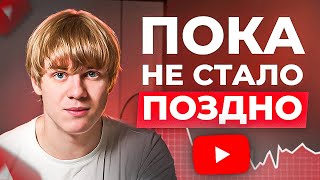

Why Telling Friends Kills Your Channel
45sIt challenges a common instinct and reveals a counterintuitive truth that shocks creators.
▶ Play Clip"Delivers on the promise with a clear argument and personal evidence, though some repetition and self-promotion."
The video argues that sharing your YouTube channel with friends and family early on can harm its growth, as it confuses the algorithm's targeting. The creator shares personal experience and explains YouTube's algorithm stages, advocating for silent, patient growth.
Sending videos to friends and family for support often leads to channel death because these viewers are not the target audience and their engagement misleads the algorithm.
YouTube is a commercial platform that prioritizes keeping viewers on the platform to generate ad revenue, not the creator's personal investment.
YouTube needs time to analyze a channel's content, audience, and performance to find the target audience, which is a gradual process.
Success on YouTube is measured by views, not praise. Sharing with friends gives praise but not relevant views, hindering growth.
The creator's experiment showed that a channel promoted externally failed, while a silent, quality channel reached monetization in a month, earning $1,000-$4,200 monthly.
The algorithm works in stages: testing, clarification, consolidation, and scaling, each refining the target audience and promotion.
Non-target viewers from sharing disrupt the testing stage, preventing proper audience identification and slowing organic growth.
YouTube's silence is a test of commitment; patience through the early no-views stage leads to eventual success.
Like a miner who gives up before striking diamonds, many creators quit early; persistence is key.
The video concludes that keeping your channel private initially allows YouTube to find the right audience organically, leading to sustainable growth and monetization.
What is the main reason sharing your channel with friends early can kill it?
Friends are not the target audience, so their engagement confuses the algorithm and prevents proper testing.
00:01
What is YouTube's primary goal as a commercial platform?
To keep viewers on the platform to generate ad revenue.
01:20
What are the four stages of YouTube's algorithm?
Testing, clarification, consolidation, and scaling.
05:30
What was the result of the creator's experiment with two channels?
The externally promoted channel failed, while the silent channel reached monetization in a month and earned $1,000-$4,200 monthly.
04:25
What does YouTube's silence in the early stages represent?
A test of the creator's seriousness and commitment.
07:42
Views over Praise
Contrasts the desire for support with the algorithm's reward for relevant views.
03:14Silent Channel Success
Demonstrates the effectiveness of not sharing, with concrete income figures.
04:25Algorithm Stages
Provides a clear framework for understanding how YouTube promotes content.
05:30Miner Analogy
A motivational metaphor for persistence in content creation.
08:08[00:01] n't work out. So you want to get quick support from friends, family, colleagues, and loved ones, and you send them your videos for approval, in return receiving words from them that you're awesome and a like under the video. And it seems that
[00:14] this is the right way, to show your loved ones that you have started. But the irony is that it is from this moment that most channels die. There are no bad videos, no algorithms, but from the desire to be understood by those who will never be able to
[00:26] understand us [music]. And if you've already told your friends about your channel and sent them a link to it, you might have taken the first step toward burying it. I've been through this myself . 6 years ago I created my first channel, put my heart and soul into it and the
[00:39] friends. And the icing on the cake were the Instagram and Facebook accounts where I promoted my videos and spam- ed them to everyone. I felt like the more people knew and saw me, the better. How wrong I was. After just
[00:53] completely stopped showing and recommending my videos. Then I started getting working, that I was shadowbanned, that the platform wasn't promoting channels at all, although the problem was with me and only with my actions. After all, I was trying to force
[01:07] YouTube to like my content. And this video is about why you shouldn't show your YouTube channel to anyone, especially at first. To discuss this fully, let's dig a little deeper. What is
[01:20] YouTube anyway? YouTube is a commercial platform that, interestingly, strictly makes money from its creators. It doesn’t matter to him at all whether we put our soul into our videos or just make them like a conveyor belt. The most important thing for him is that our content keeps
[01:33] the viewer on the platform. That is, the longer a viewer spends on YouTube, the TikTok, or anywhere else. And, accordingly, the more ads he watches, and therefore brings more money to YouTube. From here we draw the
[01:45] simplest, most logical conclusion. The longer a channel keeps a viewer on the platform, the more it will earn and the more motivated the algorithm will be to promote it in the future. But we can't force the algorithm to
[01:57] promote our videos. At first, we need to make him understand that we are interesting, that the audience loves us and wants to watch us all the time. And in the most extreme cases, this happens with the snap of a finger and very quickly. Typically, this takes a
[02:10] certain amount of time. When we create a channel and start making videos on YouTube, it’s important to understand who we are, what we’re about, who we’re for, who our target audience is, and what audience we need to promote to. And this is not a quick process. It
[02:23] does a huge amount of analysis, including how often we upload, what time we post, what ideas we have, what covers we have, how we design our videos, and everything that affects our performance. And once he finds
[02:36] our target audience, he starts recommending us more and more. And because of how people behave with our videos, they judge how widely to promote us further. And now let's remember our friends, colleagues and parents. Teli are
[02:49] people who are the target audience in our niche. Most likely not. And we send our videos to them with a thirst for some kind of support and confuse the algorithm. And the biggest problem is that, as a rule, at the
[03:01] start we think about support, and not about the result. It's hard for us to start in silence, and we're ready to trade future success for seven warm words of support right now. And on YouTube, it’s not the one who gets the most praise that wins, but the one who gets the
[03:14] most views. And these are two different things. And let's imagine [music] two channels. stable content at the level of competitors, or even higher than them. But after uploading his first videos, he went and shared them with his classmates,
[03:29] friend, who, purely out of respect, watched the video to the end and even clicked the like button. The second example is also a channel that does great work at the same level of quality and style as its competitors, but doesn't tell anyone about its
[03:43] argue about which channel will advance faster, but here everything is obvious. A channel that does a lot and says little about it will always [music] be ahead. And Channel One author watched his video to the end and liked it. When he sees the
[03:59] unlikely to click on it because he is not the target viewer. And I've right, with the right approach, budget, category plan, and the right approach to connections, but they made one key
[04:13] mistake, telling everyone, which became fatal for their channels. That's why YouTube first tests our content on hundreds of people, then on thousands, then on tens of thousands, and so on without a ceiling. It finds your target
[04:25] views if you do everything right. And I even did experiments for myself . One channel launched across all YouTube channels, did everything correctly, but promoted it in various messengers, social networks, and public pages. The second channel was
[04:38] not of such high quality, but it was broadcast [music] silently. And what do you think? As a result, after a couple of months, I abandoned Channel One simply because it had absolutely no views. Simply because YouTube couldn't even
[04:50] driving views onto it from who knows where. And the second channel reached the monetization target in just a month and began to bring me a stable income. First month $1,000, second $2,500, third $4,200. And as a result, it became my
[05:03] brainchild, which fed me for the next few years. In total, I made this amount from it. So I made a full-fledged instruction, where I broke down into specific steps everything I point where I am now, and I decided to make this video free. It
[05:17] hint in the upper right corner. And now you know what to do after watching this video. Now let's take a deeper look at how the YouTube algorithm works channels. YouTube's algorithms aren't just
[05:30] recommendations; they're one of the smartest and most interesting systems in the world. After all, it is divided into several [music] stages. The first is testing. YouTube starts pushing our video to a small audience and watches how they interact
[05:42] with our content. Who clicks, who exits, some segment of the audience, these are children, women or pensioners. Using a small sample of people, he draws conclusions about who our content is most suitable for. And at this stage, we can help him most with
[05:55] our optimization, title, description, tags, and everything else we let YouTube know about us. The second stage is clarification. After the initial tests, YouTube tries to confirm whether it has correctly understood who our target
[06:07] audience is and begins to push our videos to the same audience, concluding that either it was right or it is making adjustments to subsequent recommendations. The third stage is consolidation, when he understands exactly
[06:20] show us more and more to such viewers. We look at how much they stick to the content and how they interact with it , how involved and deeply they watch it, whether they click on our channel again, whether they watch the subsequent
[06:33] convinced that he's found the right audience and that our content is truly interesting to them, he moves on to the fourth stage - scaling. He starts to massively push our videos into recommendations for the audience [music]
[06:46] content and that gives us high retention. And all these four stages are do everything right. And how to do it correctly, again, I explained in the instructions at the link in the description. And now the most important thing. Imagine if,
[07:00] in all four stages, during the first stage of testing, we threw a bunch of people onto our channel unrelated to our content, who watched us from beginning to end simply to please us and were not even our target viewer. This
[07:15] prevents YouTube from conducting proper testing, which complicates and slows down the promotion of our channel. But if we allow YouTube to generate pure statistics, then this leads to the very organic growth that we all
[07:29] love so much and that YouTube provides after a certain amount of time after the channel’s launch. So why do we share our channels anyway? Why do we want to everything right? Why do we want to see support from someone, to hear some
[07:42] silence. But the most important thing to understand here is that YouTube's silence is a test of how serious our intentions are. If we are patient and endure the moment when we see nothing on our channel and go through the stage when no one is
[07:56] when we have a million views on each video . And if you uploaded the first 30 videos without a task, then you are already a winner, because 99% of channel creators give up early. And here
[08:08] we see the very same image of a miner who is about to dig up diamonds, but gives up and decides not to make the final strike. And every time I want to give up, I remember that miner and put myself in his place and I understand that
[08:20] no, I need to strike, I need to finish what I started. And as a result, now I am in my place and have my results. And the most important thing is that we only work with people who have the right mindset, the right approach to
[08:32] YouTube, because without this there is no point in even starting. And the best thing you can do for yourself right now is to decide not to tell anyone about your channel in the early stages and play for the long haul. And if you want YouTube to
[08:44] become a full-fledged business for the next few years of your life, then grab without holding back, tell you everything I did to achieve my result. And remember, YouTube rewards not those who make noise,
[08:57] but those who do it right. And if you've watched this far, you're one of watched this far, you're one of them. See you at the top of YouTube. Yeah.



⚡ Saved you 0h 09m reading this? Transcribe any YouTube video for free — no signup needed.