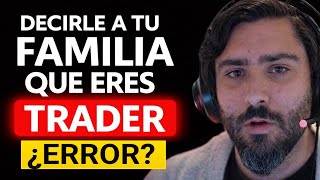

Should You Tell Your Family You Trade?
45sThis directly addresses a common dilemma for traders, creating an instant connection and curiosity.
▶ Play Clip"Delivers on the promise of discussing whether to tell family, but padded with personal anecdotes and repetition."
The video discusses the dilemma of whether traders should tell their family and friends about their trading activities. The speaker, drawing from personal experience and psychology sessions, argues that while privacy is wise, hiding trading out of fear of judgment leads to isolation, frustration, and destructive cycles. He emphasizes the importance of assertive communication, setting boundaries, and creating a structured monthly update to reduce uncertainty and maintain healthy relationships.
Traders often struggle with whether to tell their family about their trading activities, fearing judgment and misunderstanding. The speaker recalls his own experience of being afraid that his family would think he was losing his mind or being brainwashed.
Many traders choose to suffer in silence, hiding their emotional pain and frustrations, which leads to isolation and a lack of support. This approach is compared to being a 'samurai' or 'lone wolf'.
The speaker distinguishes between privacy (a positive, cautious approach) and avoidance (hiding out of fear of judgment). Privacy is smart and allows gradual disclosure, while avoidance leads to a feedback loop of frustration and misunderstanding.
Family members worry because they see traders becoming obsessed, isolated, and speaking a different language. The speaker urges traders to be empathetic and understand that from the family's perspective, trading looks like a dangerous obsession.
Without explanation, success is seen as luck (like a lottery win), and losses are seen as gambling addiction. This lack of understanding leads to frustration and a lack of realistic external validation.
Most traders explain trading to their families in the wrong way, from a perspective of overconfidence and arrogance. They criticize others for being in the 'rat race' and create a pedantic, unpleasant discourse that alienates their environment.
When traders publicly commit to trading, their self-esteem becomes tied to results. This creates cognitive dissonance and leads to irrational decisions, as they cannot afford to take losses or admit failure.
Traders often project their own fears and insecurities onto others, believing that their family sees them as failures. The speaker shares a case where a trader's perception of his wife's thoughts was false; she was actually proud of him.
Without communication, family members create their own narratives to explain the trader's mood swings and behavior, leading to marital problems and deteriorating relationships. Uncertainty breeds fear and emotional actions.
The speaker advises traders to tell their families assertively, explaining what trading is, that it's a profession with risks and rewards, and that they have a plan B. This reduces uncertainty and helps family understand.
To manage family's constant questions, the speaker recommends having a monthly meeting (e.g., over dinner) to give a structured update on trading results. This creates a pattern and reduces daily pressure.
Having at least one person who understands you is crucial for long-term survival in trading. It provides comfort during tough times and amplifies the joy of success, making the journey more bearable.
The speaker concludes that while it's natural to fear judgment, hiding trading from loved ones leads to isolation and frustration. The key is to communicate assertively, set boundaries, and create a structured update system to maintain healthy relationships and reduce uncertainty. Ultimately, having support is vital for a trader's long-term success.
What is the difference between privacy and avoidance in the context of telling family about trading?
Privacy is a positive, cautious approach where you know it's a real profession and gradually explain it. Avoidance is hiding out of fear of judgment, which leads to frustration and isolation.
03:35
What is 'performance-conditioned identity'?
It's when your self-esteem is based on results: if you win, you're valuable; if you lose, you're a failure. This leads to irrational decisions and fear of taking losses.
16:36
What is 'second-order thinking' in the context of trading?
It's projecting your own fears and insecurities onto others, believing they see you as a failure, when in reality they may be proud of you.
19:43
What is the recommended frequency for updating family on trading results?
Once a month, at a specific time, to create a pattern and reduce daily pressure.
27:32
Why do family members worry about traders?
They see traders becoming obsessed, isolated, and speaking a different language, which looks like a dangerous obsession.
05:08
Privacy vs. Avoidance
Clearly distinguishes between healthy privacy and harmful avoidance, a key insight for traders.
03:35Performance-Conditioned Identity
Explains a psychological concept that can ruin a trader's career if not recognized.
16:36Second-Order Thinking
Illustrates how traders project their own fears onto others, leading to unnecessary stress.
19:43Monthly Updates as a Control Mechanism
Provides a practical, actionable solution to manage family's constant questions.
27:32The Importance of Support
Emphasizes that having at least one understanding person is crucial for long-term survival.
29:34[00:02] trader should ask themselves at some point , although few say it out loud . Should I tell my family that I trade, or should I keep quiet about it? I remember many years ago and I had to decide whether to tell my closest circle or not
[00:16] afraid of thinking that they wouldn't understand me, that they would think I was losing my mind , that I don't know, that maybe I had been kidnapped by some kind of brainwashed me into thinking that I was going to give up everything, my studies, my job,
[00:31] everything, my studies, my job, my life to dedicate myself to the stock market, right? At that time, I remember that the view from my environment and the people I knew of what trading and investing was was more like a
[00:43] casino, right? Like a place made for gambling addicts, for people who I don't know gambling addicts, for people who I don't know want strong emotions, and the truth is judge me from the outside, so I understand what many of
[00:55] you feel. I know you're afraid of being judged, I know you're afraid that the pressure will increase to produce results to prove to your environment that you are worthy, right? You're not really the
[01:08] failed, mediocre person that you unfortunately think others believe you are all of this, won't we? It's about how we see ourselves, how others see us , the fears we have, and how we project them onto those around us
[01:21] when they are not actually there. But I understand that point that many of you are at, because I do it daily in psychology sessions and that terrifies you take the path, the final decision, to keep quiet about this, to do it
[01:35] as if you were a samurai, right? Like a lone wolf. Hey, swallow all your emotional pain, your fears, your frustration to yourselves and you 're in front of screens
[01:47] your life, the lives of those around you, in silence, right? And putting up with others asking you every day, telling you every day whether you win or lose, with your friends, the know-it-alls, telling you how the stock market works, right? How's that little
[02:01] game you guys are playing with the graphics going? I really understand that, I've been through it . Um, I think a lot of people are very unfair to us as traders when it comes to doing this, because this is an entrepreneurial activity, right?
[02:14] At least here in Spain, entrepreneurship is severely penalized, isn't it? And many people the State, working for a company, or on someone else's account. And when you see make a decision like trading, most people don't understand it and are
[02:28] decision, right? No, very few people support you. So I want to start this video about whether telling [music] that we are traders to our family and our environment is a right thing or not, whether it is a necessary thing or not. Uh, [music]
[02:41] laying the groundwork on the fact that I know this is difficult, I know that our, in general, environment isn't the best for receiving what we need as traders, uh, but still, uh, I want to talk about it. I'll do it the
[02:54] way you see, with minimal editing. There are some things I have written down here that I want to tell you. Okay, I'm going to tell you things that you probably won't like, things that will will offend you, because you probably think the opposite, but that's what
[03:07] wanted to hear, I would do it regularly, and I rarely do, right? So, let's talk about whether it's really necessary, talk to our family, to really explain to them what we do, or if it's better to
[03:21] go through all this alone, in silence, crossing our fingers that in the end the result will come. Okay. Let's lay some groundwork for this first, shall we? For me, there's a fundamental error in whether or not to tell your family and friends that you
[03:35] trade. And the thing is, we have to confuse privacy with the fact inner world, right? And carry this somewhat alone to protect yourself from external opinions and stares with
[03:48] distinct concepts that I want you to keep in mind. Privacy is one thing , and it's positive that you want to proceed cautiously and not get carried be millionaires, as I'll explain now that many do. And the other is
[04:02] avoiding the judgment of others for fear of what they ca n't say to you, right? When you make the decision to keep it to yourself for privacy reasons, it means you know this is something professional, a real profession,
[04:14] that you have no prejudices about it, you're not afraid of what people might say, but you prefer to proceed cautiously, step by step, and explain it to your environment gradually as you see that you are becoming more and more
[04:26] I think that privacy is smart at first and can save you to state the obvious, is that many traders I meet in the sessions
[04:38] avoid—no, not again— telling your family that you are traders because you think that they will criticize you, judge you, not reject you, right? They're going to point you out. And that avoidance never leads to anything
[04:54] positive; it always leads to a feedback loop. There because they are genuinely concerned about you your environment, they don't want harm for you in general, and therefore their
[05:08] someone else's shoes. Imagine that you see a family member of yours, a son, a brother, a father, a husband, a whatever, right? A friend who stock market, charts, whether it's shoulders, head and shoulders, double bottoms,
[05:23] fair value gaps, is starting to speak in a different language, is becoming less and less interested in traditional life, does less and less that used to make him happy, doesn't feel like watching series or movies as much, is
[05:36] screens, comes home from work or studies, opens his screens, locks himself in his room, in his office and spends hours and hours in silence with himself. looking at those screens. There are fewer and fewer conversations like the ones we used to have
[05:50] . You see him becoming more and more taciturn, more stubborn, more immersed in a world you don't understand. I wouldn't really worry you, I family member like that, whatever the reason, it does
[06:03] any other kind of activity, so be a little empathetic with your environment and understand that from their perspective, from their vision, what they see of us is seeing. They are seeing something that is out of the ordinary, out of the ordinary, and
[06:18] as obsessive as this, because we have all become an activity that awakens that obsession. So, first let's put this on the table and understand that when you don't explain to those around you what you
[06:31] 're doing as a trader out of avoidance, to avoid that judgment, what you 're actually achieving is accumulating daily frustration. Because when everything is going well for you, which I hope it will , when you start winning, you won't
[06:44] because they won't understand, because they'll think you're deceiving them, that you're that's not the reality, right? You won't be able to maintain it, because they don't that increases your frustration because you won't be able to share
[06:59] the fruit of your sacrifice and effort with anyone, the music, as you deserve, so that they can because I've really seen it,
[07:13] job if you don't explain to them what you do when you earn a lot of money. They value it as if it were, I do n't know, a lottery prize, for example, or as if you went to bingo and won the jackpot. When you explain trading to educated about it, and you don't explain that it's a
[07:26] appreciate the effort and sacrifice point. Because you haven't explained it to them, they'll think you've had a stroke of luck, and that's very frustrating. But on the other hand, which is more likely when you
[07:38] when you're suffering emotional pain that only traders know, if you don't explain it, if you haven't had time to educate those around you, your husband, about what you're doing, what they're going to think is that this is a
[07:52] game, that they're going to think you're addicted to roulette or some kind of dangerous activity that's going to make you a junkie of the markets, money, losing the family's money. You're already losing money that you could spend on
[08:07] taking care of your children or taking your friends out to dinner, I don't know, I mean, in the only the losses, the negative consequences, without understanding the whole process Therefore, apart from that frustration, you're not getting
[08:22] realistic external validation. You are having a completely wrong correctly conveyed what you are doing. Therefore, as I have said, little by little I have seen many traders who isolate themselves from their
[08:36] environment, who each time try to convey that and see that the reception they get from their environment is not what they expect. When they lose, they explain it to them and understanding. When they win, they explain it happily, and instead of
[08:49] lose it." Since there's no communication, it's like a breakdown because they don't understand what you're doing, and you don't understand that frustrates you more, isolates you more, they worry, and it's a destructive cycle, like
[09:03] a fish chasing its tail, that will lead you to total those two worlds separate, the more time passes, the harder it is to sustain it and eventually Think about it: on one side we have the real world, the traditional world where
[09:17] everyone lives, and then there are us traders in front of the charts. I know this is a bit paranoid, but believe me, I think it's a pretty easy way to visualize it. It's like us living in the Matrix and then seeing
[09:30] When you try to explain to people what's in the Matrix, in this case what show them what you actually do, and therefore, there is an ever- worlds. Believe me, it's very difficult to
[09:42] let's be clear, okay? As I've said, I'm going to tell you things that we're going to terrible ego problem here. Most of the traders I meet, when they explain to me whether or not they should tell their families about this, are very angry because their families don't understand them, and we get into a
[09:55] loop, right?, of wishing they had never explained to their families that etc., etc. What they don't want to accept is that their ego is excessive and that most traders who explain this to their environment, to their
[10:09] friends, to their family, do it in the wrong way. I'm sure many of you have done it because I think that out of 100% of the people I've met like this, 95% must be doing it this way which is wrong.
[10:22] You do it from a perspective of over-guarantee. You start in trading by watching some video or I don't know, uh, reading some book, uh, especially books that are quite unreliable in terms of what it means to do trading, and whether it's
[10:35] kinds of books that open your mind, right?, with respect to what society means, the rat race, uh, to flee, from the wheel, right?, from the industry, from the world. You know, you know what I mean because we've all been through
[10:48] it, right? You see someone who awakens you, makes something click, and from be part of the traditional world, you no longer understand work as you and you see a different reality that others do not see. At that moment when
[11:03] trading crosses your path, your life, instead of doing it in a professional way, as I said at the beginning, in a calm way, seeking privacy and with caution, right? saying, "Hey, I'm going to
[11:15] analyze it, I'm going to explain it to my surroundings, hey, look, I've discovered this, I there, I think it's probabilistic." And by gradually building a narrative about what it means to be a trader correctly, what most
[11:29] people do is... get cocky, right? And then you start criticizing others, criticizing what they are, saying they are very mediocre for continuing in the rat race, saying they have money game, that nobody becomes a millionaire working for others, that what you have to do
[11:43] is invest and trade and so on, and you start to have a very pedantic, very unpleasant discourse for your environment, which becomes tiresome, really, it becomes very, I tell you from the heart, among traders and among friends of
[11:57] some kind of social networks that we are, eh, because we have been through place too when I first learned about trading 12 years ago, and I thought I was going to conquer the world, in a truly crazy way, right? And in the end, that doesn't
[12:10] n't win at trading, I'm not saying that." I believe it has been proven that this is not the case. Obviously, you can make a living from trading. Well, obviously you can dollars with trading, and trading can truly change your life. I'm not
[12:23] talking about that. I'm talking about how before we can achieve that, before we can achieve real results, we need to calm down, proceed with caution, be humble, and not step too deeply into our neighbor's yard
[12:36] constantly surrounded by friends, instead of talking about movies, series, books, food, restaurants, or sports, we end up talking about whether the S&P 500 is at its peak, whether gold is going to
[12:50] retrace and then rise again, and whether it's the best safe haven in the world because Instead of having everyday conversations like you towards one that is much more annoying in terms of judging others, right? You start
[13:05] saying that it makes no sense to buy real estate, and that do is live in rented accommodation and invest in parallel, that what you're saying is that it makes no sense to work for others. Uh, when
[13:17] start businesses and trade and want to accumulate wealth, you start judging and , as I say, right? Too much arrogance. Uh, this excessive, unbridled ego that we, those of us brought in at the beginning, have when
[13:32] we somehow discover that there is an alternative to traditional life, breeding ground in our environment where they begin to see us with putting that vision of ourselves onto them. Most of us do that, and
[13:47] have done it, and you do it, but on top of that, your family, your friends have seen, encountered, have seen—I don't want to trouble either, but understand me— people who say they are traders, who
[14:02] sell courses, who appear in constant advertisements telling you that you are going to be rich against the trader, so what you are saying is combined with, and also in a what they see on social networks, on TV, etc., they create for themselves
[14:17] a narrative that makes them repudiate and reject the idea of the trader. So you're already starting off negatively about what people are going to see from yourselves. They're not viewing trading as a profession like saying, "Hey, I'm going to be an engineer or an
[14:30] with completely different eyes that are already tainted with those prejudices that you yourself have created, because of how you speak, how you change, how you also because of what they see in others who
[14:44] present themselves with respect to trading. So , I repeat, let's understand the context in order to then also understand and be able to empathize with our family not giving us problems for being traders, because they do it out of love
[14:57] but most people worry about us because that's why they're there, because they care, they love us and it's normal that if we put these factors together, there will be enough, that this doesn't make sense. At that point, when you start to
[15:12] talk too much, right? Being a little too bold and hasty in saying you know what you're talking about will get to that point, but at that moment, half, two years, and you still have no idea what you're talking about, you don't know what
[15:26] euro from trading, you can't go around saying that working for others is a mistake, nor can you judge others for
[15:39] and it's respectable, but you don't have to express it in a derogatory way towards others, because when you do that you're somehow creating an From that moment on, if you are unsuccessful, the mental catastrophe of ego,
[15:55] is so great that it scares anyone, even a dragon. He would be scared by something like that because you've created a kind of totem of what you can become, of what you're going to achieve, and if that goal isn't achieved, and the
[16:10] looks that are going to be seen, let's say the risk of being judged and how you're going to deal with that is so great, so great, that nobody can withstand that pressure, nobody. And that's already starting off on the wrong foot, with the
[16:23] wrong foot in trading, because if this is already difficult in itself, because it is an also do it with such extreme pressure from the outside, the probability of success, of surviving long enough to be able to get results, disappears. This is what
[16:36] in psychology is called performance-conditioned identity. In other words, your worth, your self-esteem from that moment on is based on whether I win, I am valuable. If I lose, I'm a failure. So from now on you're not just
[16:49] you're managing the risk to your self-esteem. At that moment, when you create that public commitment, the mechanism that is created there is very powerful, because your brain creates a kind of need to avoid what
[17:04] is known as cognitive dissonance, okay? In other words, there's one side of you shown yourself to be, and another side is what you 're actually achieving. So you start irrational decisions, even if you have a plan, even if you study a strategy,
[17:18] n't think you're more special than others, because everyone same thing, everyone does the same thing, the sacrifice is the same in most external condition, excuse me, an extra condition, a handicap. And that
[17:30] n't afford to take losses when you should, because you can't afford to prove that what you're doing for so many hours in front of the screen risk when you lose because you have to recover, you can't stay in
[17:44] losses because then you would be like proving them right, giving credence common problem related to whether or not to tell the idea that you know more than you actually do. As I was
[17:57] saying, it's so typical to see that many traders in their early years think they know everything because they've studied four, I mean, four little books or watched 100 videos about order blocks, surviving value gaps, about
[18:10] double tops, about volume profile, about, I don't know, order flow, I don't care , really, traders, come down a little from the pedestal you think you're on but not so much because of the literature that exists about it, not so much because of the
[18:24] anyone in the world can study trading and after a few months something fantastic that you should be proud of; it's part of the process, and the real difficulty isn't there, but it creates an illusion of competence.
[18:37] others and you always believe that you sacrifice more than others, that you work harder than others, that by dedicating one weekend a month to drinks, you are already better than them. Uh, that, that again, that false sense
[18:52] of self-worth because of the result, because again, the society we perform at our best constantly, that we have to work when others are sleeping, that we have to get up at 5 in the
[19:04] That type of narrative, which is very dangerous, makes us create a vision of ourselves that is unrealistic, unsustainable, it cannot be sustained for a short time or a long time, it's like, "it's going to fall at some point, you're going to fall
[19:17] defeated at some point and that's okay , it's normal to fail, it's normal that there will be a moment when you fall and that you need people to pick you up." Hey, don't you need a hand to pull you out of the pit you're going to be in, if you haven't
[19:30] not going to get that hand because you yourself have worked on that whole narrative of believing in yourself, of being a superhero, which is false. Finally, as a last concept that occurs in the matter of communicating this to your
[19:43] second-order thinking. And the fact is that most of us, as traders and as human beings, put thoughts into the heads of others that are not real, thoughts that we have about
[19:55] ourselves, but that they do not have. I remember a case of a trader, time, who was terrified of explaining to his wife what he was doing, because he always told me the same thing: "My wife thinks I'm a
[20:08] failure, my wife thinks I'm worthless , my wife thinks I'm lazy." He always had a very negative discourse about how his wife saw him . And it surprised me because I thought, wow, and you've been doing this for years,
[20:22] how do you put up with something like that , right? a day-to-day life in a relationship is constantly judging you as after much investigation, after saying, "Hey, tell your wife to come to
[20:36] this," the truth is that his perception of what his wife thought was false. It was him inside his wife's head, projecting himself into her mind, , but his own. His fear of being
[20:52] thinking he wasn't good enough, was so great that he projected that vision onto her mind, when in reality she was worried about him. She capable, that he had always sacrificed a great deal, that he had
[21:06] proud of him, but he wasn't able to communicate this to her, to tell her, or to open up because he was afraid she would see him the way he saw himself. And that, that second-order thinking, is very typical in trading. We think that
[21:19] Our friends will see us as failures if we don't succeed, they'll see us as gambling addicts if they see us working with charts. We seen in the eyes of others. And that self-perception
[21:31] is unfair, because we're unfair to ourselves. traders, are very demanding, very perfectionistic. We have too much, we than others demand of us, but we project that onto other people's minds
[21:45] worldview that we believe exists, but it's not reality. The world isn't as we believe it to be, thankfully. And therefore, it's communication so you can ask people how they see you
[21:58] , so you have a realistic picture of who you are. No, don't create of who you are, but ask others and build that want to say all this because it's natural for your family, your environment, to criticize what you
[22:12] protection, it's a survival instinct. If you connect all the said, this is improvised, I have some things here, right?—I my head when, after so many hours of talking to traders who are going through this
[22:27] see you in front of the screen for many hours alone. They see that How many of you, like me—it happens to all of us, one day you're day you're bitter, frustrated,
[22:40] depressed, and then suddenly you're proud? That emotional rollercoaster, that kind of rollercoaster that we traders go through in our identity as traders and our results, is very frustrating for
[22:53] others. Because how do you explain it to them if you don't tell them? What you do to your wife or husband, for example, and every day they see you arguing, you're more tense, more irritable, one day you're happy and they don't know why, or they do
[23:06] n't know what happened to make you happy. Another happy, you're sad and angry, when nothing has happened. This can create marital
[23:18] problems, as I've seen with many people, because the doing, who doesn't know why you're suffering or why you're happy, wonder, "Hey, is he angry because of me?" Will he be happy because I did it
[23:31] for someone other than myself? Hey, what's going on there that has anything to do that you are the protagonists of your own life, but you also have co-stars in it. And therefore, those co-stars are also part of your
[23:44] influenced by what you feel. If you don't explain what you're doing correctly, it's very likely that they'll start to distort reality because they lack information. And when there is uncertainty, it leads to
[23:57] when there is uncertainty, it leads to fear, and fear to paralysis, and emotional and hasty actions. So, if you don't explain to him what probability, that it's an exercise in mathematics, in risk management, that it
[24:10] hours, many headaches, but that it has a very positive reward and that you're trying with all your might, against you, because that's what the numbers say. If you don't put those pieces on the table
[24:23] 're doing, they're going to start creating their own narratives, they're going to create their own movie of saying, "Okay, so he's angry because of whatever, because of whatever that person feels like that day , huh? Or you're happy because of
[24:35] have no control over their truth. Her truth is hers and she will create it from what she feels or what he feels, from what she sees or what he perceives from you, from what you project, not from what you
[24:48] believe me, it's dangerous for maintaining a healthy family and social life. You're losing control, and as traders, we should be afraid of that. Hey, you're losing control over your family life. Trading is already
[25:02] constant uncertainty, it's variance, it's the fear of not being able to control things lose, you do everything wrong and you win. That's already incredibly difficult. If, in addition to that environment of uncertainty, you allow that uncertainty to spread to your
[25:17] daily life, causing your children, your environment, your family to begin to be created uncertainty about how you are, who you are, what is happening to you, you will be constantly surrounded by uncertainty and uncertainty never
[25:30] leads to anything good. All of this makes you more isolated. All of this makes you constantly lonely, thinking only about trading, about the stock market, losing the ability to communicate, losing the ability to relate to others,
[25:43] your relationships begin to deteriorate, marriages break down, fathers and mothers argue with their children because they really don't know what to advice in this case as a trader, after explaining all this to you, everything, and
[25:57] giving you this context that I've seen many times, is that you absolutely must that you trade as soon as possible, but do it assertively. Explain it to them without them needing to understand what
[26:10] have problems in their daily lives; they already have their own lives, needs, their minds are elsewhere. Don't put any more load on them. You protagonist of this story for everyone . So, be humble,
[26:24] just share what's necessary, explain to them what trading is, portrays it. Explain to him that you want to do this because you believe the risk taken is worth the potential benefit. Give them information so they understand
[26:37] more or less what you're doing, that it's not a game, that this isn't a in an arcade, that you're real profession that allows people to make a living from it, so that if you're
[26:50] enough, you can have an incredible life, and if not, it's not the end of the world because you'll have your plan B, your safety net, so there is n't a financially, mentally, or in your family life. But above all, try to
[27:03] try to reduce uncertainty because I know that what bothers most traders is that every day your family and friends ask you, "How are you doing?" Hey, how are you doing ? Do you have any results yet? Did you win
[27:16] today? Have you lost? That kind of insistence is because they don't have control, they do it however it comes out, however it comes to them emotionally. Therefore, you have to of control. And for that, what I recommend is that each month you have a
[27:32] person, with those people, at a dinner, want, sit down with those people and explain to them that on that specific day is when you are going to open up your world as traders to them. For an hour or half an
[27:45] has gone well for me, this month has gone badly for me, this happened, that happened. In half an hour, which isn't much of a mental burden for them, you can give them a little update on how you're doing. That will happen if you do it consecutively, the
[27:57] same thing every month; you create an order in their behavior pattern ask you that month. They'll start asking us every single day. At first, they will, you explain the same thing every month, at the same time, in the same way, little by little they'll realize
[28:10] that there's no danger, that everything is under control, and their because they'll know that they simply have to wait for the month to arrive, you'll give you their advice and follow it. You take the burden off their shoulders
[28:24] and off your own. So, in order to try to family may be putting on you, which I understand, you have to be the ones to you have control over your decisions. You will explain
[28:38] and organized manner at a specific time each month, as if it were part of your job as traders. In this way, when you this month I went through a period of losses, that's what he told me, a few
[28:51] days ago, as you saw, a little off, then I gained a little more, I was on it and say, "Ah, yes, that's true." You 're giving him an emotional plan in a way when I'm unstable, I'm not unstable. I'm really unstable because of
[29:05] this, because of that, and because I have no control over my emotions." You take away the you guys." As you can see, this happened to me, that happened to me . When it's something that's in this way you will separate what has to do with the world of trading from the
[29:19] learn that language, they will understand how your mind works, how leave you in peace. Finally, believe me, if you do this right, if you create an effective, healthy, two-way communication channel, when you have to
[29:34] when you've had a sleepless night staring at the ceiling, like we've all done, like, you made mistakes and you can't stop beating yourself up, in those trader's long- term survival, having someone who understands you,
[29:49] even if it's just one person, will allow you to survive over one more day in this business carries a greater probability of success. When you need someone to lean on and comfort you, when you're doubting
[30:02] confidence and boost your self-esteem, that person needs to be there. If you do it alone, you'll sink into the misery of thinking that you're that, hey, how is it possible that others succeed and you don't, that you've done something wrong?
[30:15] Hey, why are you punishing yourself, and God or whoever else you want? You will start to beat yourself up and demand more of yourself than you really deserve. And on the other hand, when you succeed, if you manage to have it, if you manage to have an incredible month
[30:28] that this is taking off." When that moment arrives when you need to moment arrives when you need to through. They will understand, as I was saying before, the sacrifice this entails, how
[30:42] difficult all of this is, and therefore you will savor the victory more, because it will no longer be a random victory; it's not that you've pressed a key and won behind it, the odyssey you went through to climb that mountain,
[30:57] behind it, and therefore they will be happy at the same similar level as enjoyed much more. So, traders, that's all for reflection. Believe me, I often encounter
[31:12] not, in both group and individual sessions. Here's my little take on all this, my most professional view because in the end we've all experienced the same thing. I hope you feel that way, but I'm not saying it's my truth; I think everyone has their own context, but this is
[31:26] something more generalized. Hey, if you use certain things I've told you about, to above all, believe me, that can help you a lot. And I truly hope that if you decide to tell those around you, you do so in a
[31:39] helps you a lot. And if not, if you choose to keep it to yourselves and keep it to yourselves , I hope the process is as painless as all been there, and it's hard to endure this if you do it alone. So that's all,
[31:53] give it a good profit, because you know that always helps keep this going, and much for continuing to watch the videos. content because I think it's the closest I can get to what we
[32:06] obviously I like making reaction videos and stuff like that. I really like it, but I think what I enjoy most is this, being able to chat, and I wish I could Unfortunately, these types of videos never get as much attention as
[32:20] others, but it always helps if you give it your support, okay? Don't forget below, CFON 24, okay? All of this also works through sponsorships, through the best ones. For investment purposes, I've always used Freon
[32:32] 24. I've been using Freon 24 for years, so I encourage you to do the same you get those 20 shares as a gift. I think it's a great with the least possible risk, since these are practically free shares. So check it out
[32:46] and now, see you in the next video.
⚡ Saved you 0h 32m reading this? Transcribe any YouTube video for free — no signup needed.