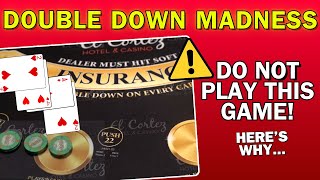

Why Double Down Madness is a Trap
45sImmediately hits viewers with shocking odds comparison, making them want to learn more.
▶ Play Clip"The title is accurate and the video delivers a thorough, evidence-based explanation of why the game is bad, though it includes some promotional content."
This video analyzes the casino table game 'Double Down Madness' and explains why it offers significantly worse odds than regular blackjack. The creator compares the house edge, demonstrates the game's restrictive rules, and performs a practical comparison of three shoes of each game to illustrate the difference in risk and variance.
Regular blackjack can have a house edge as low as 0.5%, while Double Down Madness has a house edge of about 2.07%, making the odds four times worse for the player.
In Double Down Madness, the player is dealt only one card face up initially, and the dealer's second card is dealt face down, unlike regular blackjack where both player cards are face up.
The game uses a completely different basic strategy, developed by Michael Shackleford (Wizard of Odds), which allows doubling down on any hand, including soft hands and totals like 8.
A key disadvantage is that players cannot split pairs, which eliminates a common strategy in regular blackjack and reduces the player's ability to maximize winnings on favorable hands.
The most significant rule change is that when the dealer has a total of 22, it is a push (tie) rather than a bust. This removes the player's win on a dealer bust and gives the house a major edge.
The ability to double down multiple times can lead to risking large amounts of money (e.g., $800 from a $100 initial bet) on a single hand, increasing variance and potential losses.
The creator played three shoes of regular blackjack and three shoes of Double Down Madness with the same cards and a $100 unit. Regular blackjack ended even, while Double Down Madness lost $1,100.
There is uncertainty about whether a natural blackjack can be doubled and still pay 3:2, and whether a dealer 22 pushes a natural blackjack. The creator invites viewers to clarify in the comments.
Double Down Madness is a high-variance game with a house edge four times worse than regular blackjack, making it a poor choice for players. The creator strongly recommends sticking to regular blackjack and learning card counting for better odds.
What is the house edge for regular blackjack?
About 0.5%
00:28
What is the house edge for Double Down Madness?
About 2.07%
00:43
How many times worse are the odds in Double Down Madness compared to regular blackjack?
Four times worse
00:43
What is the key rule change in Double Down Madness regarding the dealer's 22?
A dealer 22 is a push, not a bust.
04:28
What is a major disadvantage of Double Down Madness compared to regular blackjack?
Players cannot split pairs.
01:55
Who developed the basic strategy for Double Down Madness?
Michael Shackleford (Wizard of Odds).
01:24
In the video's comparison, how much did the player lose after three shoes of Double Down Madness?
$1,100 (11 units).
16:14
What is the payout for a natural blackjack in Double Down Madness?
3:2, but there is ambiguity about doubling and dealer 22 pushes.
16:43
House Edge Disadvantage
Quantifies the core problem with the game, showing it is four times worse than regular blackjack.
00:14Dealer 22 Push Rule
Identifies the most impactful rule change that gives the house a significant edge.
04:28Empirical Comparison
Provides a practical demonstration of the difference in outcomes between the two games.
08:28Loss Quantification
Shows the real financial impact of playing Double Down Madness over a short session.
16:14[00:01] Double Down Madness that may [music] have made its way to your casino by now. to kind of infiltrate to some of the smaller casinos, some of your locals. And we're going to talk today in this video why it's actually really bad and
[00:14] you should probably not play Double Down Madness. All right, we'll get into kind hands kind of cherry picked for us. We're going to go over in a second, but real quick, some numbers. You can usually find a regular blackjack game at
[00:28] your local casino [music] that can get the house edge to about 0.5% or 1/2 of the house edge to about 0.5% or 1/2 of 1% in the houses's advantage. [music] All right, so you're almost 50/50 odds there. Whereas double down madness, the
[00:43] best you're going to do with that is about [music] 2.07. So from one half of 1% so over 2% that is four times worse [music] odds that you have playing this game just because you want to double down any points
[00:57] [music] in with any cards that you get. All right, we're going to show why that actually might be a bad thing here in just a second, but let's go over some examples. This game is dealt a little bit differently than regular blackjack.
[01:09] some other rules, too. We'll talk about why this is so bad in a second, but the right. And then you get your card face up and then the dealer gets their second card, the whole card. And let's say this is our first hand. By the way, this also
[01:24] uses a completely different basic strategy that Wizard of Odds um or Michael Shackleford found out. I'll pop those on the screen here for you. And with that, this is the optimal way to play this game. And so nine versus deers
[01:39] according to this. You can double down anytime. And when you double, of course, you just get one more card. Um, but I could double down again if I wanted to. But one of the reasons that double down madness is so bad is because I can no
[01:55] with one card. There's no [music] way to split just one card. Whereas in normal blackjack, you get two. And with pairs, you can split any two cards of equal value um if basic strategy calls for it. And so here nines, even though normal
[02:13] [music] me to split those, I can no longer do that. Now an 18 versus the dealers five according to their charts. This is going to be like a hard 18 is a stand at this point. So let's see what happens here. Dealer would have a 15,
[02:29] happens here. Dealer would have a 15, 16, and also 18. So 18 18. Hey, that's a push. We didn't lose any money. But what if this was regular blackjack? Let me Remember, you'd get your two to start with here. Put the double down back. Um,
[02:45] instead of being like this, if I take these two cards back, remember our five was on top just like this. We would split our nines and we would have to put out an additional 100. So, kind of similar. Um, again, pull those cards
[02:59] back in the same order. The ace would give us a soft 20. We'd stand on that. The two is actually a 11 now for this nine and two and 11 of course would double down. So we actually get more money out on the table with regular
[03:13] blackjack and now I can double that. Okay, 21. So now we're dipping into Now of course I am cherrypicking this a little bit. Dealer has 15 and 18. So even when they don't bust, we would have won $300 here as opposed to a double
[03:29] down madness. we just pushed. It was, you know, we didn't lose or win any money. So, that's one example where this can be bad. And you're probably in the comments yelling at me because yes, I am cherry-picking these hands. I understand
[03:42] that. I'm just trying to find out maybe why it might be better to not play this compared to regular blackjack. All right, let's look at another example of double down madness and why it's not that great of a game. Let's say I have a
[03:56] two versus a dealers five. Now, this is not a double. This is just a hit here on the screen. All right, so we're going to hit this. However, remember at that I have two cards, a 10 versus dealer's five. This is a double down. So
[04:11] let's put out another $100 there. And we're going to double that. Hey, 20. going to stand and [music] hopefully we can make $200. Dealer, however, oops, 15 and [music] 22. So, unfortunately, another rule
[04:28] about double down madness that gives the edge to the casino, this is probably the biggest deal is that on 22s, when the dealer has 22, you don't win or lose. It's just [music] a push. Now, often times there'll be a side bet here that
[04:42] maybe you can bet that says push 22. [music] And if you play that, it pays out 11 to one, which kind of tells me that there's, you know, maybe about every 11 hands or so, or maybe 10, maybe a little less since the casino has to
[04:55] make money on it. um the dealer is likely to get 22, [music] Because normally in normal base or normal um blackjack that is this would be a bust. We would win $200, whereas here you don't win or lose anything and
[05:11] here you don't win or lose anything and the dealer actually did go over the 21 another reason that this is a terrible game. Uh let's try another one here. And that is if you start with an eight and dealer
[05:26] according to the chart, this is a double down. I would have never guessed that, but it is. All right. So, let's see what happens. We double that. Now, we [music] get 10. So, you can double double down. Double double, right? Um [music] the
[05:39] there to start with. We doubled it to have 200. [music] Well, if I double that, that is 400. And these are all your chips to start with. dealer yet. [music] So you have you're risking $400 on an a 10 versus the other
[05:56] 7. Whereas your [music] kind of base unit might have been just 100. All don't know if we do it this way or this way. I haven't dealt this enough, but I'll go this way. All right. Now we have 14 versus dealer 7, which is a hit
[06:11] 14 versus dealer 7, which is a hit according to their basic strategy. And we went over. So even though we have 22 this time, we don't get the push feature. we actually lose as we're playing to get to 21. The dealer can get
[06:24] playing to get to 21. The dealer can get to 21 or 22 and that does not affect them. They would have had 17. So, unfortunately, that one was a loss. Another reason why this game is very bad. All right, let's try one last
[06:37] into some gameplay [music] and see how regular blackjack versus double down madness is um different over the long run. Okay. In this one, we get dealers run. Okay. In this one, we get dealers card, our card, and like this two versus
[06:51] a dealer six. This is a double down. All right. So, we double it. Now, a soft 13 down. So, we have to do the same thing as last time. Now, we're risking $400.
[07:05] as last time. Now, we're risking $400. And a soft 17 versus a DO6, you guessed it, is a double down. So, we started with 100 out there and now all of a sudden we have [music] 800. By the way, some dealers will stack the first double
[07:19] and then the second double like this. And so, we have I guess the first, second, and third double downs. So, we have doubled each of these. Um, can't bust, which is nice. So, we have a soft 17.
[07:33] looking pretty good. We could win potentially four 56 7 $800 if the dealer bust or is less than 19. Let's see if it happens here. Got 10 and
[07:46] Let's see if it happens here. Got 10 and oh no 20. So just like that, you lost $800 [music] when your initial bet was just $100. So again, this game is really bad for those reasons. Now in regular blackjack, like
[08:00] I said, when you can split, you're playing two hands individually. When you You get one more card. You're only risking that one extra bet. This is real way more risky. Yes, the variance can be good for you. You could win that, right?
[08:14] They could have pulled something like a seven here and one, but um this game is just really risky. All right, I want to uh move into kind of some gameplay now. chips set out here. And from what I could find online, um [music] Double
[08:28] Down Madness is only available in six and eight deck shoots. So, that's what I through three shoes of these. I'm going to throw this into a hyperlapse so I don't waste your time. But, I'm going to play three shoes of regular blackjack.
[08:42] Um, just basic strategy with a $100 unit. And if I need to split, I'll split. If I need to double, I'll double just like normal blackjack rules go. Um, and then I'm going to do the exact same thing with double down madness rules
[08:56] basic strategy charts from Michael Shackleford at Wizard of Odds. All right, we're playing with the same um exact cards. I'll shuffle them each time. We'll have the same penetration or same cutoff. I'm not counting cards. I'm
[09:10] not raising lowering my bets. It's just all going to be with one um a $100 unit there. And after about three shoes, we'll see if that 2% um house edge that Double Down Madness has compared to the.5%
[09:25] house edge that regular Blackjack has, if that kind of catches up or not. Um, if I need to add some more chips here, let's do this. I'll give another two, three, four, another 5,000. We need to tap into that. Um, because those $100
[09:39] doubling quite a bit. So, we're doing the regular first and then I'll be back these. If you really want to slow it down and see every hand, feel free.
[11:01] [music] him.
[11:34] of blackjack. Remember, we started with four piles of 100s here. These are all that I got on blackjack, which happened one, two, three, four, five, six times. And so if I replace those
[11:50] those with 300s instead of those $25 chips, we are literally right where we started. Okay. And so after three shoes, um, that 0.5% again, really, really close to 50/50.
[12:05] We're only at a 0.5 disadvantage for regular blackjack. We didn't lose a single dime. All right. Now, I'm going to do the same thing for um, Double Down Madness. Um, I cannot go near as fast because I'm going to have to look at my
[12:19] charts, which I have kind of behind the camera here. So, um, bear with me. I'll try to speed this up again so it doesn't waste your whole time. But I am guessing that it's going to be far less chips when we're done with those three shoes.
[13:45] [music] Yeah,
[13:58] [music] kill him.
[14:58] >> All right, that's the last hand of the double down madness. And my goodness, it made quite the comeback there. I almost stopped after um two shoes, two six deck shoes because we were um somewhere in the neighborhood of about there I
[15:13] believe. And then it made it went all the way down. I think I might have even taken one or maybe ended the last the third to last um [music] pile. And anyway, we're all the way back to only being
[15:28] down uh I think it's one short. So 11 chips. We're missing the fourth pile and we're one chip short on this one. So um the swings are way different or way bigger I should say in Double Down Madness. Um however, remember it's only
[15:44] about 2% disadvantage which still is okay. There's other games out there that are [music] um way worse like roulette that have worse odds uh than this game. And so that said, um you still want to play regular blackjack. Uh [music] the
[16:00] pile on that one, we we did lose a full stack and then we gained it all the way totally even on the regular blackjack. This one we did lose one full stack and This one we did lose one full stack and one um chip. So $1,100 there, which you
[16:14] you never want to lose over $1,000. um or you could say that's 11 units if we're betting these $100 chips. So, uh there was a couple instances where I wasn't quite sure um what the rules called for. Maybe you guys know a little
[16:27] down below in the comments. But, um a lot of times when they would get an ace, I've heard, let me see if I can get one here. Yeah. So, let's say they have an ace and we have a or you have an ace, I should
[16:43] say, [music] and the dealer has a 10. Well, if you flip cuz you probably want to double down, right? That's like 11. And so if you double this, I've heard differing things. Um I've heard that if you don't
[16:55] double and you get blackjack, then you get paid your 3 to two. But I've also seen on a video from an actual casino that someone did double this down um and then they got
[17:11] paid 3 to2 on that. Now, I think in that case at the casino, the dealer did not have 21. Um, or actually, this is a good point, or 22. Remember, this would be a
[17:23] push in that case. So, let me know how, if you've played this before, how are blackjacks handled? Um, can you double and still get paid 3 to2? If the dealer pulls a 22 when you have the 21, is it still a considered a push with that
[17:37] natural blackjack? Um, I guess I'm not too familiar with that. So, um, in the there. I think there was maybe one instance where the dealer had 22 and we got a blackjack. [music] So, otherwise, I was paying out the full 3 to two after
[17:53] um the double downs. So, you can let [music] me know that down below. Um, otherwise guys, this is not a game that you want to play. Um, it's [music] just blackjack. I would highly encourage you to learn how to count cards. [music]
[18:06] to learn how to count cards. [music] In fact, um, right now on my Patreon, I have built a bankroll from 25,000 all the way up to almost 34,000 in just [music] about 30 episodes. And so, every single week on there, I'm
[18:19] doing four shoes of double deck blackjack. In fact, this next week, we're going to resize our bets there and kind of work with [music] this new um, bank roll. And if you are interested in that, the lowest tier, which is just $5,
[18:32] um, gets you access to that. However, if you want the next middle tier up in my Patreon that also gets you access to all the slots that I have covered, I do about one of those new slots every week. Yes, there are such thing as advantage
[18:45] slot machines. Um, it just has to deal with must hit by numbers. I'll let you want to know exact plays and when to jump in, when to jump out, you can join me over my Patreon for the middle tier of that. Otherwise, guys, until next
[19:00] of that. Otherwise, guys, until next time, remember this is A1 Blackjack.
⚡ Saved you 0h 19m reading this? Transcribe any YouTube video for free — no signup needed.