
Card Counting Basics: The Values
42sClear, visual explanation of card values (low, neutral, high) with immediate practical application, appealing to beginners and curiosity about beating the casino.
▶ Play Clip"The title 'Card Counting for Dummies' is slightly exaggerated but the content genuinely teaches the basics in a simple way."
This video explains the basics of card counting in blackjack, focusing on the Hi-Lo system where low cards (2-6) are +1, neutral cards (7-9) are 0, and high cards (10-Ace) are -1. The presenter demonstrates with a subset of cards to show how a balanced count starts and ends at zero, allowing the counter to predict the last card.
Low cards (2-6) are worth +1, neutral cards (7-9) are 0, high cards (10, J, Q, K, A) are -1.
With equal numbers of low and high cards, the count is balanced and should start and end at zero.
A deck rich in high cards favors the player, increasing the chance of winning.
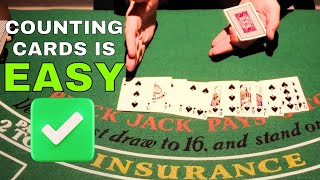
The presenter shuffles a subset of cards and counts through them, showing how the running count changes with each card.
By maintaining the running count, the presenter correctly predicts the last card is an 8 (neutral).
Card counting is a skill that requires practice, but with the Hi-Lo system, you can track the ratio of high to low cards and gain an edge in blackjack.
What is the value assigned to low cards (2-6) in the Hi-Lo card counting system?
+1
00:01
What is the value assigned to high cards (10, J, Q, K, A) in the Hi-Lo system?
-1
00:01
What is the value of neutral cards (7, 8, 9) in the Hi-Lo system?
0
00:01
What does a balanced count mean in card counting?
The count starts at zero and ends at zero when all cards are counted, indicating equal numbers of low and high cards.
00:54
Why does a deck rich in high cards favor the player?
Because it increases the player's chance of winning (topic for another video).
01:08
Card Value Assignment
Establishes the fundamental rule of the Hi-Lo counting system.
00:01Balanced Count Explanation
Clarifies that the system is designed to start and end at zero, ensuring accuracy.
00:54Why Counting Works
Provides the strategic reason for counting: high card density favors the player.
01:08Successful Prediction
Demonstrates the practical application by correctly predicting the last card.
03:13[00:01] know I titled this video card counting for dummies but um that is not true pretty smart choice now the first thing counting is that these three different sets of cards are worth different values
[00:15] this is just uh all the Spades that I took out of a a normal deck of cards over here all right so it's this one's missing all the Spades CU I took them out and the low cards 2 through six one thing that you have to know is that the
[00:29] different value here the two through six these are going to be worth plus one the neutral cards 7 8 n the ones in the middle are neutral they're worth zero okay and then the large cards 10 Jack queen king Ace are going to be worth
[00:42] minus one so what do I mean by that well if I were to mix these up because I have five little ones five big ones and three that are worth zero the five and five
[00:54] are going to cancel each other out the zero is still zero and so this is what's called a balanced count okay so if I start at zero and I go up and down as I count through these I should also end at zero so what card
[01:08] counters can do is if the deck becomes rich in um High cards so there's more High cards than there are low cards they are more likely to win okay that's a the reason why is topic for another video but that is true you're here to learn to
[01:23] count so let's do that I'm going to take these all these Spades here we're going to shuffle them up okay we'll give it a little riffle okay we'll give it a little riffle Shuffle best we can and since if I start
[01:36] at zero and go through this whole thing I should end at zero I should be able to go through maybe 12 of them and know what the last card is going to be all right so just to prove it to you I'll cut it one more time and let's see if we
[01:48] right so remember the little cards are worth plus one the medium cards are zero and the big cards worth minus one so this is a medium card that is worth zero so we're going to keep a running count what is what's what you call it as we go
[02:04] here this is worth zero so the running count is at zero this is a big card worth minus one so 0 minus one is at minus one now maybe keep this as I go going this way another zero so we're still at minus
[02:18] minus two that's another minus one another big two that's another minus one another big one so minus -2 minus another one is now -3 there we go there's a little one so from
[02:33] -3 is where we were this is a plus one so now we're going to move back to um -2 another big one this is worth minus one so we we're at -2 now we're at
[02:46] one so we we're at -2 now we're at -3 another small one SO3 moves back to -3 another small one SO3 moves back to -2 another plus one so -2- 1 is where we are now another one now we're back to zero
[02:59] right there's an equal amount of big and small out there currently we're at small out there currently we're at zero back to negative one that's a big card now we're back to zero and without even looking at this I know this is
[03:13] going to be either a seven eight or nine because since we're at zero and I have to end at zero it has to be one of those middle cards and there you go it is the eight all right so that is how you card count for dummies you might say and
[03:27] anyway um if you would like to see this done a little bit quicker now that you know kind of the pace with this um I'm going to take a full deck in my next video which I'll put right here and in that video if you click on it let's see
[03:39] if you can follow along with a full deck if you can't yet maybe go back and watch what I did with this one and give it a few more practice tries
⚡ Saved you 0h 03m reading this? Transcribe any YouTube video for free — no signup needed.