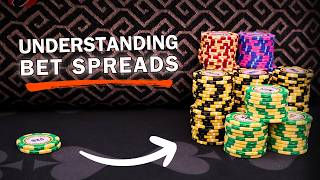

What is a Blackjack Bet Spread?
60sClearly explains a core concept for advantage play, making it educational and shareable for aspiring card counters.
▶ Play Clip"Delivers on the promise of bet spreads for various bankrolls, but includes a lengthy sponsor segment and some repetitive explanations."
This video provides a comprehensive guide to blackjack bet spreads, tailored to different bankroll sizes. The presenter explains how to structure bets based on the true count, using examples for large, medium, and small bankrolls, and demonstrates the expected value and risk of ruin for each scenario using Blackjack Apprenticeship software.
A bet spread defines how much to bet at various true counts. The example shows a large bankroll spread: $50 at true count 0 or lower, increasing to $100 in two spots at +1, up to $500 in two spots at +5 or higher.
The spread ratio is calculated by dividing the maximum bet by the minimum bet. For the large bankroll example, $1000 / $50 = 20, so it's a 1 to 20 spread.
For a smaller bankroll, a $10 minimum table is used. Bets start at $10 at true count 0 or lower, increasing to $50 at +1, $100 at +2, $150 at +3, $200 at +4, and $300 at +6. This is a 1 to 30 spread.
Lower limit tables are slower because other players are present, reducing rounds per hour. However, they are more affordable for smaller bankrolls, allowing gradual growth from $10,000 to $25,000.
The presenter uses Blackjack Apprenticeship software to optimize bets and calculate risk of ruin and expected value. He emphasizes that rules vary by casino, and his examples use H17, double after split allowed, resplitting aces allowed, and no surrender.
For a $50,000 bankroll playing double deck, the best game has 1.3 decks penetration. The optimized spread starts at $25 in one spot, then two spots of $75 at +1, up to two spots of $500 at +6. Risk of ruin is under 1%, with an expected value of just under $250 per hour.
For six deck, a $25 minimum table is used. The spread goes from $25 in one spot to two spots of $350 at true count +7 or higher. Expected value is about $125 per hour with risk of ruin under 1%.
For a $20,000 bankroll playing double deck, the expected value is about $80 per hour with a risk of ruin of 0.62%. The player must Wong out (stop playing) if the true count drops below -2.
For six deck, a $5 minimum table is used. The spread starts at $5 at true count 0 or lower, then two spots of $25 at +1, up to two spots of $150 at +6. Risk of ruin is just under 1%, with an expected value of about $70 per hour.
With a $10,000 bankroll, playing double deck is not recommended because the best game has a $25 minimum, resulting in a 7.5% risk of ruin even with Wonging out at -3. The swings may be too large for many players.
For six deck, a $5 minimum table is used. The spread starts at $5 in one spot, $10 at +1, and maxes out at $125 in two spots at +7. Risk of ruin is about 1.5%, with an expected value of about $42 per hour.
If the expected value is below $40 per hour, the presenter suggests considering a regular job, like a Costco checker ($30/hour) or overnight Walmart stocker, because blackjack carries the risk of losing money due to variance.
The video provides a practical framework for selecting bet spreads based on bankroll size, emphasizing the importance of managing risk of ruin and expected value. It also highlights the need to use software like Blackjack Apprenticeship to tailor strategies to individual circumstances.
What is a bet spread in blackjack?
A bet spread defines how much to bet at various true counts, typically increasing bets as the true count rises.
00:31
How do you calculate the spread ratio?
Divide the maximum bet by the minimum bet. For example, $1000 / $50 = 20, so it's a 1 to 20 spread.
02:39
What is the recommended risk of ruin for advantage blackjack?
The presenter likes to keep risk of ruin under about 1%.
05:37
Why is double deck not recommended for a $10,000 bankroll?
Because the best double deck game has a $25 minimum, resulting in a 7.5% risk of ruin, which is too high for many players.
09:46
What does 'Wong out' mean?
It means to stop playing when the true count drops below a certain level, such as -2, to avoid negative expected value.
08:33
What is the expected value per hour for a $50,000 bankroll playing double deck?
Just under $250 per hour.
05:50
What is the expected value per hour for a $10,000 bankroll playing six deck?
About $42 per hour.
10:54
Optimizing for $50,000 Bankroll
Shows a concrete example of a high-stakes spread with low risk of ruin and high expected value.
05:10Avoiding Double Deck with Small Bankroll
Provides a clear warning about risk of ruin, helping players avoid costly mistakes.
09:46Comparing Blackjack to a Job
Offers a realistic perspective on the financial viability of advantage play versus traditional employment.
11:24[00:01] tips as to some bet spreads you can use when you play blackjack in the casino. I've used in previous [music] videos. We have spreads that are for maybe smaller bankrolls, as well as some that are for some bigger bankrolls. And like I said,
[00:15] into what you might need if you have a really big, kind of a medium, [music] or even a really small bankroll, what might be best for you so that when you get to breaking the bank. And at the same time, you're going to be generating some
[00:28] really good positive expected value using these bet spreads. All right, spread is for a second. Let's use maybe this one for example. And here you can categories. We have the true count that we're going to be using at those
[00:44] particular spreads. All right, the bet itself at those true counts. And then number of betting circles that we're going to be betting that amount in. All right, so here you can see that the lowest is at a true count of anything
[00:58] that's zero or lower. That's what the negative means, at zero minus. We're going to be betting $50. So now this is an example of a of a bet spread you want to use if you have a really big bankroll. All right, so at $50 here,
[01:11] minimum. So a lot of times maybe you've seen a table that's a $10 or $15 $25 minimum. This would be an example of a $50 minimum. And so people that can afford to play at these tables, there's some benefits as there's probably not
[01:26] going to be other people playing at this table, or not very many, you might say. And so you can get a lot more rounds per hour in, and that's going to be a good trade-off compared to some of those lower limit tables. Now, if we go up a
[01:39] true count, at a true count of plus one or higher, this calls for us to bet $100. You can see instead of just in one spot like the previous one, this is going to be $100 in two spots. And so I'm going to be betting like this. These
[01:52] are now both of my betting circles. And at a true one, betting $100 in two spots. A true two is $200 in two spots, all the way up to a true count of plus
[02:04] five or higher, that's where we max out. It's going to be a true count of or it's going to be a bet, I should say, of $500 in two spots here. Now, if you think about how much money that is, that of course is $1,000,
[02:16] right? 500 * 2. Whereas our lowest amount was $50, just kind of one single amount was $50, just kind of one single bet of 50. So, to go from 50 to 1,000, bet of 50. So, to go from 50 to 1,000, that is a bet spread of 1 to 20. If I
[02:32] were to take the biggest amount, $1,000, and divide by 50, the smallest amount, and divide by 50, the smallest amount, well, 1,000 / 50 gives us 20. So, you can say that this is a 1 to 20 bet spread. Now, let's say you go to a table
[02:46] other people at the table, you only have one spot available to you, the minimum, the table minimum is $10, and so you might want to use a bet spread that looks more like this, especially if you have a smaller bank roll. And that's
[02:59] going to be at zero or lower, we are also betting the table minimum of $10. However, if the true count goes to a true one, then all of a sudden we're going to bump it up a little bit. Now, notice this is still in one spot. A true
[03:15] two, we're going to bet $100 in one spot. A true three is 150. A true four is 200, all the way up to a true six, which is 300. So, again, this time our bet spread, well, if you think of the minimum, which is 10, and the maximum,
[03:32] minimum, which is 10, and the maximum, which is 300, what is 300 / 10? Well, it's 30. So, this will be a 1 to 30 bet spread. Now, there's a couple trade-offs has to play as well, and so this is going to go a lot slower. You're not
[03:45] going to get as many rounds per hour in. However, you are playing at a lower table minimum, which means this is $40 less than that other table that I showed you. And so, people with smaller bankrolls might be able to afford this.
[03:58] where you slowly grow your bankroll from maybe 10,000 or so up to 20,000, 25,000, and so on, and slowly grind your way up. And then maybe you can start to afford
[04:10] And then maybe you can start to afford some of those higher limit tables after that. Now, with all these bet spreads, I use Blackjack Apprenticeship to help me kind of iron out the details. So, I'm going to jump over to the computer, and
[04:22] we're going to show you what someone with a big bet spread can maybe afford to bet at both six-deck and double-deck, what someone with a medium bet spread with a small bet spread. So, let's jump over there and take a look at what you
[04:36] other thing before I kind of get into the different bet spreads is that my rules at my local casinos might be different than your rules. going to show you in this video, I have the rules set to the H17, where the
[04:51] dealer hits their soft 17s. Um double after split is allowed. Um so is re-splitting aces. However, we can only split to four hands max. If we get something, we can only split those to four hands. And then surrender is not
[05:06] available. So, with that said, let's look at our biggest bankroll size in this video, and that's going to be a $50,000 bankroll. And let's say we're playing some double-deck, like you can see here. The best double-deck game that
[05:18] I've seen so far this year in 2026 has had a penetration of about 1.3 decks, meaning that there's about 36 cards behind the cut card. Remember, half a behind the cut card. Remember, half a deck is about 26 cards. And so, this is
[05:33] uh kind of the best that I've seen. And anyway, what we're looking to do here is sort of optimize um the bets in such a way where our risk of ruin is nice and low. I like to keep it under about 1%. Here it's at .93 and our expected value
[05:49] is as high as possible. In this case, it's just under $250 per hour, which I think most of you would probably take that, myself included. I do not have a $50,000 bankroll. Um another reason why you can hit that like button for me.
[06:02] Maybe we'll get there eventually. Uh but otherwise, you can see here that this uh particular bet spread, we start at $25 in one spot and then once it bumps up to a true one, then we go to two spots of 75, two spots
[06:16] of 150, two spots of 200, all the way up to a true six where we're maxing out our to a true six where we're maxing out our bets at two spots of $500. So again, you can probably afford to do that if you have a $50,000 bankroll. Now if you're
[06:30] playing six-deck, uh you also probably want to spread to two spots if possible. And in this case, let's say we're playing we're playing a $25 table where the five and $10 tables, we're going to let the lower bet spread people or lower
[06:45] there's probably going to be fewer people at this table. We can get more rounds per hour in. Now I did not change the rounds per hour in any of these slightly different whether at a really full table, if your uh dealer is fast
[07:01] you want to have Blackjack Apprenticeship Pro Betting software so you can change these to whatever your particular needs are. Um this one particular needs are. Um this one though, this is a minimum of $25 and
[07:14] we're going to spread all the way up to two spots of 350 at a true seven or higher. And this is going to yield about $125 per hour and our risk of ruin is still under 1% at .8. All right, next we're going to have our medium-sized
[07:28] bankroll, but before we do that, I want to show you this really quick. As an advanced Blackjack player, I drink a lot of coffee. I've always wanted to partner with a coffee company, but only if they give my viewers a solid discount. When
[07:40] Black Ink Coffee gave us 10% off, I bought a couple bags with my own money to test the quality first before showing you guys, and it passed the test. I picked up their Maniac Blend and whole bean Colombian. In fact, they offer
[07:53] ground coffee and whole bean ranging from specialty blends to their single origin roast. I brewed up the Maniac before heading out, and it was fantastic. It tastes great and kept me focused on those long grinds on the
[08:05] casino floor. Scan the QR code on the screen and use code A1BJ at checkout for 10% off your order. Plus, if you subscribe monthly, you save an additional 25% off. Grab a bag of Black Ink Coffee today to fuel your next
[08:19] medium-size bankroll is going to be $20,000, and here for playing double expected to get about $80 per hour with a risk of ruin at only .62%.
[08:31] Um but one thing you want to notice on this is as we're playing, we do have to wong out, meaning that we're not going to play if the true count drops below a true negative two. So, we're playing down to a true negative two, but once it
[08:44] hits a true negative three, we're going to pull our bets back and not play at this particular table. All right, if you're playing six deck, the best six deck game I've seen so far this year in 2026 is a $5 table. It was a $5 minimum
[08:58] 2026 is a $5 table. It was a $5 minimum to about a $500 maximum, and so the bets that range. If you have a $20,000 bankroll, you can bet the table minimum at a true count of zero and lower. And then once it gets to a true one, you can
[09:13] spread to two spots betting $25 all the way up to two spots of 150 at a true count of plus six or higher. That's going to be just under 1% risk of ruin, $70 an hour. Now, before I show you my small bankroll we're using in this
[09:27] thumbs up button if you're finding this video valuable, I'd really appreciate that. That said, our small bankroll we're going to be using is $10,000. Now, before you turn this off if you don't have a $10,000 bankroll, I do want to
[09:40] this where you can still take money from the casino and build that bankroll up, particular tables yet. But, stay tuned to the end of the video for that. That said, if you do have a $10,000 bankroll, I would not play double deck. Again, the
[09:55] best double deck game that I have seen this year in 2026 is a $25 minimum table. And you'll notice here, even if we wong out, don't play at a negative we wong out, don't play at a negative three or lower, we have a 7.5%
[10:09] risk of ruin. Now, it would be a decent expected value, but again, the higher the risk of ruin, the bigger the swings that you're going to see as you are playing. And I know some of you just cannot stomach those swings. And so, if
[10:22] that's you, I definitely would not play double deck blackjack with a $10,000 bankroll. Otherwise, if you have a $10,000 bankroll and you can play six $10,000 bankroll and you can play six deck, again, if you see a $5 table, this
[10:36] live. Now, one thing that might jump out to you right away is the risk of ruin is about 1.5%, which is a little bit higher than I would suggest, as you might have remembered from earlier in this video. However, in order to get a expected
[10:50] value of about $42 an hour here, we did have to bump up that risk as we do have to put some big bets on the line there in those bigger counts. This is going to be a minimum of $5 in one spot. Even at a true one, we're still just doing $10
[11:05] in one spot. However, at a true seven is going to be where I max out at $125 in two spots. And so, if you're able to find a table like this and you have a $10,000 bankroll, um you could potentially get about $42 per hour in
[11:21] that case. Now, I will say that anything lower than this, about 40 bucks an hour or so, if it were me, I would probably just go find a good paying job. Um in fact, I heard recently that a Costco checker makes about 30 bucks an hour.
[11:33] I've also heard really good things about working overnights stocking shelves at Walmart. It's also really good. I say that because Blackjack is a job where you can potentially lose money. If you have several bad days in a row with
[11:47] bad variance, it is well within the realm of possibility to take those $10,000 down to four or five thousand dollars with just a few bad days. Whereas a job, if you you know are a checker at Costco or something,
[12:02] you do not have the possibility to lose money. Now you might be tempted to spend more, but that's going to be a whole different animal. So anyway, if you want a little bit of a risky type job like this and you have a decent bankroll,
[12:15] then Blackjack might be for you. Now one thing I will say is I ran all these Again, you really want your own membership to Blackjack Apprenticeship because there is a huge difference between a $10,000 bankroll, a $20,000
[12:30] bankroll, and a $50,000 bankroll. If you're somewhere at like $16,000, you're going to want to run your own numbers so you know exactly what to bet when and maybe kind of tweak those different rules. Maybe you have S17 games
[12:45] available to you or maybe you do have surrender available, in which case you those bets. And so if you're interested in purchasing Blackjack Apprenticeship, I'll put a link to their member site down below in the pinned comment of this
[12:57] videos to not only the Pro Betting Software, but other features they have like I mentioned earlier, if you don't have $10,000, you might not be ready to start playing advantage Blackjack, but you can still take the casino's money a
[13:12] different way. In this video right here, I go over how to beat slot machines. Yes, that is very real. Check it out. I show you with math in that video. Otherwise, until next time, remember this is A1 Blackjack.
[13:24] >> Woo. >> [music]

⚡ Saved you 0h 13m reading this? Transcribe any YouTube video for free — no signup needed.