
How Terminal Velocity Works
55sEducational physics explanation in an exciting space context makes it shareable for science fans.
▶ Play Clip"Delivers exactly what the title promises: a full engineering journey of an egg drop from space with genuine failures and triumphs."
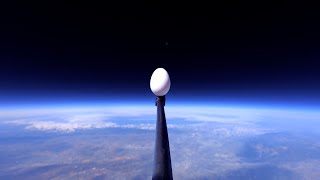
Mark Rober attempts the world's highest egg drop by launching an egg into space on a rocket attached to a weather balloon. Over three years, his team faces multiple engineering failures, iterates on design inspired by NASA missions, and ultimately succeeds with both a primary and backup egg surviving the fall.
Mark introduces the goal: drop an egg from the tallest building, but decides to go to space using a rocket on a weather balloon.
The team breaks the problem into smaller steps, starting with understanding terminal velocity—humans: 120 mph, cats: 75 mph.
A test at 10,000 feet in Gridley, California, with a mattress as target, using rocket fins for guidance.
A metallic streamer causes GPS interference, triggering premature egg release at 10,000 feet.
The balloon rises faster than predicted and drifts off course, causing the rocket to enter an uncontrolled death spiral.
After search, the egg is found missing from the wreckage; a rogue negative sign in the code is identified as the cause.
Adam Steltzner, chief engineer for Perseverance, points out that releasing an egg from a small, fast rocket onto a large mattress is flawed.
Team redesigns with a two-stage rocket, parachute, and airbags, mimicking NASA's Mars landing sequence.
Successful tests in the desert with a lucky orange parachute and airbags; final preparations take three years.
The rocket's support structure fails under tension/compression, leading to a critical engineering lesson.
Team fixes the connection point, runs vacuum/temperature tests, adds redundancy with a second egg, and heats the egg chamber.
After three years, the balloon lifts off; ascent rate is perfect, but the balloon begins spinning, twisting the cord.
The payload autonomously ejects from the tangled balloon, deploys the parachute, and both eggs land safely on the mattress.
Both the primary and backup eggs survive the fall from space, confirming the engineering effort.
Through iterative failure and redesign, Mark Rober successfully dropped an egg from space, demonstrating that persistence and engineering principles can overcome seemingly impossible challenges.
What is the terminal velocity of a human?
120 miles per hour
01:25
What is the terminal velocity of a cat?
75 miles per hour
01:39
Why did the first test fail?
GPS interference from a metallic streamer caused premature egg release.
04:25
Who is Adam Steltzner?
Chief Engineer for NASA's Perseverance Mars rover.
10:52
What was the fatal flaw in the original plan?
Releasing an egg from a small, fast rocket onto a large mattress is nearly impossible to hit accurately.
10:52
What technique did the team use for the final landing?
A two-stage rocket with parachute and airbags, mimicking NASA's Mars landing sequence.
11:32
What is a radiosonde?
A weather balloon payload that transmits temperature, humidity, and wind data.
09:14
How many weather balloons are launched daily worldwide?
2000
09:29
What was the code bug that caused earlier failures?
A single rogue negative sign in the code.
07:37
How did they ensure the egg's electronics survived the cold?
They placed the egg and electronics in a heated chamber.
17:46
What was the backup landing method?
A second egg with a simple beach ball landing, no parachute.
18:43
Did both eggs survive the final drop?
Yes, both the primary and backup eggs survived.
24:28
Breaking Down Complex Problems
Demonstrates a core engineering principle: breaking large problems into manageable steps.
01:11Rogue Negative Sign
A single character bug caused mission failures, highlighting the importance of code review.
07:37Expert Feedback
An outside expert instantly spotted a fundamental flaw, showing the value of collaboration.
10:52Learning from Failure
Mark's philosophy: every failure is a chance to learn one more way not to do something.
16:52Both Eggs Survive
Redundant systems worked perfectly, achieving the goal after years of effort.
24:28[00:00] moments before I attempted the world's highest egg drop. to do it yourself in school, when dropped from the tallest height possible.
[00:14] in a contraption I built from the world's tallest building, So if I really wanted to future proof this record, and straight to outer space.
[00:28] I knew if I could draw on my experience But what I didn't know is this would be the most physically, I would ever attempt.
[00:42] The plan was to clamp an egg to the front of a rocket, Once there, the weather balloon would release it, the rocket would eventually accelerate past Mach One,
[00:57] and then it would autonomously adjust it would release the egg, And that all seemed pretty straightforward.
[01:11] we broke the problem down into smaller steps, starting first And by terminal velocity, have a maximum speed at which they fall
[01:25] from bumping into more and more air molecules For humans that max speed is about 120 miles per hour. it tops out at 75 miles per hour.
[01:39] if we dropped it onto a mattress at its terminal velocity, whose lawyers would agree we had to improvise a bit.
[01:54] - Yes, check the egg, no cracks. even if it's traveling faster than its terminal velocity.
[02:06] The next step in our DIY space program in the small farming town of Gridley, California, where the plan was to set out a target mattress
[02:18] with a little bit of margin built in just in case. so that as we're like coming down from the sky, - This, by the way, is Joe,
[02:33] And what makes him especially cool is he didn't go to school and recently even landed a launched rocket SpaceX style Joe was in charge of tracking and guiding the rocket
[02:48] Whereas I was in charge of the payload. in a little oven with heaters, along with the the mechanisms to release the egg itself.
[03:00] And the purpose of this first trip to Gridley Basically before we spent all the time and money we were here just to do a low altitude test at 10,000 feet
[03:13] using the fins. World's largest mattress, fastest egg. What could possibly go wrong besides like 4,000 things?
[03:28] and ready to go, all we needed now was an official egg, Hi. This is terrifying. (chicken squawking)
[03:41] Okay, nope, nope, nope. (chicken squawking) this is the first chicken that's ever laid an egg
[03:57] supersonic Mach One. Congratulations. to run through all our final pre-launch preparations.
[04:11] to add a metallic streamer to the back of the rocket - We've got redundancy all over the place here. Mark has two servos on the fairing.
[04:25] - And that's exactly when we had our first dumb failure. - [Joe] The GPS is mad. I hear the egg go ploop, and it pooped it out.
[04:39] all the helium out of the balloon, Hello, wow, that's so cool! (all laughing) that since the GPS unit was right at the back of the rocket,
[04:56] was interfering with the GPS signal. So it thought it was time to release the egg. The most important being
[05:09] with one made from plastic. Bad news, it's about 20 degrees colder, Nevertheless, we pushed forward.
[05:23] As I very carefully delivered the rockets - [Mark] Send it, baby. (dramatic music)
[05:40] Oh, yeah, yeah, I see it, I see it, I see it. (dramatic music) - [Mark] And while the whole thing looked really cool.
[05:54] We quickly realized the balloon was rising We're already south, and we're only halfway up. And so after a few more minutes,
[06:07] already way too far off course to the mattress using just the fins and gravity. (wind rushing)
[06:23] the second problem of the day into an uncontrolled death spiral. Altitude is 1400 coming down fast.
[06:40] - Check the mattress just in case. we headed out to track it down. - Mark, I think I might have some bad news for you.
[06:54] of sitting birds, which is another opportunity I'm not gonna let just pass on by.
[07:06] - [Joe] There's no egg. But despite that silver lining, which was surprising because Joe had definitely run through
[07:21] So after conducting a thorough review of the footage a single rogue negative sign in the code which meant we were ready to give this one final try.
[07:37] so regardless of outcome, this would be the final attempt. from 10,000 feet up, coming all the way down from space.
[07:51] for everything is exactly as expected. I'm standing in the middle of the world's largest mattress where hopefully the egg will be landing in like 45 minutes.
[08:05] and my new video's world's largest mattress. - The last step. - [All] Three, two, one.
[08:19] Yee haw! - [Joe] Looking good so far, we're at 500 meters. we'd started from different spots around Gridley,
[08:32] how do big balloons like hot air balloons steer themselves And the answer is computers know the wind direction
[08:44] if these are the predicted wind directions and speeds, when we got to 10,000 feet. because every day it's someone's job
[08:59] at noon and midnight London time. all around the world at those same two exact moments. called a radiosonde attached to them
[09:14] and then they transmit the information which gets fed into supercomputers. So 2000 of these massive weather balloons go up every day,
[09:29] And since they're transmitting a signal, - [Joe] How close are we to the drop point? - That's it.
[09:42] but it raised some new challenges on the other. - [Man] Grab a chair!
[09:55] - [Mark] Grab a chair. (all laughing) See something? (Mark screaming)
[10:09] - Everyone okay? So we were much closer this time, - [Joe] We found it.
[10:24] - [Joe] Wait a minute. (Mark gasping) - [Mark] Oh, did it crack? we still seemed pretty far off from where we needed to be,
[10:38] who you might recognize as this guy - [Radio Operator] Touchdown confirmed. and he's also the Chief Engineer for Perseverance
[10:52] And so after explaining to Adam what we were trying to do, he immediately spotted a fatal flaw in our brilliant plan. to something about the size of a house.
[11:04] I mean, I know how you physically do that. - [Mark] In other words, we were basically attempting who have done this before, and they are sworn by federal law
[11:19] - [Mark] And to be fair, he raised a good point. And even if we figured it out ourselves, the ethics of just slapping that how to video up on YouTube
[11:32] - But we release at about the height, You might wanna start with a two-stage thing. on a mattress in a small town,
[11:48] by heading out to the desert. and spent a couple months designing and building from the Curiosity landing
[12:01] it could safely land an egg on Earth. but this time the rocket would have fins that didn't move, and it would be three times as long and four times as heavy
[12:13] Then just like NASA separates the cruise stage to dissipate a bunch of the energy and speed, after we'd already broken the sound barrier.
[12:28] it would naturally arrow break Then on Mars, the next step is the parachute deploy, And we would follow in kind by launching our own parachute
[12:43] which would then expose our set of cushioning airbags, which we borrowed from the Spirit and Opportunity landings. but after a couple months
[12:57] we found ourselves in the desert And that was due in part to our lucky orange parachute And for scale, that's the exact same rectangle here.
[13:12] So that piece of parachute as they were running the final tests And so it only felt fitting that after some scribing,
[13:26] it had nobley repurposed itself for the new mission. we worked late into the night on final preparations. three years in the making.
[13:42] even to get us to this point. that could go wrong. I knew at the end of the day it was the laws of physics
[13:54] that would ultimately determine our fate. the crew in charge of the balloon got to the launch site because it's a zero pressure weather balloon.
[14:07] is they can go higher up into space, carry more weight, which means they equalize to the pressure, you send a signal that will pull down on a string
[14:21] and it opens like a zipper and self-destructs. and so thin and delicate, And they were about an hour into filling it
[14:33] when we made a gut wrenching discovery. Hey, dude, I got bad news.
[14:47] start taking the helium out of the balloon. They had some issues
[14:59] so we're sucking out the helium from the balloon and trying for another day, so.
[15:12] - What are you talking about? Joe was in charge of this part of the rocket, And while we'd each tested our individual systems
[15:26] that we were able to test And when we did, it became immediately clear to me So tension compression, this is great.
[15:40] The problem is this is so long and heavy, Great tension compression. - That's not gonna work out.
[15:57] that we can get access to. We're trying to save this one you touch it in the wrong spot,
[16:10] that may actually be a failure point for a future mission. And this was an absolute low point for me. is such a classic failure point in engineering.
[16:24] and financial concerns aside, not just my team and the rest of the crew helping out, some of whom drove six hours to come out and watch as well.
[16:40] They can sting like crazy, to learn one more way, not to do a thing. like any good engineer,
[16:52] of all the things we were going to fix to get back out here and try this dang thing one more time. In fact, I believe this so much,
[17:05] with the express goal of helping kids So with the Build Box, not only do you get a super fun toy while I teach you all the juicy physics of how it works.
[17:19] building and succeeding together, So if you're a kid and you're looking for something so you can be the household hero,
[17:32] or use the link in the video description. we did four things to really get serious First of all, we fixed the connection point
[17:46] and then then at the right altitude, Second, we ran some vacuum and temperature tests and it's really, really cold in space.
[18:00] for the two hours, it takes the balloon to get up to space. So we tested some heaters in our egg chamber Third, we built redundancy into our system.
[18:14] they can't go there to fix it, so it just has to work. Even the part of my own hardware in Curiosity into the belly of the rover had two doors
[18:29] in case one of the doors ever stopped working. that we would stuff with a second egg With a 20 foot streamer on the back,
[18:43] No parachutes to deploy, This would be our redundant to land a safe egg.
[18:58] we went to a local crane yard to test both our solutions Starting first with the beach ball. Oh, she's alive.
[19:12] And after that we tested the final landing configuration Oh yeah, oh yeah. (lips smacking)
[19:24] we made the six hour trek back to the desert Hey guys. which left me feeling cautiously optimistic.
[19:39] that super delicate zero pressure balloon we had to reuse because there was no possible way to get a replacement, and creates a weak point for it to tear.
[19:53] that would give us the verdict. The force reading is 37.6 kilograms of buoyancy force. Importantly, it's not changing.
[20:07] But it's holding steady at 37.6. is my buddy and warm-blooded, good luck charm You might recognize Al as the other guy here with Adam,
[20:22] - [Al] Touchdown confirmed we're safe on Mars. he'd be the one to make the official call. and three long years, here we go girl,
[20:36] it was finally time for liftoff. (uplifting music)
[20:53] The balloon ascent rate was just what we predicted. and things were finally breaking our way. And it takes about two hours to get all the way up to space.
[21:08] So once the balloon hit 30,000 feet, about 45 minutes away. Balloon's in the air.
[21:21] We've passed some critical threshold points, Fifth time is the charm as they say. so we pulled over for a bit
[21:34] of 100,000 feet. (crew cheering) than a typical commercial plane flies.
[21:47] we realized we could actually even spot it from the ground, Dude, that's totally it. Joe, while looking through the binoculars
[22:03] - [Joe] It looked really big, - [Joe] Yeah, it like, it seems to be smaller. - [Mark] Which was followed by a devastating call
[22:17] - [Joe] That's 30,000 feet over the last, however. There's zero pressure. while we were looking at it from the ground,
[22:32] had been spinning around and around relative to the balloon This meant the cord that attaches to the string, until it was so tight.
[22:45] that is designed to essentially unzip and destroy itself. it all started coming down in one big tangled heap
[22:57] which is way faster than the eggs could survive. all I could think about of the redundant systems we'd put in place.
[23:12] - We think it's probably about two miles up that way. If our payload could autonomously jettison itself then it would be able to deploy our lucky orange parachute
[23:28] And as we parked, we knew what was done was done. but go on a hunt to find the wreckage and reveal our fate. I see something orange that looks like a rover parachute.
[23:44] Okay, we've got a thing. because it meant it had actually autonomously ejected itself And later when we checked the footage,
[23:59] And while that was incredible news, I mean, so let's look through the window. - Pretty good.
[24:11] - Let's check it out to be sure. (upbeat music) - We're safe on earth.
[24:28] This was in space, and now it's on earth, which as far as I was concerned, This is the backup, the simple solution.
[24:42] The true engineer's solution here. - We are safe on earth. Two for two.
[24:56] I was reminded that in life things rarely unfold coupled with a bit of tenacity, as the world's smartest martian robots,
[25:11] or as ridiculous as the world's tallest egg drop. Because like I hope you learned something if you were out there in the desert with me
[25:24] Well, I got great news for you and it's called the CrunchLabs Build Box. and then we build it together
[25:38] You're basically unlocking where you learn a new engineering principle but more importantly thinking like an engineer.
[25:51] and those problem solving skills. on just how cool the toys we'll be building together Like this insanely accurate, rapid fire disc launcher
[26:06] or this Rube Goldberg style catapult launcher like you just landed your own dang egg from space. It's where we design all these boxes,
[26:18] and the world's longest Hot Wheels track And each month when you open your box And if your box has it,
[26:31] and visit me and my team for a day, So if you wanna embark on this yearlong journey with me a happy Christmas tree,
[26:43] in the video description as a holiday special.



⚡ Saved you 0h 26m reading this? Transcribe any YouTube video for free — no signup needed.