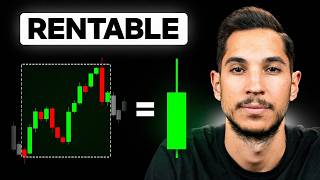

Why Most Traders Lose with Fair Value Gaps
45sHighlights the common mistake of seeing FVGs as quick money and reveals big player manipulation, sparking curiosity and debate.
▶ Play Clip"Title promises easy FVG trading, and the video delivers a clear, actionable method, though it emphasizes that success isn't guaranteed."
This video explains how to trade Fair Value Gaps (FVGs) effectively by following a five-step method that increases the probability of success. The presenter emphasizes that FVGs are not a guaranteed quick-profit tool and that traders must consider additional factors like testing, breakout, confluences, position, and structure to avoid common pitfalls.
Millions of traders use Fair Value Gaps daily, but novice traders see them as easy money, leading to mistakes. Big players exploit this popularity to manipulate markets.
An FVG is a three-candle pattern with an incomplete space between the high of the first candle and the low of the third (bullish) or between the low of the first and high of the third (bearish).
FVGs act like support and resistance levels. Price tends to test these gaps, making them useful for placing limit orders.
The presenter introduces a five-step method to identify high-probability FVGs and avoid low-probability ones.
Avoid FVGs that are tested immediately after formation; they have lower success probability. A delayed test is preferable.
If price breaks forcefully through the FVG and closes beyond it, the gap is invalidated. A clean rejection is needed.
Combine FVGs with other support/resistance levels (e.g., previous lows/highs) to increase probability.
In a strong trend, multiple FVGs form. Those farther from the current price have higher probability of rejection than those closer.
Use TradingView's 'Labels' tool with Fibonacci levels (0, 0.5, 1) to identify strong vs. weak FVG zones.
A change in price structure (higher highs for bullish, lower lows for bearish) combined with an FVG increases success probability.
Not all five steps must be present, but more steps increase the probability of a successful trade.
The presenter shows a trade where structural change, FVG, and confluence with previous support/resistance lead to a profitable short trade.
Trading Fair Value Gaps requires a systematic approach beyond simply identifying gaps. By applying the five-step method—testing, breakout, confluences, position, and structure—traders can significantly improve their odds of success.
What is a Fair Value Gap (FVG)?
A three-candle pattern with an incomplete space between the high of the first and low of the third (bullish) or low of first and high of third (bearish).
01:15
Why do novice traders often fail with FVGs?
They see FVGs as quick and easy money, ignoring that big players manipulate them.
00:15
What is the first step of the five-step method?
Testing: avoid FVGs tested immediately after formation; prefer delayed tests.
05:06
What invalidates an FVG according to step 2?
If price breaks forcefully through the FVG and closes beyond it.
06:17
What does 'confluences' mean in the context of FVGs?
Combining the FVG with other support/resistance levels to increase probability.
07:00
In a strong trend, which FVGs have higher probability of rejection?
Those farther from the current price.
08:01
What tool in TradingView helps identify strong vs. weak FVG zones?
The 'Labels' tool with Fibonacci levels (0, 0.5, 1).
09:23
What structural change is needed for a bearish continuation FVG?
Lower lows (break of previous lows).
11:02
Is it necessary to have all five steps present to trade an FVG?
No, but more steps increase the probability of success.
12:01
Popularity leads to manipulation
Highlights a key market reality: popular strategies are exploited by big players.
00:02Clear FVG definition
Provides a precise, easy-to-understand definition of the core concept.
01:15Testing step
Introduces a critical filter to avoid low-probability FVGs.
05:06Confluences increase probability
Emphasizes the importance of multiple confirmations, a universal trading principle.
07:00Complete trade example
Demonstrates the method in action, showing how to combine all steps.
12:43[00:02] one of the best tools for trading. Every day, millions of traders worldwide use fire value gaps in their trading strategies and make money with them. But as always happens in the
[00:15] trading world, when something becomes popular, problems begin. Novice and beginner traders see this element as a way to make quick and easy money—a serious mistake. Furthermore, the
[00:31] big players realize that it's a very popular element and take advantage of it to manipulate and profit from it. That's why some fire value gaps work, while others do n't. But beyond the fact that nothing
[00:47] works 100% of the time in the trading world, there are certain concepts that, if followed, I assure you will greatly increase your chances greatly increase your chances of success trading fire value gaps. So
[01:00] in this video, I'm going to explain what a fire value gap is, why they work so well for trading, and what five specific, very easy-to-follow steps will allow you to start making money trading fire value gaps, even if
[01:15] trading fire value gaps, even if you're a simply a three-candle pattern where there's an
[01:30] incomplete space between the first and third candles. Here, for example, you're seeing a bullish candle followed by another bullish candle and a third bullish candle. If you look closely, between the high of the first candle and the low of
[01:46] the third, there's an incomplete space. This is an FVG. If one of these two candles had filled that space, either with the high of the
[01:58] first or the low of the third, there wouldn't be a fire value gap. And obviously, the same thing happens with bearish fire value gaps. For example, in this case, you're seeing a bearish candle followed by
[02:14] another bearish candle and a third bearish candle. If you look closely, between the low of the first candle and the high of the third, there's an incomplete space. This is an FVG. If one of these two candles had filled that space, either
[02:31] with the low of the first or the high of the third, there wouldn't be a fire value gap. Value gaps typically occur within an uptrend, where, for example, each time the price breaks through resistance levels and forms higher highs and higher lows,
[02:45] resistance levels and forms higher highs and higher lows, resistance levels, now acting as support, and can be represented by moving averages, Fibonacci levels, or even fire value gaps. Here you can see a
[03:01] downward movement where a fire value gap has formed. Similarly, we can use moving averages, Fibonacci levels, or any other zone that was
[03:13] previously support but is now resistance. Just as the price will want to test those levels, it will also want to test the fire value gap itself. Therefore, many trading strategies are based on waiting for the price to attack this
[03:27] fire value gap to place a buy limit order and a stop loss order above it. However, it's not about looking for empty spaces between three candlesticks, drawing boxes, and waiting for the price to
[03:41] reach those levels to place a buy or sell limit order and then start making money trading. It's about trading in the same way as with any other support and resistance tool. Technical patterns, resistance levels, candlestick patterns,
[03:55] moving average crossovers—you need to use them more to create a strategy that encompasses certain aspects and moves in the same direction. The same applies to first value gaps. Surrounding
[04:09] first value gaps and considering parallel structures that can complement them allows you to be profitable trading with first value gaps if you take them into account. Or, conversely, it can make you unprofitable.
[04:24] So, with this five-step method, I'm not only going to teach you how to find the best first value gaps for trading, but I'll also teach you how to detect first value gaps with lower probabilities of
[04:39] success. What I assure you is total success is if you like not already, and if you leave a the video and what kind of content you'd like me to upload
[04:52] next. Also, remember that below, in the first pinned comment and in the description of this video, you'll find other links of interest such as courses, tutorials, training, more content about Smart Money, etc. etc.,
[05:06] simply so you can continue learning as a trader without needing to invest your money. Step number one: testing. We're not interested in the price quickly testing a fire value gap once it's formed,
[05:19] as that obviously doesn't invalidate the possibility of the fire value gap being valid, but it does significantly reduce its probability. Notice how in this case a large fire value gap forms, but the very
[05:34] value gap forms, but the very next candle after its formation already generates a test. Not only does the first candle test it, but the second candle does as well. Then the price creates a little more space, but it's to
[05:48] get right into the fire value gap and end up breaking it forcefully. On the other hand, notice in this case how once the fire value gap has formed, what happens is that a kind of arc forms, which causes
[06:04] the fire value gap itself to be tested again, but later. Result: retesting, rejection, and continuation downwards. Step number two: breakout. We're not interested in the price not
[06:17] reaching the fire value gap, nor in the price breaking forcefully and closing below it. or above the FVG. Since in both cases it is completely invalidated, notice how in this case a fire value gap forms. The
[06:34] price tests it, then tests it again strongly, even clearly breaking below it. And although it then seems that it can continue upwards, it
[06:46] ends up reversing again. Step number three: confluences. In the same way that occurs with any other element of technical analysis where we don't want to trade only patterns,
[07:00] only supports and resistances, only moving averages, the same thing happens with fire value gaps. It is what we have discussed previously. And that is that adding certain zones that can support that fire value gap in the form of support or
[07:15] resistance will add an extra probability that the fire value gap will act as such and that you can execute a profitable trade. In this case we can see an upward movement with a large-bodied candle that forms
[07:31] a large-bodied candle that forms a fairly clear fire value gap. At this precise moment we can expect the price to attack that FVG zone, but also if we notice on the left side of the chart we have a
[07:45] left side of the chart we have a low that converges with the zone of So the probabilities of the price testing that level and also rejecting that structure to give an upward continuation are really high. Step
[08:01] number four: position before, we mentioned that a fire value gap is a three-candlestick pattern, but the fact that it's a three-candlestick pattern doesn't mean that there has to be a fire value gap in every move. Only if there's a
[08:15] clearly bullish or clearly bearish move will there be multiple fire value multiple fire value gaps. Well, depending on the position of the gaps. Well, depending on the position of the
[08:28] lower probabilities of success. Notice what a clear bearish move has formed, and starting from the top, not one, not two, not three, not
[08:40] four, not five, but six different fire value gaps have formed. And now you might ask what point the price can reach to reject a fire value gap and give that
[08:54] bearish continuation. Well, the reality is that the fire value gaps that are further from the price—that is, these first three fire value gaps—have a higher probability of rejection and
[09:08] downward continuation than the fire value gaps that are closer to the price. Price. That is, the last three fire value gaps, which means this upper zone has a much higher probability of success than this entire lower zone. In fact, there's a tool in
[09:23] TradingView that can help you detect these levels. To do this, go to the top left where your profile picture is. where your profile picture is.
[10:01] interested in any of them: the labels on the right and the labels on the left. the right and the labels on the left. three: the zero level, the 0.5 level, and the 1 level.
[10:18] Once you have it configured, click " accept," and something like this will appear, marking the 0.50 point and indicating which is the strongest zone (in this case, it's this upper zone where these fire value gaps appear) and
[10:35] which is the weakest zone (in this case, it's this lower zone where this lower zone where these fire value gaps appear). So, from the 0.50 level onward, you can interpret that the fire value gap could be an optimal
[10:50] turning point. Let's see what ends up happening with this movement. We realize that the price rejects a Fire Value Gap located above the
[11:02] 0.50 level and continues with that bearish movement. Step number five: structure for trading a high-probability Fire Value Gap. There should have been a change in the price structure itself, generating higher highs if you
[11:18] are looking for a bullish continuation Fire Value Gap, or conversely, lower lows if you are looking for a bearish continuation Fire Value Gap. Note that in this case, the price not only forms a downward movement but also
[11:32] breaks the previous lows, causing that change in structure. Combined with the Fire Value Gap of one of the breakout candles, it generates a high probability that when the price tests that Fire Value Gap, it will be to
[11:47] give that bearish continuation that ends up forming, continuing with that downward trend. And before showing you a complete example with each of these elements we have discussed, I imagine you might be asking yourself
[12:01] the following question: Hey Alex, do all five steps have to be present in each of the Fire Value Gaps I trade? The answer Obviously, you don't have to wait for all five elements I mentioned to be present to
[12:14] trade fire value gaps. But the reality is that the more elements there are within the fire value gap you're trading, the higher the probability of success for that trade. Even if you find all five elements in every
[12:29] fire value gap you trade, it doesn't mean that every fire value gap will be a positive trade. However, it is true that the more elements there are, the higher the probability of success for each
[12:43] trading. Notice that in this case, the price is hesitating between forming an upward continuation or forming a kind of accumulation, but ultimately a breakout from the lower boundary occurs, thus initiating a
[13:00] structural change. At that moment, not only is the structural change formed, but a clear fire value gap also forms. So we now have a reference zone that also connects to a previous support level. This zone you
[13:16] 're seeing now is superimposed on the fire value gap, but it's now a resistance level. So, step number one: structural change. Number two: Fire Value Gap. Step number three: Confluence between the
[13:30] Fire Value Gap and the previous support level, now resistance. So we can place a limit sell order at the point where the two levels converge, a stop loss above the Fire Value Gap, a take profit in the
[13:47] recent lows area, and wait for the price to attack those levels so the position is automatically executed through a high-probability Fire Value Gap. And in this case, a continuation to the downside reaches
[14:03] our set take profit in just a few hours. Remember that below, in the first pinned comment and in the description of this video, you'll not only find other courses, tutorials, training, and profitable trading strategies, but
[14:17] you'll also find a specific list of Smart Money and ICT discussing different strategy concepts and other elements that can help you improve without investing your own money. I
[14:32] 'll leave this video here. I hope you liked it and that it was helpful, which is the important thing. If so, like, subscribe, share it with friends and family, and I'll see you in the next video. Goodbye.
⚡ Saved you 0h 14m reading this? Transcribe any YouTube video for free — no signup needed.