
The Rise and Fall of Electric Cars
36sSurprising historical fact that electric cars were popular in 1900 but died due to battery issues.
▶ Play Clip"The title 'Electric cars vs Petrol cars' is accurate but somewhat generic; the video delivers a detailed technical comparison as promised."
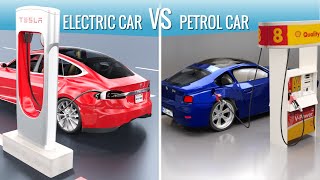
This video compares electric vehicles (EVs) and internal combustion engine (ICE) cars on technical metrics like power, weight, efficiency, and economics. It traces the historical decline and recent revival of EVs, and concludes that while ICE cars still offer faster refueling and higher energy density, EVs are superior in torque, control, and long-term cost.
Electric cars were popular in 1900, but poor battery tech and rise of petrol engines killed them by 1920. Improvements in batteries and power electronics have revived them.
ICE uses pistons, crank mechanism, and transmission. EV uses battery, inverter, and induction motor with rotating magnetic field.
EV motors are lighter and produce more power/torque than ICE engines. However, battery weight is a major penalty.
ICE refuels in 5 min. EV takes 1+ hour. Gasoline has far higher energy density than lithium-ion batteries.
Heavy battery low to ground lowers center of gravity, increasing stability and safety. Also provides structural rigidity.
EV motor works efficiently over wide speed range, so no transmission needed. ICE requires complex transmission and performs poorly at low RPM.
EV provides instant torque from start, superior traction control. ICE struggles at low RPM and needs DC motor to start.
EV motor acts as generator. ICE needs separate BLDC motor and battery for regeneration.
EV cost per mile is lower based on US prices. Maintenance also cheaper. ICE tech is nearly saturated while EV tech is improving rapidly.
While ICE cars still win on refueling speed and energy density, EVs dominate in torque, efficiency, safety, and long-term costs. With ICE tech saturated and EVs advancing fast, electric cars are the future.
Why did electric cars die out by 1920?
Sudden rise of petrol engines and battery technology inefficiencies killed electric cars by 1920.
00:12
What converts DC battery power to three-phase AC in an electric car?
An inverter.
01:05
What is a key mechanical disadvantage of an IC engine compared to an electric motor?
The reciprocating components cause substantial mechanical balancing issues and it is not self-started.
01:19
How can you control the speed of an induction motor?
By adjusting the frequency of the AC power input.
01:54
What is the typical refueling time for a petrol car vs recharging for an electric car?
Petrol car: 5 minutes or less. Electric car: at least 1 hour.
02:36
What is a disadvantage of the poor energy density of batteries?
It produces a huge weight penalty, reducing tire-road friction and making cornering difficult.
03:05
How does the heavy battery pack improve electric car safety?
Low center of gravity increases stability, and the pack spread across the floor offers structural rigidity against side collisions.
03:48
Why do electric cars not need a speed-varying transmission?
The motor works efficiently over a wide speed range, so speed can be controlled directly from the motor via the inverter.
04:31
What technological improvement played a key role in the revival of electric cars?
Improvements in the software behind inverter power electronics.
04:58
How does an electric car achieve regenerative braking?
The same induction motor acts as a generator.
05:45
Based on US prices, which car type is cheaper per mile?
Electric cars are at least one-third cheaper per mile.
05:59
Motor light weight and high power
Reveals a fundamental advantage of electric motors over ICE: they produce more power and torque despite being lighter.
01:54Refueling vs charging time
Exposes the biggest practical disadvantage of current EVs compared to petrol cars.
02:36Battery pack improves safety
Highlights an unexpected benefit: the heavy battery pack lowers center of gravity and adds structural rigidity.
03:48No transmission needed in EV
Explains a key engineering simplification that reduces cost and complexity in EVs.
04:31EVs are cheaper per mile
Provides the economic verdict: despite higher upfront cost, EVs are cheaper to run and maintain.
05:59[00:00] Electric cars are internal combustion engine cars. Which is better? Electric cars were in their heyday back in 1900, but a sudden rise in petrol engine cars,
[00:12] accompanied by battery technology inefficiencies, killed electric cars by 1920. However, with recent improvements in battery technology and power electronics, electric
[00:24] cars have made a strong comeback. We will compare these totally different technologies scientifically and come to understand which is superior. An IC engine is the prime mover in petrol cars.
[00:38] The fuel supplied to the engine produces combustion and enough pressure and temperature energy to move the pistons. The linear motion of the piston is transferred to rotary motion using a slider crank mechanism.
[00:53] A transmission is used to transfer this rotation to the drive wheels. In an electric car, the power source is from a battery pack.
[01:05] An inverter converts the DC battery power into three-phase AC. The three-phase AC can turn an induction motor, which will thus turn the drive wheel.
[01:19] Now let us directly compare these technologies. In an IC engine, the force and power production is never uniform. The reciprocating components cause substantial mechanical balancing issues. In addition, the engine is not self-started.
[01:34] Many accessories are needed to sort out these issues which makes an IC engine quite heavy Such issues are not there in an electric motor The induction motors work with the help of a rotating magnetic field generated by the stator You can easily control motor speed by adjusting the frequency of the AC power
[01:54] input. They produce uniform power and speed output and are self-started. For these reasons, an induction motor is much lighter than an IC engine and at the same time produces much greater power and torque output.
[02:09] It is interesting to note that both the IC engine and induction motor require cooling. Both the prime movers must reject the waste heat generated in order to keep the temperature within a certain limit. However, it is worth noting that the waste heat generated by an induction motor is much
[02:24] lower than that of an IC engine. The main advantage of an IC engine car is the ease with which it can be refueled. A petrol car can be refueled in five minutes or less.
[02:36] However, recharging electric cars can take at least one hour as of this present moment. Another major advantage of petrol cars over electric cars pertains to their high energy density. The energy density of current lithium-ion battery is nowhere near to that of the gasoline.
[02:53] Both these cars produce comparable travel ranges. You can just compare the size and weight of their energy storage devices. The poor energy density of the battery produces a huge weight penalty to the electric car.
[03:05] The huge weight of the car reduces the coefficient of friction between the tire and road considerably, making cornering difficult.
[03:17] The battery pack also has huge heat generation issues. If you tear down the battery pack of an electric car you will see that the battery pack is a collection of common lithium cells that you might use in your daily life Continuous liquid cooling is required to keep battery temperatures at normal levels
[03:35] The removed heat is rejected to the atmosphere via a radiator. A petrol car's energy storage part does not require any such cooling mechanism. The battery pack of electric cars does have advantages as well.
[03:48] Because the heavy battery pack is sitting very low to the ground, it lowers the center of gravity and increases car stability. Thus, overall safety is increased. The large battery pack is also spread across the floor,
[04:02] offering structural rigidity against side collisions. Another primary difference visible from these visuals is that in an IC engine car, a complex exhaust gas treatment is needed to keep pollutants and noise at statutory levels.
[04:16] Now, let's compare the power dynamics of these two technologies. Electric cars are the clear winner here. IC engines cannot be operated beyond a certain speed range.
[04:31] This necessitates the use of a complex and costly transmission mechanism for speed control. The motor can work efficiently in a wide speed range. So, in an electric car, speed can be controlled directly from the motor.
[04:45] As a result, a speed-varying transmission is not required for an electric car. Induction motor speed is accurately controlled by the inverter simply by adjusting the output power frequency.
[04:58] In fact, improvements made in the last decade to the software behind inverter power electronics played a key role in the revival of electric cars The electric car can produce great torque even at the start whereas an IC engine car will struggle at low RPM A DC motor is thus needed to take the engine to the optimum RPM range at the start
[05:21] Moreover, the torque and power of an electric motor can be controlled instantaneously, while the IC engines have a low response. This, in effect, leads to far superior traction controls in electric cars.
[05:33] Electric cars have inherent advantages when it comes to regenerative braking. The same induction motor acts as a generator here. In a petrol car, in order to achieve regenerative braking,
[05:45] you must install a separate BLDC motor and a battery pack. Before concluding the video, let's solve the big question. Which car is more economical? An electric car is much costlier than an average petrol car.
[05:59] However, to get the full picture, you must also compare the cost required to travel a mile. The calculation based on current U.S. gasoline and electricity prices shows that electric cars are at least one-third cheaper compared to petrol cars.
[06:15] Moreover, the maintenance cost of electric cars is also low when compared to IC engine cars. As you might already be aware, electric cars are much safer than internal combustion cars. With technological advancements in internal combustion engines almost saturated
[06:31] and rapid development of electric cars taking place, one can clearly see how electric cars have an edge over IC engine cars as the cars of the future. To learn more about this interesting topic, please check out this excellent video by the channel Kyle Drives.
[06:47] Kyle is an automobile expert and motorsport design and analysis engineer. Please support us at Patreon so that we can sustain our free educational service. Thank you.
⚡ Saved you 0h 06m reading this? Transcribe any YouTube video for free — no signup needed.