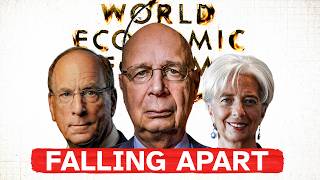

Spy Bug Found in WEF Founder's Office
45sThe shocking discovery of a spy device in Klaus Schwab's office immediately grabs attention, blending intrigue, irony, and high-stakes power struggles.
▶ Play Clip"Delivers on the promise of elite power struggles, but padded with repetitive commentary and a lengthy subscribe pitch."
The World Economic Forum (WEF) is embroiled in a leadership crisis following the resignation of its founder Klaus Schwab and CEO Børge Brende within 10 months, amid scandals and internal power struggles. The video analyzes the implications of this power vacuum, the rise of finance titans like BlackRock's Larry Fink as interim co-chair, and the deliberate shrinking of the WEF's board, which concentrates power and distances ordinary people from global policy decisions.
Klaus Schwab, founder of the WEF, filed a criminal complaint with Geneva prosecutors after a spying device was found in his home office, highlighting irony given his role in normalizing surveillance.
An anonymous whistleblower letter alleged $1.1 million in questionable expenses by Schwab and his wife, including hotel massages and first-class flights, plus claims of a toxic workplace and political manipulation of reports.
On April 20, 2025, the board accepted Schwab's resignation. An investigation by Swiss law firm Hamburger found 'no evidence of material wrongdoing,' but WSJ reported findings at odds with the public statement, and the interim chairman resigned citing a toxic environment.
In February 2026, CEO Børge Brende resigned after DOJ files revealed three business dinners with Jeffrey Epstein between 2018-2019. He cited avoiding 'distractions' but did not mention Epstein.
Andre Hoffman (vice chairman of Roche) and Larry Fink (CEO of BlackRock) were named interim co-chairs. BlackRock's assets under management crossed $14 trillion by end of 2025, making it the largest asset manager ever.
Reporting suggests a faction of trustees is moving to shrink the board from ~28 members to a tighter circle, dominated by business representatives, reducing friction and witnesses to decision-making.
Schwab has sent letters to board members with legal threats and a demand list: advisory role over successor, reinstated security, access to premises, sign-off on farewell trips, and half his legal costs covered. He received a $7 million exit package.
Schwab is pushing for Christine Lagarde, ECB President, to succeed him, but Fink and Hoffman resist, wanting a 'more institutional model.' Lagarde has signaled she intends to finish her ECB term through October 2027.
BlackRock's $14 trillion in assets influences policy, with Fink arguing AI data center funding should come from ordinary Americans' savings and pensions. This affects index funds and workplace pensions, while monetary policy by officials like Lagarde dictates the value of savings.
The WEF's leadership crisis and board consolidation represent a deliberate concentration of power among financial elites, with ordinary savers and households bearing the consequences. The shrinking room means fewer voices and greater distance between decision-makers and the public, making it crucial to stay informed about these power dynamics.
What triggered Klaus Schwab's resignation from the WEF?
An anonymous whistleblower letter alleging $1.1 million in questionable expenses and a toxic workplace.
01:35
Who are the interim co-chairs of the WEF after the leadership crisis?
Andre Hoffman (vice chairman of Roche) and Larry Fink (CEO of BlackRock).
04:49
What is BlackRock's assets under management by end of 2025?
Over $14 trillion, the first firm to hit that threshold.
05:15
Why did CEO Børge Brende resign in February 2026?
After DOJ files revealed he had three business dinners with Jeffrey Epstein between 2018-2019.
03:55
What are the reported demands Klaus Schwab made after his resignation?
Advisory role over successor, reinstated security, access to premises, sign-off on farewell trips, and half his legal costs covered.
08:30
Who is Schwab pushing to succeed him as WEF leader?
Christine Lagarde, the sitting president of the European Central Bank.
10:34
What is the reported direction of the WEF board's size?
Shrinking from ~28 members to a tighter circle dominated by business representatives.
06:23
What did Larry Fink argue about funding for AI data centers?
That it should come from ordinary Americans' savings and pensions.
12:21
Irony of Surveillance
Highlights the hypocrisy of a figure who normalized mass surveillance now fearing being watched.
Investigation Findings Contradict Public Statement
Reveals potential cover-up in the WEF's internal investigation, undermining trust in the institution.
03:25BlackRock's $14 Trillion AUM
Demonstrates the immense scale of financial power now co-steering the WEF.
05:15Board Shrinking as Consolidation
Illustrates the deliberate concentration of power and reduction of oversight in global policy-making.
06:23Pension Funds as AI Infrastructure Funding
Shows a direct conflict of interest where elite decisions could redirect ordinary people's savings.
12:21[00:00] The World Economic Forum is turning into Game of Thrones. The man who put together the most exclusive room in global politics just found a spying device hidden inside his own home
[00:12] office. That's right. None other than Claus Schwab, the founder of the W filed a criminal complaint with the Geneva prosecutors [music] against well, persons unknown. Yep. The irony
[00:27] here is nothing short of perfect. The architect of the world's most powerful influence network, the one thing that helped normalize mass surveillance, is now concerned that he's the
[00:39] one being watched. But the timing, it would seem, is no accident. [music] This bug surfaced right in the middle of a bitter [music] behind closed doors war for control of Davos itself. A war that
[00:54] has already claimed the forum's founder and its chief executive in under a [music] year and left the most exclusive institution in global policy effectively leaderless. So today we break down how
[01:06] the W lost both its heads in [music] the space of 10 months, who's walking into that empty room to seize control, and why a boardroom getting [music] smaller and more closed by design should worry
[01:19] anyone whose life is shaped [music] inside it. And spoiler, that's everyone, including you and I. My name is [music] Nick and this is the Coin Bureau. Now, to understand just how deep the crisis runs,
[01:35] we have to rewind to April 2025 because that's when the whole thing started to unravel. An anonymous whistleblower letter landed on the desks of the W's board of trustees and the allegations
[01:48] inside it were spicy to say the least. roughly $1.1 million in questionable expenses build by Schwab and his wife Hilda to the forum. We're talking 14 hotel massages, first class flights for
[02:03] a wife who held no official WE role and traveled to Venice, the Sey Shells, Monaco, and Miami with, shall we say, an unclear business purpose. The letter also alleged a toxic workplace and claimed
[02:18] Schwab pressured staff to alter the forum's flagship competitiveness report for political ends. Now Schwab has denied all of it, calling the allegations quote stupid and constructed. But on
[02:32] the 20th of April 2025, the board accepted his resignation with immediate effect. The founder was out and the forum did what these types of institutions tend to do when the walls start
[02:45] shaking. It commissioned an investigation run by the Swiss law firm Hamburger. And by August 2025, the board publicly announced it had found quote no evidence of material wrongdoing. Case closed, or
[03:00] so they said, because the story certainly doesn't end there. The Wall Street Journal reported that the lawyers running that probe presented findings on discrimination, data integrity breaches, and
[03:12] misuse of funds that were quote at odds with the board's clean public statement. In other words, what they said in public and what they found in private may not have been the same thing. And
[03:25] guys, get this. The interim chairman who pushed for that investigation resigned right after the final report dropped, citing a toxic environment. So if the man cleaning up the mess decides to walk
[03:38] out rather than sign off on the verdict, something isn't adding up. Now that alone would be a crisis, but the W wasn't done losing leaders. Fast forward to February 2026. CEO Bora Brenda after more than
[03:55] 8 years running the place resigns on the 26th. The reason Department of Justice files released that month revealed Brenda had three business dinners with uh Jeffrey Epstein between 2018 and 2019,
[04:10] plus emails and text messages. He said he was stepping down so the forum could continue its work, quote, without distractions. As you might no doubt imagine, he conveniently failed to mention
[04:22] Epstein in his official resignation. So, let's just tally this up. In the space of 10 months, the World Economic Forum lost its founder and its chief executive. No permanent chair, no permanent
[04:35] CEO. The most exclusive room in global policy suddenly had nobody sitting at the head of the table. So guys, the question then becomes, who walks into a room like that when it's empty?
[04:49] And well, uh, the answer should set alarm bells in your head because in the vacuum left behind, two men were named interim co-chairs. Andre Hoffman, the vice chairman of farmer giant rush,
[05:03] and Larry Frink, the chief executive of BlackRock, the largest asset manager the world has ever seen. Now, you've probably heard that stated before, but let's put Black Rockck scale into a bit of
[05:15] perspective because the numbers here are just insane. Black Rockck's assets under management crossed $14 trillion by the end of 2025. That's the first firm in history to hit that threshold.
[05:28] Now, for comparison, its closest rival, Vanguard, sits at around $12 trillion, and Fidelity sits at around $7.1 trillion based on its year-end 2025 reported managed
[05:40] assets. There's uh no way to escape it. This is the institutional infrastructure of global finance. Now, Black Rockck's market cap, which is of course the value of the company itself,
[05:52] sits somewhere between 160 and $180 billion. But the money it controls and steers is $14 trillion. The gap between what Black Rockck owns and what Black Rockck influences is the focus
[06:08] over here. The world's largest pool of capital is co- steering the most influential private forum on Earth. And that resulted in Mr. Frink earning a new title from the media, the mayor of Davos.
[06:23] Except as one analyst framing put it, the new mayor of Davos is simply a massive balance sheet. This is pure consolidation. It's about deciding who gets a seat at the table where global policy
[06:37] gets shaped. And that brings us to the part where the table itself starts to shrink. For most of its life, the West Board of Trustees was a broad sprawling thing. Historically around 28 members,
[06:51] governments, scientists, civil society, business, a messy multi-shareholder mix, at least on paper. But reporting from just this month suggests a faction of trustees is now moving to shrink
[07:04] that board into a much tighter circle. Fewer trustees and concentrated authority, a smaller governing board that's being increasingly dominated by business representatives. Now, there's no hard confirmation on the final headcount, but the direction is well reported,
[07:20] and the logic behind it makes perfect sense. A smaller board means less friction, fewer voices to slow a decision down, and crucially fewer witnesses to how those decisions get made.
[07:35] The multistakeholder model gets retired and in its place you get a boardroom for the global economy that is becoming a lot smaller but a lot more powerful. And for the everyday person,
[07:48] the thing to remember is this. The fewer people in that room, the further away you are from it. And that guys is exactly why it's so important on keeping up with this kind of stuff. So, if you
[08:01] want more coverage like this, breaking down who really pulls the levers behind the madness you're seeing in the headlines, then you should subscribe to the Finance Bureau channel. And that's where we cover global finance, macro trends, and the power struggle shaping your life and your livelihood.
[08:18] So, if you want to be prepared for the crazy world we're living in, then check out the Finance Bureau right now by hitting this QR code on the left of your screen. Right now, back to Schwab. Because if
[08:30] you think a man forced out over a $1.1 million expenses scandal would go quietly, well, think again. Claus Schwab is not retiring to go and live out his golden years in the Swiss countryside. No,
[08:44] no, he's fighting. According to the Wall Street Journal, Schwab has been sending letters to the WE board members packed with legal threats, accusing the organization of quote deploying
[08:56] money and using advisers to diminish his legacy. And along with those threats comes a demand list. So, let's take a closer look at this list because it pretty much speaks for itself. One,
[09:10] an advisory role that gives him sway over who his successor actually is. Two, his personal security detail reinstated. Three, continued access to we premises and communications. Four, sign off on
[09:26] socalled farewell trips for him and his wife to the forum's overseas offices. And five, half his personal legal costs covered. That's quite the list of demands, and it hardly reads
[09:39] like a wish list of a man packing up his desk. Uh, that sounds like a man negotiating to keep his place. And it gets better because there's already money on the table. Schwab reportedly received an
[09:52] exit package worth around $7 million. This is basically a pension style payment on top of his standard Swiss entitlements structured as two cash installments. The first was paid in December
[10:04] 2025 and the second is due in December 2026. But the thing to really focus on is this. Threatening lawsuits and demanding sign off on a goodbye tour aren't really the actions of a man who's actually
[10:19] leaving. And Schwab has one more card he's trying to play. A name that he once installed as the heir to the original throne. And it's a big one. Schwab has been pushing for Christine Lugard to succeed
[10:34] him, the sitting president of the European Central Bank. And that would mean we'd have a serving central banker, one of the most powerful monetary officials on the planet, positioned to run Davos. The line between central banking and the world's most powerful private forum effectively erased.
[10:52] Now, just a quick reminder that this is not a done deal. Lagard has signaled she intends to finish her ECB term, which runs through October 2027. So, this is a bit like the crown just
[11:04] being dangled in front of her face, at least for now. And there's yet another twist to the story because the people currently running things while trying to shrink the board, Frink and Hoffman,
[11:16] are apparently resistant to Lagard. They want a quote more institutional model, which is just corporate speak for no single dominant figurehead. Schwab is now fighting to install his preferred
[11:30] heir against the faction that pushed him out. Which means even if Lagard wanted the job, she'd be walking straight into the middle of a factional war as opposed to a clean handover.
[11:42] And that, my friends, appears to be the real state of Davos right now. A leaderless institution with a finance titan consolidating control while a powerful central banker has been thrown into
[11:55] the mix just for good measure. Now you might be thinking, "Well, Nick, this is amazing. Let them squabble. None of this really impacts me at the end of the day." And indeed, most of us will never
[12:08] ever set foot in a room or receive an invitation to Davos. But that's precisely the point because the decisions shaped inside it don't stay inside it. Black Rockck's $14 trillion in assets gives
[12:21] it the power to influence the policy governing where that money flows. Larry Frink has argued that funding for the AI data center buildout should come from ordinary Americans savings and
[12:33] pensions. And that is about as creepy and crony capitalist as it sounds. The man co- steering Davos wants your retirement money redirected into the infrastructure his firm profits from building.
[12:47] Black Rockck is likely a top shareholder in your index funds and its decisions ripple straight through your workplace pension. Meanwhile, the monetary policy set by officials like Lagard
[12:59] dictates the real value of every pound and dollar you've put aside. The asymmetry here is just mind-boggling. The people in that shrinking room can read the board. They can position, hedge, and
[13:13] profit from decisions before you even know they were made. You get to find out afterwards on your bank statement or your portfolio. And the smaller and more closed that room becomes by design,
[13:26] the wider the divide gets. This room is shrinking deliberately to tighten its grip on global policy. So, who ends up profiting in this situation? Well, the finance titans, of course, sitting pretty in
[13:41] boardrooms with fewer chairs and fewer questions. The central bankers being offered the crown. And then we have the insiders who were always going to be in the room. Whoever won the fight. And
[13:54] who pays here? Well, it's the ordinary everyday saver whose pension is being volunteered to fund whatever it is the elites decide should get your money. The ordinary household on the wrong side of
[14:08] policy written by people they never elected and will never meet. The story of the bug in Claus Schwab's office marks the start of a new era and most of us will be left permanently outside the
[14:21] door. But what do you think? Does it actually matter who wins the fight in Davos, Schwab's old god or thinks inner circle if you're stuck outside the room either way? Or is a smaller,
[14:35] more concentrated Davos a greater threat? Let us know your thoughts in the comments down below. And if you want more topics like this, then you should check out this Finance Bureau video on how China
[14:47] is set to collapse the global economy. But that's all from me today, though. As always, thank you guys very much for watching and I'll see you over on the Finance Bureau. This is Nick signing off.




⚡ Saved you 0h 15m reading this? Transcribe any YouTube video for free — no signup needed.