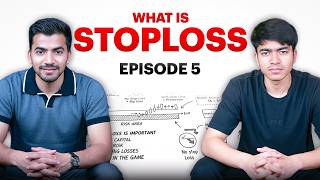

I'd Hold a Losing Trade Until It Reverses
53sRelatable beginner mindset that instantly hooks anyone who has made the same costly mistake.
▶ Play Clip"Delivers what the title promises — a solid beginner lesson on stop loss — but repeats itself and includes a sponsor plug."
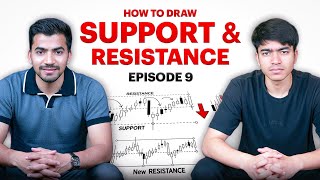
This episode of a beginner trading series focuses on the single most important rule in trading: the stop loss. The host explains what a stop loss is, why it is crucial for protecting capital, and how beginners consistently avoid using it due to hope and fear. Using simple examples and a simulated account, the video demonstrates how disciplined stop-loss usage keeps traders in the market and creates long-term profit opportunities.
When asked what he would do if a trade went against him, the host's brother replied, 'I will hold it until it reverses.' This shows a complete lack of awareness about using a stop loss — a common issue among beginners.
Stop loss is made of two words: stop and loss. 'Loss' means losing money, and 'stop' means to prevent. A stop loss is a barrier that ensures you lose only a fixed, predetermined amount and no more.
If you enter a trade at ₹100 with ₹10,000 capital and the price drops to ₹90, a stop loss exits the trade and limits your loss to ₹1,000. Without it, holding on could wipe out the entire account.
The main job of a stop loss is to save your capital. It protects the money in your trading account by keeping losses small, and it should be placed before entering any trade.
Losing only 10% (₹1,000) on a ₹10,000 account leaves ₹9,000, giving you nine more trade opportunities. If you make 50% on just one of those trades, you profit; if two trades hit, your account doubles.
The biggest mistake beginners make is not placing a stop loss because they think it will hit and then hoping the market reverses. This combination of hope and fear keeps them from using stop losses.
You must be willing to give money to the market, but the amount you give must be under your control. A stop loss is what puts that control in your hands.
A professional is always ready to lose money by managing risk. The host shares his own example: willing to risk ₹500 to make ₹10–12 lakh, accepting losses while capturing larger profits.
On ₹10,000 capital with a ₹1,000 stop loss: two SL hits bring the account to ₹8,000, then a 1:3 target hit earns ₹3,000, bringing it to ₹11,000. Repeating this creates growth despite losses.
If you risk ₹1,000, your target should be at least 1:2 or 1:3 (e.g., ₹2,000–₹3,000). This risk-reward ratio is what makes the strategy profitable over many trades.
Beginners try to avoid all losses, while professionals focus on controlling losses. Avoiding losses by not using SL actually increases losses and wipes out capital; controlling losses keeps you in the game.
Taking a stop loss today leaves money for tomorrow. Over time and with experience, traders learn to accept losses and stop revenge trading — a critical lesson for long-term survival.
The stop loss is the foundation of professional trading: it caps losses, preserves capital, and creates ongoing opportunities to profit. Beginners must overcome hope and fear, accept controlled losses, and let discipline — not emotion — drive their trading decisions.
What is a stop loss?
A predetermined price level at which you exit a losing trade to cap your loss.
02:53
What do 'stop' and 'loss' mean in the term stop loss?
'Loss' means losing money, and 'stop' means to prevent or put a barrier, so you limit your loss.
03:07
In the example with entry at ₹100 and stop loss at ₹90, how much is lost on a ₹10,000 investment?
₹1,000, which is a 10% loss.
04:35
How many additional trades do you get if you lose only 10% of a ₹10,000 account each time?
Nine more trades, because you keep ₹9,000.
07:18
What are the two biggest beginner mistakes that prevent placing a stop loss?
Hope trading (hoping the price reverses) and fear of losing money.
08:40
What is hope trading?
Holding a losing trade in the hope that the market will reverse in your favor.
08:54
What risk-reward ratio did the trainer suggest when risking ₹1,000?
At least 1:2 or 1:3, e.g., target ₹2,000–₹3,000.
14:37
What is revenge trading?
Taking another trade in the opposite direction to recover a loss because you cannot accept the loss.
16:43
In the account simulation, what happens after Day 1 SL hit and Day 2 SL hit?
The account goes from ₹10,000 to ₹9,000 to ₹8,000.
14:10
What is the difference between beginners and professionals regarding losses?
Beginners try to avoid losses, while professionals try to control losses.
17:24
Definition of Stop Loss
Breaks the term down literally — stop + loss — giving beginners a clear mental model of protecting capital.
02:53Small Losses Create More Opportunities
Shows mathematically that a 10% loss leaves nine future trades, proving how capital preservation fuels long-term profitability.
07:18Professionals Accept Losses
The principle that you must be ready to give money to the market — but decide how much — separates professionals from beginners.
10:43Simulation Proves SL Saves Accounts
A concrete example of an account growing despite multiple stop-loss hits, demonstrating that discipline, not prediction, builds wealth.
13:42[00:06] how much capital we exactly start trading. But a big question came up there. And to I have brought today's episode. The first question I ask my brother is that brother, if
[00:20] any trade goes against you, what will you do? I will hold it. How Until it reverses. That means he doesn't even know that there is
[00:33] know this then I know that there are many beginners among you who don't know this and do n't even know how to use it. So today's video is going to be very important because in today's video we are going to cover what exactly a stop loss is. And for
[00:46] those who don't know about me my name is Dinesh Krola and you know me as stock burner and I am Arjunla. I am 17 years old and I am new in trading. So if he is new to trading then I am teaching him trading from zero so that he can become a profitable
[00:59] he will become a profitable trader or not, we will see that later. However, he also has a dream car that he wants to own at the age of 18 – a PSA 911. Now whether that will be possible or not, we will understand that only when he learns trading in the right way. So
[01:13] I thought why not if I am teaching him trading then the same series should be Because I know that at the level at which I will teach trading to my younger brother, So every beginner should get its benefit. So that is why we have uploaded the complete course
[01:27] complete series on YouTube for you people free of cost. So make sure you like this video. Subscribe to the channel and share this series with your beginner friends so that they can learn trading very well within the next 6 months.
[01:39] Ok? So without wasting your time, we are going to start today's topic directly. So brother, what is today's topic? What is stop loss? That is, what is stop loss? Ok? So if you look at the chart behind now, a trade is going on here. Is there a
[01:51] stop loss here? Yes, it is installed, right? So, what we're going to learn is that we've made an entry into this trade here. Our target price here is around $4,000. But
[02:07] $5,631 of $5,600. This means that if I want to make $4,000, I will have to pay some stop loss and risk some money in the market. That means $500 will go from my pocket here. So,
[02:26] we will understand why stop loss is there, why is there a need to use stop loss, you should also know that biggest mistake means mistake means
[02:39] after that we will understand how stop loss saves the account, when you deposit money in the trading account, how will your account remain saved, for that you will have to use stop loss and we will understand professional thinking, that is, how do I use stop loss. First of all let
[02:53] us talk about the first topic. What is stop loss? That is, what is stop loss? What are the two words in stop loss ? Stop and Loss. Stop and Loss ? Stop and Loss. Stop and Loss means STOP. The second is loss.
[03:07] What does loss mean? Loss means loss. Loss. That means your capital can become zero here. There may be loss. The money you brought can go away. Stop means what happened? prevent. prevent. That means you stop your loss, put a barrier
[03:23] , hold it. That means my loss should be this much only. I ca n't lose more beer than this. Now for example, you took up some trade. Ok? Your entry was made at ₹100 and ₹100 and you invested capital of ₹10,000 there.
[03:39] Invested the money. Now you placed the trade thinking that the price will go up from here. That means my ₹10,000 will increase to ₹00. Right? But what did you just see?
[03:51] Only the price will go up. By chance, what would you do if you came down? I would hold it. I would hold it. But till when would he hold it, till when would this ₹10,000 come down to ₹100, so how long would he hold it ? Until the price reverses. Until the price reverses. Now for
[04:05] example, this price did not reverse from here. Then what will happen? If Rs 10,000 is lost, there will be a loss. If Rs 10,000 is lost, there will be a loss. Meaning that the entire account will become zero. ? No, I will not be able to take it. Exactly to
[04:19] keep my losses under control, I have invested ₹10,000 in it. The price is ₹100. I want it to go from ₹100 to ₹200 but I want to control how much it falls below. That means ₹90. Ok? ₹100 comes to 90. That means
[04:35] Ok? ₹100 comes to 90. That means how much loss will I incur? Of ₹1. ₹1,000 ok. How much loss will there be on ₹1,000? If 100 came to 90 then ₹1000 of ₹1000 means I lost ₹1000 here. Now you invested ₹10,000. Till now at ₹10,000 you were
[04:49] thinking that brother, I will hold the price till it reaches there. If it goes down then it will all be zero. But that's what I told him to put a stop loss. If it comes down from 100 to 90 then you should exit. You will suffer a loss of only ₹1000. If it comes up,
[05:02] your ₹10,000 will become ₹00. So what is the benefit for you? Should I apply stop loss or not? Placing a stop loss. Now if placing stop loss is beneficial then what does it mean that stop loss is good for us. Is it
[05:15] Capital is saving our capital. Saving capital. That means our capital is being completely protected. So the job of stop loss is to save your capital. That means So the job of stop loss is to save your capital. That means
[05:30] What to put before the trade? Stop loss. Put a stop loss. Ok? Now let us talk about another topic that why exactly stop loss is so important? Isn't it? While walking, some understand something about saving capital. To save capital, that is, if you want to
[05:45] To save capital, that is, if you want to save your capital, then you will have to understand stop loss keys. Let me tell you how capital is saved here. As we
[05:58] required to start trading. We can start our trading with 10, 10, 5000, 10,000. So we invested capital of Rs 10,000 and with the capital of Rs 10,000 I have to trade in the market. Right? And I
[06:11] told you that it is very important to place stop loss. But why is it necessary? Let me tell you this. You entered a trade. You took a trade at ₹100. You said that ₹100 should go for ₹150. What was the percentage return? 50. I want to capture 50% of the returns.
[06:25] But I still have to trade further. Isn't it investing ₹10,000 in a single trade and I hold the same trade till it becomes zero, then what will happen to me, the capital will be wiped out to zero, but if I continue to trade further,
[06:41] then you will come to me again and say give me ₹10 more, then I will slap you and will not give you the money, I will say why did you make a loss, so that is why if you do not want to be beaten by me, do not want to listen to my scolding, then what will you have to do, you will have to save your capital, you will have to
[06:53] save it and how will you save it, by placing a stop loss, so what will happen here is that as soon as you took a trade at ₹100, you said if it reaches 90 then I will take a stop loss and exit. If it stays above 90 then
[07:06] I will hold. I have to hold it but I cannot go above 90 or below 90. That ? 10% of 10%. So if it goes down by 10%, how much will my account lose?
[07:18] One worth ₹1000. I will go negative here for only ₹1000. left? ₹900 ₹9000 So here we have saved capital of ₹9000. Now from ₹9000, if you take a stop loss of only ₹10000 in each trade and
[07:35] trades can you do further? Nine can trade nine. This means you have nine opportunities to trade. Now, if you make 50% in even one of those nine trades, then you will make a profit, right? If it is
[07:48] done in two trades also, your account will double. This means that the more you use stop loss correctly, the more your capital is saved and the more opportunities are created for you so that you can trade more in the future.
[08:03] So when opportunities are created for us, are they beneficial for us or loss beneficial, right? And you will be able to participate in those opportunities only when we have what? Capital will be capital. Otherwise, if you
[08:15] use the capital without stop loss, then all your money will become zero. Now let's talk about the biggest beginner mistake. Since he is a beginner, I ask him, brother, when you invest money in a trade or take a trade, why don't you put a stop loss?
[08:27] What is the reason? I feel that when I place a stop loss, it will hit my stop loss. It will hit. Well yes, if I do not place a stop loss then there are chances that it may reverse. The reverse can happen. If it hits, the money will be
[08:40] Yes, if the money reduces then there will be a problem. Therefore, it is better not to place a stop loss. Yes dear. Same thing. This is the beginner mistake that people make? Let's hop inside the market. Hope Trading. What is Hope Trading? Like it said if the
[08:54] trade reverses in my favor then I will make money. First Hope. The second is fear. Fear of losing. What is the meaning of this ? Stop loss is hit. Stop loss is
[09:06] hit. No, this means fear of losing money. You are afraid of losing your money. When you are afraid, you will not place a stop loss. What would you think if I had placed a stop loss? Ok? So what will happen to that? A hit will be a hit. It will be a hit.
[09:18] n't want to pay any money n't want to give money to the market, will the market give you your money back? No, I won't give it, right? So first you have to be ready to give money to the market.
[09:31] But how much money to pay should be in your control. But the ? Ok? That is why I told you this topic in the beginning so that if you are trading along with my series then you should understand the stop loss keys
[09:46] so that by the time this series ends, it does not happen that you wipe out all your money I have learned trading. No, right now you just understand what stop loss keys are ? Right? So write beginner in the comment if you are a beginner and you are watching this series.
[10:00] And my brother is able to help you guys So like this video and write beginner in the comment so that I can know Ok? Now let's talk about hope trading that the market will reverse.
[10:16] Second is fear of losing. These two things force a beginner not to place a stop loss, thinking that brother, I should not place a stop loss, if my trade goes negative or against me, then what will I do? You will lose money here. I will make you
[10:30] ? So you want to lose money? No. Don't want to do it. No But a professional is always ready to lose money. Let me show you one example at a time. How? Like if a trade is going on here.
[10:43] So have I placed a trade here and thought it would make a profit? No. What else have I put here ? So how much loss am I willing to give ? $5000
[10:55] $500. I am willing to lose $5.1 million here for $500. Where I have to make $10-12 lakh. So I am ready to give it also. The Now let me show you an example. I made one last trade just
[11:10] for motivation so that you keep getting motivation. So let me give you some motivation. When I trade here I have planned it. Now if you see here, within a day the profit is around Rs 1750000 i.e. 17.5 lakh. But would this have been
[11:24] made in 1 day? It must not have been made, right? If I am going into this in 30 days, then If I am going into this in 30 days, then see how much loss did I make here, 5 lakhs, 5 lakhs, how much was there here,
[11:38] 2 lakhs, how much was there here, 3 lakhs, how much was there here, so see, is it like this, is there only profit in the market, when you have to capture good profits, then you capture good profits, then you always have to be ready to give losses at the bottom.
[11:51] Ok? So this is what happens when you set a stop loss. Now I think you must have understood that profit is not the only profit. You will have to place a stop loss. always be under your control. Rest of these trades, all these trades, even this
[12:04] I share all the trades with my community. So all of you who are need guidance mentorship. So you guys can join my community where I have shared all my trades my current trade which is going on right now. So that you
[12:19] how to work in the market. 18,000 plus members are connected here. And the Delta Exchange. A FIO State trade derivatives of cryptos. That is, when I used the word cryptos here for its futures and options, what do
[12:33] think about how much tax is there in crypto ? 30% 30% but here you don't have to pay any 30% tax nor any 1% TDS. You trade futures and options here in IAR, this means that you don't have to pay 30% tax here.
[12:47] given the link in the description box, you can open your account and start learning trading in with small capital. Here you get leverage up to 200X, that is, if you have ₹1000 then you can trade up to 2 lakhs. But yes,
[13:03] I will also tell you how much leverage to use in this upcoming series. Okay, whoever wants to trade , the link is in the description and if you fill up the Google form, then I will give you access to my community free of cost there. Ok? So till now
[13:15] what is the biggest mistake of beginners? The first is hope trading. The second is the fear But I showed you that when you learn to lose money, that is, when you learn to give in to losses, learn to give money to the market and learn to place stop losses
[13:29] , only then you can make good profits. Ok? So, is it Correct. Now let us talk on the next topic that why exactly does stop loss save our account ? By now we have understood the importance of stop loss.
[13:42] Will apply. Now let me explain how stop loss helps. For example, I brought an account. Right? And I added capital of ₹10,000 to that account. And I started trading. I want to trade daily. So I traded on the first day,
[13:57] traded on the second day, traded on the third day , traded on the fourth day, traded on the fifth day. Right? And what we thought was that we would take a stop loss of ₹1000 on an account of ₹10,000. Now on the first day I got my SL. Stop loss was hit. So here I made a
[14:10] Stop loss was hit. So here I made a loss of ₹1000. Ok? Now our SL was applied on the second day also. So what did we do? Made a loss of minus ₹1000. But how much do I have since I came here the other day ? Here we have ₹9,000.
[14:23] Here I have 8000. I am telling you a hypothetical situation. There are many things like charges, charges etc. in this. Just one example. On the third day, I reached my target my price reached the target I had set. Now what target do we set and how much target?
[14:37] If we are taking our loss as ₹1000, then what is our target? 1:2, 1:3, 1:2, 1:3 This is called risk reward. We will understand this also. That means if I am ready to lose ₹1000 everyone wants to make a big profit, so if you want to make it big then 1:3, 1:4, 1:5 for example,
[14:52] here you made ₹3,000 on the third day. Ok? So your account went here? What is 8000 + 3000 equal to 8,000? 11 11000 Which Pay did your account come to? Profit turned into profit. Next day you again placed SL here. When SL was applied,
[15:08] placed SL here. When SL was applied, how much loss of ₹1000 was incurred. If you lose ₹1000, 10,000 10,000 p.e. Now tell me here, next day make? 3,000.
[15:21] 13,000. 13,000 p.a. So this is how your stop loss saves your account. You can make it to zero in a single trade without You can make it to zero in a single trade without placing a stop loss or you can follow this method by
[15:36] placing a stop loss. Now what benefit did this bring? I am not saying that you will take it from here at 13 to 20. I would say it will go from 13 to 15. From 15, there will be loss in five trades and then 10 will come. Then it will go from 10 to 13. Then 10 will come. Then it will go from 10 to 18.
[15:49] Then 15 will come. Then it will go from 15 to 20. Then 18 will come. By doing this your account will grow. But how many trades have you made in that time ? Lots of trades. Now imagine that you were able to make so many trades. You have captured opportunities so many times.
[16:03] right or wrong? Correct. Experience. I am getting experience. The market is teaching us. The market is getting a chance to learn. But if we come on the same day
[16:15] without stop loss, as brother was saying, I was sitting in the hope that now it will turn in my favor. If we keep working with this thought in mind, then on the very first day our account will go first day our account will go from Rs 1000 to zero and here we will
[16:28] not be able to survive in the market. So this is how your stop loss saves your account. So I hope you have understood things till here. Now look brother, even if there is any doubt in things, it means that a beginner
[16:43] not accept losses. I take another trade in reverse. Take revenge, yes, take revenge. Meaning, they are unable to accept the loss and start revenge trading. However, this topic, this question is related to psychology and
[16:56] explain things, I will build up how you can improve your psychology and mindset. in a professional way. As a professional trader, how do I can survive in the long term? That is, how do I accept the stop loss. This
[17:11] tell you how it gets accepted. Ok ? So for this we go to the board and understand there how we accept it. See, two things happen. When you have to understand the loss thing, two things happen. One is avoid.
[17:24] Correct? One is control. Now how does one work as a professional? Professionals always work to control losses. Beginners always work on avoiding. That means the beginner feels
[17:36] that he should not suffer any loss. I should look at the loss direction so that neither my account suffers loss nor I incur any loss in any trade. That means he always wants to avoid losses. Now tell me one thing, if you are placing any trade without SL, what is that?
[17:51] Ok? I know the question was that we are not able to accept after SL is imposed. But after SL is imposed, you will not be able to accept it in the beginning because you have not reached that level mentally. But a professional has put in time in the market. Have gained
[18:05] experience. Ok? He has gained experience, given time, so he knows that whenever he does not apply SL, or does , his loss increases. He suffers a big
[18:17] loss. His capital gets wiped out. He exits the market and becomes zero. So, what did he try ? What did a professional learn? Professional like my journey so what did I see? I noticed that when I am placing SL
[18:29] , my losses are under control. Ok ? But somewhere in my mind a second thought comes that this should be covered up. But as soon as I went to cover up, I started trading a lot. And where did that over trading
[18:42] take me? In Losses. This means that over- trading also leads to losses. So as I started taking losses also. Over trading also started to gradually reduce. Expanded time in the market. I got the experience that if I take
[18:54] a stop loss today then I will have money left tomorrow. If I have money left tomorrow, I will again look for opportunities in the market and add to it because the market never closes. The market ever close? No. The crypto market remains open 24*7, 365 days.
[19:09] But I have only limited money. So how does one develop the nature of acceptance? When you spend time in the market, gain some experience and you see that yes, when I accepted the loss, yesterday I had
[19:22] money left, yesterday I missed the opportunity with my money and made my money. But as soon as we do not accept and start taking revenge, our account becomes zero. Now I am telling you and also telling him that the account will become zero. But it will
[19:35] not accept until it tries it itself. Today I told him, tomorrow he tried it himself and the same thing happened that the account became zero. Then he will remember that yes, get a validation and it will start improving from tomorrow. So it takes
[19:49] time and that is where experience comes from. Only then your nature is built up to accept losses. Only then you can control losses and only then you can understand the value of stop loss. Ok? So, I have understood how a
[20:04] professional controls losses and learns to accept them. Any doubt? I understood this. But you just mentioned one thing here, over trading. Over trading. Yes, over trading also lead to losses? Yes, loss due to over trading. Overtrading can
[20:17] destroy a beginner's account. Stop Loss: Okay, I have told you about the multiple time SLs that are being placed and after that you are trading. This is over trading. So what is overtrading? What is over trading basically
[20:29] ? Basically yes this is our next topic which we are going to cover up in the next video that what exactly is over trading ? And after that I will give a recap of what we have learned so far and in which direction are we taking it.
[20:41] So make sure you wait for the next episode because in the next episode we are going to cover what is over trading and how to control over trading and and how to control over trading and
[20:53] beginner can overcome himself through over trading, we are going to cover all this in the next video. new to this channel, subscribe to the channel. Hit the bell notification button and be sure to like this episode. All the beginners who are watching this series, please write 'Beginner' in the comments
[21:06] so that I can know how many beginners we are able to educate. I am able to in learning trading. See you in the next video. Whoever wants to description. Your account will be opened free of cost. Till then by-b see you. Jai
[21:21] Till then by-b see you. Jai Hind.
⚡ Saved you 0h 21m reading this? Transcribe any YouTube video for free — no signup needed.