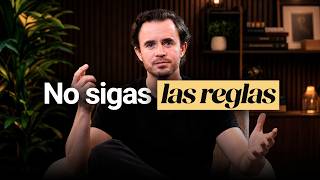

The 0.01% Know Effort Isn't Enough
45sChallenges common beliefs about hard work and reveals a counterintuitive principle used by the ultra-rich.
▶ Play Clip"Delivers on the promise of seven principles, but padded with self-promotion and a product pitch."
The video presents seven principles learned from the top 0.01% of successful people, as shared by Alex Orozco, an e-commerce consultant. It covers topics such as unreasonable effort, breaking rules, reversible decisions, saying yes under pressure, surrounding oneself with higher achievers, recognizing anti-talents, and the importance of preparation.
Alex Orozco introduces himself as a consultant who has helped clients generate millions in revenue, and promises to teach seven fundamental rules learned from the top 0.01%.
Orozco shares his personal story of overcoming a stutter by recording content for hours, emphasizing that the 0.01% are willing to put in effort that others consider insane.
He introduces the concept of 'inverse identity' – selling to your past self – and encourages questioning assumptions, using AI to challenge them.
Using a client example, he explains the 'family price syndrome' and the rule: if a decision is reversible, implement it now; if irreversible, plan and seek advice.
He recounts buying an expensive training during the pandemic, which led to his business success, and advises saying 'yes' to opportunities that make you uncomfortable.
He describes attending a high-level event in Switzerland and emphasizes the importance of being in environments where you feel both deserving and inadequate.
He shares his experience of failing in engineering and realizing his anti-talent, leading him to pivot to sales and e-commerce.
He contrasts average entrepreneurs who post content without preparation with his team's method of preparing multiple variations, emphasizing that preparation shows respect for the audience.
The video concludes by encouraging viewers to choose one lesson to apply and mentions a free prompt for finding products, available via Instagram.
What is the first principle of the 0.01%?
Unreasonable effort – doing something so many times that others call you crazy.
01:50
What is 'inverse identity'?
Selling to your past self (who you were 5-10 years ago) because that person exists and understands you.
03:10
What is the rule for reversible decisions?
If a decision is reversible, implement it now; if irreversible, plan and seek advice.
07:43
What is an 'anti-talent'?
Something that no matter how much you train, will never flow because your brain isn't made for it.
12:29
What is the 'family price syndrome'?
The fear of raising prices due to worry about losing customers, which is often unfounded.
06:50
Unreasonable effort
Defines the core principle of going beyond normal effort to achieve success.
01:50Inverse identity
A unique approach to marketing by selling to your past self.
03:10Reversible decisions
Provides a clear rule for decision-making that reduces fear and procrastination.
07:43Say yes under pressure
Encourages taking risks in high-pressure situations, which can lead to breakthroughs.
09:51Anti-talent
Introduces a concept that helps people pivot away from unsuitable paths.
12:29[00:01] millionaires, founders of large companies, and very high-level people. I have Alex Ormozi, I have helped my clients to collectively generate we currently have the largest Spanish-speaking e-commerce consulting firm
[00:14] that top-level people operate on seven specific principles are what allowed me to go from being a normal kid selling building several businesses that today generate millions of euros in revenue per year.
[00:29] Next, I'm going to teach you the seven fundamental rules I learned from the top 0.01%. The first lesson is that the 0.01% know something that most people don't dare to accept: effort is
[00:41] in this life. I'm going to tell you a story that I will always carry with me. From the age of 6 to 16, I stuttered to the point that I couldn't say more than three words in a row without getting stuck. I had the idea stuck in my
[00:54] communicating, and that made me suffer inside every day, feel ashamed, and think that I wasn't good enough for certain things. It was a fear that I carried with me everywhere I went on a daily basis. And a few years later, when I decided to
[01:07] start my first company, life forced me to do the thing that scared me the most a camera and talk. My first piece of content was one minute long. And do you know how long it took me to record it? 3 hours. I spent about 3 hours straight
[01:22] in front of the camera having a pretty bad time. And on top of that, when I finished, my editor had to make more than 500 cuts to disguise the times I stumbled. Do you know what the easy way was? I accepted that it wasn't for me and looked for someone to
[01:35] stand up for me, but obviously I wasn't going to go down that road. not caring about the hours I had to spend failing in front of the 0.01% calls unreasonable effort.
[01:50] doing something so many times that the rest of the world calls you crazy for doing it companies with more than 100 people. I record content in a single take. I speak in events, but the day I understood this was the day I had a
[02:05] really bad time in front of the camera. If everything is against you, you have to remind yourself that the only lever you control 100% [music] is how much Find one thing you're pretty good at and put on a level of
[02:18] would consider insane. That is the only formula for achieving true success. The second lesson I learned was don't play by the rules you were given. For years I've always seen the same pattern. repeated time and time again in
[02:31] first online store. They try to find the winning product by copying what they see as having apparent success on TikTok. And whenever it doesn't work for them, they convince themselves that the problem was the "what," what to sell, what
[02:45] sales angle to use, what creative approach works. And one day, looking at our data of more than 2,000 clients who are within consulting. And specifically among those who earn the most, I discovered that 95% of those who were truly scaling up
[02:58] had not found a winning product, had not discovered a secret niche, [music] what they had in common was something completely different. They sold by being themselves. That's where I decided to break the rules. I started teaching them something I
[03:10] call inverse identity. Instead of thinking about who to sell to, [music] think about who you were 5 or 10 years ago and sell to that person, because that person exists, that person understands you and nobody in this world can compete with
[03:24] you in being [music] yourself. And here's the real lesson. If you can't problem is difficult, it's because you're playing by the rules you were taught. It sounds ironic, but the problem isn't the problem. The problem is how you think about
[03:39] everything in front of you. Whether you need money, connections, or even a degree. Look, I invite you to think about something. Think of a problem you have right now, any problem, and
[03:52] ask yourself what I'm assuming here that isn't necessarily true. And if you can't think of anything artificial intelligence, for example, cloud-based, and ask it to challenge each of the assumptions in your problem. Breaking a single assumption changes your perspective on how you
[04:05] saw everything before. That's what 0.01% does. They do not accept that it has always been done this way. They obsessively ask why and question the rules. [music] And this is where it gets practical, because breaking
[04:19] the rules of e-commerce doesn't mean inventing something from scratch, it means asking the right questions. And there's a tool that, when used correctly, forces you to that while everyone is using the cloud to write their emails or to
[04:32] small group of people who have discovered how to use it to earn more e-commerce. In the end, as I mentioned before, I've been own businesses for over 10 years and I've been
[04:49] money with them. And this is what I found. First, you need to copy and paste this prompt into the cloud. I'll show you what it does, but if you want it Orozco Mo, and send me a private message with the word "clot" and I'll send it to you.
[05:04] First you're going to copy it, then you're going to go to cloud, paste it into [music] and press enter. And he's only going to ask you one question at a time, but it's a interview, they will extract all the valuable information about you, from your
[05:18] interests, what you are good at, the problems you have experienced, the people you interact with, your budget, your level of involvement, and at the end of that exact product you can sell in your e-commerce store. There are some people who
[05:31] getting their first sales in 30 days with a product they never thought they would sell. And once you have the product validated, you can ask Cloud again what content to publish on Instagram. [music] to
[05:44] This is extremely important because most people post videos hoping to go viral, but viral videos are shown to the general public on Instagram. people who will never buy anything from you . On the other hand, when you talk about topics
[06:00] related to your product, you start to attract a quality audience. And that means that even if you only get 500 or 1000 views on a video, that's a lot of people who are really interested in what you're selling. And if you sell your product to 30
[06:13] people a month, you're already at €2,000 a month. It's one sale per day. If you want the exact prompt, remember to go to my Instagram, Jesús Orozco Mo, and send me a private message with the word clot and I'll send it to you. I learned the third lesson
[06:26] myself in a conversation with a client, but the principle behind it is exactly the same as that applied by billionaires when making big decisions. I worked with a founder who made handbags and accessories. He had been working himself to death for
[06:38] years. He created content every day, had a loyal community of followers, and a very well-developed and unique product on the market, but his company paid him a just-right salary and he didn't see how to scale up, and he
[06:50] Un-commerce founders have, which is raising prices. She her customers would leave and she would destroy her brand. I call this the family price syndrome. I asked him the
[07:03] simplest question in the world: if you make a mistake and raise prices and the worst happens, what do you do? And he said to me, "Well, I'll put them back down ." And I told him, "Exactly, it's a decision you can change again. There's no risk whatsoever.
[07:16] 're experiencing it as if it were irreversible, when it really isn't." And what we did was, over several years, manage to triple the prices, and with that same base of 3,000 orders per month, we multiplied the
[07:30] profit by five, simply by applying that small change. Same job, better clients. The 0.01% rule says that if the decision is reversible, implement it now. Don't overthink it.
[07:43] What you need to do is take action, measure results, and if it goes wrong, all you have to do is backtrack. If the decision is irreversible, then you stop, then you plan, and then you ask for advice from other people. But
[07:56] most of the decisions in your life are reversible. And what's holding you back isn't the real risk, it's that you're treating a reversible decision as if your life depended on it. That's the point. The fourth lesson, and I learned this one during the
[08:09] worst economic period of my life. I still remember it like it was literally yesterday, March 2020, the pandemic started and overnight, the few clients I had at that time stopped
[08:21] paying me, literally all of them. And I was left with 4 or 5 thousand euros in the account, basically just enough money to survive a month, pay the rent and pay the salaries. Right at that moment, while browsing the internet, an
[08:33] a training course that, frankly, was quite expensive. I was thinking about it and my head was telling me I was crazy. That money was all I had, so I'd better save it. But another part of my brain acted from a different point of view
[08:48] and I ended up buying the training. I literally emptied my account and I didn't even have a plan B. I studied the training in one whole night, implemented it in two days, and the following week I started making money again. That impulsive decision,
[09:02] that "yes" at the most fearful moment of all, was the beginning of the entire business group that he leads today. And this is precisely where the real learning happens. The human mind is programmed to say no in those kinds of decisions.
[09:14] financial situation and the solution requires investing, but you feel that uncertainty about what will happen. [music] Will this work? The answer "no" usually comes out naturally. People in the 0.01%
[09:27] are programmed to say yes in those kinds of high-pressure situations. And why? Because when you say yes, your brain stops asking if I can do this and starts asking how I can do this; those two questions live in
[09:39] different universes. That's why I'm giving you a challenge for this week. When an opportunity, an invitation, a challenge, something that might make you uncomfortable comes your way [music], before thinking as you always do, with no or with
[09:51] doubt, turn it around and apply just the yes to see what door it opens. However, learned it the day I entered a room that changed my way of thinking forever. A while ago I went to Stat in Switzerland, I paid about €50,000 for
[10:05] that trip and I'm telling you, it's not something you're going to do tomorrow, it's not about that. Remember the lesson I'm about to explain. I arrived there and place. I'm serious. I mean, I saw people flying in $70,000,000 private jets,
[10:18] casual conversations about operations involving figures that my mind had never processed. I can assure you that anyone with a bit of ego in those rooms will quickly have it crushed. And I've been climbing the ladder, and I eat
[10:31] five, six, seven, eight figures, I bill seven and eight figures a year, and yet there I felt like the smallest person in the room. And here's the thing that 0.01% understand and nobody explains to you. In that room there were two forces that
[10:44] coexisted in my head at the same time. First, I deserve to be here. The second one didn't even come close to these businessmen. That mix of thoughts and the internal battle that was in my head is what
[10:56] really forced me to level up in a way that one cannot force oneself alone. In fact, I came home obsessed, and not because those businessmen I had been with were any smarter. In fact, many of them
[11:08] probably weren't; they had simply been in the game longer than I had. They had much more experience and a longer track record. Now apply this to your specific case. Obviously you don't have to go to Switzerland, but you do have to enter
[11:20] rooms where you feel both things at the same time, that you deserve to be there and is not my place." It might be a be a community of people who are two steps ahead of you. If
[11:33] you're the smartest person in every room you enter , you're in the wrong room. Perfect. Now let's move on to the sixth lesson. And this one hurt me quite a bit, but it the movie about the creator of Facebook. The one that tells how Mark
[11:46] Zuckerberg started from a college dorm room. And I left the cinema to become a millionaire you had to be an engineer, that the path lay through telecommunications, code and understanding bytes. And I enrolled in
[12:00] how my first year went? [music] A total disaster. I wasn't making progress, I wasn't grasping classmates understood things the first time, I was working myself to the bone for days and still couldn't even get a five. I felt like a failure trying to fit into
[12:15] a mold that my brain rejected. And one [music] day I accepted something that no one had ever weakness. You can improve a weakness with effort. That was an anti-talent. An anti-talent is something that, no matter how much you train, will never flow because your
[12:29] wasn't made for circuits, I was made for selling, for connecting, for building companies and building narratives. That's why I decided to drop out of the program. I went to sell cables at a store in a shopping center for €600
[12:42] a month. And while I was working there, in my free time, I set up my first online store and soon after starting I got my first €4,000 salary for several whole months working in the store. Ultimately, the
[12:54] biggest trap is staying in one place because you're good at it. If you look at others and feel that jealousy, that feeling of "I think I could do that," don't ignore it, it's a clue. Don't stay in the wrong place because of pride or
[13:07] fear of starting from scratch. It's not worth becoming an expert in something you don't really want to be. Do the exercise and reflect on whether you are on the wrong path and perhaps it is time to make a change in your life. Now, I
[13:19] learned the seventh lesson by looking at the difference between how in my team. The average entrepreneur I know releases three to five music videos a month, eight at most. He records them in an afternoon, uploads them, and then stares at
[13:33] his social media wondering if he'll get any views, if he'll sell his ways you can work. And it's the worst because underneath it all there's an incredible lack of preparation. In my team we apply something we call the
[13:47] turning on the camera to record content, we need to have once we have it, we record multiple variations of the same video with different clothes, different speed, with a different tone, with a different aperture. And
[14:01] what is the result of this? Well, we produce hundreds of pieces of small team, and that's why, because of that preparation which seems like a lot of work and the e-commerce brands that are within the consulting firm can do it. They can
[14:15] generate hundreds and millions of visits per month without driving us crazy. And here is the lesson that took me many years to understand. If you don't prepare something, you don't give it the same importance. It's that easy. Preparation is not a skill, it's
[14:27] It's respect for the person who will receive your work, it's respect for your time, and it's action. It's a bit like a football match. What you see on TV is 90 minutes of gameplay. What you don't see are the months of practice behind those
[14:40] 90 minutes. Imagine walking into a meeting and discovering that the other person is better prepared than you, knows more about your business than you, and has studied your numbers more than you have. That's what the 0.01% do. So I'm throwing down another
[14:52] challenge. Check your calendar this week. Grab a meeting, a call, a . Imagine it's the last thing you'll ever do in your life and prepare as if your life depended on it. You'll come up with more notes, more data, more
[15:07] analysis than anyone else. That's the difference between 0.01% and the rest. a whole decade of mistakes. You just minutes. Imagine Jesus from 10 years ago, stuttering and selling cables
[15:20] in an Apple store, listening to this video. It would have saved him a lot of headaches. Choose one of these lessons, the one that resonated with you the most, the promo, which is helping a small group of people earn their first
[15:33] online store so they can choose the right product, go to my Instagram, Jesús private message with the word clot and I'll private message with the word clot and I'll send it to you. Yeah.


⚡ Saved you 0h 15m reading this? Transcribe any YouTube video for free — no signup needed.