
99% of People Can Hit a One-Plate Overhead Press
42sThe bold '99%' claim immediately challenges skepticism and hooks anyone chasing this strength goal.
▶ Play Clip"Delivers exactly the promised four-step system with a clear progression plan; only a couple of product plugs muddy it."
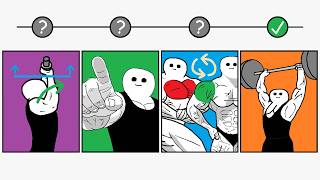
This video presents a simple four-step system for achieving a one-plate overhead press (OHP) for multiple sets and reps. It emphasizes that the goal is attainable for 99% of people, provided they fix technique, press more often, prioritize the movement, and follow a patient progressive overload plan.
The one-plate overhead press is achievable by 99% of people — not just for a single rep, but for normal sets with multiple reps each.
The overhead press punishes bad technique more than almost any other lift. What looks like a strength issue is often a technique issue. Learning to press properly can instantly add pounds.
Grip width and head position. The wider your grip, the weaker your pressing ability. Use the cue 'push your head through the window' — head slightly back as the bar passes your face, then forward, without overexaggerating.
The overhead press responds extremely well to frequency. For most people, the sweet spot is two shoulder-pressing sessions per week, while being careful not to overtrain.
Put the overhead press first in your workout, before bench press or any chest-focused exercise. If you bench first, your shoulders are already fatigued and the press suffers.
Progression is the bridge to one plate. Choose a rep range (e.g., 3 sets of 5-8 reps), start with a weight you can press for at least 5 reps per set with good form, and aim to add reps each session.
Your goal is to hit the top of the rep range on all sets (e.g., 8 reps). Once you do, add weight. Don't exceed the top of the range in a set — doing so means the weight was too light and hurts later sets.
Use small jumps when adding weight. This feels slow but is the key to long-term overhead progress. After adding weight, you'll drop to the lower end of the rep range and build back up.
Some sessions won't beat your previous performance. That's part of the journey. Over months, small increases add up — consistency matters more than any single session.
Following these four steps — proper technique, higher frequency, correct priority, and patient progressive overload — will get most lifters to a one-plate overhead press for multiple sets and reps.
What percentage of people can achieve a one-plate overhead press?
99% of people can achieve it, not just for one rep but for multiple sets and reps.
00:02
What are the two main technical factors for a stronger overhead press mentioned in the video?
Grip width and the 'push your head through the window' cue.
00:57
What is the 'push your head through the window' cue?
As the bar passes your face, move your head slightly back, then push your head forward through an imaginary window; don't overexaggerate the movement.
01:24
What is the recommended weekly frequency for the overhead press?
Twice per week is the sweet spot for most people.
02:18
Why should the overhead press be performed before bench press or chest exercises?
Bench pressing first taxes the shoulders, leaving you fatigued for the overhead press. Training the press first keeps your shoulders fresh.
03:10
What example rep range is given for progression?
Three sets of five to eight reps.
04:28
According to the rep goal system, when should you increase the weight?
When you hit the top of the rep range (e.g., 8 reps) on all sets.
05:32
Why should you avoid going over the top of the rep range in your first set?
It weakens your later sets, preventing you from hitting the top on all sets, and it means the weight was too light in the first place.
05:45
How should weight increases be handled?
Keep increases small; small jumps are key to long-term overhead press progress.
06:37
Technique beats strength
The video reframes weakness as a technique issue, showing that fixing form can add pounds instantly.
00:16Frequency drives overhead progress
Pressing twice per week is presented as the sweet spot, a simple but often ignored lever for progress.
02:18Train the press while fresh
Moving the overhead press to the start of the workout before chest work can skyrocket results.
03:10Earn the right to add weight
Shifting from 'I must add weight today' to 'I need to earn it' is a powerful mindset change for lifters.
04:16[00:02] the same way the two-plate bench press is. And you need to know that getting to the one-plate overhead press is a goal that is achievable by 99% of people. And I don't mean hitting it just for one repetition. I mean doing your normal
[00:16] three sets and performing several reps in each one. If you want to achieve because I'm going to simplify the whole process for you so that you just have to follow four simple steps and finally get to your goal. Step number one, learn how
[00:30] to press properly. The overhead press punishes bad technique more than almost any other lift. You might think that you are just weak at overhead press, which little bit, but instead of instantly making it only a strength issue, it most
[00:44] likely also is a technique issue. Just by learning how to press properly, you can instantly add a couple of pounds to your overhead press. And if you want to need all the help that you can get. There are two main things that you have
[00:57] press. The first one is your grip. Your width. That is the sweet spot that will make you the strongest on the overhead press. Of course, this varies a little bit from person to person, but generally
[01:10] wider your grip is, the weaker your ability to push the weight will be. The if you ever want to lift some respectable weight on the overhead press is a special cue that will help you press at your absolute best. You might
[01:24] called pushing your head through the window. This means that as you will your head slightly back as the bar passes your face. Then push your head forward through the imaginary window. But this forward movement of the head
[01:38] should of course not be over exaggerated. As I always like to say, if you can be certain that you are doing it wrong. If you want to press one plate for multiple sets and reps, you need to do those two things I just talked about.
[01:51] There is no way around that. If you want to learn the full technique breakdown in detail you should know, I highly recommend you check out the new beginner bundle, which includes a super in-depth technique guide for every single basic
[02:04] to your bodybuilding journey. And it's not only a training plan and a technique guide, it also comes with a nutrition and a cardio guide, so you will never If you want to learn more about it, click the first link in the description.
[02:18] Step number two, press more often. Once your technique is solid, you need to start pressing more often. If you only overhead press once per week, your progress will obviously be slower. The overhead press responds extremely well
[02:30] week you do it, the better you will become at it. And because getting to the goal of hitting a one-plate overhead press is mostly something that lifters that are not advanced yet strive for, it's really important to practice
[02:43] the beginner side of things. The sweet spot is pressing twice per week, and you but then you have to be really careful to not completely destroy yourself because the overhead press can get pretty taxing. So, for most people, I
[02:58] shoulder pressing sessions per week because while it might seem like not that big of a deal how many times per week you press, the more familiar and comfortable you get with the press, the more weight you will be able to press in
[03:10] the long run. Step number three, switch your priority. This is what most people really what the average Joe in the gym thinks about, but it really isn't that difficult to understand why you should do it. If your goal is to build a strong
[03:23] overhead press, then the overhead press needs to come first in your workout, incline bench press, or any chest-focused exercise. You can't expect your overhead press to improve if you're always training it in a fatigue state.
[03:36] When you bench first, your shoulders are already pretty taxed by the time you get to the overhead pressing, and that is not a situation you want to be in if overhead press. Of course, switching priorities doesn't mean you stop
[03:49] do it the other way around. Instead of starting the workout with the chest and then doing shoulders, you start off with the shoulders while you are still fresh alone can completely skyrocket your overhead press progress because if you
[04:03] are like majority of people, you have probably never even trained your shoulders while you were 100% fresh. So, once you apply this, you will feel how powerful this change really is. Step number four, progression is key. This
[04:16] final step is where everything comes together. Progression is the bridge between where you are now and pressing one plate for multiple sets and reps. But, without a progression plan, all your efforts will just go in vain. The
[04:28] goal is not to mindlessly add more and more weight even though you are clearly not ready for it. The goal is to own the weight before you move up and this is thinking, "I must add weight today." think, "I need to earn the right to add
[04:42] weight." So, first of all, you need to pick a rep range. So, for example, three sets of five to eight reps. Once you got your rep range, here is how it works. You choose a weight that you can press for at least five reps in each one of
[04:54] your sets with good form because that is the bottom end of the rep range you to do more reps with the same weight. So, if in the last workout you achieved, for example, six reps in the first set, five reps in the second set and five
[05:07] reps in the third set, your goal now is to increase any of these numbers by at least one rep in order for it to count as a successful progression. So, if in the next workout you hit six reps on the first set, six reps on the second set
[05:19] and five reps on the third set, you successfully progressed because you time. Over time, you work towards hitting the top end of the rep range on all sets. So, for the example five to eight rep range, your goal is to hit
[05:32] exactly eight reps on all three of your sets. Once you achieve that, you are careful. You should not be going over the top of the rep range. Once you hit the top end, you stop. So, if we use the five to eight example again, that would
[05:45] mean that your sets should never look like this, for example. Because if you go over the top of the rep range in your first set, this will most likely weaken get even close to hitting the top of the rep range on the rest of your sets. And
[05:58] if you're able to hit the top of the rep range on the rest of your sets, even first set, it just means that you used weight that was way too light in the first place. Your goal is to hit the top of the rep range on all sets and then
[06:11] increase the weight. Not to hit 10 reps on your first set and then only seven on the rest of your sets. That is not how the rep goal system works. It's not take advantage of the rep goal system and have the most clear and smooth
[06:24] progression, you should follow exactly what I explained to you. Otherwise, you hit the top end of the rep range on all of your sets, add more weight, and repeat. This is how you will always have the perfect weight set on the bar. But
[06:37] be careful when you add weight. You need to keep the increases small. Just use gym. This might feel slow, but small jumps are the key to long-term overhead progress. Once you add more weight, your
[06:49] the lower end of the rep range, and that is completely normal. Remember, your job again. Build the reps to the top of the rep range again, and then add more weight, and repeat. Some weeks will feel easy, others will feel brutally hard,
[07:04] will also be sessions where you don't beat your previous performance. your performance from last time, and sometimes you might not even be able to do that. And even though it might feel demoralizing, that is just how it is,
[07:18] It's simply a part of the journey, and as long as you are consistent, you will progress in the long run. Because over months of steady progression, those small increases add up. You just have to be determined and not get discouraged
[07:31] when the times get rough. So, if you commit to those four steps I showed you today, the results will come. And when that day comes, and you finally achieve the one plate overhead press, you will be glad that you did it the way you did.
[07:44] something. Please don't forget to check out the beginner bundle by clicking the on your body building journey, and I will see you next time. If you like this video, then you will for sure like this one, too.




⚡ Saved you 0h 08m reading this? Transcribe any YouTube video for free — no signup needed.