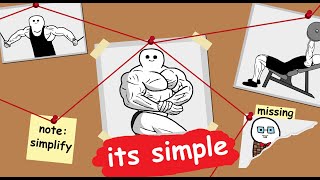

Stop Doing TikTok Chest Exercises
38sCalling out TikTok fitness trends creates instant controversy and sparks the 'simple vs. fancy' debate in the comments.
▶ Play Clip"Delivers exactly what it promises: three essential exercises and a clear programming template, with only a minor plug for training plans."
This video reveals the only three chest exercises you need—horizontal press, incline press, and chest isolation—and shows exactly how to program them across two weekly workouts. It provides specific rep ranges, exercise order, and a copy-ready template to simplify chest training.
To build the chest, focus on three movement patterns: a horizontal press, an incline press, and an isolation exercise.
Horizontal presses include flat barbell/dumbbell bench presses and push-ups. They are the primary chest builder and should be a core part of programming.
Rep ranges for horizontal and incline presses can range from 5 to 15 repetitions, depending on the exercise and individual situation.
Incline barbell/dumbbell presses and decline push-ups work the upper chest. Combined with horizontal presses, they cover the whole chest.
For best results, train chest twice per week and alternate the order of horizontal and incline presses between the two workouts.
The first exercise of each workout uses a low rep range (5–8), while the second exercise uses a higher range (8–12 or 12–15) due to fatigue.
Use dumbbell or cable flies for the isolation movement. Recommended rep range is 12–20 reps, no special order or variation needed.
The final structure combines horizontal press, incline press, and isolation with alternating order and rep ranges—ready to copy into your routine.
The key to a well-developed chest is simplicity: master three movement patterns and apply a smart rep-range and ordering strategy across two weekly workouts. Stop overcomplicating and start executing the basics.
What are the three essential chest movement patterns?
Horizontal press, incline press, and chest isolation.
00:25
What is a common example of a horizontal press?
Barbell bench press, dumbbell bench press, or push-up.
00:52
What rep range is recommended for the first exercise in a chest workout?
5–8 reps.
02:36
Why should the second exercise use a higher rep range?
Because you are already tired from the first exercise.
02:48
How many times per week should you train chest according to the video?
Twice per week.
01:58
What are the best isolation exercises for the chest?
Dumbbell or cable fly.
03:39
What is the recommended rep range for chest isolation?
12–20 reps.
03:51
How should you alternate exercise order across two chest workouts?
In the first workout, horizontal press first and incline second; in the second, reverse the order.
02:12
Simplify Chest Training with Three Patterns
Provides a practical framework that avoids overcomplicated routines and focuses on effective basics.
00:25Alternating Exercise Order for Balanced Development
Shows a smart programming technique to emphasize both pressing strength and upper chest work across two weekly sessions.
01:58Fatigue-Based Rep Range Selection
Explains why lower reps come first and higher reps second—a logical approach to managing energy and maximizing stimulus.
02:36Isolation Exercises Finish the Chest
Emphasizes the importance of high-rep isolation work (12–20 reps) to fully fatigue the chest after compound presses.
03:13[00:01] need, and I'm going to show you exactly how to program them into your routine so you can just copy them and start doing them right away. Whether you like it or not, the time to simplify your chest training is now because doing overly
[00:13] complicated routines and exercises will not get you anywhere. I know doing some weird exercises you saw on TikTok might seem cool, but you need to decide if your priority is looking cool or building muscle because all you need is
[00:25] the basics. And while they might not be as flashy, they are certainly the most effective. So, let me show you the only three chest exercises you will ever need single other thing that you will ever need to get a juicy-looking chest. For
[00:39] the chest, you need to focus on three movement patterns. You need a horizontal press, an incline press, and an isolation exercise. So, let's first go over the horizontal press. The exercises that go into this category are all your
[00:52] classic flat presses, like for example, the barbell or the dumbbell bench press or even the push-up. You could consider the horizontal press to be your main chest builder, and that's why it's so important to do it. In terms of the rep
[01:04] ranges for this type of exercise, it can vary a lot, and I really mean a lot. It heavily depends on the situation. So, any rep range starting from five to possible. We will get to more detail when we get to the incline presses
[01:18] because when it comes to programming these two types of exercises, you always because they work hand-in-hand. And if you mess it up, all your efforts will go in vain. All right, so let's talk about the incline presses now. The exercises
[01:31] here are obviously exercises like the incline barbell or dumbbell bench press and the push-up in a decline variation. These incline presses are responsible for building your upper chest. So, when combined with the horizontal presses,
[01:44] will basically cover your whole chest. As with the horizontal exercises, the rep range here can be anything from five to eight all the way to 12 to 15, which finally brings us to how we should program these two types of exercises. In
[01:58] training your chest twice per week. So, this example. So, when you have two different chest workouts, you want to do different rep ranges and two different exercise orders in each one of your
[02:12] chest days. By doing this, you will achieve the perfect chest training layout. So, what this means in practice is this. For example, in the first chest workout, you put the horizontal press first and the incline press second. And
[02:24] then in the second chest workout, you do the exact opposite. You put the incline press first and the horizontal press after that. This takes care of the order. Thanks to this setup, you can get the best of both worlds. But now, we
[02:36] need to take care of the rep range. For the first chest exercise of the workout, you always want to use a low rep range. So, we will do that right now and add the five to eight rep range to both of the first exercises. And because we
[02:48] already have it in the perfect order, everything is looking beautiful. Then for the second exercise, you want to utilize a little higher rep range because you will already be a little tired from the first exercise. So now,
[03:00] we will add either the eight to 12 or 12 to 15 rep range to the exercises that are done second. And as you can see, everything now looks absolutely perfect except one thing. We are still missing the last piece of the puzzle, and that
[03:13] is the chest isolation. So, let's take a look so we can add it to what we just created, and then you can go ahead and copy that exact thing into your routine. show you my training plans. If you are looking for something that you can
[03:26] and overwhelmed so that you can just should definitely grab one of my training plans. You can do so by description. All right, now let's talk about the chest isolation. To isolate
[03:39] the chest, you should use exercises like the dumbbell or the cable fly. These are your best choices. The rep range for the chest isolation will of course be towards the higher end. My recommendation is to always go at least
[03:51] above 12 reps. So, something between 12 to 20 repetitions will be perfect. The chest isolation exercise doesn't really need some special type of order or rep range change. That's why we kind of left it until the end. You just take it and
[04:04] created before. That is the final product. You can just copy this and put it right into your routine. Thank you for watching. I hope you learned training plans in the description. And I will see you next time.
[04:18] pretty good. [Music]



⚡ Saved you 0h 04m reading this? Transcribe any YouTube video for free — no signup needed.