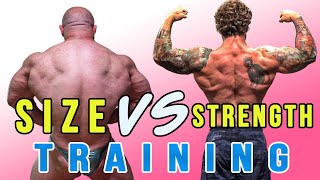

Size vs Strength: NOT the Same?
45sThis clip challenges the common misconception that training for size and strength are identical, sparking curiosity.
▶ Play Clip"The title accurately reflects the content: the video thoroughly explains the differences between training for size and strength, including rep ranges, volume, progression, and exercise selection."
Dr. Mike from Renaissance Periodization explains that while training for size and strength has overlap, they are not the same, especially for advanced lifters. He covers key differences in loading, volume, progression, frequency, and exercise selection, and provides strategies for getting the best of both worlds.
Basic strength is best developed with sets of 3-6 reps. Overall hypertrophy is best stimulated with sets of 5-30 reps. The overlap is small (sets of 5-6).
Strength training is more fatiguing per set but requires lower total volume and high preparedness. Hypertrophy training allows much higher volume and can work even with higher fatigue.
Strength progression comes primarily from increasing load. Hypertrophy progression comes from increasing volume (sets/reps) and secondarily load.
Hypertrophy training can be done more frequently because lighter loads allow faster muscle recovery. Strength training requires fuller recovery between sessions.
Strength training favors compound exercises (squat, bench). Hypertrophy benefits from a wider variety of exercises to target all muscle regions.
For advanced lifters, the best approach is phase potentiation: 2-3 mesocycles of hypertrophy followed by 2-3 of strength, with active rest in between.
Beginners can use sets of 5-10 reps and get both size and strength. Intermediates can do concurrent training. Advanced need separate phases.
What rep range is best for basic strength development?
3–6 reps per set.
2:28
What rep range is best for overall hypertrophy?
5–30 reps per set, taken close to failure.
2:45
What is the small overlap in rep ranges that works for both strength and hypertrophy?
Sets of 5 or 6 reps.
3:20
How do volume and fatigue requirements differ between strength and hypertrophy training?
Strength training requires lower total volume and high preparedness (low fatigue). Hypertrophy training allows higher volume and can work even with higher fatigue.
5:37
What is the primary driver of strength progression?
Increasing load on the bar (e.g., 200 lbs to 210 lbs).
9:08
What are the main drivers of hypertrophy progression?
Increasing volume (sets and reps) and, secondarily, load.
9:31
Why can hypertrophy training be performed more frequently per week than strength training?
Hypertrophy training can be done more frequently because it uses lighter loads, allowing muscles to recover faster while joints and connective tissues are less stressed.
12:14
What type of exercises are best for strength development?
Compound, multi-joint movements like squats, bench press, and deadlifts.
17:37
What type of exercise selection is optimal for hypertrophy?
A wider variety of exercises including machines, cables, and different angles to target all muscle regions.
16:49
What is the recommended strategy for advanced lifters to maximize both size and strength?
Phase potentiation: alternating 2–3 mesocycles of hypertrophy-focused training with 2–3 mesocycles of strength-focused training.
22:41
How should beginners approach size vs. strength training?
Beginners can use sets of 5–10 reps and get both size and strength gains simultaneously.
27:03
Rep Range Sweet Spots
Clearly defines the optimal rep ranges for strength (3-6) vs hypertrophy (5-30), showing the small overlap.
2:28Volume and Fatigue Trade-off
Explains that strength training requires low volume and high preparedness, while hypertrophy can handle high volume and fatigue.
5:37Progression: Load vs Volume
Highlights that strength gains come from increasing load, while hypertrophy gains come from increasing volume.
9:08Phase Potentiation Strategy
Provides a practical, evidence-based method for advanced lifters to alternate hypertrophy and strength phases for best long-term results.
22:41Beginner Exception
Clarifies that beginners can effectively train for both size and strength simultaneously with moderate rep ranges.
27:03[00:00] hey folks dr. Mike here for Renaissance
[00:02] period ization let's talk about strength
[00:06] training versus size training the match
[00:09] of the century Jake a lot of folks think
[00:12] these are the same you ask someone what
[00:14] they're training for they'll say all to
[00:15] get like bigger and stronger and there's
[00:17] a ton of overlap there's not exact
[00:19] overlap especially as you become more
[00:21] advanced it pays to know the difference
[00:24] between these two and perhaps pursue
[00:26] them separately even if you want in the
[00:28] end to be as big and strong as possible
[00:30] so here's we're gonna talk about today
[00:32] first aren't size and strength training
[00:34] the same we'll see that they're not
[00:36] right then we're going to talk about
[00:38] some differences between strength
[00:40] training and size training notably
[00:42] differences in loading how much weight
[00:43] you're using differences in volume
[00:45] differences in how you progress over the
[00:48] weeks differences in optimal frequencies
[00:51] of training and the undulation of how
[00:54] many hard workouts versus easier
[00:55] workouts you have and if you're thinking
[00:57] what the hell is easier workouts well
[00:59] then your hypertrophy trainer because
[01:00] there's no such thing really but for
[01:02] strength training you're like oh use
[01:03] your workouts that makes sense
[01:04] automatically we have a difference right
[01:05] there
[01:06] exercise selection differences between
[01:08] the two approaches for optimal results
[01:10] and then we're gonna talk about how to
[01:12] get the best of both and there are some
[01:15] really good ways to do that at the end
[01:17] we'll wrap it up with some simple
[01:18] take-home points let's get started so
[01:20] aren't size and strength training really
[01:23] just the same they are very similar okay
[01:26] but they are not the same optimized
[01:30] strength training looks a little bit
[01:32] different than optimized size training a
[01:36] really quick anecdotal piece of evidence
[01:38] and it's not act only small at your
[01:40] static Dodoma technical sense is the
[01:43] fact that bodybuilders at a high level
[01:45] professionals and power lifters at high
[01:49] level professionals don't train the same
[01:51] yes they both training gyms yes they
[01:54] both use barbells but the differences
[01:56] are G really massive if you've been in a
[02:00] gym for longer than a few months you
[02:02] could start to tell them apart not just
[02:03] in their appearance but how they train
[02:04] maybe there's something to that and
[02:06] they're really absolutely is so let's
[02:09] find out what there is to it and start
[02:10] with the most
[02:11] obvious loading differences basic
[02:14] strength when we have sports science
[02:15] called basic strength the fundamental
[02:17] ability to produce force not peaked for
[02:19] competition which is like sets of 1 2 3
[02:21] rep so the basic foundational getting
[02:23] stronger and stronger type of training
[02:24] is best done in roughly 3 to 6 rep range
[02:28] per set ok it's so like sets of 3 sets
[02:31] of 5 sets of 6 stuff like that that
[02:33] those sets build basic strength the best
[02:35] right however overall hypertrophy
[02:38] overall hypertrophy not the kind of a
[02:41] per trophy that translates to strength
[02:42] the best which we'll get into later
[02:43] overall hypertrophy is actually best
[02:45] stimulated in the 5 to 30 rep range
[02:48] right when I used to be a power lifter
[02:50] and I was dabbling in some hypertrophy
[02:51] training I would do dumbbell presses 4
[02:53] sets of 20 and my powerlifting buddies
[02:55] correctly were like dude what are you
[02:56] doing like that's not gonna make you
[02:57] stronger and fundamentally they had a
[03:00] really really good point if it was gonna
[03:01] make me stronger it was gonna take
[03:02] months to convert that new size
[03:04] neurologically into the ability to use
[03:06] it for strength there's a big difference
[03:08] there right so if you train 4 sets of 3
[03:11] to 6 you get your best strength results
[03:12] if you train 4 sets of 5 to 30 reps
[03:14] close to failure you get your best size
[03:16] results gee-whiz I'm no mathematician
[03:18] it's a really small overlap you can do
[03:20] sets of 5 you can do sets of 6 and
[03:23] that's it ok you have two types of sets
[03:26] - dude - rapper not even ranges to
[03:28] specific numbers of reps you can do and
[03:29] that's all the optimal overlap really is
[03:32] at the end of the day that's not that
[03:34] great right so can you train 4 sets of 5
[03:36] and 6 and get a decent measure of
[03:38] hypertrophy shake yes your variation is
[03:40] gonna be very low so after a while your
[03:41] results are gonna suck because you're
[03:42] not mixing it up enough but
[03:43] fundamentally you're just missing out on
[03:45] a lot right so I'm gonna be like why
[03:46] don't you do sets at and someone's like
[03:49] why don't you do sets of 3 to get even
[03:50] more peak strength relative to what you
[03:52] have now yeah well I kind of want both
[03:54] but it's a very very tiny overlap in
[03:56] sort of that's not the greatest thing in
[03:58] the world right we can do better if
[03:59] we're gonna optimally get for
[04:00] hypertrophy where this whole thing we're
[04:02] just not using right it's like it's
[04:04] almost like here you know I'm dieting
[04:06] still because of the food analogies it's
[04:08] like going to an all-you-can-eat like
[04:10] super incredible buffet and you're on a
[04:12] like a clean food only diet and you're
[04:13] like I'm having fish and chicken like
[04:16] bland like it was white rice like is
[04:19] they happen to have that at the buffet
[04:20] but they also have 50 trillion other
[04:21] things you know maximize your buffet
[04:23] experience
[04:23] don't go there a diet can you sure if
[04:26] you're gonna maximize your diet stay at
[04:28] home you don't have a little smells
[04:28] distracting you so on and so forth just
[04:30] the same the strength rep ranges for
[04:32] here I perturb your brain just tiny
[04:34] overlap but it's really large it's way
[04:36] over there and truthfully if you stick
[04:40] to the five to six reps negative that's
[04:42] a five in sets of six you're just sort
[04:43] of in that general range or good for
[04:45] both I would bet and there are some good
[04:49] studies confirming this and certainly
[04:51] almost every bodybuilder can tell you
[04:53] this if you really try for extended
[04:56] periods of time to get all of the same
[04:59] hypertrophy volume from just sets of
[05:01] five to six never doing sets of eight or
[05:03] ten or twenty then the fatigue
[05:05] accumulates are really fast and really
[05:08] messes you up
[05:09] so even if you get pretty good or close
[05:12] to optimal short-term hypertrophy
[05:14] results doing let's say sets of six and
[05:15] great short-term strengths results you
[05:17] can't keep that going in the hyper tree
[05:19] front so because the volumes are too
[05:21] high for those low rap numbers for a
[05:23] month or two it can work but it's not
[05:25] sustainable which is also why basically
[05:27] nobody trains like that so we got some
[05:29] problems there are some differences if
[05:31] you want the best of one or the other
[05:33] there's gonna have to be a little bit of
[05:34] a fork in the road next up is volume
[05:37] strength training is really fatiguing
[05:40] per set especially sets of three and
[05:42] four right which are great for strength
[05:44] development they beat you up more per
[05:46] set than like sets of ten or something
[05:48] like that especially overtime joint
[05:50] fatigue and how people feel
[05:51] psychologically it's really really
[05:53] really tough training right at the same
[05:57] sort of thought process is strength
[06:00] training sort of beats you up more per
[06:02] set but in order to your best of
[06:05] strength training the amount of total
[06:07] fatigue you can have at any one time
[06:09] needs to be lower you need a high degree
[06:12] of preparedness you can come into the
[06:14] gym and I approach of your training
[06:16] program and be pretty tired pretty
[06:18] messed up but just grind and get great
[06:20] results for strength you have to be on
[06:22] right there are weights that if you're
[06:25] even somewhat fatigued you simply can't
[06:27] live for any reps anymore okay
[06:29] you were doing them for such a fore last
[06:30] week you got too much fatigue now
[06:31] instance of one it's just
[06:33] Hannibal right so at the same time while
[06:35] strength training fatigues you more
[06:37] percent it actually is optimal for you
[06:41] to never do with that many sets of it
[06:43] because strength training isn't
[06:44] optimized at high levels of fatigue that
[06:46] that many sets bring in right on the
[06:49] other hand hypertrophy training doesn't
[06:52] generate a ton of fatigue per set right
[06:54] which is which is great because you can
[06:57] do a lot of it but it doesn't also
[07:00] require rights it doesn't also require a
[07:02] high degree of preparedness so not only
[07:05] can is the fatigue allow you to get more
[07:08] productive sets in but also you can get
[07:10] even more fatigue because you don't have
[07:12] to be spot-on for I purchase between to
[07:14] work well you can be pretty fatigued and
[07:15] it still works are a great so
[07:17] essentially hypertrophy sees higher
[07:20] stimuli with way higher volumes and
[07:22] strength training or does and the result
[07:24] to get a little bit technical real quick
[07:25] from volume landmarks and you can google
[07:27] all the stuff just google hypertrophy is
[07:30] route al guide and you'll just go right
[07:33] to the RP website and read of all the
[07:34] stuff but basically your maximum
[07:37] adaptive volume which is the volume at
[07:40] which on average you grow the most for
[07:42] strength training is often at what is
[07:45] somewhere between the maintenance volume
[07:47] and the minimum effective volume by the
[07:49] way that means it's Ungerman and
[07:50] effective volume all hypertrophy
[07:52] training so to put this as an example
[07:54] something like eight sets of quad work
[07:57] per week on a strength program is like a
[08:00] lot of work and that's like full-on well
[08:03] into that you know maximum to have two
[08:05] volume that's and meat potatoes work
[08:07] where on the other hand that might just
[08:09] be a little bit above what maintains
[08:11] your quads for hypertrophy and something
[08:14] like sixteen sets of quads for that same
[08:17] person is totally possible and close to
[08:19] optimal for muscle growth but sixteen
[08:21] would just not even be survivable for a
[08:23] week on strength training there's a huge
[08:25] discordance there the optimal volume for
[08:27] strength training is here the optimal
[08:29] volume for hypertrophy training is here
[08:30] and if you try to mix the two there's
[08:32] gonna be some middle ground in which
[08:34] you're not getting the best of either
[08:36] one right and the reality there is that
[08:38] for best results you probably really
[08:40] can't
[08:41] both optimally at the same time
[08:44] progression differences this one's super
[08:46] straightforward intensity loading
[08:50] progression is everything in strength so
[08:54] you get stronger not by doing more sets
[08:56] of 200 pounds you will put on some
[08:59] muscle and your work capacity will go
[09:00] off and that's nice and it will make you
[09:01] stronger for a while but not optimally
[09:03] this is the least rocket science shit
[09:05] I'll ever say it you get stronger by
[09:08] putting more weight on the bar it's
[09:09] crazy I know right so you get stronger
[09:11] going 200 210 220 230 you know over time
[09:14] maybe not on each week but when you are
[09:17] asked for key you have to present a
[09:19] bigger stimulus and strength training
[09:20] where is that bigger gonna come from is
[09:22] it going to be more reps is it going to
[09:24] be more sets
[09:25] no no it's almost always mostly going to
[09:28] be increases in load on the other hand
[09:31] for hypertrophy training doing more reps
[09:34] grows more muscle doing more load grows
[09:37] more muscle and doing more sets really
[09:39] grows more muscle but if you start at
[09:41] your minimum effective volume the fewest
[09:43] number of sets it takes to grow the
[09:44] distance to your maximum recoverable
[09:47] volume is there really high it can be
[09:49] like 10 sets per muscle group different
[09:51] and you slowly work from your minimum
[09:53] effective and you add one set here this
[09:55] week to next week
[09:57] zero the week after they start how
[09:58] you're recovering 2 again 1 again and
[10:01] then all of a sudden you've traversed a
[10:03] huge progression and set numbers and
[10:05] that got you a lot of growth that does
[10:07] not work very well for strength because
[10:09] your fatigue or what was it and you'll
[10:10] do a whole lot of nothing and why the
[10:12] hell you adding sets to begin with
[10:14] you get fundamentally the most strong by
[10:16] adding load so reach this question if
[10:19] we're trying to really do both at the
[10:20] same time you know should I add for
[10:22] example 15 pounds to the bar but zero
[10:26] sets next week or should I add 5 pounds
[10:29] to the bar but add a whole set next week
[10:31] same amount of total fatigue increase
[10:33] same amount of stimulus generally one
[10:36] stimulates much more strength adaptation
[10:38] one much more hypertrophy so they're
[10:40] adding 15 pounds definitely the right
[10:42] choice for strength in this example but
[10:44] the 5 pounds in one set probably the
[10:46] right choice for hypertrophy now and in
[10:48] 15 pounds will add hypertrophy it it's
[10:50] good but not the best the best
[10:52] hypertrophy probably come
[10:53] from raising volumes quite a bit
[10:54] sometimes raising repetitions but
[10:56] raising the load a little bit more
[10:58] slowly because you want to build high
[11:00] volumes of growth you want to do a lot
[11:02] of training and only increase as much as
[11:04] needed to keep the sets challenging
[11:06] whereas with strength training you're
[11:08] trying to increase as a matter of course
[11:09] that the whole reason you're there is to
[11:11] try to put more load on the bar in
[11:13] hypertrophy training it's a tool in
[11:15] strength training it's everything
[11:16] so for this fundamental reason either
[11:23] really bias load increases or really
[11:25] bias your volume increases at the
[11:28] expense of as much load as you could
[11:29] increase it's either one of the other or
[11:31] something in between you can't have
[11:33] everything of both interestingly enough
[11:35] in advanced strength training you'll
[11:37] even have plans which are quite good
[11:39] which do something like five sets per
[11:41] week four sets per week three sets per
[11:43] week while the load really goes up
[11:45] really fast it'd be like 5 by 5 4 by 4 3
[11:48] by 3 great strength progression but then
[11:51] decrease and weekly volume causes
[11:53] arguably no hypertrophy at all or even
[11:57] sometimes a slight degree of a sort of
[11:59] temporary atrophy so you can make a
[12:01] weight class have your best performance
[12:03] ever and then rebuild some muscle
[12:04] absolutely a thing if you do an advanced
[12:06] plan like that there's no way you're
[12:08] getting muscle growth out of it you
[12:09] definitely can't have both at the same
[12:11] time what about frequency and undulation
[12:14] here's the deal in hypertrophy training
[12:16] you need the local muscle to be healed
[12:19] to do another good job of training again
[12:21] and you don't even need the joints and
[12:22] connective tissues to heal completely
[12:23] because if you train heavy on Monday for
[12:26] example sets of five to ten on Tuesday
[12:28] you can do the same exercise four sets
[12:30] of ten to twenty and you're probably not
[12:32] gonna get hurt and you probably gonna
[12:33] get a good hypertrophy stimulus because
[12:34] the muscle is healed and the joints are
[12:36] like healed enough connective tissues
[12:37] healed enough but because you're
[12:38] dropping the load you're reducing how
[12:41] much weight you're lifting you're not
[12:42] really at risk of much of anything on a
[12:45] Wednesday for example right after that
[12:47] Tuesday you can again do sets of ten to
[12:49] 20 but just switch up the exercise and
[12:51] all of a sudden you're hitting different
[12:52] parts of the muscle different parts of
[12:54] the joint and everything's fine
[12:55] and then Friday you might do sets of
[12:56] twenty to thirty again your muscle has
[12:58] recovered each time your joint
[13:00] significant issues if not but that's
[13:01] that's the twenty to thirty they don't
[13:02] even they're too light to beat up your
[13:04] joints to connective tissues the
[13:05] thing heals by the end of the week and
[13:07] the next week you restart that
[13:08] progression so with hypertrophy training
[13:10] you can squash a lot of Highly Effective
[13:12] stimulative training many times in the
[13:15] week and as long as the muscle is
[13:16] recovering neither are the joints
[13:18] connective tissues tissues beat up as
[13:20] much because the rep ranges are on
[13:21] average or higher that loads are lower
[13:23] but also you don't need them completely
[13:25] healed at all times or even close with
[13:27] strength training it's very much the
[13:29] opposite stimulative sessions for them
[13:32] to actually cause strength improvement
[13:34] you need much fuller recovery then you
[13:37] do for hypertrophy training right if you
[13:40] do extra sessions on top of those
[13:41] they're not super useful right as far as
[13:45] you know getting you results they might
[13:47] be useful for enhancing technique and
[13:49] strength but they're not exactly pushing
[13:51] their strength along and they're
[13:52] certainly not pushing our Jaffee long
[13:53] what would that look like so for example
[13:55] a better strength sort of weekly
[13:57] undulated pattern would be on Monday
[13:59] doing like sets of 2 to 4 reps at a nine
[14:01] RPE really really tough really really
[14:03] heavy Wednesday new sets of four to six
[14:04] reps still strength this time at an 8 RP
[14:07] it's a more volume less loading and less
[14:10] relative intensity so you can you know
[14:11] you really messed it up on Monday on
[14:13] Wednesday you really put in some good
[14:14] work to continue to make that
[14:16] progression Friday there's no way you're
[14:18] doing hard training in this example at
[14:20] least for this advanced lifter you might
[14:22] do sets of 2 to 4 again but at a 6 RPE
[14:24] leak you basically doing the same loads
[14:26] you did Wednesday for 4 to 6 but now
[14:28] you're doing 4 sets 2 to 4 and even
[14:29] maybe lighter loads this allows you good
[14:31] practice on the bar put some weight on
[14:32] your back still trains the nervous
[14:34] system doesn't cause a tiny bit of
[14:36] hypertrophy at all it isn't directly
[14:38] enhance strength either so in this
[14:40] example you have to stimulate of
[14:42] strength sessions per week fundamentally
[14:43] in one recovery session to get ready for
[14:45] next week whereas in the hypertrophy
[14:47] example you have 4 stimulative
[14:49] hypertrophy sessions you can't really do
[14:52] the same heart training frequency for
[14:55] both ok if you try to have an optimal
[14:58] hypertrophy training frequency and you
[15:00] try to do strength that many times you
[15:01] will burn in the Sun you last out two
[15:05] and a half weeks and you'll fall apart
[15:06] like mr. Potato Head on the other hand
[15:08] if you try to get maximum hypertrophy
[15:10] results training only as hard as your
[15:12] strength training is often training hard
[15:14] as often as your strength training would
[15:15] dictate then your training like at a
[15:17] decent frequency but nothing to write
[15:18] home about and you're gonna be
[15:19] hanging out on optimal hyper to result
[15:21] someone could say for that Friday work
[15:22] out they watch you do you know sets of
[15:25] two to four reps and at a 6rp and they'd
[15:27] be like was that stimulating growth
[15:29] you're like nope they're like why don't
[15:30] you do some growth stuff you're like
[15:31] well as that'll beat me up too much for
[15:33] an axe Monday you can't have the best of
[15:35] both worlds certainly not at the same
[15:37] time right
[15:38] next a little bit more of a minor point
[15:40] but nonetheless salient it does apply
[15:43] exercise selection differences strength
[15:47] training is usually defined by a set of
[15:50] exercises not just abilities or parts of
[15:53] your body people usually talk about
[15:55] increasing their squat not just making
[15:58] their legs generally stronger can you
[16:00] imagine someone's like hey man I want to
[16:01] I want to you know get my legs stronger
[16:03] you look right sweet we're gonna focus
[16:04] on hack squats and leg presses if
[16:06] they've been in any sport there's
[16:08] relator string sport long enough to be
[16:09] like don't you mean like lower squat and
[16:11] like well no you said stronger legs it
[16:13] doesn't really matter which exercise
[16:14] like well I'm mad at stronger squad
[16:16] right so all of a sudden there's some
[16:18] exercise differences there you'll notice
[16:20] that like high-level Pro bodybuilders a
[16:22] lot of the exercises are using they're
[16:24] not exactly strength exercises and
[16:26] that's okay for them because they're
[16:28] geared towards hypertrophy so a lot of
[16:30] times when we say we want strength we
[16:32] just want a movement to increase that
[16:34] means we have to do that movement often
[16:35] sometimes that means doing other
[16:38] exercises less exercises that would
[16:40] offer benefit for example it's been
[16:42] shown that if you vary the kinds of
[16:45] exercises you're using for a muscle you
[16:47] can get regional hypertrophy differences
[16:49] more parts of your muscle growth use
[16:51] different actually as for example if you
[16:52] do legs Monday Wednesday Friday you do
[16:54] squats then hack squats then leg presses
[16:56] you probably get better hypertrophy
[16:58] overall in your quads then if you do
[17:00] squats squats squats right if you're
[17:02] training for optimizing strength
[17:03] optimizing strength and you want your
[17:04] squat to go up your programs probably
[17:06] gonna look a whole lot like squat squat
[17:08] squat and someone who could say well are
[17:10] you getting bigger legs totally but are
[17:12] you getting as big of legs as possible
[17:14] absolutely not you would use different
[17:15] exercises for that which again is why
[17:17] pro power lifters train with like two or
[17:19] three exercises like squats front squat
[17:21] maybe one or the derivative occasionally
[17:23] I'll do a leg press and my bodybuilders
[17:25] trained with nine or ten different
[17:26] exercises because they get better
[17:27] overall development plain and simple
[17:29] next strength training is just not ideal
[17:32] with some exercise
[17:32] right you don't develop strength on
[17:34] cable push downs you don't develop
[17:35] strength on lateral raises you more
[17:37] compound variations you might develop
[17:39] strength better on JN presses you might
[17:41] develop strength better on upright rows
[17:42] so if you're choosing exercises there's
[17:45] gonna be at some point we have to give
[17:46] up the best hypertrophy exercises to do
[17:48] more strength or give off the best
[17:49] strength exercises do hypertrophy
[17:50] there's not a perfect intersection of
[17:52] those circles and again missed
[17:54] opportunities if you always want the
[17:56] best of both worlds all at the same time
[17:59] we took care the interest the intra week
[18:02] variation right so if you're sticking to
[18:05] hypertrophy training you do a lot more
[18:06] exercises usually than strain training
[18:08] that's a downside for strength training
[18:10] Observatory per trophy we have a
[18:11] confluence problem there and sometimes
[18:15] the best stimulus to fatigue ratio
[18:16] exercises for strength are not the best
[18:18] ones for hypertrophy especially at the
[18:21] given volumes for example a really good
[18:24] stimulus to fatigue ratio exercise for
[18:26] improving your squat even low bar is the
[18:29] high bar squat I mean it really drives
[18:32] your squad up there in strength what
[18:34] about in hypertrophy the high bar squats
[18:36] are great exercise but there's only so
[18:37] many you can do until your lower back
[18:39] gives out and maybe you switch to hack
[18:41] squats or leg presses but as far as
[18:43] making strong hack squats and leg
[18:45] presses because they're a little bit
[18:46] more isolation based they're not as
[18:48] compound they don't require a balance
[18:50] and that most much of a neural Drive
[18:51] component usually can't load them as
[18:52] heavy safely it's just not as great for
[18:55] strength so some of the best exercises
[18:57] for hypertrophy are just not gonna make
[18:59] you as strong potentially if that's just
[19:01] like with lateral raises an upright rows
[19:03] that it's just difficult to load them a
[19:05] lot of times they just don't work as
[19:07] well so you're gonna have this thing
[19:09] where if you want to choose optimal
[19:11] hypertrophy versus if you want to choose
[19:13] optimal strength development it's gonna
[19:14] be like the power lifter is gonna be
[19:16] over there doing jam presses and you
[19:17] make butt cable tricep extensions
[19:20] they're good no not really you're like
[19:21] man I don't know which way to go on this
[19:23] definitely some decisions to make all
[19:25] right speaking of decisions how do we
[19:29] get potentially the best of both if you
[19:33] insist on concurrent hybrid training if
[19:37] you insist on training strength and
[19:39] hypertrophy at the same time which we'll
[19:40] talk about a little bit is actually
[19:42] possible for some groups of people to
[19:43] get good results with here are some
[19:46] recommendations
[19:46] as to how to structure plan to the best
[19:49] with what you have right first of all
[19:52] you're gonna choose as far as all of
[19:54] your exercises for any given session
[19:55] you're gonna choose more compound freely
[19:57] exercises because they're the ones that
[19:59] make you stronger right so you're not
[20:00] going to be compared to the average
[20:02] hypertrophy trainee doing as many
[20:04] machines there's many cables you're
[20:05] gonna be doing more barbells more
[20:06] dumbbells so on and so forth
[20:08] in each session or almost each session
[20:11] the first thing you're gonna do is
[20:13] perform those compound strength based
[20:15] exercises in the three to six rep range
[20:17] almost every session that's what you do
[20:19] first because you're fresh all right
[20:22] accessory movements to enhance
[20:24] hypertrophy are going to be performed
[20:26] performed after in probably the 6 to 12
[20:29] rep range because 6 to 12 grows a great
[20:31] deal of muscle but neurologically it's
[20:34] not as different as sets of 20 or 30
[20:37] those would prepare a nervous system
[20:39] very poorly for strength that actually
[20:41] sort of potentially make it even
[20:42] short-term worse at strength sets of 6
[20:44] to 12 still very close to those low rep
[20:47] sets they don't detract from your
[20:48] nervous system as much but they also add
[20:50] size so it's kind of a little bit more
[20:51] of a happy medium though not an optimum
[20:53] lots of 60 sets of 6 to 12 in the
[20:56] accessory movements but you want the
[20:58] accessories to be very related to your
[21:00] strength movements so there's still
[21:01] strength-enhancing for example a
[21:03] bodybuilder might do some squats and
[21:06] move on to like extensions as a person
[21:09] who's doing a hybrid training concurrent
[21:10] program who wants to enhance power and
[21:12] strength as much as our sorry size and
[21:15] strength as much as possible they might
[21:16] do squats first just like the
[21:18] bodybuilder but then they would move
[21:19] into high bar close stance squats or
[21:22] high bar close down scott smith machine
[21:24] or front squats or maybe hack squats or
[21:26] leg presses but leg extensions are so
[21:28] far away from specificity and from
[21:30] transferring to strength they're not as
[21:32] compound they're not as heavy they don't
[21:33] require as much coordination that maybe
[21:35] they wouldn't choose them as much and if
[21:37] you could say well I can definitely do
[21:38] more set of sets of leg press them then
[21:40] hack squat and they beat me up less well
[21:42] yeah an or a leg extension more on the
[21:44] hack squat yeah but you're definitely
[21:45] missing out you're not gonna be getting
[21:47] your optimal hypertrophy but you're
[21:48] going to be doing a decent job at it
[21:49] while getting as strong as you can give
[21:52] in that context number four you're going
[21:55] to begin at your hypertrophy minimum
[21:56] effective volume that means you're
[21:58] getting some palms you get a little soul
[21:59] nothing to write home about you're not
[22:01] getting souperblast crazy optimum
[22:03] workouts and you're gonna stick close to
[22:05] it and you're gonna progress mostly in
[22:07] load week to week maybe you progress in
[22:10] sets a little bit that's a for example
[22:12] if your minima fective volume is roughly
[22:13] 10 sets per week for hypertrophy and
[22:16] maximum recoverable is like 20 if you're
[22:19] doing concurrent program you start at 10
[22:22] and you just increase load more than you
[22:24] usually would maybe you end at 10 or
[22:25] maybe end to 12 you sure as hell aren't
[22:27] going to 20 that is how a concurrent
[22:30] program at any one week does the best
[22:32] job
[22:33] however ideally you would not do this
[22:37] and especially if you're advanced we'll
[22:38] get to that in a bit you face potentiate
[22:41] what does that mean it's a shoe per
[22:43] complicated term it's actually super
[22:44] easy for two to three mesocycles in a
[22:47] row like three or four months you do
[22:49] hypertrophy training but because you
[22:50] want to be bigger and stronger in the
[22:52] long term you stick mostly
[22:53] in the 6 to 15 rep range but you start
[22:58] each session with strength building
[23:00] exercises 4 sets of 5 to 10 and then
[23:03] later do exercises that are in the 10 to
[23:05] 15 rep range gives you a really good
[23:06] combination of both but a really close
[23:09] to optimal hypertrophy stimulus while
[23:11] keeping you sort of neurologically and
[23:13] technically by practicing those
[23:14] movements are ready to transition a
[23:16] strength which is what you do next so
[23:18] after two to three ounces of hypertrophy
[23:19] training hypertrophy for strength you do
[23:22] strength training and what you do 2 to 3
[23:24] mezzos mostly sets of 3 to 6 right at
[23:28] your strength maximum adaptive volume
[23:30] which could be like 7 you know 6 that's
[23:31] a week of something instead of 10 or 12
[23:33] and you will keep some hypertrophy work
[23:37] in very low volumes maintenance volumes
[23:39] like several sets a week of stuff to
[23:42] train your lats or your biceps or your
[23:44] calves side delt stuff that's not
[23:47] adequately covered by your strength
[23:48] lifting but you're gonna keep those in
[23:50] sets of 10 to 15 so there's no room for
[23:52] sets of 30 or anything like that you're
[23:54] just gonna want to do we're relatively
[23:56] strength focus stuff but also keep the
[23:59] hypertrophy stuff on the backburner
[24:01] that's not going to cost you a lot of
[24:02] fatigue is gonna cost you some but
[24:03] that's the price you pay being both as
[24:05] strong and as jacked as you can possibly
[24:07] be after that you take a 1 to 3 week
[24:10] active rest
[24:11] active recovery phase really heal
[24:13] everything up and then you go right back
[24:14] in to hypertrophy training and then
[24:16] strength training and the cycle repeats
[24:17] itself that's probably the best way to
[24:19] do it let's take a look at three
[24:22] examples of how concurrent or hybrid
[24:25] programming would look just examples of
[24:27] how strength specific programming would
[24:29] look and of how hypertrophy specific
[24:31] program would look those last two are in
[24:33] the context of getting as Jack and
[24:35] strong long term as possible so
[24:36] concurrent quad session would be you do
[24:39] squats for three sets of six reps decent
[24:41] hypertrophy stimulus but notice it's six
[24:43] reps not three or four so it's a little
[24:45] bit more volume a little bit more
[24:46] hypertrophy and after you leg presses
[24:49] for two sets of 10 reps 10 is pretty
[24:52] heavy so you still get a decent strength
[24:54] stimulus but notice it's three sets of
[24:56] squats two sets of lack process so
[24:57] you're biased pretty well into strength
[24:59] but you get some decent I per trophy as
[25:01] well
[25:01] early if you had like two or three
[25:03] sessions like this in the week earlier
[25:06] sessions in the week would be a little
[25:07] bit more strength focused slightly
[25:08] little reps less accessory sets later in
[25:11] the week
[25:12] you could do less strength work in a
[25:14] little bit more hypertrophy work
[25:15] potential what about strength a pure
[25:19] strength session for quads that still
[25:21] conserves your muscle mass would be
[25:22] squatting only because that's your
[25:25] strength exercise for five sets of four
[25:27] reps for reps definitely over a long
[25:30] term will increase your strength better
[25:32] than if you just do sets of six so it's
[25:34] better than concurrent and it's five
[25:36] sets of way more practice right still
[25:38] the same number of sets here but it's
[25:40] way more practice at the actual lifts
[25:42] this will get you stronger faster than
[25:44] concurrent but it won't optimize muscle
[25:47] gains at the same time which is why if
[25:48] you did two strength quad focus for a
[25:50] few massive cycles after that after an
[25:52] active a car is days you do hypertrophy
[25:54] focus with strength in mind which would
[25:56] look like squatting for two sets of
[25:58] eight reps right two sets of eight is
[26:00] not gonna get you a ton stronger but
[26:03] aids are pretty heavy and you're ready
[26:05] to transition to strength right after
[26:06] you stop now and it's just two sets we
[26:09] have more fatigue left over more volume
[26:12] our next three sets are going to be
[26:13] twelve in the leg press probably a
[26:16] better distribution better hypertrophy
[26:18] than any of these other samples but not
[26:21] very good for strength training but
[26:22] remember we have a whole other series of
[26:24] cycles in a phase potentiated pattern to
[26:26] not just recover our strength but to
[26:28] elevate it further and further and
[26:29] further so which one of these three
[26:32] approaches is best I mean two of the
[26:37] approaches have to be done at the same
[26:38] time you know you can optimize strength
[26:40] or you can optimize hypertrophy but
[26:42] ideally if you want both size and
[26:43] strength you do several math cycles of
[26:45] strength with hypertrophy in mind with a
[26:47] backburner hypertrophy and then several
[26:50] mouth cycles of hypertrophy and so on
[26:51] and so forth you basically just stagger
[26:52] them with some active rest in between
[26:53] for sure that's the optimal but it's
[26:56] really more about who's gonna notice
[27:00] optimal versus who won't here's the deal
[27:03] beginners can just do sets of basically
[27:06] five to ten reps
[27:07] they build so much hypertrophy and so
[27:09] much strength off such a minimal
[27:10] stimulus they literally just get the
[27:12] best of all size and strength so
[27:13] beginners people that have been training
[27:15] for less than a few years there is no
[27:18] discordance between size and strength
[27:19] training fundamentally it's really just
[27:21] the same thing that's a five and ten or
[27:22] sets of five to ten reps boost the
[27:25] strength and size like crazy just leave
[27:27] them and actually they can make the
[27:28] decision after the first couple of years
[27:30] when they begin to be intermediates
[27:32] which way to go mostly sighs mostly
[27:33] strength or somewhere between
[27:35] intermediates many times can benefit
[27:39] from the low complexity and very good
[27:40] effect of a hybrid concurrent program
[27:43] just like we described hybrid concurrent
[27:45] approach can have them sort of mix
[27:46] strength and a per trophy in the same
[27:48] weeks in the same sessions and that's
[27:49] okay but as you become more advanced as
[27:52] a later intermediate and early advanced
[27:55] you need to be increasing the faceook
[27:57] bias a little bit more so you still can
[27:59] do a concurrent program but like some
[28:02] messes cycles would be a little bit more
[28:03] biased towards hypertrophy and then some
[28:06] mesocycles would be a little bit more
[28:07] biased towards strength as you become
[28:10] advanced that split really starts to
[28:12] happen where you have dedicated
[28:14] hypertrophy phases dedicated strength
[28:16] phases then you truly get the best of
[28:19] both worlds because if you're advanced
[28:20] true hybrid programming starts to work
[28:23] very poorly for you and you have to
[28:25] split it up to get the best of both
[28:26] worlds folks I must have said get the
[28:29] best of both worlds at least 20 times
[28:30] here I'm going to stop seeing that shit
[28:32] and I'll see you next time for the next
[28:34] video



⚡ Saved you 0h 28m reading this? Transcribe any YouTube video for free — no signup needed.