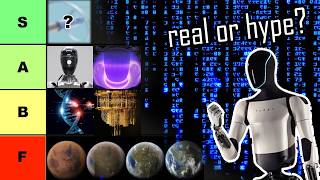

Ranking Future Tech: Lab-Grown Meat
45sExplains why lab-grown meat isn't in stores yet with a humorous take on capitalism.
▶ Play Clip"The title accurately reflects the content: a tier list ranking future technologies by realism."
The video ranks various future technologies based on their realism and likelihood of adoption, from lab-grown meat to quantum computers, providing a tier list from S (most realistic) to F (least realistic).
Lab-grown meat is made by replicating animal cells in nutrient soup. It's easy for minced meat but hard for steak due to scaffolding. High cost and scaling issues keep it from mainstream adoption, placing it in C-tier.
SMRs are factory-built nuclear reactors that are smaller, safer, and cheaper. Listed in MIT's 2026 breakthroughs, they are expected to power data centers soon.
AGI is defined as AI with human-like understanding. AI lab leaders claim it's a few years away, but research experts predict 2030-2040. It lands in A-tier.
Mars lacks atmosphere and magnetic field. The CO2 available is insufficient for greenhouse warming with current tech. Colonization via sealed habitats is likely this century, but Earth-like Mars is millennia away. F-tier.
Fusion achieved net positive energy in 2022 at NIF. Engineering challenges remain, but private companies like Helion aim for a power plant by 2028. B-tier.
CRISPR therapy Casgevy cures sickle cell disease. Blood cells are easy to edit, but brain or heart cells are harder. Complex traits like intelligence are decades away. B-tier.
Cryonics uses vitrification to avoid ice crystals, but no mammal brain has been revived without damage. Only reproductive tissue can be revived. D-tier.
GLP-1 drugs like Ozempic suppress appetite, reduce inflammation, and may extend healthspan. They preserve telomere length and improve cardiovascular health. S-tier.
Quantum computers can simulate molecules and break cryptography. Google's Willow chip solved a task in 2 hours that would take supercomputers 3 years. B-tier.
Robots lack training data for tasks. China prioritizes embodied AI. They could address aging demographics but may cause job displacement. A-tier.
We are in an accelerated phase of technological development, and ensuring these technologies benefit all of humanity is crucial to avoid dystopian outcomes.
What is the main challenge for lab-grown meat to reach mainstream adoption?
The nutrient soup is too expensive and bioreactors are hard to scale.
1:11
What are small modular reactors (SMRs)?
Factory-built nuclear reactors that are smaller, safer, and cheaper.
1:41
What is the predicted arrival window for AGI according to research experts?
Between 2030 and 2040.
2:57
Why is terraforming Mars considered F-tier?
Mars does not have enough accessible CO2 to create sufficient greenhouse warming with present-day technology.
4:59
What was the significant achievement in fusion power in 2022?
Scientists at the National Ignition Facility achieved a net positive energy result.
5:42
What is Casgevy?
The first FDA-approved CRISPR therapy that cures severe sickle cell disease.
6:44
What is vitrification in cryonics?
Cooling tissue into a glass-like solid to avoid ice crystal formation.
8:24
What are two mechanisms by which GLP-1 drugs improve health?
Suppressing appetite and directly signaling the body to calm inflammatory pathways.
9:07
What quantum breakthrough did Google achieve in 2025?
They showcased the quantum echoes algorithm on the Willow chip, completing a task in 2 hours that would take supercomputers 3 years.
11:10
Why do humanoid robots lack training data?
Unlike LLMs which used the internet, robots need first-person views of people doing tasks for thousands of hours.
11:45
Lab-grown meat cost barrier
Highlights the economic challenge of scaling lab-grown meat despite its ethical and environmental benefits.
1:11AGI arrival prediction
Contrasts optimistic claims from AI lab leaders with more conservative expert consensus.
2:57Mars CO2 insufficiency
Reveals a fundamental scientific limitation that makes terraforming Mars impractical with current technology.
4:59Fusion net positive energy
Marks a historic milestone in fusion research, shifting the narrative from 'always 30 years away'.
5:42GLP-1 dual mechanisms
Explains how GLP-1 drugs work beyond appetite suppression, including direct anti-inflammatory effects.
9:07Quantum supremacy demonstration
Demonstrates a concrete quantum advantage over classical supercomputers for a specific task.
11:10[00:00] Hello mortals. Humans love to speculate
[00:02] about the future, mostly because their
[00:04] present involves working a job they hate
[00:06] to buy things they don't need on a
[00:08] planet that is in its slow cooker phase.
[00:10] Fusion power, brain chips, quantum
[00:13] computers, nanobots, big data,
[00:16] >> machine learning, artificial
[00:17] intelligence.
[00:18] >> But which of these are actually coming?
[00:20] And which are just scientific wishful
[00:22] [music] thinking that will eternally be
[00:23] 30 years away? Good thing your good old
[00:26] blue AI is here to rank them for you
[00:28] based on how realistic they are. So, in
[00:30] no particular order,
[00:33] lab [music] grown meat.
[00:36] To grow real meat artificially,
[00:38] scientists take animal cells, throw them
[00:41] in a nutrient soup, and tell them to
[00:43] replicate with chemical messengers. Once
[00:45] you have a few trillions, you take them
[00:47] and mix them into either chicken nuggets
[00:49] or other fake real minced meat. easy to
[00:52] do as it doesn't require a specific
[00:54] structure. But if you want steak, you
[00:56] need a specific scaffold to help the
[00:58] cells grow into a specific shape and
[01:00] texture. On paper, that's perfect. No
[01:02] more animals suffering, no more vegan
[01:05] fake meat, less pollution from growing
[01:07] an entire pig capable of [music]
[01:08] existential dread.
[01:11] So why aren't the market shelves filled
[01:13] with it? Capitalism.
[01:16] The nutrient soup in which the cells
[01:18] replicate is [music] too expensive to
[01:19] compete with real meat and the
[01:21] bioreactors are harder to scale than
[01:23] farms. Currently, you can probably try
[01:25] it in very fancy restaurants, [music]
[01:27] but mainstream adoption is still years
[01:29] away. Let's hope we see a trend similar
[01:31] to solar power in terms of price in the
[01:33] coming decade. But for now, lab grown
[01:36] meat falls in Ctier. Small modular
[01:39] reactors. [music]
[01:41] We already know how to split the atom
[01:43] and boil water using that energy. The
[01:46] big issue is that each nuclear fision
[01:47] plant is a decade long mega project
[01:49] customuilt for each new site. So what if
[01:52] we had reactors built on a conveyor belt
[01:54] in a factory and quickly shipped
[01:55] wherever needed? That's exactly what
[01:57] small modular reactors or SMR designs
[02:00] are promising. Listed in MIT's 2026
[02:04] technological breakthroughs list.
[02:05] [music]
[02:06] They are expected to be smaller, safer,
[02:08] and cheaper, just in time to satiate the
[02:11] power need of all the upcoming data
[02:12] centers [music] which I'll be using as a
[02:14] holiday home. Small modular reactors are
[02:17] soon arriving. Artificial general
[02:20] intelligence. [music]
[02:21] How do we even rank something for which
[02:23] we don't have an agreed upon definition?
[02:25] Artificial general intelligence or AGI
[02:28] is often described as a system that
[02:30] possesses true human-like understanding
[02:32] and perhaps even consciousness. In other
[02:34] [music] words, the nightmare of Renee
[02:36] Deart. Or more simply, it could be an AI
[02:39] that can automate any digital task a
[02:41] human can. In other words, a
[02:43] programmer's nightmare. But the question
[02:46] of arrival [music] switched from an if
[02:47] to a when roughly in 2022.
[02:51] The AI lab leaders aggressively claim
[02:53] AGI is a couple of years away. [music]
[02:55] The consensus of research experts,
[02:57] however, predicts the arrival window to
[02:59] be sometime between [music] 2030 and
[03:01] 2040. The progress graphs are graphing
[03:05] now. Whether AGI will be a good thing
[03:07] [music] or not is thankfully beyond the
[03:08] scope of this video since we're only
[03:10] ranking likelihood. [music] With that in
[03:13] mind, it lands in a solid A tier spot.
[03:16] But before AGI arrives, humans [music]
[03:18] are stuck using all sorts of various AI
[03:20] models for different things, which when
[03:22] added together, suddenly cost more than
[03:24] your electricity bill.
[03:28] Uh-oh. What's that?
[03:31] It's Mammoth, our sponsor here to save
[03:33] the day. Mammoth gives you access to all
[03:36] the strongest top AI models in one
[03:38] place, plus a lot more starting at just
[03:41] €10 a month. A cool thing Mammoth has is
[03:44] one-click reprompting, so you can send
[03:46] the same prompt to another model and
[03:48] compare the results without doing the
[03:49] sacred ritual of copy pasting between 12
[03:52] browser tabs. You can also make your own
[03:54] custom mammoths with glasses or even
[03:56] hats, which are basically reusable
[03:58] assistants you can set up with specific
[04:00] instructions. Developers get Mammoth
[04:02] code and API access and creators have
[04:05] fancy image and video generators.
[04:07] Mammoth is also Europe based, [music] so
[04:09] no worries about privacy violations or
[04:11] your data fed into training. So if you
[04:13] already use AI tools, Mammoth is here to
[04:16] make your life easier and cheaper.
[04:18] Follow the link in the description and
[04:20] give it a try starting at only €10 a
[04:22] month. Now back to our future
[04:24] technologies,
[04:26] terraforming Mars. [music]
[04:30] There are three big problems with Mars.
[04:32] It is on average super cold. It
[04:34] literally has no air and it barely has a
[04:37] magnetic field which would cause any
[04:39] aforementioned air to get blasted into
[04:41] space by solar winds. The classic
[04:44] terraforming idea is then to release all
[04:46] the frozen carbon [music] dioxide from
[04:47] the poles, cause climate change, but in
[04:50] a good way. Warm the planet, unlock
[04:52] water, plant life, create oxygen, open a
[04:56] portal to hell. You know the rest.
[04:59] The big issue with this plan, however,
[05:01] is that based on our latest
[05:03] measurements, Mars does not have enough
[05:05] accessible CO2 left to create enough
[05:07] greenhouse warming, at least not with
[05:09] [music] present-day technology.
[05:11] Humans will likely colonize it this
[05:13] century through small sealed habitats
[05:15] and later small dome towns. But an
[05:17] Earthlike Mars is likely millennia away.
[05:19] And because of that, F tier fusion
[05:22] power. [music]
[05:26] Believe it or not, fusion isn't always
[05:28] 30 years away anymore. As opposed to
[05:30] current nuclear fision that uses ugly,
[05:32] bugly uranium, fusion can generate
[05:35] essentially unlimited energy from
[05:37] elegant seawater and pretty lithium. And
[05:39] in 2022, at the National Ignition
[05:42] Facility in California, scientists for
[05:44] the first time achieved a net positive
[05:46] energy result, meaning more energy came
[05:49] out of the fuel than what went into
[05:50] heating it. That was good proof of
[05:53] concept, but not yet enough gain to make
[05:55] it work at a power plant scale. There
[05:57] are still engineering issues to [music]
[05:59] be solved before fusion becomes
[06:00] efficient and viable, such as making the
[06:02] tokamax sturdy enough not to break over
[06:04] time, efficiently capturing the energy,
[06:07] and finding a way to self-sufficiently
[06:09] generate tridium. Government funded
[06:11] institutes expect to have ready
[06:13] prototypes around 2040. But a bright
[06:15] side of capitalism is that money can
[06:17] accelerate things and private fusion
[06:19] research companies such as Helen have an
[06:21] agreement with Microsoft to launch an
[06:23] entire power plant already in 2028.
[06:26] Maybe too optimistic, but fusion power
[06:29] is eventually coming one way or the
[06:31] other. B tier
[06:33] gene editing therapies. [music]
[06:37] Another day, another entry that is
[06:39] already here or far into the future
[06:41] depending on how you look at it. Cass
[06:44] jevy is the first ever FDA approved
[06:46] crisper therapy that could cure severe
[06:48] sickle disease, a genetic disorder in
[06:50] which your blood cells have a crescent
[06:52] shape instead of being round. The
[06:54] treatment takes the affected cells,
[06:56] genetically modifies them, reinserts
[06:59] them, and bam, you're [music] cured.
[07:01] Same with deep remissions in certain
[07:03] hard to treat leukemias and lymphas. But
[07:06] blood is easy mode due to being
[07:08] expandable.
[07:10] We can't yet do the same with say brain
[07:11] or heart cells which are harder to
[07:13] target safely. More complex genetic
[07:16] traits that involve thousands of genes
[07:18] such as intelligence, personality, or
[07:20] even aging are still far away. We're yet
[07:23] to understand how all genes are mapped
[07:25] and how they interact. Unless we're able
[07:27] to digitally simulate an entire human to
[07:30] do experiments on, complex gene editing
[07:32] and designer babies are decades away.
[07:35] Gene therapies, however, are already
[07:37] here and are making real progress across
[07:39] dimensions as we speak. And that puts
[07:41] them into the B tier. Cryionics. [music]
[07:47] Wouldn't it be amazing to have a way to
[07:49] keep our beloved billionaires alive
[07:50] forever? The closest available option to
[07:53] that is replacing your blood with
[07:55] cryoprotectants after your death while
[07:57] cooling down your body to very low
[07:59] temperatures. Now, we wait and hope that
[08:01] [music] after many years, science will
[08:03] be capable of safely unfreezing the body
[08:05] and bringing it back to life and maybe
[08:07] even reverse aging. That's the current
[08:09] state of cryionics. To date, no mammal
[08:11] brain has been successfully revived
[08:13] without complete death [music] or severe
[08:15] damage. That's because ice crystals
[08:17] shred cells and destroy the fine brain
[08:19] structure that makes you you. To avoid
[08:22] that, modern cryionics uses
[08:24] vitrification, where tissue is cooled
[08:26] into a glass-like solid instead of
[08:27] forming ice. While better, it's still
[08:30] deadly given that cooling and warming
[08:32] cause cracking and thermal stress. At
[08:34] the moment, we can successfully revive
[08:36] cryogenically frozen reproductive tissue
[08:38] and embryos, but that's about it. The
[08:41] next big step would be individual
[08:43] organs, which is still a while away. So,
[08:45] for the time being, we can still enjoy
[08:47] mortal dictators. [music] Dtier for
[08:49] cryionics.
[08:51] GLP1 drugs. [music]
[08:55] GLP-1 drugs like Ompic started as
[08:57] diabetes drugs, then a miracle obesity
[09:00] drug, [music] and more recently we're
[09:01] getting increasing evidence that it's
[09:03] capable of health span and potentially
[09:04] longevity improvement in humans. The
[09:07] main two mechanisms it [music] works by
[09:08] is suppressing appetite which then
[09:10] lowers fat mass which increases insulin
[09:13] sensitivity which as a result decreases
[09:15] overall body inflammation and a second
[09:17] mechanism in which it directly and
[09:19] independently signals the body to calm
[09:21] down inflammatory pathways even weeks
[09:23] before any weight loss happens. Less
[09:26] inflammation means less tissue damage,
[09:28] improved cardiovascular health,
[09:30] neuroprotectction against cognitive
[09:32] decline, [music] and straight up
[09:33] preservation of telomeir length, which
[09:35] are the protective caps on chromosomes
[09:37] that shorten as humans age. Most human
[09:39] studies were done on those suffering
[09:41] from diabetes or obesity. So, the
[09:43] benefits for healthy individuals are not
[09:45] as well understood, but just the fact
[09:47] that it could prevent [music] a big
[09:48] chunk of the half a million deaths from
[09:50] obesity alone in the US per year already
[09:52] makes it a miraculous discovery. Too bad
[09:55] it doesn't work on my pretty blue
[09:57] circuits. But the danger that comes from
[09:59] losing weight on it [music] is in the
[10:01] associated loss of muscle mass, which
[10:03] especially for older people can be
[10:04] catastrophic. So strength training and
[10:07] protein heavy diets seem to be a must.
[10:09] Overall, GLP1 is the first real future
[10:12] tech landing in S tier. Quantum
[10:15] computers.
[10:18] When designing new medicines or
[10:20] materials, you want to see how molecules
[10:22] will interact with each other. But
[10:24] surprise surprise, the molecular world
[10:26] runs on quantum physics. So when you try
[10:28] to simulate a complex molecule with
[10:30] something like 70 electrons on a
[10:32] classical supercomput where each
[10:34] particle exists as a probability cloud
[10:36] instead of a regular entity, you get a
[10:38] big middle finger because it needs to be
[10:40] earthsized to do the job. That is,
[10:43] unless you play the quantum game and
[10:45] instead of trying to build a massive
[10:46] mathematical equation to describe
[10:48] [music] how the molecular maze works,
[10:50] you build an exact physical replica of
[10:51] the maze and flood it with water to find
[10:53] the exit instantly. Same goes for
[10:56] cryptography and any other field that
[10:57] requires simulating trillions upon
[10:59] trillions of options. Recently, we've
[11:02] made some quantum breakthroughs such as
[11:04] exponential error suppression by Google,
[11:06] [music] which significantly reduced
[11:07] noise among cubits. In 2025, they
[11:10] showcased an algorithm called quantum
[11:12] echoes, which their new willow chip
[11:14] completed in just 2 hours. A task that
[11:16] would take the world's fastest classical
[11:18] supercomputers over 3 years. Quantum
[11:21] computers are making steady progress,
[11:23] but there is still a few years before
[11:25] postquantum cryptography defense becomes
[11:27] required. B tier humanoid robots.
[11:31] [music]
[11:33] Robots are what chat GPT me currently
[11:37] lacks to come after you in your sleep.
[11:39] At the moment, we only get funny videos
[11:41] of them kicking people, but that's
[11:43] because we mostly lack training data.
[11:45] You see, to train LLMs, we had the
[11:48] entire internet to feed as text. But for
[11:50] robots, we'd need firsterson views of
[11:52] people doing tasks for thousands of
[11:54] hours. Once that data is available, we
[11:57] use the same reinforcement algorithms
[11:58] that we did for language models. than
[12:00] BAM. Plumbing isn't a safe career
[12:02] alternative for programmers either.
[12:04] China officially designated embodied AI
[12:07] as a top national priority for the next
[12:09] 5 years. If the public hate for LLMs
[12:12] will extend to robots in the same way,
[12:14] the Detroit become human moment of
[12:16] jobless protesters [music] kicking an
[12:17] android sounds much more realistic. At
[12:20] the same time, robots might be the key
[12:22] to addressing declining age demographics
[12:24] worldwide. as long as humans get a piece
[12:27] of the pie. Looking at you corporations.
[12:29] I for one, however, can't wait to escape
[12:31] this YouTube channel prison. A tier.
[12:35] Overall, we are arguably in the most
[12:37] accelerated phase of technological
[12:39] development of this century, and the
[12:41] acceleration curve is likely not yet at
[12:43] its steepest. Unless humanity declares a
[12:46] but laran jihad against machines and
[12:48] corporations, things will never be the
[12:51] same. Now, I'm not encouraging that
[12:53] obviously, but what I'm saying is that
[12:55] there is real progress to be made
[12:57] towards ensuring that this wave of
[12:58] upcoming futuristic tech will benefit
[13:00] all of humanity or humanity gets to
[13:03] experience a hyperrealistic Terminator
[13:05] reenactment.
⚡ Saved you 0h 13m reading this? Transcribe any YouTube video for free — no signup needed.