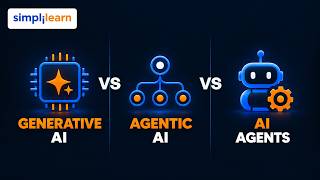

Why AI is switching from generating to executing
47sHighlights the shift from generative AI to agentic AI, a hot topic with curiosity appeal.
▶ Play Clip"Delivers exactly what the title promises — a clear, structured comparison with real demonstrations, proving its worth without hype."
The video explains the difference between generative AI, AI agents, and agentic AI, using a relatable Goa trip planning example. It introduces the key concepts, including tool execution loops and memory, and provides real-world demonstrations.
OpenAI describes the shift as moving from assistance to execution; Google talks about the rise of agentic AI and agentic systems.
Generative AI creates content like itineraries. The flow is simple: you ask, AI creates, you receive.
An LLM-based agent combines a model, tools, state, controller, and permissions. It can decide what to do next, use tools, and keep track of tasks.
The tool execution loop: model proposes an action, runtime validates, tool returns result, state updates, and external results feed the next decision.
A workflow follows a fixed path, while an agent can choose the next step based on the current situation.
Agentic AI plans by breaking down the goal, acts by running tools, observes results, and adapts. The goal stays the same even if individual steps change.
Working content, persistent state, saved preferences, and execution traces are used to keep the task consistent.
A single agent can be agentic; multiple agents add coordination work and costs.
Runtime enforces limits: tool access, approval gates, and execution limits. Prompts guide behavior, but application controls enforce the rules.
Evaluating agents requires checking behavior when things go wrong: retry on API timeout, recalculate on price change, ask for approval before bookings.
The video demonstrates using ChatGPT for a simple itinerary, then a more complex task to search and shortlist hotels, and finally a goal-oriented prompt for a full trip plan with budget constraints.
Microsoft Applied Agentic AI System Design and Impact program
service
LangChain
tool
AutoGen
tool
CrewAI
tool
Na10 (likely Nano)
tool
LangGraph
tool
MCP
tool
Jupyter
tool
GitHub Copilot
tool
Figma
tool
ChatGPT
tool
Agoda
tool
TripAdvisor
tool
MakeMyTrip
tool
Expedia
tool
Kayak
tool
IMD (India Meteorological Department)
link
Shift from assistance to execution
Defines the industry trend from generative AI to agentic AI, framing the entire video.
00:19Anatomy of an AI agent
Breaks down the core components (model, tools, state, controller, permissions) of an agent.
04:54Plan, act, observe, adapt
Encapsulates the agentic AI behavior loop, key to understanding autonomy.
08:08Prompts guide, controls enforce
Clarifies the critical role of runtime enforcement in AI safety.
12:57[00:07] story was generative AI. AI that could write, summarize, create images, generate code and answer questions. But if you look at what companies are talking about now, the conversation is little bit changing. The focus is
[00:19] shifting from AI that helps you generate or create code to actually AI that takes action and work towards a goal. OpenAI describes this as moving from assistance to execution. While companies like Google are increasingly talking about
[00:33] the rise of agentic AI and agentic systems. So that raises a very important question. What actually changed? When does generative AI become an AI agent and what makes an AI agent truly agentic? This is exactly what we are
[00:48] going to understand in this video. Today we'll break down the difference between generative AI, AI agents and agentic AI. see how each one behaves and also understand why this shift matters. And if you want to go beyond understanding
[01:01] these concepts and actually learn how to design, build and work with agentic AI systems, Microsoft applied agentic AI system design and impact program is built for the next step. The program covers a full journey from AI and
[01:15] genative AI fundamentals to LLM internals planning systems multi- aent ecosystem model context protocol workflow automation agentic UX product readiness and also AI agent development to Azure. You'll also get a hands-on
[01:29] exposure to tools and frameworks such as lang chain, autogen, crewi, nat, lang chain, autogen, crewi, nat, langraph, lang, mcp, jupiter, github, copilot, figma, and more. And the learning is highly practical. The
[01:42] program includes 40 plus demos, 10 plus guided practices, seven course end projects, and also a capstone. So you don't just learning theory behind a ki, world use cases. Some of the projects include building an agentic rack
[01:58] pipeline, a multi-agent workflow planner and an AI powered automation system with NA10 and a production grade multi- aent GTM system using crew AI and MCB. It's a 10-week live online interactive program and on completion learners earn a joint
[02:15] program completion certificate from Microsoft and Simply Learn. So if you want to move from simply using AI tools to actually understanding how a HTTPI systems are built and applied, the link is given in the description box below
[02:27] and in the pin comments, go check it out. But before we continue, let's see what you already know. Here's a quick question for you to answer. Which one of the below can work towards a goal, take action, respond to results, and also
[02:40] change its next step when needed? Is it generative AI, traditional automation, AI agent, or agentic AI? Let me know your answers in the comment section below. Now let's start with a question at the center of the shift. Now what
[02:54] happens when AI stops just answering? A useful answer is just the beginning. For example, AI can give a travel plan such as places and also create an itinary. But the biggest question is can AI help carry out the plan? Can it go beyond
[03:08] just answering questions and actually helping me take the next steps? That is what we are going to explore by comparing genative AI AI agents and also agent AI. So let's take a simple example. I am planning a 3-day Goa trip.
[03:22] I want a 3-day break in Goa with quiet beaches, local food, and less time planning. So I start with a very simple question. Can you help me plan it? At this point, I'm only asking AI to help me create the plan. I'm not asking it to
[03:37] book anything or take action yet. And this is where we begin with generative AI. Now that I've asked AI to help me plan the trip, this is where generative AI creates. I can simply ask suggest a 3-day itinary and then AI creates
[03:52] content in this case an itinary. It could also create an image, code or ideas. And in my case, I will receive a plan that I get to review. The flow is very simple. You ask AI creates and you receive. So at this stage AI is helping
[04:07] me generate the plan but it is not yet taking actions outside the conversation. Now generative AI has already created the itinary for me but I want more than just an itinerary. I want AI to find hotels for my dates, compare the options
[04:23] and save my short list. At this point I'm no longer asking only for generated content. I want the AI to work with current information and help me complete a specific task. So the question becomes can AI take the next step? This is where
[04:38] we move from generative AI towards an AI agent. Now that I want the AI to do more than just generate an itinary, we need to understand what makes an AI agent. An LLM based agent combines a model with an execution system. The model processes
[04:54] the next action. The tools explores searches, APIs and other operation. The state tracks the task results and also decisions. The controller runs the loop and handles failures and permissions restrict what can be executed. So unlike
[05:10] simple generative AI, an AI agent is not just producing an answer. It can decide what to do next, use tools, keep track of task and work within defined limits. Now that we know what makes an AI agent,
[05:24] let's see how actually works through a task. This is the tool execution loop. The first is model proposes a search for the hotels. Then the runtime validates and execute that action. Next, the tool returns the result. This could be hotel
[05:40] prices or even an error. That result is then used to update the state. And the key point here is that external results feed the next decision. So the agent keeps moving through this loop until the task is completed. It reaches a limit or
[05:55] at least needs human input. This is how AI agent goes beyond simply answering and starts taking action step by step. Now that we have seen how tool execution loop works, the next question is workflow or agent. In a predefined
[06:10] workflow, the steps are fixed in advance. For example, it's search, filter, and save. But with an agent, the next step is not always predefined. The current result is passed back to the model and then the model selects an
[06:25] model and then the model selects an allowed action. It might search again, compare, ask me or finish depending on what it finds. So the key difference is this. A workflow follows a fixed path while an agent can choose the next step
[06:39] based on the current situation. Now we move from single task to a much bigger question. What if I give AI the whole goal? Instead of telling AI exactly what to do at every step, I simply say help me organize the whole trip. But I still
[06:54] give clear condition. My budget being 30,000. So it has to stay within my budget. I also give it my preferences, quiet, beaches or even local food. And also if plans changes, it should adjust for weather or prices instead of
[07:09] starting over. This is where system has to think across multiple steps and keep the overall objective in mind. It may need to check the weather, compare hotel options, look at the cost and revise the plan if something changes, but there is
[07:24] still boundary. Ask me before any booking or payment. So the AI can work towards a goal, adapt when needed and still keep in control. Now let's see what happens if my plan changes. Suppose the system receives new information.
[07:38] There is rain during beach day. Now for that situation, instead of ignoring that change, it creates a revised plan and also may suggest an indoor activity that still fits the trip. At the same time, the same conditions still apply. Budget,
[07:54] preferences, approval. So the system should not change the trip randomly. It should adapt while still respecting the original requirements I gave it. That is important point here. The plan changes but the goal stays the same. This
[08:08] ability to respond to a new information while continuing towards the same goal is a key part of agentic behavior. This is where we actually see agentic AI. Agentic AI plans, acts and adapts towards a goal. First, it plans by
[08:23] breaking down or decomposing the goal into smaller steps. Then it acts by running an allowed tool. After that, it observes the results returned by the tool. And based on what it observes it, it can adapt and revise the next step.
[08:38] The important point is that my goal still stays the same even if individual steps change. The important point here is that my goal still stays the same even if the individual steps change. So the system keeps moving through the
[08:51] the system keeps moving through the loop. Plan, act, observe, adapt until the goal is completed. It reaches a limit or it needs a human input. And as the slide says, it should continue within the limits and ask for help when
[09:04] needed. Now the next question is how does AI remember my goal and preferences. This is where state and memory become important. The working content contains the goal and also a recent result so that the model knows
[09:17] what is happening in the current step. The persistent state can store things like my short list and also budget which helps the system resume and task later. My save preferences such as quiet beaches can be reused with permission
[09:31] and the execution trace keeps tracks of calls and outcomes which helps with auditing and also debugging. But the important thing here is stored information must be selected and supplied to the model. So the system
[09:44] everything. It uses the right sorted information at the right time to keep the task consistent. Now another important question is one agent or several agent. A single agent can work with shared trip state and also use
[09:59] different tools such as hotel, weather and a calendar tool to complete the task. But in some cases, we can also use several agents. Here a coordinator combines results from specialized agents such as hotel research and also an
[10:13] activity researcher. This can be useful when different parts of the task need separate expertise or can handle independently. But there is a trade-off. Multiple agents add coordination, work and also costs. So agent AI does not
[10:27] always mean multiple agents. A single agent can also be agentic if it can plan, act, observe and adapt towards the goal. Now let's compare all the three terms together. Generative AI, AI agent and agentic AI. For generative AI, the
[10:43] main emphasis is content creation. Its core mechanism is model generation and the typical result is text, image or code. What we mainly verify is the accuracy and usefulness of that output. For an AI agent, the emphasis is on
[10:58] acting system. It uses tools state and also controlled to complete a task. So the typical result is a task outcome and we need to verify correct tool execution. For agentic AI, the emphasis is goal directed behavior. Its core
[11:14] mechanism is planning and feedback and the result is progress towards a goal. Here we verify whether the system is following the goal and also constraints correctly and the most important point is an AI agent can be an agentic and one
[11:30] system can combine all the three. So these are not completely separated technologies. There are different ways of describing what the system is doing and how much autonomy it has. Now that we understand how the agent works, now
[11:44] let's get to the next question is how would I test this agent? We should not just test whether it gives a goodlooking answer. We need to check how it behaves when things go wrong. For example, if no hotel matches the expected behavior, it
[12:00] is asked for constraint change. If the price changes, it should recalculate the total. If the API times out, it should retry within a fixed limit instead of looping forever. And if approval is missing, it should not execute the
[12:15] booking. So we need to evaluate outcomes and tool traces and also not just the final response. We should also track success rate, latency and cost per task. That tells us whether the agent is actually reliable, efficient and also
[12:30] safe to use. Now even if the agent can plan and act, it will still needs clear boundaries. This is why runtime enforces the limits. First there is tool access.
[12:42] The system should only have the search scope and also permission it actually needs. Then there is approval gate for actions like bookings and payments. The system should stop and confirm with me before continuing. We also need
[12:57] execution limits. This is such as timeouts, retries and step caps so that agent does not run endlessly if something goes wrong. The key idea here is simple. prompts guided behavior but application controls enforces the rules.
[13:11] So even if the model makes a poor decision, the runtime helps restrict what it is actually allowed to do. Now let's see a classic example of generative AI as mentioned in the PPT. Let's just give it plan a 3-day itinary
[13:26] in Goa. And also with that let's give the conditions also. So we are just the conditions also. So we are just typing create a 3-day Goa itinerary for typing create a 3-day Goa itinerary for me and I prefer quiet beaches, local
[13:41] me and I prefer quiet beaches, local food and relaxed holiday or schedule. So food and relaxed holiday or schedule. So holiday or schedule and let's start with the simplest case. This is basically I'm planning a 3-day trip to Goa. So I'll
[13:54] planning a 3-day trip to Goa. So I'll ask AI to create an itinary for me. So as you can see it generates a complete plan based on my preferences. So as you can see it has suggested me places to visit, foods to try and also how I could
[14:09] organize each day. This is generative AI. I gave the AI a prompt and it generated new content for me. But notice what is happening here. I'm asking question and I'm getting an answer. The AI is helping me create a plan but still
[14:24] driving the conversation step by step. Now let's make task a little more action oriented. For this part I'll be using chat GPT work which is more into agenti.
[14:37] So let's switch to work. Now here as you can see I've given a prompt of find suitable hotels in Goa under 5,000 per night for my trip. Compare the available options and also short list the best three based on price, location and
[14:52] overall suitability. do not make them booking because this is an agendic AI. booking because this is an agendic AI. So let's use the highest model which is So let's use the highest model which is Astra and let's give it a go. Now here I
[15:05] am asking the AI to do something more specific. I am not only asking it to simply generate hotel suggestions. I'm giving it a task to find suitable hotels, compare them, and short list the best three. To complete this task, the
[15:18] system may need to search for current information, inspect different options, compare them against my requirements and then decide which ones offers are more suitable. So here AI will be doing more than just generating text. It is using
[15:32] than just generating text. It is using tool or external information to complete a specific task. So as you can see each step is also showed that it is searching step is also showed that it is searching from agoda trip advisor make my trip and
[15:45] experia kayak.com in every website it is collecting information. Now these websites are tools. So as you can see comparing Goa accommodation options and comparing Goa accommodation options and prices from agoda here again and we have
[16:00] multiple other platforms also which includes Google. So the next step will Obviously because we have already mentioned we need the best. This is the actual idea behind an AI agent. An AI agent receives a task, decides what
[16:16] action is needed, uses the available tools, look at the result and then completes that task. The important thing here is that the task is still relatively narrow. I asked for hotel options and the agent is trying to
[16:30] complete that specific task. Now let's wait for the results. So as you can see the result here we have got the simro say is my first choice for you to relaxed beach trip. Then we have platinum garden resort offers the best
[16:45] value and these three have advertised raised below 5,000. So we have a clear table so it's easier for me to just select one and go. This will be inside my limits. Now let's make this problem a little much more complex. Now look how
[17:02] different this request is. This time I'm not giving the AI one small task. I'm giving it a complete goal. I want a 3-day Goa trip. The total budget should stay under 30,000. I want quiet beaches, local food, and relax schedule. It needs
[17:18] to consider the weather as well. It needs to compare hotels. It needs to build the itinary. And if something changes, it needs to adjust the plan while still respecting my original conditions. Notice here that I have not
[17:32] only told the system every individual step. I haven't said first check weather then find hotels then calculate the budget and then build the itinary. I've just given it goal and constraints. Now the system has determined what needs to
[17:47] happen. For example, one of my condition depends on weather. So the system may decide that checking the weather is necessary before finalizing the itinary. If it finds that one of the days has heavy rain, the new information affects
[18:02] the plan. Suppose the original plan included a beach activity on that day. The system now has the problem. The weather has changed, but my overall goal has not. I still want a good 3-day Goa trip. So instead of stopping, the system
[18:17] can adapt. It may replace the outdoor activity with an indoor local food experience or another option that is still matches my preferences. The plan changes but the goal stays the same. Next, it has to compare hotel options.
[18:31] It already knows one of my constraint which is the hotel should be under 5,000. So instead of simply showing everything it finds, it can use that condition to decide which options are relevant. Now it also needs to check
[18:44] whether the complete plan still fits within my 30,000 budget. So it can combine the estimated hotel cost, transport, food and activities. If the hotel is within the budget, the plan can continue. If the total goes above the
[18:59] limit, the system needs to adjust something. It might choose a cheaper hotel, change an activity or revise another part of the trip. This is important because the system is not just following one fixed sequence. It is
[19:12] responding to the result. And there is one or more important conditions. I told the system not to make any bookings or payment without asking me first. So even if it has completed the planning and foundation, the best option here is it
[19:27] should stop before taking that final action. This is the human in the loop control. Agent AI does not mean giving the system the ultimate authority. It means allowing it to work towards a goal within a defined boundaries. Now let's
[19:42] compare all the three. In the first example, I asked AI to create an itinary. It generates the content for me. This is where generative AI comes in. In the second example, I asked AI to find hotels, compare them, and shortlist
[19:56] the best options. The system had a specific task and could use tools or external information to complete it. That is an AI agent. In the third example, I gave AI a broader goal with multiple conditions. The system had to
[20:12] work through several steps, use information, make decision, check constraint, adapt when conditions change and continue working towards the same and continue working towards the same goal and that is aki. Now this task
[20:24] might take a few minutes for execution. Now here as you can see it has already given us my best proposed plan for two nights in Patnam one relaxed outing to
[20:36] Agoda and then estimated total of 27,300. Uh the location will be Patnams and also it's a budget for travel. I assume two adults are sharing one room 3 days in Goa two hotel nights. Since you haven't
[20:53] supplied the dates 10 to 12 October 2026 is an illustrative window for weather check. Exact hotel availability and transport phase remains unconfirmed and weather support is relaxed beach itinary checked on 7th October's IMD's latest
[21:08] bullet expert dry weather on 11th and weather reports as well. The hotel comparison again we have the best three comparison again we have the best three resorts or hotels given for us with the
[21:22] prices also uh it has given a reasoning also why it has choose these things. Then your practical itinary keeps the same hotel throughout. So it is a practical itinary here for day one, day two and day three. And then we have here
[21:40] the total estimated cost for two people. Now since we have not mentioned it if it's for one person or two two person it has suggested to go with the two persons sharing one room. So we have hotel for two nights and on an average price is
[21:55] two nights and on an average price is 7,000 and then return is maybe 6,000 and 7,000 and then return is maybe 6,000 and then we have 4,000 and then outing local rides include 2,000. Meals, drinks, water, snacks 3 days is 4,800.
[22:09] water, snacks 3 days is 4,800. small incidents which is 500 and we have small incidents which is 500 and we have total up to 27,300 and we have remaining 2,700. The 6,000 return travel figure it allowances not a
[22:23] verified fair. So we have not mentioned on what means we are traveling and from what location we are traveling. So that also has been assumed. So if I mention those both and run the same prompt, you will have an end toend plan in your own
[22:37] hands. You don't need to do a separate research on itinary or hotels, check multiple platforms, anything as such. This is a goal oriented platforms where you can actually plan or any other task related to automations, you can do it
[22:52] using a proper goal oriented prompt. Now that we understood the difference and seen how this works, let's look at where you could use them. With generative AI, common use cases include drafting an email, creating an image, summarizing
[23:07] notes. The main idea is that it creates content. With AI agents, the system can go a step further. It can check and order, compare products, and find information. In other words, it performs actions. And then agentic AI, the focus
[23:23] is on larger goals. It can coordinate research, manage a workflow and also respond to changes while continuing to work towards the same objective. So the easiest way to remember it is to generative AI creates content. AI agents
[23:38] perform actions and agentic AI keeps goal on track. And finally, here's the big takeaway. Generative AI creates, it generates content such as text, images, code, or ideas. And AI agents acts. It can use tools, make decisions and also
[23:53] compare specific task and also agentic AI plans, acts and adapts. It works towards a broader goal, responds to changing information and also adjusts the next step when needed. And that brings us to the end of this video. By
[24:08] now, you should have a much clearer picture of how generative AI, AI agents, and agentic AI differ and more importantly, how they build on one another. As AI continues to move from generating outputs to taking actions and
[24:21] working towards goals, understanding these differences will actually become even more useful. If you found this video helpful, let us know your thoughts in the comment section below. And don't forget to like, share, and subscribe to
[24:34] SimplyLearn for more such content. Thank you for watching and keep learning with you for watching and keep learning with Simply Learn.


⚡ Saved you 0h 24m reading this? Transcribe any YouTube video for free — no signup needed.