AI Summary
Google's algorithm updates have devastated independent websites like Retro Dodo, which lost 85% of its traffic after following all of Google's guidelines. The site, once valued at $1 million, now struggles to survive as Google prioritizes large media companies, Reddit, and AI-generated content.
Chapters
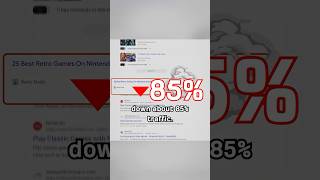
Retro Dodo, a video game site, reached a peak of a couple million monthly search visitors and received a $1 million acquisition offer. However, a Google algorithm update caused traffic to plummet to around 200,000 visitors per month, an 85% drop.
The site owner claims they followed Google's guidelines perfectly, doing nothing shady, yet the traffic never recovered. Users searching for the site by name could not find it.
Google's algorithm changes have buried independent sites, favoring larger media companies, Reddit, and AI-generated answers, while profiting from content created by smaller websites.
The owner realized the mistake of relying solely on Google for traffic. They are now building a media brand with multiple revenue sources to avoid dependence on any single platform.
The story of Retro Dodo highlights the risks of relying on Google for traffic. Independent creators must diversify their traffic sources and revenue streams to survive algorithm changes.
Clickbait Check
90% Legit"Title accurately reflects the story of a site crushed by Google despite playing by the rules."
Study Flashcards (6)
What was Retro Dodo's peak monthly search traffic?
easy
Click to reveal answer
What was Retro Dodo's peak monthly search traffic?
A couple million visitors per month.
How much traffic did Retro Dodo lose after the Google algorithm update?
easy
Click to reveal answer
How much traffic did Retro Dodo lose after the Google algorithm update?
85% traffic drop.
What was the acquisition offer for Retro Dodo?
easy
Click to reveal answer
What was the acquisition offer for Retro Dodo?
$1 million.
What did the site owner say about following Google's guidelines?
medium
Click to reveal answer
What did the site owner say about following Google's guidelines?
They were following Google's guidelines to the T and doing nothing shady.
00:30
What types of content does Google now favor over independent sites?
medium
Click to reveal answer
What types of content does Google now favor over independent sites?
Larger media companies, Reddit, and AI-generated answers.
01:00
What lesson did the site owner learn from the experience?
medium
Click to reveal answer
What lesson did the site owner learn from the experience?
To not put all eggs in one basket (Google) and to build a media brand with multiple revenue sources.
01:30
💡 Key Takeaways
Peak Traffic and Offer
Shows the initial success and high valuation of the site before the algorithm change.
Following Rules but Still Penalized
Highlights the frustration of playing by the rules yet being punished.
00:30Google's Favoritism
Reveals the shift in Google's algorithm that harms small sites.
01:00Diversification Lesson
Key takeaway for any online business dependent on a single traffic source.
01:30Full Transcript
Google crushed this man's thriving video game site. Why? Because he played by the rules. >> Our best month was a couple million search visitors a month, organic traffic. It was an incredible moment. We actually had a $1 million offer to purchase Retro Dodo. But out of nowhere, Google took everything away from him and his dream became a nightmare. We are around about 200,000 visitors [music] a month now. People were literally searching for us and couldn't find
us anywhere. We're still down about 85% traffic. >> Google algorithm changes have buried independent sites like his, favoring larger media companies, [music] Reddit, and its AI-generated answers, while profiting from content created by smaller websites. >> We were doing everything right. We weren't doing anything shady. We were following Google's guidelines to the T, but it just never ever came back. I was putting my eggs in one basket. That was the Google basket. I knew I had to
change and build a media brand that was slightly different, that had multiple [music] revenue sources, and didn't rely heavily on one.