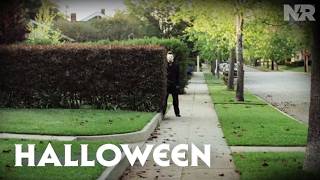

Why Michael Myers is scarier in daylight
45sThis hook challenges a common horror trope, immediately grabbing attention with a paradoxical statement.
▶ Play Clip"The title asks why a killer is scarier during the day, and the video does answer it, but it is a re-upload of a previous analysis and includes a sponsor segment, so it's average content."
This video essay analyzes John Carpenter's 1978 horror classic, Halloween, exploring why Michael Myers is scarier in the daytime, his motivations, and the film's cultural impact. It examines the film's themes, including the false security of suburbia, the rise of serial killer awareness in the late 1970s, and Laurie Strode's role as the 'final girl.' The essay also touches on the film's production, budget, and its enduring influence on the slasher genre.
The slasher subgenre's true beginning is often credited to Carpenter's Halloween. It holds up because it upends the safe suburbia trope and asks what the true origin of the boogeyman is in American mythology.
This video is the first of a Saturday weekend watch series, revisiting a past analysis from the Witching Hour channel, with plans to cover Beetlejuice, Poltergeist, and Scooby-Doo.
On Halloween 1963, Michael Myers, at six years old, murders his sister Judith. Fifty years later, he escapes, returns to Haddonfield, and targets Laurie Strode and her friends, leading to a climactic confrontation.
Michael's mask was created by painting a 1975 Captain Kirk mask, widening the eye holes, and altering the hair, an iconic detail that contributes to his unsettling look.
The film's elements, like Jamie Lee Curtis as the final girl, the suburban setting, and the rules (e.g., teenagers who have sex get killed), were staples cited in films like Scream and widely used in the slasher genre.
Carpenter shot the film in South Pasadena on a $300,000 budget, grossing $70 million, making it one of the highest returns on investment in movie history.
Throughout the film, Michael Myers is frequently in the background, watching from a distance, even in daylight, creating a pervasive sense of paranoia and suspense, a technique later seen in films like It Follows and Hereditary.
A station wagon is visible in the background before Laurie reaches the Myers house, leaving open whether it's Michael's car or just a town vehicle, yet the ambiguity heightens the sense of dread.
Tommy Doyle calls Michael the boogeyman, a concept Laurie dismisses, but by the end of the film, everyone is left wondering if evil is now a real entity.
Sequels and reboots have offered various backstories (sibling bond, Celtic cult, broken home), but the film suggests his motives are ambiguous, possibly triggered by Laurie humming improvised song that reminds him of his sister.
Film scholar Carol J. Clover argues that slasher killers like Michael are fueled by (quote) psychosexual fury, which is essentially a moral scolding of young women for sexually liberated choices.
John Carpenter and Deborah Hill have pushed back against the interpretation that Michael punishes sexual behavior. They say that is their term and that any thematic element from Debra Hill's Catholic upbringing was unintentional, the creator insisting he is just a story without moral judgment.
Dr. Sandra Kay & Loomis's line portraying Michael's as blind, pale, emotionless face and as 'purely and simply evil' establishes a central theme of the film: an unstoppable, unexplained predatory force.
A deleted scene from the script reveals another patient asks Loomis for a purple lawnmower, and Loomis says, 'the evil's gone.' This shows how other patients were tortured by Michael's mere presence, highlighting his evil nature.
Debra Hill's inspiration for Halloween setting comes from 'the night of the harvest when the bonfires were lit and the barrier between the living and the dead is at its thinnest.'
Film scholar Pat Gill notes that the theme of suburban and small-town teenagers being danger, mocking the attempts of parents to flee cities to protect their children, reveals danger is within the haunted, family and from the term.
The film reflects the real American fear of serial killers, which became a public concern in the late 1970s, with real cases like Zodiac, Manson, and Bundy. This fear made the film resonate.
Laurie Strode is not targeted for any incompetence, wantonness, or historical sin; she's simply in suburbia, doing a simple task, and her sung improvisation about being alone with someone makes her a target. She is not an archetypal temptress.
Jamie Lee Curtis improvised her song 'I Wish I Had You All Alone to myself is a real reason for Michael's imprinting on Laurie, as he believes she is making a song for him.
The film explains that boogeyman is a menace that exists in all hometowns, a stress test for our safety mindset; the more secure we feel, the more violently the inevitable shattering when the evil finds us.
What budget was used to produce the 1978 Halloween movie?
The film was shot in South Pasadena on a $300,000 budget.
05:12
In the movie, what did Dr. Loomis call the state behind Michael's eyes when he first examined him?
Pure and simple evil.
15:43
What was the inspiration behind the Halloween setting according to Debra Hill?
The Celtic festival of Samhain, the night of the harvest, when the barrier between the living and dead was at its thinnest.
17:14
What was the term used by Carol J. Clover to describe the psychosexual motivation of slasher killers?
Psychosexual fury.
13:47
What was the name of the academic study by Pat Gill?
The Monstrous Years: Teen, Slasher Films, and the Family.
18:29
The Icon of the Final Girl
Jamie Lee Curtis's role in her first film as a final girl became a defining archetype that influenced countless horror movies.
03:28Huge Return on Investment
Quantifying the film's $300k budget vs $70M gross, demonstrating its massive commercial and cultural impact.
05:12The Boogeyman Concept
The movie's shift to the concept of the boogeyman and the uncertainty of its real existence is a core theme.
10:35Pure evil
The iconic line defining Michael as pure evil is central to the film's philosophy on supernatural horror.
15:43Cultural Fear of Serial Killers
Linking the film's terror to real-world serial killers of the 1970s which explains its profound cultural resonance.
19:58Innocent Victim
The point that Laurie is targeted purely because she exists in polite suburbia, not because of any sin or deviation, is a profound horror concept.
22:06[00:00] Oh look. It's a nice place. Why is Michael Myers scarier in the daytime than he is at night?
[00:14] Welcome back to New Rock Stars, I'm Eric Voss and this is a breakdown of 1978's horror masterpiece Halloween, directed by John Carpenter. It is officially spooky season here at New Rock Stars and we are looking back at classic horror and creepy titles for our weekend watch series.
[00:28] In many ways, what we consider to be horror cinema, at least in the slasher subgenre, truly began with Carpenter's Halloween. It's a classic that holds up to this day for the way that it upends the safety blanket of suburbia and keeps us asking what the true origin of the boogeyman really is in American mythology.
[00:44] Why does Michael Myers do his slashings? Why does he appear in the background of the film at the precise moment that he does? And what does he mean to audiences in 1978 and now, nearly 50 years later? As you'll see in this video essay, it's the same horrifying thing.
[00:59] So for the first of these Saturday weekend watches, we are bringing home to this channel the Halloween analysis that you may have already seen in a previous version on the Witching Hour channel last year. That's why for the rest of this video, you're going to see me in a cheesy costume that I immediately regretted.
[01:12] But for the next couple Saturdays, you're going to see us doing all new breakdowns of movies like Beetlejuice, 1982's Poltergeist, 2002's Scooby-Doo. But here, enjoy this analysis of the deeper themes of John Carpenter's 1978 Halloween.
[01:25] Let's start with a recap of the film. On Halloween night in 1963, in the fictional town of Haddonfield, Illinois, a teenage girl named Judith Myers, after hooking up with her boyfriend, is stabbed to death by a killer we only see from their point of view until we realize, surprise, it's their six-year-old little brother, Michael.
[01:41] Fifty years later, Michael escapes from his mental institution, and Dr. Loomis, well aware of the evil that Michael represents, is on the hunt. Michael returns to his abandoned home in Haddonfield, where he sets his sights on Laurie Strode,
[01:53] who made the unfortunate mistake of listening to her father when he told her to leave the key to the Myers house under the mattress and cross-bite his buyers because he plans to sell the house. Nice going, Lori. Calm down.
[02:05] From there, Michael stalks Lori and the boys he'll be babysitting that night, Tommy Doyle, around town in various creepy sightings. Some, like Lori spotting him by the clothesline outside, happen so fast that Michael seems to possess a supernatural ability to appear and disappear like a goose.
[02:20] Michael wears mechanic coveralls and a mask that Potsdamers made by taking white a 1975 Captain Kirk mask and making the eye holes bigger than William Shatner could ever open them and brushing back the hair.
[02:32] Dr. Loomis investigates the town and finds the headstone of Judith Meyer's missing and assumes Michael will return to the Meyers house. On Halloween night, while Lori babysits Tommy, her friend Annie babysits Lindsay Wallace across the street, the girls plan to bring the kids to one house so that they can hook up with their boyfriends.
[02:48] But outside the Wallace house, Michael kills the family dog and then kills Annie after hiding in the car. While Lori waits with the two kids back at the Doyle house for Annie to get back, their other friend, Linda, and her boyfriend, Bob, get to the Wallace house and hook up.
[03:02] Michael kills Bob downstairs by hitting the kid to the wall with a knife. Michael then poses as a ghost to Linda, but then strangles her as she tries to call Lori. Lori goes over to the Wallace house where she finds the bodies of her friends, starting with Annie posed in front of the Judith Myers headstone.
[03:16] Michael tries to kill Laurie, but he flees back to the Doyle house. Laurie fights back, but Michael never seems to die. Dr. Loomis arrives and shoots Michael out the upstairs window, but when he looks over the balcony, Michael's body is gone.
[03:28] We end the film hearing Michael's reading over the various shots of Haddonfield, not sure where he went next until we get to Halloween 2, and you kind of figure out where he goes there. John Carpenter's Halloween is a film in which every component is seen as iconic
[03:40] and deeply influential to all slasher films that followed. There was the casting of Jeannie Lee Curtis in her first ever film role, the daughter of Hollywood royalty Tony Curtis, and Janet Leigh, yes, the Janet Leigh, screen queen of Alfred Hitchcock's Psycho,
[03:54] making this movie star someone destined to play this role. And since I referenced Psycho with Osgood Perkins in my previous video essay on this channel, Osgood, who actually might have been named after a movie that Tony Perkins was most famous for,
[04:07] Some Like It Hot, now that I think about it, I do feel obligated at this point to point out an incidental Easter egg that not enough people talk about with this movie. In the opening titles, this shot of the jack-o'-lantern, look closely and you will see a fly
[04:19] crawling around that crooked smile, which I choose to see as the horror film gods calling back the final line of Psycho. No, sir. I see we're leaving her aside.
[04:32] There's these staple elements cited in films like Scream, the final female archetype, the suburban setting, the rules, like teenagers who have sex get killed, or Never Say, I'll be right back.
[04:44] I'll be right back. Or even the meta aspect of characters in a movie watching a classic horror film. In Scream, they watched this movie, Halloween. And in this movie, Halloween, they watched Howard Hawks' 1951 The Thing,
[04:57] which John Carpenter would ironically remake four years after this as yet another horror masterpiece. But we should also just talk about Carpenter's incredible work in this film. He shot this movie in South Pasadena on a $300,000 budget and grossed $70 million with it,
[05:12] making it one of the hugest returns on investment in any movie ever. He composed the film's haunting score himself, and he crafted every scene with incredible suspense. From the early minutes of the film, you get the sense that Michael Myers is always watching from the suburban streets of Haddonfield,
[05:29] somewhere in the background, plaguing these safe streets, even in broad daylight. From the beginning, we hear Michael Myers breathing inside the Myers house when Laurie drops off the key. Then, Michael steps into the foreground as Laurie walks away humming.
[05:41] Then, Michael appears outside Laurie's school, watching her through the window, and then suddenly disappears after she answers a question about fate. And also, you may know that this thought came back later in movies like It Follows and Hereditary. Then, Michael suddenly grabs the kid lying after Bonnie bullies Tommy and breaks his pumpkin.
[05:57] Following that, Michael follows Tommy home from school for a block or so. Then, Michael drives past Lori and her friends in Dr. Loom's stolen station wagon and gets mad when Annie yells, Be killed!
[06:09] Probably triggered by the word killed. Then, Michael stands behind the hedges as the girls approach in the famous shot and then disappears when Annie rounds the hedge to look. Then, Michael stares up at Lori's bedroom from the clothesline in the yard outside and then disappears.
[06:22] Michael's station wagon can be seen driving behind Lori and Annie. Then Annie and Lori pull up to the broken hardware store and after they pull away When Dr Loomis arrives Michael turns into the main road passing right behind Dr Loomis and I love this shot because Carpenter must have timed it perfectly with a very natural long take with lots of other traffic driving through the street
[06:42] Michael continues to drive behind Annie's car at dusk and then parks in their neighborhood, and then they really get cooking. Tommy looks out his window and sees Michael crossing the street, thinking it's the boogeyman, and he's right. Then Michael is outside the kitchen watching Annie strip when she's still butter on her clothes,
[06:56] and then he knocks over the hanging plant. Then we see Michael outside another window, and he kills the family dog. Then Michael veers outside the laundry room while Annie washes her clothes, and at this point, Michael locks her in. Then Annie leaves the door to the kitchen open, and Michael suddenly appears in the background of that shot.
[07:11] And then when the camera pans back in the same shot, he's gone again. Then Annie and Lindsay cross the street to the Doyle house, and Michael stands up behind a parked car. Then Annie finds the door to the car locked, and goes back for the keys. And I love this detail, that when she comes back, she doesn't even think that,
[07:25] Hey, why is the car door now open if I didn't have the keys yet to open it? She figures it's not too late, because when she sits down, she finds the windows all fogged up, and Michael pops up in the backseat, strangles her, and cuts her throat.
[07:37] Then Tommy sees Michael carrying Annie's body back inside of Lindsay's house, which then is confirmed. Linda and Bob make out in Lindsay's house, and Michael watches them. And then, while upstairs, Linda and Bob have sex with a jack-o'-lantern on a nightstand.
[07:51] Nice. Michael's shadow passes on the wall beside them. And then when Bob goes down for the beer downstairs, Michael rips out of the closet, chokes Bob, and pins him against the wall with a knife. Then Michael, wearing the bed sheet as a ghost costume with Bob's glasses, stands in the doorway and tears at Linda.
[08:07] Then Michael strangles Linda with the telephone cord. And then after Lori finds the bodies, Michael's mask looms into view from the shadows behind her. And then he slaps her sleeve. Then Michael tussles with Lori and chases her back to the Doyle house.
[08:21] Lori locks the door and then finds the window open. And then Michael pops out from behind the sofa, and Laurie stabs him in the neck with a knitting needle. Michael now appears at the top of the stairs behind Laurie, and Laurie tries to hide from Michael,
[08:33] and smartly opens the balcony door, a fortuitous move for her, as it sets up why the balcony doors are left open when Dr. Loomis shoots him through that opening. And then, after Laurie sees how he got in a fatal stab on Michael, he spits up again in the background.
[08:47] But now Dr. Loomis is arrived with his gun, and shoots Michael repeatedly off the balcony. But, in the final shot, wow, Michael's body has vanished. So, in all of those appearances, all of those jump scares,
[08:59] the scariest of them was the final one, where Michael doesn't appear in the frame. And throughout all these, you see this ingenious construction by John Carpenter to really deliver the maximum amount of suspense. But making us even more paranoid is the sighting that I don't think most observers clocked
[09:14] minutes before Laurie even gets to the Myers house, when she's walking away from her father. Whoa! There's a station wagon in the distant background. Now, it's hard to tell if that's Lewis' station wagon driven by Michael
[09:26] or just any of the many station wagons that would be in a suburb in 1978. Either way, Carpenter has made us so paranoid that we kind of want this to be Michael this early. So over the years, there has been no shortage of speculation and analysis
[09:39] as to why Michael Myers kills in this movie. It's Tommy Doyle who thinks the thing he saw, which the film's script and end credits creepily call The Shape, The kid assumes that this is the Boogeyman, and even asks Laurie to define the Boogeyman as they flip through his comic books,
[09:55] which we see later actually contains Marvel's Howard the Duck number 26 from 1978, featuring Howard asking on the cover, have you heard the one about sudden death? Laser Man? Neutron Man? I can understand why.
[10:10] Tarantula Man? Laurie, where's the Boogeyman? While Laurie spends this movie dismissing the boogeyman as just mere superstition,
[10:22] you know, the kind of thing that Tommy's bullies taunted him about, by the end of the film, Laurie, Tommy, and really all of us are left wondering, well, shit, shouldn't we call Evil Dispensable the actual boogeyman?
[10:35] This is the boogeyman. I'm scared. He's nothing but a hero. I'm a hero. I don't know why, but the month of September always feels like a major transition for me.
[10:50] Like, I haven't been in high school since high school. But because I spent so many of my formative years treating September like the start of some big new adventure, it's just hard to flip that switch off. And it's not just the residual inertia of going back to school.
[11:02] A lot of the patterns I developed before I had the right context or self-awareness to appreciate them still linger. Something my therapist is reminding me of that's really helpful is that now I can apply adult context and agency to some of those feelings.
[11:14] So yeah, it's September, and if I'm feeling geared up for a big new adventure, why not just lean into it? Maybe you feel the same way, maybe you've been thinking about therapy yourself, and maybe now is the time to embark on that adventure. BetterHelp, the sponsor of today's video, makes starting therapy easy.
[11:28] You take a short quiz, then get matched with a licensed therapist quickly. You can communicate however you feel comfortable, phone, video, or text. If your therapist isn't a good fit for you, you can switch at any time with no additional cost. Over 6 million people to date have gotten help through BetterHelp,
[11:41] earning a 4.8 out of 5 rating on the App Store. Click the link in the description or go to betterhelp.com slash new rockstar to get 10% off your first month of therapy. Signing up using our link helps support our channel and lets us keep making videos like this and the next one and all the others.
[11:56] Let's get back to it. So what makes Michael Myers the boogeyman? What drives him? There have been some motivations explored in the sequel film. Halloween II takes place in the later hours of that same Halloween night, and we learn that Laurie Strode and Michael Myers are, in fact, siblings.
[12:11] Although this backstory was later retconned, Halloween III, the season of the witch, is the one film of the series to not feature Michael as the antagonist, as the producers wanted to try to explore an anthology story taking place elsewhere on Halloween.
[12:23] But then things returned somewhat to formula, and Halloween IV, the return of Michael Myers, which transferred Michael's obsession onto Laurie's daughter, Jamie, technically his niece, with whom it's implied that Michael shares a telepathic link.
[12:36] In Halloween 5, The Revenge of Michael Myers, and then even more so in its follow-up, Halloween 6, The Curse of Michael Myers, that's the one with Paul Rudd, we get to learn about Michael's backstory as the product of a Celtic cult carrying a curse of thorn.
[12:49] This was the explanation behind Michael's singing supernatural strength and his apparent immortality because it's established that hell will not accept him. Meanwhile, there was Rob Zombie's Halloween in 2007 that reimagines Michael Myers origin story as coming from a broken household But since pretty much all of these sequels were later retconned especially in the most recent trilogy of films from 2018 to 2022 by David Gordon Green that built a new continuity stemming from the events of that first night
[13:17] in Haddonfield on Halloween of 1978, without the Halloween 2 Michael-Laurie-Bloodline connection. So the assumption among most fans is that Laurie was just in the wrong place at the wrong time, reminded Michael Myers too much of the sister that he slaughtered in his canon
[13:31] events, and that led to Michael's lifelong obsession with Laurie Strode. Now, film scholars like Carol J. Clover, in her 1987 media study, Her Body, Himself, Gender in the Slasher Film, argues that killers in the slasher films, like Halloween, are fueled
[13:47] by a, quote, psychosexual fury, and that they amount to moral scolding of young women for just making sexually liberated choices. One could argue, after all, that Michael Myers' defining moment was seeing his sister have
[13:59] when she was supposed to be watching him and killing her for that. And now, as an adult, seeing babysitters of the same age her sister was when he killed her engaging in similar sexual delights, neglecting the children they're supposed to be looking after,
[14:11] just triggers this code of punishment he now feels obligated to dole out. So, after seeing Annie stripped down to prepare to abandon the child she was responsible for to go have sex, Michael does the same to her,
[14:23] and then even crucifies Annie with the headstone of his sister Judith. However, John Carpenter and his co-writer Deborah Hill have put back against these interpretations that Michael Myers is a kind of executioner.
[14:35] Yes, that is my term, and I was kind of proud of it until I realized it just kind of sounds like an executioner who fucks the condemned to death. So instead, let's call this take Michael Myers as the cockpot killer in a suburbia filled with overly horny youth.
[14:49] To this interpretation, John Carpenter has said, quote, In another interview, he said,
[15:18] And then Deborah Hill said, Quote, there was absolutely no intent for that to be the underlying reason. I was raised a Catholic schoolgirl, and what leaked into the script is my Catholic sensibility. It was totally unintentional.
[15:30] So, as we look elsewhere for Michael Myers' motivations, let's look at characters in the movie. Characters like Dr. Loomis and others who echo him throughout the franchise have simplified this as, Michael Myers is just pure evil, plain and simple.
[15:43] There is Dr. Loomis' line in this film, describing when he first examined Michael when he was a boy. I met this six-year-old child with this blind, pale, emotionless face.
[15:56] As I realized that what was living behind that boy's eyes was purely and simply evil. There's also the chilling exchange from the original screenplay
[16:08] from a version of the mental institution escape that did not make it into the final cut of the film. In that version of this scene, Dr. Loomis goes to talk to another escaped patient, and when he comes back to the car to talk to the nurse, he says, he asked me if I could help him find his purple lawnmower.
[16:22] But then getting serious, he says, he says something else. It's all right now. He's gone. The evil's gone. I loved reading this because it shows how the patients at this institution were all tortured by Michael's mere presence among them.
[16:36] It's kind of like that idea that comes up in Halloween 6, how even hell was like, fuck no, this dude's too evil for us. Or even the onion screaming that the other patient yelled out in the opening scene of The Yard in the 2018 Halloween.
[16:48] The idea floated by Tommy that you can't kill the boogeyman, you can't kill the evil, came from Debra Hill's inspiration for the setting of this film on Halloween night. The producer, Erwin Yavline, and financier, Moustafa Akkad,
[17:01] reportedly approached John Carpenter, after he had directed Assault on Precinct 13, about the idea of a horror film about a killer who stalks babysitters. And some say originally this film was actually going to be called The Babysitter Murders.
[17:14] In this 2002 interview with The Guardian, upon the movie's 25th anniversary, co-writer Deborah Hill explained her interest in the holiday tradition of Halloween for its Celtic origins in Samhain, which referred to the night of the harvest, when bonfires were lit and trees were left out and the barrier between the living and the dead was at its finish.
[17:33] Hill said, quote,
[18:03] Three documentary Halloween that cut above the rest confirmed that it was actually Deborah's hand and arm as young Michael Myers in that opening long take. She was literally the slasher that slashed Judith Myers. So now we're kind of getting somewhere.
[18:17] The traditions of Halloween and this idea that everyone's hometown has a legend of a Greek murder that they're always worried will come back someday. You know, every town has something like this happen. So what they got to that point in my research,
[18:29] Also around its 25th anniversary, I found this 2002 academic media study by Pat Gill called The Monstrous Years, Teens, Bachelor Films, and the Family, matched on an academic paper.
[18:41] She wrote, quote, In films following Halloween, suburban and small-town teenagers are put in danger time and time again, at home, at school, at camp, and on holiday. These films seem to mock white flight to gated communities, in particular the attempts of parents to steal their children from the dangerous influences represented by the city.
[18:59] Widespread crime, easy access to drugs, unsupervised friendship. The danger is within, the films seem to say. The horror derives from the family and from the troubling ordeal of being a late 20th century teenager.
[19:12] Ah, I love this take. So according to Pat, the real boogeyman is the false sense of security of suburbia. Starting in the late 20th century. This whole lie of the American dream that families could ever protect their kids by
[19:27] just fleeing these dangerous and immoral cities and then fortifying their families within cul and neighborhood watch signs The illusion of suburbia and the dangers beneath that refuse to stay buried is really a recurring theme explored explore not just in these slasher films that Halloween inspired but another 80s classic like Poltergeist
[19:46] The Goonies, E.T., It, and now our current era of millennial Gen X targeted non-stop effects like Stranger Things. And the reason film audiences in 1978 found this to be so terrifying
[19:58] was a very real fear in America during that time, the mind of a serial killer. Due in large part to the way violent crimes were starting to be linked and reported by both law enforcement and the media,
[20:10] the concept of a serial killer, defined as an individual who murders three or more people, was starting to enter the public consciousness in the late 1970s and early 80s in a big way. The decade leading up to this, the Zodiac Killer frightened many California Bay Area communities
[20:25] due to the release of his letters and cryptograms in newspapers like the San Francisco Chronicle. The Manson family cult was connected to a number of high-profile murders and attacks. The summer of 1976 was even called the Summer of Sam,
[20:38] after David Berkowitz went on a violent spree due to what he said were devilish voices from his neighbor's dog. In Los Angeles, from 1977 to 1978, the Hillside Strangler terrorized the city. From 1972 to 1978 in Chicago, John Wayne Gacy murdered at least 33 young men.
[20:54] From 1974 to 1978 across various western states, Ted Bundy killed dozens of young women and girls. And while the dots were finally connected in recent years, Joseph James D'Angelo, who went by many media monikers and later dubbed the Golden State Killer, killed and attacked dozens in California in the 70s and 80s.
[21:12] Infamous killers like these led to the Behavioral Sciences Division at the FBI that broke into the public discourse when, in 1981, the New York Times first used the term serial killer to describe the Atlanta child killer Wayne Williams.
[21:26] The victims of all of these crimes that I've mentioned were not protected by things like suburbia, and all of these tragedies led to a national curiosity in this country as to how these things could penetrate our neighborhoods,
[21:38] and what kind of mind could or would ever do this. All this was on the minds of American artists and audiences in the late 70s and early 80s, and as much as the producers of this film don't want to admit that they didn't set out to make a horror film
[21:51] that would target old Don and Stacey of the Babysitter's Club, That is clearly how society received 1978 Halloween and the entire slasher subgenre that it kicked off. Laurie Strode is not targeted as a result of any gross incompetence by the girl,
[22:06] any disregard of tradition or history or societal virtues, any original sin that she inherited from her family or from the community. She's not a temptress archetype. She doesn't wander off the beaten path like the kids in Evil Dead or the Texas Chainsaw Massacre.
[22:20] There's no traumatic death in her life that she struggles to mourn like the heroines of Ari Aster films. She's not the victim of clear gaslighting mechanisms that we see in movies like Rosemary's Baby and Alien.
[22:32] All Laurie Strode did was exist in a suburb in 1978. She did a typical suburban chore, and as she walked away, humming this song with an earshot of just the wrong guy. I wish I had you all alone, just us two alone.
[22:49] Just as I was fascinated by Sigourney Weaver improvising You Are My Lucky Star from Singing in the Rain at the critical moment of Alien, I'm also obsessed with this moment because it's not a real song.
[23:01] Zinnia Lee Curtis made it up at a 2014 Beyond Fest Q&A with John Carpenter. Zinnia Lee Curtis recalled this first thing of shooting. She told Carpenter, quote, At the end you said, now walk away and finish out the scene, scene. And I remember saying to you, like, um, what's the tune of the little song?
[23:16] And you said, I don't know, make it up. Now you have to understand, I don't sing at all. I just don't sing. And I remember it like, what do I sing? So I sang, I wish I had you all alone.
[23:28] Horrible! But it ended up being the perfect choice by Jamie Lee Curtis for the character of Laurie Strode because his little improvisation became an innocent mistake where Michael Myers imprints on Laurie Strode
[23:40] after thinking this girl who reminds him of his sister made up this little love song just for him. That's why she's the final female. because in his mind he's saying, I'm going to deliver on that promise of just the two of us. She's going to have me all alone.
[23:53] So Halloween as a film is really saying, in suburban America, just something that sweet can make you a target. So that later that evening you're going to find yourself pounding on your neighbor's doors begging for help, but they're going to dismiss you as just a Halloween prank,
[24:07] the girl who cried boogeyman. So what drives the boogeyman in this movie to do his slashing? Well, it's the same thing that has always driven every boogeyman throughout the ages. What Laurie Strode would even say in her classroom in this movie.
[24:19] Fake. A menace that exists in all hometowns. To stress test our mindset of security. The safer we feel in our cul-de-sacs, the more violently shattering those stress tests will feel when they inevitably find us in our homes.
[24:32] So really, that's my 2025 contribution to why Halloween was such a landmark hit in America in 1978 and why the seminal slasher film remains iconic today. It's American suburbia's hysteria over serial killers,
[24:46] and our perennial need to build out our nest with these very cozy protections from outside worlds that will always find their way in, which I assume many of you manifested in the past month by streaming movies like Halloween,
[24:59] or Netflix serial killer miniseries, or horror YouTube channels from those cozy couches that Laurie Stroh thought protected her when she was watching scary stuff. I'm just saying you may want to grab that knitting needle
[25:11] as you look behind your couch right now. Thank you so much for joining us for the first of our Horror Weekend Watches on the new Rockstars channel. We're going to be here every Saturday
[25:23] for the next two months. Here's the September schedule and where you can find these titles on streaming, at least in the U.S. Comment down below with your thoughts on this film and a special thanks to one of our In Our Underground subscribers, Rick Denman, for supporting us at the executive producer level.
[25:36] You can get all of our exclusive bonus content by clicking the link in the description below or going to nrunderground.supercast.com. Big thanks to Studio Tech, Brian Kim, New Rock Stars editors, Joshua Stephen Hurd, and Abby Friel, and all of our supporting editors for their work on this video.
[25:49] Follow me at EAVOS and hit that subscribe button. Thanks for watching, and I'll see you next time. Bye.
[26:09] Thanks for watching!
⚡ Saved you 0h 26m reading this? Transcribe any YouTube video for free — no signup needed.