[00:02]
remember why you're there. You do a hard workout and you can't sleep that night and you're incredibly sore the next day. And then you go to work out again and where you used to be able to crush 10
[00:17]
reps, you might only get four reps in and you feel like you are aging. Well, I have incredible news for you because there is one key nutrient that women
[00:29]
there is one key nutrient that women start to lose quickly as we age. It is definitely a byproduct of the menopausal experience. And on this video, I want to experience. And on this video, I want to show you how to raise the levels of this
[00:42]
one nutrient. And yes, you guessed it. It is creatine. Our friend creatine that keeps getting so much attention and for good reason. So, in this video, we're
[00:54]
going to break down why creatine is so powerful for women. And I want to give powerful for women. And I want to give you a 30-day protocol that you can use that will help you bring your creatine stores up so that you get more muscle
[01:09]
power, you have better brain focus, and you sleep better. Here we go. Let's dive in. Now, first, I've done videos on a lot of videos on creatine. I'm going to leave them in the notes below for those of you who want to dive in deeper. And
[01:24]
in all the research that I've done on creatine, there's an interesting study done in nutrients, the journal of nutrients. It was a 2024 study and it nutrients. It was a 2024 study and it showed that women who took five grams of
[01:39]
showed that women who took five grams of creatine a day slept about 48 minutes creatine a day slept about 48 minutes longer than people who took a placebo. And the other interesting part of this is that it was specifically looking on
[01:54]
is that it was specifically looking on at sleep on the days that these women lifted. So, the reason that this is so important is because who would think all this talk that we have in the zeitgeist right now about lifting weights, who
[02:09]
would think, gosh, I lifted weights in the morning and that's going to affect the morning and that's going to affect my sleep at night. But this is the beautiful part of creatine. Creatine recycles a component that is made from
[02:26]
your mitochondria called ATP. It is the component of energy from every single cell. So no ma I don't know how far down the rabbit hole of research on wellness you are but if you've come
[02:41]
across anything on the mitochondria the mitochondria are like the power battery packed of the cells and you have 72 trillion cells and those mitochondria
[02:53]
make something called ATP and creatine's job is to make sure that and creatine's job is to make sure that when ATP is used in the muscles it gets recycled so that it can be now used in muscles
[03:07]
again and can be used in the brain. Without creatine, you do not get that Without creatine, you do not get that recycling capability of ATP. Therefore, your muscles start feeling like they are powering down. I really want to point
[03:23]
this out because for many of you, this is why you get into your 50s and your 60s and you don't feel like working out anymore. It's because your creatine anymore. It's because your creatine stores have gone down and your muscle
[03:37]
doesn't have the same ATP it used to have in your younger years. Now, what makes creatine loads so unique for menopausal women is that estrogen, our
[03:50]
good friend estrogen, she used to stimulate creatine. But as estrogen goes stimulate creatine. But as estrogen goes down, all of a sudden, you don't have that resource anymore and you fatigue muscularly more quickly and you sleep
[04:07]
more uh disjointedly. Let's just put it that way, where you have trouble falling asleep or you have trouble staying asleep. So, we want to change that. And asleep. So, we want to change that. And it's so simple by this 30-day challenge.
[04:21]
Are you ready? Here's what I want you to do on day one. And you're going to do this through the whole 30 days, but on day one, I want you to go to food first. Every single video that I have done here on YouTube, I always want you going to
[04:37]
food first. But I also realize some of you are on the weight loss medications, some of you are fasting, and your app your appetite has gone down. and getting enough creatine through your food sources may be more difficult. So, let's
[04:53]
sources may be more difficult. So, let's highlight some key foods. This is your beef or lamb. So, these are a lot of your red meats. This is things like beef your red meats. This is things like beef tartar because when you cook meat, you
[05:06]
start to ruin the creatine stores. So, we want rare or medium rare grass-fed meat. that red meat, that is going to be your highest creatine resource. The
[05:18]
second resource for great creatine is fish. So, those of you that are sushi lovers or sashimi lovers, you can start to get more creatine in fish. It would be the second resource that you can
[05:33]
access for more creatine from food. Now, those of you who have read Age Like a Girl, I'm just telling you right now on page 150, I did a whole checklist on foods that are high in creatine and collagen. Go to your book and access
[05:49]
that right now to get a larger list. But on day one, I want you to start looking through the lens of how do I get more creatine? Now, what do we do about our plant-based friends? There's not a lot of creatine in soy. There's not a lot of
[06:04]
creatine in legumes, but there is in fish. So, if you are willing to go into if you're like a pescatarian and you're willing to go into some fish, that could be a great resource. Otherwise, supplementation may be your go-to. And
[06:20]
we'll talk about that here in a moment. I also on day one, we're starting to add I also on day one, we're starting to add in more foods that have creatine in it. I want to point out that cooking cuts creatine. So the longer you cook
[06:36]
something, the less creatine it will have. And it was interesting because I found this statistic that they looked at 6,000 Americans and they found that the 6,000 Americans and they found that the average intake of creatine from food was
[06:51]
only one gram a day. And what we know from multiple studies is you need at from multiple studies is you need at least five grams of creatine a day. And least five grams of creatine a day. And the best version of creatine is creatine
[07:05]
So if you're going to go through supplementation, then I want you to make sure you are getting a creatine monohydrate version. My favorite is Qualia. It mixes into my coffee every morning very smoothly uh
[07:22]
[clears throat] going on at all. Okay, so day one we're assessing where am I going to get this assessing where am I going to get this in food. Now day two, you've already got
[07:35]
you're like, "Okay, I'm going to make a shopping list and go down this path." Day two, I want you to start to think about adding in supplementation because it is really difficult to get, as you saw, a thou out of 6,000 people, the
[07:52]
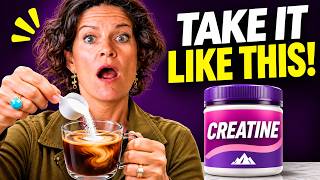
average was one gram of creatine a day. So, let's turn towards supplementation. And there are two ways we can approach supplementation. First, I want you to have five grams every day. Non-negotiable. So for me, my
[08:09]
creatine sits right next to my coffee and I put a scoop in my coffee every single morning and I mix it in and it's part of my morning ritual. I make sure I get five grams every day. You might do it mixed into by your wherever you get
[08:26]
your water from it and you just drink it through from water. But that is a bare minimum along with the foods that I was talking about the red meat and the fish and trying to get more creatine that way. There is something called a loading
[08:42]
way. There is something called a loading phase and this is optional. I will leave the creatine videos I've done down below because you'll see how why I critique some of this loading. I don't want to complicate this for you, but those of
[08:55]
you who are really dealing with muscle weakness, those of you have brain fog, those of you who aren't sleeping, this loading phase may be really important. And here's what it looks like. For one week, you are going to do 15 grams of
[09:11]
creatine. And then you're going to go down to a five gram dose. So for one week, we're going to frontload this. And there are a lot of different ways you can do this front loading. I've also got uh a lot of
[09:27]
examples and age like a girl. So you get to decide if you want to go in with a loading phase for a week. What are the pros and cons of that? Well, the pros is you're going to notice some immediate impact in muscle strength. You may also
[09:43]
notice immediate impact in your focus. The downside is when we add in that much creatine, you could start to hold on to water weight. Sometimes you'll notice
[09:55]
that your face looks a little puffy. You might feel puffy around the joints. You might even notice it on the scale that you've gained weight. I can tell you I've experimented with so much creatine, different brands, trying different loads
[10:10]
different brands, trying different loads that I do notice if I take a higher dose and I look in the mirror some days I'm like, I just look a little puffy today. After a week, it goes away, but that influx of creatine causes your cells to
[10:25]
hold on to water and it can make you feel a little more bloated. So, just be aware of that and know that it is temporary. As far as putting it in your
[10:37]
coffee, I just want to say that a lot of you have been concerned about hearing you have been concerned about hearing that high temperatures start to affect your breakdown creatine. I don't know about you, but my coffee slowly loses
[10:52]
its its temperature within a matter of minutes. So, you know, you if you're drinking your coffee fairly quickly, if you're drinking your coffee when it's lukewarm, you may not kill as much of that creatine as as you think. So, but
[11:09]
I'm here advocating for a creatine supplement along with a creatine food combination to make sure that you're getting enough. Now, once you have that first week under your belt, you're leaning into those foods, you're working
[11:25]
with the supplementation, you're maybe throwing in a a higher dose, frontloading it. When we get to eight, day eight of this 30-day challenge, I day eight of this 30-day challenge, I want you to start to realize that this
[11:39]
is the moment it may be a little boring. You may not notice as much of a You may not notice as much of a difference, but consistency matters. So difference, but consistency matters. So it takes four weeks for creatine stores
[11:52]
to start to fill in is the best way I can say it overnight. Depending on how far down the menopause pathway you are, it can take four weeks of this continual food and supplementation.
[12:07]
But what research shows is that if you are strength training along with your are strength training along with your creatine, you should start to see some noticeable strength improvement in very specific activities. And these
[12:23]
specific activities. And these activities were a leg press, a squat. I've talked to you all a lot about the power of just 25 squats. You can even look at it when you go to get grab something up off the ground that you go
[12:36]
get something off the ground. You'll notice that getting up off the ground might actually have a little more power in it. And then a bench press. So pushing a weight out in front of you, pushing a weight out in front of you
[12:51]
pushing a weight out in front of you with your legs and a squat. So it takes with your legs and a squat. So it takes that 4W week routine of food and supplementation. But what I wanted to to to point out to you is according to
[13:04]
research, it's your bigger bigger muscle groups that you're going to really start groups that you're going to really start to see a a significant change. Creatine energizes the muscles. Creatine gives you the resources to push harder in the
[13:20]
you the resources to push harder in the gym. And ultimately over time, creatine is going to start to give you that capability to get up off the ground when you need to when you're 80, 90 years old, which is what we should be thinking
[13:34]
about as we're lifting in our 50s and 60s and 70s. We're not just lifting to look good. We're looking for functionality. And if I can start using strength training to improve my leg strength, my
[13:49]
glute strength, my my upper body strength over and I do strength training with creatine over time, I am helping my 80year-old self
[14:01]
be able to get off the ground if I find myself falling. And I hope you know the statistics on osteoporosis and falling and fractures leads ultimately according
[14:13]
to research will lead depending on how old you are will lead you closer to old you are will lead you closer to death. This is how important a nutrient like creatine becomes and why doing it consistently
[14:26]
along with strength training along with a food source becomes really critical. a food source becomes really critical. Now, starting around day 22 to day 30, Now, starting around day 22 to day 30, research shows you should see a sleep
[14:40]
and focus improvement. So, you're going to see it first in muscle strength, then you're going to see it in focus, and then you're going to see it in sleep. then you're going to see it in sleep. But by one full month of this protocol,
[14:53]
But by one full month of this protocol, your creatine resources, your stores should be full and sleep and focus should come back online. A one little caveat that I want to point out is that for those of you who are
[15:08]
really into weightlifting and you aren't sleeping well the night you lift weights, you may want to double up on your creatine because you might notice
[15:20]
with this regularity of creatine that all of a sudden you can push yourself harder at the gym, but at the end of the day you're struggling to go to sleep, especially if you have restless legs. eggs, especially if you have noticed
[15:35]
eggs, especially if you have noticed sleep challenges through menopause. So, it would be okay to do five grams in the morning and then five grams at night to make sure that you've replenished those stores so that sleep can be a a good
[15:49]
night's sleep can be accessible to you. Remember that first study I told you Remember that first study I told you about? On the nights those women took their creatine at after working out, they slept better. Now, sleep in
[16:04]
general, there's a lot of pieces to it. So, if you are struggling to sleep, I also want to make sure that I point you to my nervous system questionnaire. It is a quiz you can take that will tell you where your nervous system state is
[16:17]
at. If you are in a red or a yellow state where your nervous system is in collapse or it's in fight or flight, sleeping, I don't care how much creatine you give yourself. Sleeping may be a challenge. So, make sure you take that
[16:32]
quiz. We'll I'll put it in the notes below so that you know what foods and fasts and and mindfulness tricks you can do to help get a good night's sleep along with taking your creatine. Now, I have one bonus for you for those of you
[16:47]
that are traveling, and I hope you've heard this before, but creatine is incredibly good for jet lag. I used to travel all over the world when Fast Like a Girl first came out. I don't travel as much, but I wish I had known this hack,
[17:02]
much, but I wish I had known this hack, but research is showing that four to six but research is showing that four to six times your normal dose of creatine can help with jet lag because it nourishes the brain. It gives the brain, it
[17:15]
the brain. It gives the brain, it recycles ATP. It gives the brain that energy back through this recycling process. What does that look like for process. What does that look like for actual dosage? Because four to six times
[17:29]
a normal amount if you were to eat that might be too much. So, we're going to need to lean in to supplementation. So, if you need five grams of creatine
[17:41]
So, if you need five grams of creatine every day and you want to help affect jet lag, you need four to six times. You're looking at 20 to 30 grams of creatine before you go to bed to help you sleep at night to get to sleep. Or
[17:57]
you could do it in the morning when you wake up to help your brain go online because you're in a new time zone. So, 30 days. Give me 30 days to do this
[18:09]
challenge and I want you to report back what you're seeing. Put in the comments if you're going to join for 30 days. Day one, here's your recap. Day one, we're going to eat more of the more creatine producing foods. We're going to start to
[18:24]
bring those foods into our house and eat them on a regular basis. Okay. Starting day two, we're going to do a five gram dose every single day, unless we want to
[18:36]
do a week of the loading phase. And we're going to make sure we're doing creatine monohydrate. Okay. Now, day 18 to 21, this is the boring phase. We're just doing the same eating the foods, doing our five grams
[18:52]
over and over again. not missing a day, but starting to take note of where our but starting to take note of where our muscles feel stronger. And starting on muscles feel stronger. And starting on day 22, as we move to day 30, we are
[19:06]
going to see if sleep and focus has improved. It is not hard this 30-day improved. It is not hard this 30-day challenge, but consistency matters. So, those of you that have enjoyed uh creatine have had great results, please
[19:22]
let us all know so people can can glean inspiration from your results. Most inspiration from your results. Most importantly, I always for me at 57 years old, I reject when my brain says I'm aging. I reject that. I always go to
[19:39]
aging. I reject that. I always go to what do I need to fuel myself with to be able to stop this feeling like I'm aging. And when I don't feel like working out, when I start to notice I'm sore, when I'm not sleeping, when I just
[19:53]
don't have it in my workout, I think about creatine. So, let me know if you're doing the challenge. And most importantly, I hope this helped. And do not give up on yourself because you were meant to feel incredible all the way
[20:09]
into your 80s, 90s, and if you're lucky enough, your hundreds. As always, I hope that helps. If you like this video, you're definitely gonna want to check you're definitely gonna want to check out the next