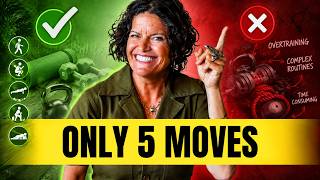

The #1 Exercise Secret for Over 50s
44sReveals a large-scale study's surprising finding about weight training's massive impact on longevity, immediately grabbing viewer attention.
▶ Play Clip"Title promises exactly what's delivered — five concrete exercises backed by solid research, with no bait-and-switch."
This video presents a 15-year epidemiological study of over 200,000 people, revealing that any amount of weight training after age 50 significantly reduces mortality risk. It then breaks down the five most effective exercises for this age group, emphasizing functional strength, muscle preservation, and metabolic health.
A 15-year study of over 200,000 people found that any weight training after 50 reduces all-cause mortality by 6% and heart disease deaths by 8%.
Muscle mass drops 3-8% per decade after age 30, making strength training essential to combat age-related decline.
Excessive cardio raises cortisol, depletes muscle, and can increase chronic disease risk — the opposite of what you want after 50.
Muscle is metabolic currency; it stores glucose and is reflected in hemoglobin A1C. High A1C (5.8+) indicates glycation and accelerated aging.
Women who did any weight training saw a 12% drop in all-cause mortality risk, compared to just 3% for men — especially important post-menopause.
Strength training plus walking beats doing either alone, with the lowest mortality risk of any combination in the study.
Short workouts (15-20 minutes) are as effective as one-hour cardio sessions for metabolic health; 5-15 minutes of weight training weekly delivers significant benefits.
Balance training reduces fall risk by a third, and simple movements like 25 squats a day or 10 sit-to-stands improve metabolic health.
Farmer's carry (carrying weights in each hand while walking) trains grip, posture, and core; heavy lifting 2-3 times per week with full-body sessions is recommended.
Resistance training (e.g., squats, push-ups) is the best form of strength training for total body fat reduction, based on a meta-analysis of 53 studies.
What were the mortality risk reductions for any weight training after 50?
6% lower risk of dying from any cause and 8% lower risk of dying from heart disease.
00:19
How does muscle mass decline with age?
Muscle mass drops 3 to 8% per decade after age 30.
00:59
Why is muscle called 'metabolic currency'?
Muscle is metabolic currency; it stores glucose and keeps blood sugar stable, preventing glycation and fat storage.
02:08
How much larger was the mortality risk reduction for women vs. men in the study?
Women who did any weight training saw a 12% drop in all-cause mortality risk, compared to a 3% drop for men.
04:53
What combination had the lowest mortality risk in the study?
Strength training plus walking beats doing each one separately.
06:05
What does a hemoglobin A1C of 5.8 or higher indicate?
A high hemoglobin A1C (5.8 or higher) indicates glycation, meaning red blood cells are gummed up with excess glucose.
02:54
How much does balance training reduce fall risk?
Balance training reduces the risk of falling by a third, according to a meta-analysis of nearly 40 randomized trials.
13:07
What is a farmer's carry and what does it train?
Farmer's carry involves carrying weight in each hand while walking, training grip, posture, and core.
13:49
What is the recommended heavy lifting protocol for over-50s?
Two to three times per week, full-body sessions (legs, back, chest, core) with 3-4 sets of 6-12 reps of heavy weight.
15:55
What type of strength training is best for fat reduction?
Resistance training (e.g., push-ups, squats) was found to be the best form of strength training for total body fat reduction.
16:59
Weight training cuts mortality risk
Provides concrete, study-backed numbers (6% all-cause, 8% heart disease) that motivate action.
00:19Women benefit disproportionately from strength training
The 12% vs 3% mortality reduction gap highlights why strength training is critical for post-menopausal women.
04:53Farmer's carry as a functional exercise
A simple, low-equipment exercise that combines grip, posture, and core training — often overlooked but highly effective.
13:49Resistance training beats cardio for fat loss
Challenges the common cardio-heavy approach and shows resistance training is superior for total body fat reduction.
17:44Health is a strategy
Encapsulates the video's core message: proactive, consistent effort beats reactive fix-its.
22:03[00:00] A study in the International Journal of Epidemiology looked at over 200,000 people for 15 years. And they discovered one thing about exercise for people over 50.
[00:17] And here's what it was. That people who did any amount of weight training after 50, any amount, this isn't even fancy, this doesn't even tell you what kind, although I'm going to tell you what kind,
[00:30] were 6% less likely to die of any cause and 8% less likely to die of heart disease. If you are over 50, exercising harder, doing more cardio may actually be killing you.
[00:50] But what we now know is that muscle mass drops 3 to 8% per decade after 30.
[01:02] So by the time you get to 50, by the time you get to 60 and 70, you got to fight for that muscle. And too much punishing cardio, too much chasing the calorie burn can raise cortisol higher and higher, depleting muscle more and leading you down the path of more chronic disease, more cardiovascular challenges.
[01:27] So, let's change that for you. In this video, I'm going to show you five exercises that are easy, that are free, and they are worth doing over and over again for the rest of your life.
[01:39] Because after 50, the exercise game dramatically changed. Okay, let's unpack this study. first it's that the title in the study the first finding of the study says any
[01:55] any weight training lowers your risk of early death and here's what the study went on to say that muscle is metabolic currency your muscle is what starts to
[02:08] keep you metabolically healthy and we've talked about this here on my channel We've talked about how there's one blood work measurement that I want you to obsess on, and it is hemoglobin A1c.
[02:23] Hemoglobin A1C is a measurement of how much oxygen your red blood cells can... Hemoglobin A1C is a measurement of how well your red blood cells are able to deliver oxygen to the tissues of your body,
[02:45] including your brain, including your heart, your lungs, to every tissue. If your hemoglobin A1c is high, you have something called glycation.
[02:57] High would be like 5.8 up into the sixes. It means that those red blood cells are gummed up with glucose, extra glucose molecules that your body didn't know what to do with.
[03:12] Your doctor is going to look at hemoglobin A1c as a measurement of diabetes or prediabetes. But on this video, I really want you to understand that if you look at that hemoglobin A1c and you are 5.5 or higher,
[03:32] I'm going to just give you a range, we got to get you more muscle. Because if I can get you more muscle, then we have more storage for glucose. Muscle is metabolic currency.
[03:45] Muscle is a pantry for glucose. And if your body doesn't know what to do with glucose because it has too much, it stores it in fat, it stores it around these red blood cells,
[03:58] it stores it in your brain, it stores it in your eyes, and you start to age faster. So we've got to get you more muscle. And this study found 6% lower risk of dying, 8% lower risk of dying from heart disease, and 5% lower risk of dying from cancer.
[04:20] It's simple. Muscle is the key for making sure that chronic disease stays away from you as you age. Now, the second finding of this study that was really fascinating is that muscle strength and making sure you are lifting weights as you age can possibly be more beneficial for women than it is for men.
[04:48] This especially matters after menopause. and this is what the study said, is that women who did any weight training at all saw a 12% drop in all-cause mortality risk compared to a 3% drop for men.
[05:05] Why would that be? Because once you go through menopause for women, it is very normal to start to lose muscle. Menopause is that moment that you want to keep your muscle going because if you
[05:22] lose it you're going to have to fight harder for it. Those of you that are on the GLP-1 medications or you came off of them, we got to get your muscle back so we can get your metabolic health back And when we know we know going into menopause that is estrogen drops that we are at more of a risk for cardiovascular disease
[05:45] but you can bring down your risk of cardiovascular disease by bringing up your muscle mass. Finding number three that the study, over 200,000 people,
[05:58] discovered was strength training plus walking was the best. So it literally said strength training plus walking beats doing each one of those separately.
[06:12] That people who did both weight training and regular aerobic exercise like walking, swimming, cycling, had the lowest mortality risk of anyone in the study.
[06:25] So this could be as simple as go walk your dog and then come home and lift some weight. This is not about always going to a gym unless you feel like the gym is where you thrive.
[06:40] So here's where I want your mindset to change as you're moving into your post-50 years. First, I don't want you to start chasing calories because you over-aid or you cheated
[06:53] and you're like, oh, I just did something really bad, so therefore I better go and do a lot of cardio. That calorie in, calorie out model doesn't work. It's like the old model was I ate a lot of food, therefore I will go on a long run.
[07:10] The new model is I can eat whatever I want. I can eat a lot of food as long as I attach fasting windows to it, and I've got plenty of videos here on my channel on that, and as long as I am building muscle.
[07:25] That is the new formula as opposed to chasing the calorie burn. Number two trick that I don't want you to, I want to break you of this habit is skipping straights for cardio.
[07:38] I've been one of those people that for a long time I've been like, okay, I love cardio. I love the high it gives me. When I was 20 and 30, it used to keep me thin, but at 56, it doesn't do that for me anymore.
[07:51] So I like the combo of strength training and cardio together. But if you are feeling like you don't have enough time, then you're actually better off doing strength training than you are doing cardio.
[08:08] Okay, the third thing I want to unwire from you is believing that a workout doesn't count unless it's long. Guess what? short workouts, 20-minute walks, 15-minute strength training sessions,
[08:23] these are proving to be as effective for your health as a one-hour cardio run on the treadmill or swim or cycle that you actually, it could be as little as a 5 to 15-minute a week of weight training
[08:39] can give you more of a metabolic upside than a long cardio experience. So long is not necessarily better. And the fourth thing I don't want you to fall prey to is ignoring balance, especially as we age.
[08:56] Balance is really incredibly important so that we don't fall and break a hip. So yoga can be really good, you know, when you go into like a tree and do tree or Tai Chi or Pilates.
[09:09] I started doing, I started surfing, and I'm really enjoying that for many reasons, but the balance on the board has been really profound for my brain. So what kind of balance exercises are you doing?
[09:23] So what you can start to do. One is walking. Walking, walking, walking. In all the videos I've done here on exercise, I've got to tell you, walking is the winner.
[09:35] Squats have been good. We'll talk about that in a moment. But walking, and if you struggle, like, oh, it's not easy or it's not enough exercise, walk a little quicker, walk up a hill, I started naming my walks forward movement. I would just
[09:48] say, I'm going to go do a forward movement exercise because I found that that was so much easier to trick. I was a competitive athlete in my younger years. My competitive athlete brain was
[10:00] like, what are you doing walking? And I had like, aren't you lazy? You're not pushing yourself hard enough. I had all kinds of messages inside my brain. So are we walking lower stress hormones,
[10:12] that right foot, left foot, right foot, left foot, go watch the interview I did with Dr. Frank Anderson. I'll leave a link right here for it. What he's talked about is that simulates a therapy strategy called EMDR.
[10:29] And when you go right foot, left foot, right foot, left foot, what you are actually doing is giving your brain a moment to calm and to bring down the stress hormones. We also know walking supports lymphatic flow, and it improves insulin sensitivity.
[10:47] Walking after a meal gets that glucose going. So you don't do it in place of strength training, but I want you to get walking. It's so easy. It's so enjoyable.
[11:00] And I want you to get it into a routine on a daily basis, 5 to 15 minutes. It doesn have to be a lot step number two is that I want you to build into your day what we call movement snacks Movement snacks are squats jumping jacks sit down stand up I just did a whole video that
[11:22] you all loved on 25 squats a day, what that does for you. That was based off of a study. You can find that here. And so in that video, I showed you 25 squats a day. That's all it takes to start to
[11:35] change your metabolic health. Years ago, I was at a seminar with a top fitness trainer, and he did a workout for everybody, and we were all so excited to be a part of this
[11:47] expert fitness workout, and do you know what he did for 20 minutes? He did sit down on your right, stand up, sit down on your left, stand up, back and forth, right, left, right, left, and he said,
[12:00] The reason that I did that is it doesn't matter how you look, per se, at 70. It matters if you can get yourself off the ground. So if you haven't practiced that sit down, stand up, it is so simple.
[12:15] We do it in our Reset Academy on Saturday mornings. If you want to join us there, just put Reset Academy in the notes or in your comments. But most importantly, let's do these movement snacks.
[12:27] 25 squats right now. You can do it while listening to me if you're in a place. I'll finish the video. You just keep doing your 25. Your 25 before you go to bed. Small amounts genuinely work.
[12:41] If you are thinking you've got to do some big workout, I'm here to tell you it's the small movement snacks that will move the needle on your health more than anything. Step number three is the balance.
[12:54] I really think it's important that we focus on balance training. There was a meta-analysis of nearly 40 randomized trials in healthy older adults that found that exercise intervals of many kinds, including balance training, tai chi, like I said, yoga, surfing, if you do balance of any kind, balance training, you were a third as likely to fall as you age.
[13:22] Now, I think we all know, if you don't, but I'm going to keep saying this, is that as we age, if we lose our balance, and especially in women who have osteoporosis, you can get a hip fracture or a bone fracture.
[13:36] And if you get a hip fracture, the statistics on your life are not great. It's proving that once you get a hip fracture or you get a bone break, that your quality of life goes down dramatically.
[13:48] step number four and this is a fun one it's called a farmer's carry and a farmer's carry is where you usually can do it with a kettlebell where you just are holding on to it or you can pick things up
[14:02] with your hand but basically carrying weight in each hand while walking trains grip it trains posture and core all at the same time so you get yourself two weights you can get them kettlebells
[14:17] Or you can just get them hand weights and get them heavy and walk around your house. You're improving your posture. You're improving grip strength, which there have been numerous studies on grip strength
[14:31] and its association to aging and your quality of life as you're aging. There's a whole chapter in Age Like a Girl that I put in here that is all about workouts that help you with more functionality as you age and grip strength,
[14:46] and all the studies are in there. So two to three times a week, carry them for 30, 40 steps, and then repeat that a few times. Farmer's carries core, back, hand strength, amazing.
[15:00] Now, the study I quoted here in the beginning said that functional, full-body strength movement is the best. So the study's mortality, best mortality benefit came from muscle strength activity
[15:16] where that load carries, like even carrying boxes, that all of that counted to exercise the same way as if you went to a gym. The study was not like, hey, people over 50, go to the gym.
[15:32] The study was like, here are the movements that if you reproduce them, whether at home or at the park, you can get these benefits. And strength training is the underlying movement that we're talking about.
[15:47] Step number five is sometimes you just got to lift heavy shit. You just got to go heavy. And that two or three times a week of heavy lifting, the research years ago used to say do max amount.
[16:03] like if you can lift like the heaviest you can possibly lift for like eight sessions, that can be incredibly helpful. I did a podcast interview with Dr. Stacey Sims where we talk about lifting,
[16:18] especially in terms of menopausal women. You can, we'll put either a link up here or down in the notes. You can find that interview. It's really interesting for those of you that you want. But what the research says is that two to three times per week full body sessions legs back chest and core three to four sets of six to 12 reps per lift of heavy heavy weight So really easy This is not long but it does mean that you training yourself in a different way
[16:54] And there was a 22 meta-analysis in sports medicine that looked at 53 studies in healthy adults. And for those of you who want that added fat reduction,
[17:06] this study found that resistance training alone So resistance training is like push-ups. It's squats as a form of resistance training.
[17:18] In resistance training, you have to bend in, you have to contract your muscles going down, and you have to contract your muscles going up, as opposed to weight training, where you're just lifting, and then you can let gravity bring it down.
[17:33] But this analysis said that resistance training was the best form of strength training for fat reduction, for total body fat reduction.
[17:47] So this video has been really talking about functionality and how do you stay strong and how do you avoid disease and death. and this study I just quoted you in sports medicine is saying that resistance training
[18:04] can do all of that but it also is the best way to accelerate fat loss which I know many of you are looking for. Now if you are working out a lot I really encourage you to test creatine.
[18:21] I've done some videos on creatine we'll leave that here too for you to see that video but creatine is amazing for muscle growth. And my favorite is Qualia. It's the one I've been using consistently for over a year now.
[18:36] And it's really helpful for making sure that your muscle has the juice to be able to do the activity. So if you're somebody who's like, I don't know, I don't feel like lifting weights, try some creatine.
[18:51] And in Age Like a Girl, I have all these creatine protocols in there that map out how you go into creatine, like you want to slowly ramp up with it, how you take a break from it.
[19:04] So I put that all in the exercise chapter in here. Okay, here is your quick five to do right now. Right now, I want you to balance for 10 seconds. So just get up, stand on one foot, and balance for 10 seconds.
[19:19] And see where you're balancing. I mean, it's that easy. Balance doesn't have to be that hard. When you're waiting for a meal, try balancing. When you're making your coffee in the morning, try balancing. Number quick step number two, do 10 sit to stand, sit on the ground, stand up before your coffee.
[19:38] So you're waiting for the water to boil. If you have a French press, you're grinding the beans, you're getting the coffee ready. Sit down on the ground, get back up 10 times. I have a friend who likes to do push-ups against her countertop while she's waiting for her coffee.
[19:54] It, again, doesn't have to be long. Quick step number three, every night after dinner, go for a 10-minute walk. It's going to help you with weight loss. It's going to bring down cortisol.
[20:06] It's going to help you work out traumas in your brain. A minimum of 10 minutes. Quick step number four, every day, you are going to find a heavy thing to lift, whether it's a box, whether it's something with
[20:21] your hands. I want you to actually seek heavy lifting things. Go look for things that are really heavy that you can lift. I'll tell you one thing that I do. I have an amazing husband and amazing
[20:34] son, and every time I go to take my suitcase for a trip and bring it down the stairs or up the there as they always offer to carry it for me. And once I started looking at all this research on what I needed to do to stay healthy as
[20:49] I aged, I started telling them, no, please let me do it on my own. Carrying that suitcase, whether it's by the handle or by you're just holding it, we want to start lifting heavy things.
[21:02] And number five is let's put two formal strength training sessions on your calendar. Hire a trainer. So I love doing TRX, like those bands that come down.
[21:14] You can go to YouTube. You're here on YouTube. You can go to YouTube and look up all kinds of TRX strength training exercises. So there's all kinds of ways that you can get free information.
[21:28] So there really are no excuses. But strength training, yes, you can overdo it and injure yourself. I think those of you who have made it this far in the video, you know and you're identifying that this is not hard.
[21:42] It's functional strength. And a little bit multiple times a day or a little bit every day has a really big impact. So if you love strength training, put in the comments what you've noticed.
[21:55] Did you have a great exercise? Have you had good results with squats, with walking? help others feel motivated and put in the comments what you your experience has been but most importantly do not give up on yourself there is a strategy
[22:11] health is a strategy and I'm here to continue to teach that as always I hope that helps if you like this video you're going to want to check out the next one
⚡ Saved you 0h 22m reading this? Transcribe any YouTube video for free — no signup needed.