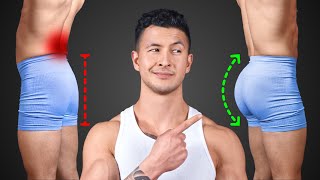

The #1 Hidden Reason Your Glutes Are Flat
44sReveals a common but overlooked cause of flat glutes, sparking curiosity and relatability.
▶ Play Clip"The title promises two exercises to fix a flat butt, and the video delivers exactly that with detailed instructions from an expert."
This video presents two key exercises recommended by glute expert Brett Contreras to target and strengthen the glutes, addressing common issues like strength plateaus and back pain. The glute-focused step-down and the hip thrust, performed with specific techniques, can help build stronger, more developed glutes without excessive soreness.
Weak glutes are often the hidden reason your strength stalls and back pain never goes away. Two exercises can fix this, helping you move better, jump higher, and run faster.
Brett Contreras, who invented the hip thrust, provided these exercises. He has helped thousands build stronger glutes.
The gluteus maximus is the largest glute muscle. It gets weak from sitting all day and not training properly, leading to posture issues and back pain. Its main function is hip extension.
Brett says the reverse lunge is the best but makes you too sore. Dumbbell walking lunges to failure cause extreme soreness in glutes and adductors.
Common exercises like squats and deadlifts are taxing compound movements. Other muscles (lower back, grip) can fail first, leaving glutes underworked. Weak glutes allow other muscles to steal gains.
Soreness from exercises like Bulgarian split squats makes them dreaded and hard to recover from before the next leg session.
The step-up does not get you as sore, so you can train glutes twice a week, or even three times if you can handle it.
Stand on a platform, step back, keep back leg in line with torso, lean forward, sit way back, tap, and come up. Freeze frame at the bottom for a stretch.
The glute focus step down looks like a lunge but with one leg in the air and specific form tweaks, forcing glutes to do almost all the work.
Push hips back, reach back leg until it lightly touches ground, drive hips forward using glute of planted leg. Keep knee over foot to prevent quads taking over. Choose bench height so back leg barely touches ground.
Hold weight in opposite hand to increase glute activation. At the bottom, glute medius is worked; as you go down, gluteus maximus activates more.
The step-down challenges glutes at the bottom (stretch), building lower glutes. For full round shape, pair with a squeeze-focused exercise like hip thrust.
Brett and the speaker ran a study comparing training muscles in stretch vs squeeze position. Combining one stretch and one squeeze exercise is likely best for growth.
Hip thrust builds end-range hip extension strength, improving squat feel, stride length, and stress distribution.
If uncomfortable with barbell hip thrust, use single leg dumbbell hip thrust at home. Setup: upper back high on bench, feet far enough so knees over feet at top.
Tuck chin, keep eyes forward, arch back at bottom, tilt pelvis upwards by squeezing glutes. This instantly lights up glutes but may reduce weight and height.
Chin tucked into chest helps with recurring back pain. The speaker's wife had to cut hip thrusts due to back pain but after chin tuck, she can do heavy hip thrusts pain-free.
60% of Brett's clients prefer scoop method, 40% prefer hinge method (look forward at bottom, look up at top, hinge body in straight line). Experiment to find what works.
Three sets of 8-12 reps, two to three times per week. Personalize workouts using the Built with Science Plus app.
By incorporating the glute focus step-down and hip thrust with proper technique (including the scoop method), you can effectively target and grow your glutes, improving strength, posture, and athletic performance.
What is the main function of the gluteus maximus?
Hip extension.
00:44
Why can common glute exercises like squats and deadlifts be ineffective for glute growth?
Other muscles (lower back, grip) can fail first, leaving glutes underworked.
01:23
What is the key difference between a glute focus step down and a lunge?
One leg is kept in the air, forcing glutes to do almost all the work.
03:19
How should you position your knee during the glute focus step down to prevent quads from taking over?
Keep your knee right over your foot.
03:59
What is the 'scoop method' for hip thrusts?
Tuck chin, keep eyes forward, arch back at bottom, tilt pelvis upwards by squeezing glutes.
07:21
What percentage of Brett's clients prefer the scoop method?
60%.
08:59
How many sets and reps does Brett recommend for glute exercises?
Three sets of 8-12 reps.
09:27
How many times per week should you train glutes according to Brett?
Two to three times per week.
02:38
Weak Glutes Cause Strength Stalls and Back Pain
Identifies a common but overlooked root cause of training plateaus and discomfort.
00:03Compound Movements Can Fail Glutes
Explains why squats and deadlifts may not effectively target glutes due to other muscles failing first.
01:23Glute Focus Step Down Isolates Glutes
Introduces a unique exercise that forces glutes to do almost all the work with minimal soreness.
03:19Stretch vs Squeeze Study
Highlights research showing combining stretch and squeeze exercises is optimal for glute growth.
05:33Scoop Method for Hip Thrust
A small form adjustment that significantly increases glute activation.
07:21[00:03] glutes look like. They're often the hidden reason your strength stalls, your back pain never goes away. But the good news is you only need two exercises to fix this, helping you move better, jump higher, and even run faster. Now, I got
[00:18] these from the world's leading glute expert, Brett Contrarus, who literally invented the hip thrust and has helped thousands of people build stronger The first exercise you've probably never done before. And for the second, I'm
[00:31] technique that completely changed my results. While your glutes are made up of three muscles, the largest muscle by far is the glutius maximus. Now, this muscle, it gets weak and underdeveloped if you
[00:44] sit all day and don't properly train it in your workouts, which for some people leads to issues with posture and back pain. Now, its main function is hip deadlift or when you're squatting. But to my surprise, Brett didn't actually
[00:58] this muscle. >> I think the reverse lunge is the best, but it's too good. It makes you too sore. If I have you do dumbbell walking lunges to failure, say we did it out in the parking lot and I just had you go up
[01:11] and down to absolute failure. Your glutes get too sore. Your glutes, your adductors, everything gets so sore. This is actually the problem with many glute exercises. It's easy to work your glutes through lunges, squats, and deadlifts,
[01:23] but they also come with three key problems. The first is that most of these exercises are taxing compound movements that target multiple muscles at once. And while this is usually a good thing, if other muscles like your
[01:35] lower back or even your grip are given out first, then you could reach failure while your glutes still have seven or eight reps left in the tank. And what's even worse is that if you already have weak or hard to activate glutes, other
[01:47] muscles can steal your glute gains. Now, I actually ran into this problem myself. Usually, squats would hit my glutes really well. But after neglecting my glutes for a while, once I came back to doing heavy squats, all I could feel
[01:59] over. It's why even if you've gotten really strong on squats and deadlifts, your glute growth just may not reflect it. And finally, soreness. It's one of the things I have hated about many glute exercises like Bulgarian split squats.
[02:13] The days after were brutal and would make me dread doing them ever again. In some cases, it was even tough to recover before my next leg session, which is when Brett proposed an exercise I'd actually never tried before. But he's
[02:25] found extremely effective at growing the glutes without the soreness and with. >> The step-up does not get you as sore. >> And therefore, you can perform it more frequently. And we want to train glutes
[02:38] twice a week. If you can handle three times a week, have at it. So, we're stand up on the platform. both hands up there. We're just learning the movement. So, you are going to step
[02:53] back, keep the back leg in line with the torso, lean forward, and sit way back. Tap, come up. Okay. Reach back even further.
[03:05] Tap, come up. Now, when you reach the bottom, I want you to freeze frame >> 45. >> Oh, that's stretch in my >> The exercise Brett has been suffering through is called the glute focus step
[03:19] down. It actually looks quite similar to a lunge or split squat, but there's one key difference. By keeping one leg in the air and following a few simple form tweaks, it forces your glutes to do almost all the work. I was honestly
[03:31] even with just my body weight. Now, Brett does have a custom platform just that's not going to be a problem. Just move a bench next to any equipment or rack that you can hold on to for balance. Then, slowly push your hips
[03:45] You want to reach your back leg out until it lightly touches the ground. And then, without using any momentum or boosting yourself up, drive your hips forward to the top by using the glute of your planted leg. Now, to prevent your
[03:59] quads from taking over, you want to try not to let your knees bend too far forward over your toes. For more glutes, keep your knee right over your foot. And lastly, do try to choose a bench height so that at the bottom of the movement,
[04:11] with the ground. And if your platform is too high, you can always add a plate for your back foot to shorten the rep. And because these are so tough, even with just your body weight, you can easily do this at home with a sturdy chair next to
[04:24] want to progressive overload this exercise with weight over time. And there's a way to use that weight for even better glute activation. When you have weight in the opposite hand, this glute has to stabilize you. When you're
[04:37] medius. When you go down into the stretch, it's not glute medius anymore. It's the glutius maximus. So that it has to produce a little more activation to on the hip. So, by holding the dumbbell in your opposite hand, you're now not
[04:53] outer upper glute known as the glute medius as well. In fact, this exercise works so well for me that it hasn't just become a staple in my own workouts, but our Built with Science Plus app so that our members can easily add it to their
[05:08] workout plans, complete with a form guide and easy progress tracking. But challenges your glutes most of the bottom when they're fully stretched. And Brett believes it may build more of your lower glutes, but if you want that full
[05:21] round shape, the kind of glutes they write country songs about, you're going to want to pair it with another exercise that challenges your glutes in the squeeze position and may help develop more of that upper region. Now, in the
[05:33] past, I was always biased towards doing stretch focused movements like the step down because they seem to grow muscle faster. But recently, Brett and I together ran a study that compared training muscles in the stretch versus
[05:45] squeeze position, and we even tested the glutes specifically. And while you can see the full results of our study in this video here, what I will say is that combining one stretch focused and one squeeze focused exercise is likely going
[05:58] just for growth. >> I've seen big strong dudes that squat 315, 405. They didn't have end-range hip extension strength. So, they were prone want to anterior tilt and put everything in the flex position. When you have
[06:13] extended range hip extension strength, you noticed you start noticing good things. Your body starts distributing stress better, squats feel better, um longer strides when you walk. >> So, to build the type of strength that
[06:26] Brett is describing, we're going to use the hip thrust. Now, I know what some of I'm doing that in the middle of the gym. So, you're telling me you're okay with bending over with a barbell, but not with thrusting with a barbell? Come on,
[06:41] >> Now, if you're still not comfortable, there is a more subtle, easy to setup alternative that can work just as well. It's the single leg dumbbell hip thrust, which you can even do at home. But regardless of if you use a barbell hip
[06:54] thrust machine or the single leg version, they're only going to work at three steps. First, you want to make sure your upper back is high up on the bench to maximize your stability. Second, plant your feet far enough away
[07:07] such that at the top position, your knees are directly over your feet. If more quads, but if they're too far away, you're going to work more hamstrings. And lastly, brace your core, squeeze your glutes, and then drive your hips
[07:21] up. But the final tip Brett showed me, it might just be the game changer that your glutes have been missing. What I'll say if he wants to be pure hingy, your gaze will go like this. Come up like that. And you'll push as tall as you can
[07:35] possibly go. Yes. That's like pure hinge. One more. Now I'll show you more pure scoop. Look forward. Move the sternum down.
[07:53] do a blend. I kind of like the scoop. Oh, >> [ __ ] >> Yeah. And it's good to know both. You >> I've never I've never done it that way. This small adjustment instantly lit up
[08:07] my glutes. The difference, it's called the scoop method. You tuck your chin and keep your eyes forward. Then you let your back arch at the bottom and simply focus on moving from the chest down, tilting your pelvis upwards by squeezing
[08:20] feel very weird at first and you're not going to be able to thrust as much weight or go as high, but it did create the perfect setup for my glutes to found, however, is just really keeping that chin tucked into your chest, which
[08:34] explains why Brett was holding my head. But this is also a great way to do hip recurring back pain, like my wife Taing, who previously had to cut hip thrust entirely from her routine after she slipped to this. But after Brett got her
[08:47] to start training with her chin tucked, she's been able to work up to heavy hip thrust completely painfree. And I'm actually challenging her right now to see who can grow her glutes the most in 90 days. So be sure to subscribe for
[08:59] where it gets really interesting. So for Brett's clients, 60% of them found the scoop method worked their glutes better. But the other 40% prefer something forward at the bottom and look up at the top and hinge your body in a straight
[09:14] line. So, the key is to simply experiment with both methods to find what works best with your body. Now, before you go, let me show you how to for the best results. So, Brett recommends doing three sets of 8 to 12
[09:27] reps two to three times per week. And this is what each full leg workout could you're definitely going to want to personalize these workouts to your body. And with our Built with Science Plus app, you don't just get form guides and
[09:40] but it builds you a personalized plan to on. And it keeps your training and nutrition all in one place. And now we actually have an AI version of myself that knows all your strength and workout
[09:54] coaching just like I would. And it's behind the countless transformations our try it right now for free for two weeks over at buildwithcience.com or by
[10:07] scanning this QR code. Then check out this video next for two exercises that growth. Thank you so much for watching and I'll see you next


⚡ Saved you 0h 10m reading this? Transcribe any YouTube video for free — no signup needed.