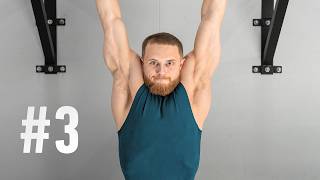

I Won $60k for Dead Hangs?!
47sThe dead hang challenge with a massive cash prize makes viewers want to test themselves and watch the story.
▶ Play Clip"Title promises '7 Amazing Exercises No One Does' and the video delivers exactly that with detailed demonstrations and scientific backing, so the score is high."
The video presents seven uncommon but evidence-backed exercises the author uses weekly, ranging from dead hangs to seated cable deadlifts. Each exercise is explained with proper technique, scientific rationale, and progressions. The author emphasizes that consistency and effort matter more than the specific exercises chosen.
Improves shoulder health, forearm growth, core strength, spinal decompression, and muscular endurance. Author's max time is 2:45 (advanced level).
Uses hammer grip on the positive and supinated grip on the negative to overload the eccentric, taking advantage of being 40-50% stronger on the negative.
Performed on a 20-30° incline bench, lifting dumbbells in a Y path. Provides constant tension on side delts, unlike standard lateral raises which have zero tension at the bottom.
Sideways on a pec deck machine, sweeping the arm across the body for full rear delt stretch (most reverse pec deck exercises miss the stretched position).
Bruce Lee's go-to core exercise. Hits lower abs hardest, but entire six-pack contracts isometrically. Progression: lying leg raises → bent-knee dragon flag → full dragon flag.
Isolates mid traps and rhomboids by keeping arms locked and squeezing shoulder blades together. Weight moves only 4-5 inches. Can be done after rows when biceps fail first.
Targets glutes and hamstrings with lower fatigue than barbell deadlifts. Hips are fixed on a bench, allowing deeper range of motion. Can be done single-leg to correct imbalances.
What are the main benefits of the dead hang exercise?
Dead hanging improves shoulder health, forearm growth, core strength, spinal decompression, and muscular endurance.
0:38
What is the author's personal max dead hang time and how is it categorized?
The author's max dead hang time was 2 minutes and 45 seconds, which is considered advanced level.
1:22
How should you adjust your grip during a dead hang to prolong endurance?
Use a looser grip initially to avoid forearm fatigue, then grip harder as you start to slip.
2:09
What grip change distinguishes the Zapman hammer curl from a standard dumbbell curl?
The Zapman hammer curl uses a hammer grip on the positive and a supinated (palms-up) grip on the negative to overload the negative portion.
3:48
By what percentage are humans typically stronger on the negative vs. the positive of a curl?
Humans are about 40–50% stronger on the negative (eccentric) than on the positive (concentric).
3:22
At what bench incline should you perform the incline dumbbell Y raise?
The incline dumbbell Y raise is performed on a bench set at 20–30° incline, lifting dumbbells up and out in a Y shape.
5:39
Why does the sideways one-arm rear delt fly on the pec deck provide a better stretch for the rear delts?
The sideways facing one-arm rear delt fly on the pec deck machine allows a full range of motion and a stretch across the body, which most reverse pec deck exercises miss.
6:44
Which famous martial artist popularized the dragon flag exercise?
Bruce Lee's go-to core exercise was the dragon flag.
8:20
What is the recommended progression to achieve a full dragon flag?
Start with lying leg raises, progress to bent-knee dragon flags, then full dragon flags once you can do 8–10 reps of the previous progression.
9:20
How do Kelso shrugs differ from standard rows in terms of muscle isolation?
Kelso shrugs isolate the mid traps and rhomboids by locking the arms and squeezing the shoulder blades together with minimal arm movement.
11:16
Why might you be able to perform extra Kelso shrugs after failing on a normal row?
During a row, the biceps and rear delts often fail before the mid-back, so Kelso shrugs allow additional mid-back work after rows.
12:05
What advantage does the seated cable deadlift have over barbell deadlifts for glute/hamstring work?
The seated cable deadlift targets the glutes and hamstrings with lower fatigue than barbell deadlifts because the hips and glutes are planted on a bench, reducing back and core load.
13:18
What approximate body fat percentage is needed for visible abs in men and women?
To see visible abs, men need to reach about 10–12% body fat and women about 20% body fat.
10:09
Dead Hang Benefits
Explains how a simple dead hang can improve shoulder health, core strength, and spinal decompression, with scientific support and personal records.
0:47Zapman Hammer Curl Grip Switch
A novel biomechanical trick to overload the negative of a bicep curl without a partner, using grip rotation.
3:48Incline Dumbbell Y Raise
Solves the tension profile problem of standard lateral raises by using an incline bench to maintain constant tension on side delts.
5:39Full ROM for Rear Delts
Shows a sideways pec deck technique that gives rear delts a deep stretch most people miss, potentially leaving gains on the table.
6:44Kelso Shrug for Mid-Back
Reveals that biceps fatigue limits rows, and Kelso shrugs (locked arms) can isolate mid-back after failure on rows, providing a practical way to increase back training volume.
11:16[00:00] Most people do the same few exercises
[00:02] over and over again, and there's nothing
[00:04] wrong with that, but it can make your
[00:05] workouts feel stale. So, today, I'm
[00:08] going to share seven exercises that
[00:10] you've probably never heard of. They
[00:11] aren't gimmicky optimal tricks, either.
[00:13] These are time-t tested movements with
[00:15] scientific support that I personally do
[00:17] every week, and I think you should, too.
[00:19] We'll start with a few that are a bit
[00:20] more common, and then as we go, they'll
[00:22] get more and more obscure. So, I'd say
[00:24] most of you probably have done exercise
[00:25] one at some point, but I'd bet less than
[00:28] 1% of you have ever even seen exercise
[00:30] 7. I think they're all worth doing. Just
[00:32] remember that training hard and training
[00:34] consistently matters more than the exact
[00:36] exercises you pick. Okay, the first
[00:38] exercise is a simple way to improve your
[00:40] shoulder health, grow your forearms,
[00:42] increase core strength, decompress your
[00:44] spine, and improve muscular endurance.
[00:47] It's a dead hang. And if you've never
[00:48] tested your max dead hang time, try it
[00:50] out next time you go to the gym. I
[00:52] actually just tested my own max time
[00:54] after coaching my friend Meged in a Mr.
[00:56] Beast challenge where he'd win $1,000
[00:59] for every second he could deadhang.
[01:02] Every second you can hang, I will give
[01:04] you $8,000.
[01:05] Get out of here.
[01:05] He started with a max dead hang time of
[01:07] just 6 seconds. And we got him up to 60
[01:11] seconds in just 30 days. Meaning he won
[01:14] 60 grand for that challenge. And I just
[01:17] tested it myself and my max time was
[01:22] okay. 2 minutes and 45 seconds. Is that
[01:25] right? Cuz it really didn't feel that
[01:27] long.
[01:27] Now, for some context, this is what a
[01:29] beginner intermediate advanced elite
[01:32] and world class dead hang time looks
[01:34] like. This is the dead hang world
[01:37] record. So, I'm advanced, not quite
[01:39] elite. Dead hangs can open up the
[01:41] shoulder joint, allowing the tendons and
[01:43] muscles of the rotator cuff to move more
[01:45] freely, which can help with shoulder
[01:47] pain. And if your back is feeling stiff
[01:48] from sitting all day, you'll get some
[01:50] spinal decompression, too. The
[01:52] scientific evidence on this is a bit
[01:53] more mixed, but I personally get a lot
[01:55] of relief from it, especially in the
[01:57] days following heavy squats or
[01:58] deadlifts. First, chalk your hands and
[02:01] buy some cheap liquid chalk if your gym
[02:02] doesn't have any. Trust me, this will
[02:04] make a huge difference. Use a bench if
[02:06] you can't reach the bar and grip it just
[02:07] outside shoulder width. This will seem
[02:09] counterintuitive, but try to take a
[02:11] looser grip initially so your forearms
[02:13] don't fatigue too quickly. Once you
[02:15] start to slip, start gripping harder.
[02:17] This is kind of like pacing yourself in
[02:18] a race. Now, if you're doing these for
[02:20] max time, brace your core, but don't
[02:23] flex so hard that you tire yourself out.
[02:25] If you're doing them for spinal
[02:26] decompression, start with a braced core
[02:29] and then gradually let your hips sink
[02:31] down and stretch out. Your legs should
[02:33] hang straight down. And I find keeping
[02:35] my feet together and pointing my toes
[02:37] down helps keep me from swinging. From
[02:39] there, just focus on keeping a
[02:40] consistent breathing rhythm. Don't try
[02:42] to hold your breath. Try it out and see
[02:44] how long you can hang. If you can't
[02:45] deadh hang with body weight yet, use a
[02:47] band for assistance by looping it around
[02:49] the bar and stepping into it. Or you can
[02:51] use an assisted pull-up machine. If you
[02:53] can beat my time of 2 minutes and 45
[02:55] seconds, post it on Instagram and use
[02:57] the hashtag Jeffnipper deadhang. I'll
[03:00] take a look at all of them and I'll
[03:01] repost some of you. Next exercise takes
[03:03] a standard dumbbell curl and makes it
[03:05] just a little more effective. At least
[03:06] in theory. I call it the Zapman hammer
[03:09] curl, named after 1800 strongman George
[03:11] Zapman. I just modified it a bit. Here's
[03:14] the idea. With a regular curl, maybe you
[03:16] can lift 20 lb on the way up, but you
[03:18] could easily control 40 lb on the way
[03:20] back down. That's because you're about
[03:22] 40 or 50% stronger on the negative than
[03:25] you are on the positive. So, with a
[03:27] standard dumbbell curl, you're always
[03:29] overloading the positive more than the
[03:30] negative. The negative never gets fully
[03:33] challenged, but since the negative is
[03:35] crucial for muscle growth, I think it
[03:36] makes a lot of sense to overload it to
[03:38] its full potential. One way to do that
[03:40] is to roll the weight up on your own and
[03:42] then have a partner apply extra
[03:44] resistance on the negative. But that
[03:46] feels awkward. So instead, what you can
[03:48] do is use simple biomechanics to make
[03:50] the weight effectively heavier on the
[03:52] negative. Here's what you do. Curl the
[03:54] weight up with a hammer grip and then
[03:56] lower the weight back down with a palms
[03:58] up supernated grip. By using a hammer
[04:01] grip on the positive, your brachiialis
[04:03] and brachioraiialis can come in and help
[04:05] out. And then when you switch to the
[04:06] supenated grip on the negative, your
[04:08] biceps are forced to take the load. For
[04:10] technique, grip the dumbbell in the
[04:12] middle of the handle. So don't let your
[04:14] thumb rest up against the head of the
[04:15] dumbbell and curl the weight up,
[04:17] stopping just before your arm is
[04:18] vertical. Then rotate your palms up and
[04:21] lower the weight back down under
[04:23] control, sweeping the weight out in a
[04:25] wide arc. Once you reach the bottom,
[04:27] rotate your palms back into the hammer
[04:29] grip. curl the weight back up again and
[04:31] repeat. I usually do these for eight to
[04:33] 10 reps. And while I don't think this
[04:35] technique will put inches on your arms
[04:37] compared to standard dumbbell curls, I
[04:39] do think it's an effective variation
[04:40] that makes a lot of biomechanical sense.
[04:42] Now, if you prefer old school dumbbell
[04:44] curls, they'll still work great. Just
[04:46] slow down the negative to even out the
[04:48] strength curve. Okay, so far we've only
[04:50] hit dead hangs and Zapman hammer curls.
[04:52] The next five are definitely more
[04:54] obscure. Okay, this next exercise I've
[04:56] been doing every week all year, and I
[04:58] absolutely love it for the side delts.
[05:00] It takes a standard dumbbell lateral
[05:02] raise and makes it feel a lot better, at
[05:04] least for me. It's the incline dumbbell
[05:06] Y raise. Now, I've covered the tension
[05:08] profile of the standard dumbbell lateral
[05:10] raise before, but here's a quick
[05:11] refresher. Because gravity pulls
[05:13] straight down, there's zero tension on
[05:15] your delts at the bottom, and peak
[05:17] tension doesn't hit until the very top.
[05:20] Now, that's not necessarily a problem.
[05:22] In fact, new research shows that
[05:24] dumbbell laterals can still grow your
[05:26] side delts just fine as long as you
[05:28] train them hard. But I still don't like
[05:30] having such a lopsided tension profile.
[05:32] I find it harder to connect with my side
[05:34] delts when I'm only getting enough
[05:35] tension in such a small aspect of the
[05:37] range of motion. So that's where the
[05:39] incline dumbbell yra comes in. Set up a
[05:41] bench at a roughly 20 to 30° incline. It
[05:44] should feel like you're leaning pretty
[05:45] far back. Brace your upper back against
[05:47] the bench and lift your chest up. With
[05:49] the dumbbells at your sides, lift them
[05:51] up and out in a Y. Think about squeezing
[05:54] your side delt fibers together to move
[05:56] the weight up and then feel them stretch
[05:58] apart on the way down. Once you get to
[06:00] the point where the dumbbells are back
[06:02] at your sides, start your next rep. So,
[06:04] don't let the dumbbells swing all the
[06:06] way back until they're hanging
[06:07] vertically because again, you'll lose
[06:09] that tension. So, stop once you get to
[06:11] your sides, just like you would when
[06:12] standing. And by lifting the dumbbells
[06:14] up and out in a Y, you'll hit the fibers
[06:17] in between the front and side heads,
[06:19] which adds a lot of shape to your
[06:21] shoulders, especially from the front.
[06:23] And while lifting straight out to the
[06:24] side is generally safe, a lot of people
[06:26] do find that their shoulders feel more
[06:28] comfortable when they lift in the
[06:29] scapular plane about 30° to the front.
[06:32] So, give them a shot the next time you
[06:33] hit shoulders. I think you'll love the
[06:35] feel of them. Okay, now we're getting a
[06:36] little bit more obscure. So, I don't
[06:38] think I've seen many people do this one
[06:39] outside of my audience. It's the
[06:41] sideways facing one arm rear delt fly on
[06:44] the PC deck machine. First, I should
[06:46] explain why it is that I like them so
[06:47] much. It's really because this is the
[06:50] only way to get a full range of motion
[06:52] for your rear delts on this machine.
[06:54] When you do them the traditional way,
[06:56] what you're really doing are half reps
[06:58] in a shortened position. The muscle
[06:59] never gets lengthened at all. It'd be
[07:01] like doing bicep curls in the top half
[07:03] only. Nobody would consider that
[07:05] optimal. Yet, that's exactly how most
[07:07] people treat the reverse pec deck. The
[07:08] rear delts don't get anywhere close to a
[07:10] stretch position until you reach across
[07:12] your body. So that's why I do them this
[07:14] way. The technique is pretty simple,
[07:16] too. Instead of sitting down and facing
[07:18] the pad as normal, you turn sideways and
[07:20] sweep your arm out across your body. A
[07:22] cue I picked up from Dr. Mike is to
[07:24] think about there being a big pile of
[07:25] money on the ground. And however much
[07:27] area you can cover is how much money you
[07:29] get to keep. This will help you sweep
[07:31] the weight out with your rear delts
[07:33] rather than yanking the weight back with
[07:35] your back and biceps. Obviously, you
[07:36] don't need to go all the way around.
[07:38] Now, if you don't have a pec deck
[07:39] machine, you can still get the job done
[07:41] with cables. Just make sure that you
[07:42] still reach your arms across your body
[07:44] for the full rear delt stretch. And if
[07:46] you only have dumbbells, all you need to
[07:48] do is lie down on a bench, stretch the
[07:50] dumbbell across your body, and lift it
[07:52] back up. It's not that I think this
[07:53] super deep stretch is going to suddenly
[07:54] double your gains, but I do think that
[07:56] if you're completely missing the
[07:58] stretched aspect on all your rear delt
[08:00] work, you probably are leaving some
[08:01] gains on the table. So, try these out.
[08:03] Let me know what you think. All right,
[08:05] let's go even deeper. The next few
[08:06] exercises on here do get a little wild,
[08:08] but like I said, I do all seven of them,
[08:10] and I think they're all super
[08:12] underrated. Okay, next one is a pretty
[08:14] uncommon ab exercise that I've been
[08:16] doing every week on my cut so far.
[08:18] Dragon flags. It is a classic, though,
[08:20] and it was actually Bruce Lee's go-to
[08:22] move for building up his incredible core
[08:24] strength. They'll hit your lower abs the
[08:26] hardest since you're lifting your legs
[08:27] up, but your entire six-pack has to
[08:30] contract isometrically to keep your
[08:32] spine extended. Actually, the first time
[08:34] I did these, my upper abs were so sore,
[08:37] I was still sore, I think five or 6 days
[08:40] after I hit them, so don't say I didn't
[08:42] warn you. On top of that, your obliques
[08:44] come in for stability, and your serrus
[08:46] muscles anchor your back and shoulders
[08:48] in place. You also get some lat
[08:49] activation here, and man, it just lights
[08:52] your entire core up. For the technique,
[08:54] grab onto the top of a bench and with
[08:56] straight hips and straight knees, lift
[08:58] your entire body, including your glutes,
[09:01] up off the bench until your legs are at
[09:03] a roughly 60 to 80° angle. Then, while
[09:07] keeping your hips straight, lower your
[09:09] legs back down under control. And repeat
[09:12] that for 4 to eight reps or however many
[09:14] you can get. Now, fair warning, this one
[09:18] is a lot harder than it looks. So, if
[09:20] you're new to it, I'd start with lying
[09:22] leg raises. Just lie flat on your back
[09:24] and lift your legs up while bracing your
[09:26] core. Once you can do that for eight to
[09:28] 10 reps, move on to a bent knee dragon
[09:31] flag. This is quite a lot easier than
[09:34] the full dragon flag. Bending your knees
[09:36] shortens the lever arm, which makes it a
[09:37] lot easier on your abs. Once you hit
[09:39] eight to 10 reps of those, you should be
[09:41] ready to ease into full-blown dragon
[09:43] flags. I've been doing these more than
[09:45] hanging leg raises lately because with
[09:47] hanging leg raises, you don't have
[09:49] anything to stabilize your torso, and so
[09:51] it's tricky to avoid swinging back and
[09:53] forth. That instability then limits the
[09:56] tension that you can direct into your
[09:57] abs. A Roman chair fixes most of this,
[10:00] but your back, arms, and shoulders still
[10:01] have to hold your body weight up. A
[10:03] dragon flag solves those issues. But
[10:05] honestly, when it comes to abs, the most
[10:07] important thing is your diet. You'll
[10:09] need to get down to around 10 to 12%
[10:10] body fat as a male and around 20% as a
[10:13] female. So, before we get to exercise
[10:14] six and seven, let me quickly show you
[10:16] how to get from 20% to 10% like I did
[10:19] this year using my smart nutrition app,
[10:21] MacroFactor. All you need to do is
[10:23] download a free trial on the App Store
[10:25] or Google Play, and then the app will
[10:26] take you through a quick series of
[10:28] questions to learn about you, your
[10:30] goals, and your nutritional preferences.
[10:32] Then, our metabolic rate equations will
[10:34] use that info from your questionnaire to
[10:36] get a picture of your specific
[10:38] metabolism right away and set up a
[10:40] nutrition plan specifically for you.
[10:42] From there, all you need to do is log
[10:44] your weight and track what you eat. And
[10:46] then each week going forward, the app
[10:47] will do a full check-in with you just
[10:49] like a coach would. So, it'll update
[10:51] your nutrition based on any changes to
[10:53] your metabolism every week. Then, it'll
[10:55] tell you exactly how much weight you've
[10:57] lost and how much weight you have left
[10:58] to lose to get to your goal body fat.
[11:00] I've been using the app to run my own
[11:01] cut all year, and if you're ready to
[11:02] start yourself, I'll put a link to a
[11:04] free trial in the description box below,
[11:05] or you can scan this QR code on screen.
[11:08] Just make sure you use code Jeff when
[11:09] you download, and that'll get you 2
[11:10] weeks for free. Okay, this next one is
[11:12] one of the most underrated backbuilders
[11:14] out there and most people have probably
[11:16] never heard of it. It's called the
[11:17] Keelso shrug and it's amazing for back
[11:20] thickness because it completely isolates
[11:22] your mid traps and romboids without
[11:24] fatiguing your lower back or involving
[11:26] your biceps. Now, despite the name, it
[11:29] really is more like a row than a shrug.
[11:31] With a standard row, you bend your
[11:33] elbows and squeeze your back together at
[11:35] the same time. But with the keelso
[11:37] shrug, your elbows stay locked and you
[11:40] completely isolate the back squeeze.
[11:42] That's what makes it so effective. When
[11:43] you think about it, during a row, all of
[11:46] this motion at your arms isn't doing
[11:48] anything for your back. This part is all
[11:50] biceps. Research shows that while rows
[11:52] do grow your biceps to some extent,
[11:55] curls grow them about twice as well. And
[11:57] since your biceps are obviously much
[11:59] smaller than your back, they will
[12:01] eventually limit the amount of tension
[12:03] that your back gets on a row. That's why
[12:05] after you hit failure on a normal row,
[12:07] you could probably crank out another
[12:09] four or five keels shrugs. That should
[12:11] tell you that your biceps may have hit
[12:13] failure, your rear delts may have hit
[12:14] failure, but your midback probably
[12:17] didn't. So, for the kelso technique,
[12:19] load up a chest supported T- bar row
[12:21] machine. Brace your chest against the
[12:23] pad and take a fairly wide grip around
[12:25] 1.5 times shoulder width. Unrackck the
[12:27] weight and with completely locked arms,
[12:30] squeeze your shoulder blades together as
[12:32] hard as you can. Pause for about 1
[12:34] second at the top and then let your
[12:36] shoulder blades peel apart on the
[12:38] negative. If you're doing it right, the
[12:40] weight should only move about four or
[12:42] five inches. This may not feel like
[12:44] enough at first, but that's because
[12:45] you're used to doing rows where most of
[12:47] the range of motion is coming from the
[12:49] biceps and the lats, but when you
[12:52] actually isolate the midback, this is
[12:54] what the full range of motion looks
[12:55] like. Now, of course, I still think rows
[12:57] are a fantastic overall back developer,
[13:00] but if I'm trying to isolate midback
[13:02] thickness, specifically, Kelso shrugs
[13:05] are one of my main go-tos. And by the
[13:07] way, if you don't have a T- bar row
[13:08] machine, you can do the same basic thing
[13:10] by bracing against an incline bench and
[13:12] using dumbbells. All right, let's finish
[13:14] with the least known exercise on my
[13:15] list. This is the seated cable deadlift.
[13:18] I think this is an awesome glute and
[13:19] hamstring exercise, and I have no idea
[13:21] why more people don't do it. I know it
[13:23] looks gimmicky, but hear me out.
[13:25] Obviously, barbell deadlifts are great
[13:27] for building total body strength, and I
[13:29] personally do barbell Romanian deadlifts
[13:31] every single week. But sometimes you
[13:32] need an exercise that activates your
[13:34] glutes and hams without the same fatigue
[13:36] demand that comes with a heavy barbell
[13:38] lift. That's where the seated cable
[13:40] deadlift comes in. Because your hips are
[13:42] fixed with your glutes planted on the
[13:44] bench, you're a lot more stable and you
[13:46] won't fry your back, core, and quads
[13:48] nearly as much. And if you do them
[13:50] right, you'll get a glute pump like
[13:52] you've never felt before. Okay, for
[13:54] technique on these, take a grip just
[13:56] outside shoulder width and plant your
[13:58] feet on the platform with your toes
[14:00] pointed slightly out to engage the
[14:01] glutes while keeping a tall chest. Squat
[14:04] the weight up and then extend your hips
[14:06] to a full body lockout position. This is
[14:08] where your glutes should stay planted
[14:10] throughout the set. From there, begin
[14:12] your first rep by unlocking your hips
[14:14] and knees, lowering the bar while
[14:16] keeping it in as tight to your body as
[14:17] feels comfortable. You can actually go
[14:19] quite a bit lower here, though, since
[14:20] there aren't any plates to limit your
[14:22] range of motion. So go as low as you can
[14:24] without allowing your lower back to
[14:25] round. For me, that's right around my
[14:27] ankles. From there, squeeze your glutes
[14:30] hard to extend your hips. Keep your
[14:32] shoulders back and your chest up as you
[14:34] complete the lockout. Remember, this
[14:36] isn't a row. It's a deadlift, so you
[14:38] shouldn't be yanking with your arms. Use
[14:40] your glutes to move the weight. I find a
[14:42] big glute squeeze at the very top of
[14:43] each rep can help you feel your glutes
[14:45] working better. You could also do these
[14:46] as Romanian deadlifts by keeping a
[14:48] straighter knee for more hamstrings
[14:50] emphasis. Doing them single leg works
[14:52] great, too, because you don't need to
[14:53] worry about keeping your balance like
[14:54] you do with free weights. This way, if
[14:56] you have any left to right imbalances,
[14:58] you can even things out by starting with
[15:00] your weaker side, going two or close to
[15:02] failure, and then matching the reps with
[15:04] a stronger side after. Now, I don't
[15:06] think these are better than barbell
[15:08] deadlifts, but I do think they're easier
[15:10] to recover from. And honestly, because
[15:13] I'm more stable here, I'm able to
[15:14] connect with my glutes and hamstrings a
[15:16] lot better. So, try them out for
[15:18] yourself and let me know what you think.
[15:19] And if you haven't already, download a
[15:21] free trial of MacroFactor. It's the
[15:23] smart nutrition app that I've developed
[15:24] over the last several years, and it's
[15:26] the app that I use myself to run my own
[15:28] cut. We built in a ton of features to
[15:29] save you time, like barcode scanning,
[15:31] multifood plate logging, and even a new
[15:33] AI photo feature that estimates your
[15:35] macros just from a picture. And if the
[15:37] amounts ever aren't perfect, you can
[15:38] quickly adjust them, which is still way
[15:40] faster than logging every ingredient
[15:42] manually, one at a time. We've got over
[15:44] 350,000 users, an amazing, supportive
[15:47] online community to help you reach your
[15:48] goals, and great app reviews all over
[15:50] the internet. So, if you're looking to
[15:52] take your nutrition to the next level,
[15:53] download the app. Like I said, it's a
[15:55] free trial. I'll put a link to that in
[15:56] the description box down below. And
[15:58] that's it for this one, guys. Thanks so
[15:59] much for watching. Don't forget to leave
[16:00] me a thumbs up if you enjoyed the video.
[16:02] Subscribe if you haven't already, and
[16:03] I'll see you all here in the next


⚡ Saved you 0h 16m reading this? Transcribe any YouTube video for free — no signup needed.