
3 Physiques, 1 Secret: Shoulders
40sInstantly hooks viewers with a visual comparison and promises rare tips, appealing to the desire for exclusive knowledge.
▶ Play Clip
[00:00] What's the difference between these
[00:01] three physiques? It's the shoulders,
[00:03] right? This person has underdeveloped
[00:06] delts. This person has well-developed
[00:08] delts. And this person has 3D delts. And
[00:11] in this video, I'm going to show you
[00:13] seven shoulder training tips for 3D
[00:15] delts. So, we'll start with a few tips
[00:17] that are a bit more common, and then as
[00:19] we go, they'll get more and more
[00:20] obscure. So, I'd say most of you have
[00:23] tried the first tip before, but I'd bet
[00:25] less than 1% of you know about the
[00:26] seventh tip. Of course, these things
[00:28] that I'm going to show you aren't as
[00:30] important as simply training hard and
[00:32] being consistent, but they are
[00:34] techniques that I use in my own
[00:35] training, and most of them have at least
[00:37] some scientific support, which I'll
[00:38] highlight as we go. All right, the first
[00:40] tip is to take your traps out. This
[00:42] one's pretty obvious, but if your traps
[00:44] are taking over on your shoulder
[00:46] movements, your delts could be getting
[00:47] robbed of precious tension. Now, you'll
[00:50] hear some coaches say that since most
[00:52] guys want bigger traps anyway, getting
[00:54] some crossover work isn't actually a bad
[00:56] thing. And the argument goes, as long as
[00:58] you go to failure, your delts will grow,
[01:00] even if your traps help out. There's
[01:02] some truth to that, but I do think that
[01:04] for some trainees, their delts go nearly
[01:06] silent if the traps take over. And in my
[01:08] coaching experience, a lot of female
[01:10] trainees want to avoid growing their
[01:11] traps. So, this will help with that.
[01:13] Over the years, I found one cue to be
[01:15] most effective in helping people engage
[01:17] their side delts over their traps. Here
[01:20] it is. Picture that you have this long
[01:22] shovel and you're scooping sand out to
[01:25] the side. This will force you to keep
[01:26] your shoulders down and sweep the weight
[01:29] out using your side delts rather than
[01:32] shrugging it up using your traps. To be
[01:34] sure though, I went to the gym and I
[01:35] asked random people to try out two
[01:37] different cues. For the first queue, I
[01:39] just told them to just get the weight
[01:40] up. Use whatever muscles you need to use
[01:43] to move the weight.
[01:43] >> I just want you to focus on getting the
[01:45] weight up. So, use whatever muscles you
[01:46] need to to move the weight.
[01:48] >> Perfect.
[01:49] >> I'm already thinking too much.
[01:51] >> Good. It looks nice. For the second cue,
[01:54] I told them to think about keeping their
[01:56] shoulders down and sweeping the weight
[01:58] out like you've got this long shovel and
[02:00] you're scooping sand out to the side.
[02:02] >> Jesus. Wow.
[02:04] >> It makes it way harder, right? Did you
[02:06] notice any difference in like how it
[02:07] felt?
[02:08] >> Harder.
[02:08] >> It was harder than the second.
[02:09] >> Yeah. Yeah. It's interesting. Hey,
[02:11] >> I felt it a lot more on the second one.
[02:12] Like I could feel tension more on the
[02:15] way up when I'm like
[02:16] >> Yeah.
[02:16] >> down at the bottom.
[02:17] >> Good. Cuz you can like this motion will
[02:19] take your traps out from the beginning
[02:21] and then Yes. as you start to get
[02:23] through the range of motion, they have
[02:24] to come in because your scapula had to
[02:26] rotate. But
[02:27] >> if you can initiate this way, I feel
[02:29] like you can turn the side delts on
[02:31] faster. Now, this is obviously not a
[02:33] scientific survey, but every single
[02:35] person I showed this to said they felt
[02:36] more side delt activation when they
[02:38] focused on scooping the weight out
[02:40] rather than just lifting the weight up.
[02:42] The second tip is to train your
[02:43] shoulders more often. According to this
[02:45] poll of my audience, most of you train
[02:47] your shoulders twice per week. 24% of
[02:50] you hit them just once a week. But
[02:52] here's the crazy part. Only 11% of you
[02:54] hit them three times per week and just
[02:56] 4% more than that. That's a low
[02:59] frequency. And I think that's a mistake
[03:01] if you're trying to maximize their
[03:02] growth. Here's why. The amount of truly
[03:04] effective volume that you can do for a
[03:06] single muscle in a single workout is
[03:08] lower than most people think. It
[03:10] probably starts to cap out at around
[03:12] six, maybe eight sets in a workout. In
[03:15] other words, after you've done six to
[03:16] eight sets for your shoulders in a
[03:18] single workout, doing more than that
[03:20] probably isn't doing much, if anything.
[03:22] A recent meta analysis from this year
[03:24] suggests that the cap could be as high
[03:26] as 11 sets per muscle per workout, but
[03:28] once you get above six or so, the
[03:30] returns are greatly diminishing anyway.
[03:32] Because of this, the best way to get in
[03:34] more effective shoulder work isn't to
[03:36] throw more sets on top of the workouts
[03:38] you already do. It's to hit them more
[03:40] often. Rather than cramming the volume
[03:41] onto just one or two days, spread it out
[03:44] across three or four days. Earlier in my
[03:46] bodybuilding career, I used to do three
[03:48] sets of dumbbell lateral raises after
[03:50] every single workout, 5 days a week. I
[03:52] think that made a difference. But what
[03:55] about recovery? Well, this is anecdotal,
[03:57] but from my coaching experience, your
[03:59] shoulders do recover pretty quickly.
[04:01] They almost never get sore. Like, do you
[04:03] remember the last time your shoulders
[04:05] actually got sore? And in my coaching
[04:07] experience, they can tolerate quite a
[04:09] beating. My shoulder strength bounces
[04:10] back really fast, even after super hard
[04:12] workouts. So, even if you hit them hard
[04:14] with 3 to six sets on one day, you
[04:16] should feel ready to hit them again
[04:18] within 24 to 48 hours, especially if
[04:20] you're focusing on isolation exercises
[04:22] like lateral raises and rear delt flies.
[04:24] And if you want to pause and screenshot,
[04:26] this is how I'd set up a higher
[04:27] frequency shoulder plan, which borrows
[04:29] from my new Minmax program. Okay, tip
[04:31] three is to get a brutally strong
[04:33] shoulder press. For me, that's this
[04:35] machine shoulder press, but it can be
[04:36] any vertical press that you can
[04:38] overload. machine, dumbbell or barbell.
[04:40] Load it up with a weight that you can do
[04:41] for five or six reps and add a little
[04:43] weight each week. Stick with that for a
[04:45] year, a full year. And if after a year
[04:48] you haven't gained some serious shoulder
[04:49] mass, come back to this video, take your
[04:52] leg back, and swap it for a dislike.
[04:54] You've earned it. The reason why this
[04:55] works is simple. As you progressively
[04:57] lift more and more weight on the
[04:58] shoulder press, you're increasing the
[05:00] mechanical tension that your delts
[05:02] experience. Mechanical tension is the
[05:04] main driver of hypertrophy. It isn't
[05:06] that strength directly causes more size,
[05:09] but they are linked. If your delts are
[05:11] getting stronger on the same exercise
[05:12] with the same reps and the same form,
[05:15] you have in all likelihood added new
[05:17] contractile tissue to be able to produce
[05:19] that extra force. Now, you'll often hear
[05:21] that you don't need a vertical press
[05:23] because they only hit your front delts.
[05:24] And your front delts already get all the
[05:26] work that they need on horizontal
[05:28] presses. And yes, your front delts do
[05:30] get a lot of work on horizontal presses,
[05:32] but your side delts are a lot more
[05:34] active on vertical presses than people
[05:36] realize. In fact, I tested this out for
[05:38] myself with EMG and actually saw more
[05:41] side delt activation than front delt
[05:43] activation on this machine shoulder
[05:45] press. And as we'll see when we get to
[05:46] tip six, since you can only add weight
[05:48] to lateral raises for so long, having a
[05:51] strength focused shoulder press makes
[05:52] sure that you keep progress moving.
[05:54] Okay, tip number four is to bring your
[05:56] waist down. And it's funny because out
[05:58] of every tip on this list, this is the
[06:00] one I think most people will skip, but
[06:02] it's also the one that'll have the
[06:03] biggest impact on how 3D your shoulders
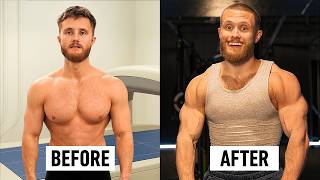
[06:05] look by far. Here I am at 20% body fat,
[06:08] and here I am at 9% body fat after using
[06:11] my Smart Nutrition app macro factor for
[06:13] my cut. My shoulders are definitely
[06:15] broader and rounder at 9% because my
[06:17] waist is smaller and there's less body
[06:19] fat around my deltoid muscle. The cuts
[06:21] are deeper. There's more separation
[06:23] between the heads. And that creates the
[06:25] illusion of a more 3D look. Honestly,
[06:27] you could ignore every other tip in this
[06:29] video and just get leaner while training
[06:31] your shoulders hard, and they'll look so
[06:32] much more 3D. So, if you need a little
[06:34] help with your nutrition, you can try
[06:35] out Macroofactor for 2 weeks for free at
[06:37] the first link in the description box
[06:38] below, and I'll have a little more info
[06:40] about that at the end. The fifth tip is
[06:41] to lift through a variety of muscle
[06:44] lengths. Real quick to get everyone on
[06:45] the same page. A muscle is shortened
[06:48] during the contracted half of the range
[06:49] of motion and a muscle is lengthened
[06:52] during the stretched aspect of the range
[06:53] of motion. That's because the muscle
[06:55] gets longer as you stretch it and
[06:57] shorter as you contract it. So the
[06:59] deltoid is shortened from here to here
[07:01] and lengthened from here to here. But
[07:04] here's the thing. For the front delts,
[07:05] when most people do shoulder presses,
[07:07] they go from here to here and back to
[07:10] here. That's a pretty short range of
[07:12] motion. For the side delts, most people
[07:14] do lateral raises from here to here and
[07:16] back to here. There's some length here
[07:18] at the bottom, but peak tension doesn't
[07:20] hit until the delts are pretty short.
[07:22] And for the rear delts, it might be
[07:24] worst of all. Instead of going from here
[07:26] to here and back to here, most people
[07:29] just go from here to here and back to
[07:32] here. That's a lot of short length
[07:34] emphasis. But longer length training
[07:36] really seems to have benefits. These
[07:38] three studies showed between 130 and
[07:41] 190% more growth when training at a
[07:44] longer muscle length for the quads,
[07:45] biceps, and calves, respectively. For
[07:48] the delts, there's only one 8week study
[07:50] that kind of looked at different muscle
[07:52] lengths, and it compared the dumbbell
[07:53] lateral raise to the cable lateral
[07:55] raise. Dumbbell laterals provide more
[07:57] tension when the delta is short. Cable
[07:59] laterals provide more tension when the
[08:00] delta is long. And based on prior
[08:02] research, the authors hypothesized that
[08:04] cables would result in more growth since
[08:06] they offered more lengthened tension.
[08:09] But there was actually no difference.
[08:11] Both cables and dumbbells grew the
[08:13] shoulders about the same. That's why I
[08:15] think as the research stands, you should
[08:17] include both short length and long
[08:19] length exercises. But since most people
[08:22] overemphasize short length deltraining,
[08:24] here's the fix to balance things out. On
[08:26] your shoulder presses, go deeper. Don't
[08:28] stop once your arms hit parallel. Sink
[08:30] your arms as low as they can comfortably
[08:32] go. On lateral raises, use a cable and
[08:34] stretch it across your body rather than
[08:36] stopping at your side. So, sweep it
[08:38] across your body like this and the range
[08:40] of motion here rather than stopping at
[08:42] your side. In fact, they actually did
[08:44] stop at their side in that 8week study,
[08:46] which I think might be part of the
[08:48] reason why they didn't find a difference
[08:49] with dumbbells. One of the potential
[08:51] advantages of using cables is that you
[08:53] can increase the adduction range of
[08:54] motion and sweep the cable across your
[08:56] body while keeping tension. You can't do
[08:58] that with standing dumbbells. Or you
[09:00] could try crossbody cable Y raises. I
[09:03] love these and they offer about as big
[09:05] of a range of motion as you're going to
[09:07] get for your side delts from fully
[09:09] lengthened to fully shortened. If you
[09:10] don't have cables, lie back on a 20°ree
[09:12] incline bench and do cross body Y raises
[09:15] with a dumbbell. For rear delts, just
[09:17] make sure you're crossing your arms over
[09:18] across your body and sweeping the weight
[09:20] back until you feel a nice rear delt
[09:22] squeeze. Whether you do that with
[09:23] cables, dumbbells, or a machine. Okay,
[09:26] tip number six is to pick the right
[09:28] progression scheme for the right
[09:30] exercise. We all know that progressive
[09:31] overload is the key to keeping a muscle
[09:33] growing. You need to add a little more
[09:35] stress to the muscle each week over
[09:37] time. If you keep using the same weight
[09:39] for the same reps week in and week out,
[09:41] the muscle has no reason to keep
[09:43] growing, but there is a slight problem
[09:45] with progressing on shoulder exercises.
[09:48] Isolation movements like lateral raises
[09:50] are really hard to overload. If you
[09:52] start with 15s and just add 5 lbs each
[09:54] week, by week eight you'd be up to 50 lb
[09:57] laterals. That's simply not realistic,
[09:59] even if you get some serious cheating
[10:01] going. So, you need to make sure that
[10:02] your progression scheme actually matches
[10:04] the exercise that you're doing. For your
[10:06] heavy shoulder press, use a simple
[10:08] linear progression. Add 5 or 10 lbs each
[10:10] week at a fixed rep count of five or six
[10:13] reps. Every 4 to 8 weeks or so, do a D
[10:15] lo week where you drop the weight back a
[10:17] bit and don't go quite as hard. For
[10:18] isolation exercises like lateral raises
[10:20] and rear delt flies, that linear
[10:22] progression won't work because you'll
[10:24] quickly max out how much weight you can
[10:26] add. So instead, use something called a
[10:28] double progression. In this case, you
[10:30] pick a rep range rather than a rep
[10:32] target. Let's say 10 to 12 reps. Start
[10:35] in week one with a weight that you know
[10:36] you can do for 10 reps and hit failure
[10:38] or get close to it. The next week, do
[10:41] that same weight, but this time for 11
[10:43] reps. Then the next week, 12 reps. Once
[10:46] you hit the top end of that rep range,
[10:48] add some weight and go back to 10 reps
[10:50] again. The next week, at the new weight,
[10:52] add one rep again, and so on and so on.
[10:54] And if you're doing three sets, you
[10:56] don't need to add a rep to all three
[10:57] sets. Just one rep to one set is enough
[11:00] to keep progression moving, especially
[11:02] as you get more advanced. But
[11:04] eventually, you won't even be able to
[11:05] add one rep to one set without your form
[11:08] breaking down. At that point, here's the
[11:10] fix. Rotate in a new exercise and start
[11:12] your progression over. If you were doing
[11:14] dumbbells, switch to cables and run a
[11:16] new double progression there. Once you
[11:17] max out what you can do on cables,
[11:19] switch to a machine and run a new double
[11:21] progression there. You'd be surprised
[11:22] just how much of a difference actually
[11:24] having a planned progression scheme that
[11:26] you actually track and stick to makes
[11:28] over time. Okay, we've gone through
[11:30] keeping your traps out, increasing
[11:32] frequency, getting a brutally strong
[11:33] shoulder press, bringing your waist
[11:35] down, including some longer muscle
[11:37] lengths, and picking the right
[11:38] progression. At the very bottom of the
[11:40] iceberg, we have the seventh tip, which
[11:42] is to target all heads of the delts.
[11:45] This anatomy research took 60
[11:47] cadaavvers, dissected them, and found
[11:49] that instead of the commonly known
[11:50] anterior, lateral, and posterior heads,
[11:53] they're actually seven intramuscular
[11:55] segments to the deltoid, each with its
[11:57] own separate tendon. What we think of as
[11:59] the posterior head actually branches
[12:01] into three separate tendons. The middle
[12:03] head has just one tendon, and the front
[12:05] head also branches into three separate
[12:08] tendons. So each of these seven segments
[12:10] has a slightly different function. So
[12:13] instead of your usual front, side, and
[12:14] rear raises, add in some movements for
[12:16] the planes in between. To bias the
[12:18] fibers of the A2 and A3 segments, I do
[12:21] incline dumbbell Y raises by lifting up
[12:23] and out in a Y. You'll place the path of
[12:25] resistance directly in line with those
[12:27] in between fibers. For the P1 and P2
[12:30] segments, try a movement like the 45°
[12:32] cable rear delt pull. Stretch your arm
[12:34] across your body at around a 45°ree
[12:36] angle and sweep the weight down and back
[12:38] almost like you're pulling out an arrow
[12:40] to use for a bow and arrow. As a ball
[12:42] and socket joint, your shoulder has a
[12:44] massive amount of freedom of movement in
[12:46] all three dimensions. So, if you're
[12:47] trying to build some 3D delts, make sure
[12:49] you're training them in all three
[12:51] dimensions. Okay, huge announcement
[12:53] before we go. The MacroFactor Workouts
[12:55] app is launching in January 2026. Most
[12:59] people just pick a weight at random and
[13:00] go for however many reps are in their
[13:02] program. This can work for a while, but
[13:05] eventually you just spin your wheels,
[13:07] doing the same weight and the same reps
[13:09] week after week and month after month
[13:11] with no actual progress. Actually,
[13:13] tracking your workouts makes a massive
[13:15] difference. And I promise you,
[13:16] MacroFactor Workouts is going to be the
[13:18] very best app for doing that. There'll
[13:20] be a massive discount to the workout app
[13:22] for current users of MacroFactor. Like a
[13:24] huge discount. So, if you haven't
[13:26] already, get started with MacroFactor
[13:27] today. You can get a twoe free trial
[13:29] using code Jeff to see if you like it
[13:31] first and then if you do, you'll already
[13:33] be a member for when the workout app
[13:34] launches. And yes, the two apps sync
[13:36] together. It also isn't just for
[13:38] tracking. Just like the nutrition app,
[13:39] it'll use science-based algorithms to
[13:41] update your program over time, just like
[13:43] a coach would. It'll have more analytics
[13:45] and detailed feedback than any other app
[13:48] on the market. And if you're a current
[13:49] user of my programs, yes, there will be
[13:51] a way to load those within the app. So,
[13:53] click the first link in the description
[13:54] box down below to get started with
[13:56] MacroFactor, or you can scan this QR
[13:57] code over here next to my head. Don't
[13:59] forget to leave me a thumbs up if you
[14:00] enjoyed the video. Subscribe if you
[14:02] haven't already, and I'll see you guys
[14:03] all here in the next one.




⚡ Saved you 0h 14m reading this? Transcribe any YouTube video for free — no signup needed.