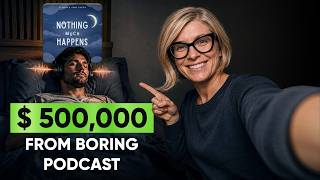

Boring Podcast Makes Millions
45sThe shocking contrast between a 'boring' podcast and its massive success with over half a million dollars in revenue grabs attention and challenges assumptions.
▶ Play Clip"Title accurately reflects the content: a boring sleep podcast that built a media empire."
Katherine, creator of the sleep podcast 'Nothing Much Happens,' shares her journey from a part-time experiment to a media business with over 14,000 paid subscribers and millions of downloads. She discusses how she built a loyal audience by solving a universal problem—sleep—without spending on marketing, and later monetized through ads, book deals, and premium memberships.
The podcast has over 14,000 subscribers at $40/year, generating over $500,000 in revenue. It grew organically without advertising.
Katherine always told herself bedtime stories. She wanted to write a book but lacked publishing connections, so she started a podcast instead.
Podcasting builds loyal audiences but is hard to grow. Katherine had no expectations and focused on solving a problem.
The show grew word-of-mouth because solving sleep issues is life-changing. Downloads went from 150 to 3,000 per day, then Apple featured them.
In 2018, only one other sleep podcast existed. Katherine's storytelling approach was unique, drawing from her yoga teaching experience.
Katherine isn't worried about AI because her content involves nervous system care and mindfulness that AI can't replicate.
She focused on regular, high-quality releases. The show's universality (helping with anxiety, PTSD, grief) surprised her.
After hitting 10 million downloads, she got a literary agent and a book deal. The book sold in 35 countries.
Ads started in 2020. She insisted on pre-roll only to avoid disrupting sleep. Later moved to a boutique ad network for better results.
Launched in 2020 via Supporting Cast and Apple. $40/year or $5/month for ad-free episodes and bonus content. Churn rate is 2-3%.
An app called 'Village of Nothing Much' will offer a community space with nature sounds, live classes, and social features.
Katherine keeps a list of story ideas from daily life. She writes in batches, records in sessions, and avoids AI.
Syndicating audio to YouTube grew subscribers. Now creating animated video versions with artist Laleh Pirverdi.
The podcast helps people in hospice, grief, and anxiety. Katherine feels honored to be there in vulnerable moments.
Stop waiting to feel ready. Ready is a choice, not a feeling.
Katherine turned a simple idea into a multi-million dollar media business by solving a universal problem, focusing on quality, and building a loyal community. Her journey highlights the power of organic growth, multiple revenue streams, and staying true to your unique value.
How many subscribers does Nothing Much Happens have and at what price?
Over 14,000 subscribers at $40 per year.
00:02
What was Katherine's original idea before starting the podcast?
She wanted to write a book.
01:26
How did the podcast grow initially?
Word-of-mouth, without advertising.
03:42
What was Katherine's rule for ads on her podcast?
Only pre-roll ads, no mid-roll interruptions.
19:47
What is the churn rate for the premium membership?
2-3% (97-98% renewal rate).
28:34
What platforms does Katherine use for premium subscriptions?
Supporting Cast and Apple Podcasts.
25:05
How does Katherine generate story ideas?
She keeps a running list in her notes app from daily life observations.
36:51
What is the name of the upcoming app?
Village of Nothing Much.
33:33
What is Katherine's number one tip for side hustlers?
Stop waiting to feel ready; ready is a choice.
47:42
Revenue Milestone
Demonstrates significant income from a niche podcast without traditional advertising.
00:02Organic Growth Power
Shows how solving a real problem can drive word-of-mouth growth without marketing spend.
03:42AI Resilience
Highlights the irreplaceable value of human touch and expertise in content creation.
07:45Low Churn Rate
Exceptional retention rate for a subscription product, indicating high customer satisfaction.
28:34Final Advice
Powerful, actionable advice for aspiring entrepreneurs.
47:42[00:02] >> And those are big numbers for any podcast, but even more interesting is that Katherine's is intentionally boring. >> Nothing much happens is one of the biggest sleep podcasts in the world, and
[00:16] she's taking it from a little part-time experiment into a full-time media business. >> I think we're north of 13,000, [music] 14,000 subscribers right now, and growing at a steady, reliable rate that
[00:31] >> At $40 a year, that's over half a million dollars in revenue, not even streams. Stick around to learn how she started and grew the show, and the monetization levers you might be able to borrow and pull in your own business.
[00:45] >> I've always told myself bedtime stories since I was a little kid. It's one of my earliest memories. Because I've always done that my whole life, I am able to sleep. I can sleep when I choose to. I can return to sleep if I wake up in the
[00:58] middle of the night. And being, um, a full-time yoga studio owner and full-time teacher, I talk to people every single day about what's going on with their health. And at the bottom of most people's
[01:11] issues, there there's going to be a sleep component there. kept thinking, so many people are struggling with this. I seem to have sorted this out organically. How can I move this bit of understanding from my
[01:26] And at first I thought it was going to be a book. I really wanted it to be a book, but that is such a far reach to make if you are not connected to the publishing industry at all, which I definitely wasn't. You know, and I I do
[01:38] that is a real barrier. >> Yeah, I I knew that I needed I needed a bigger partner to make it happen. And, um, so I kind of literally put it on a shelf, and then when I realized, sort of in the middle of the night, I had an
[01:53] epiphany that it was going to be a podcast, I bought a mic sitting on the floor from Amazon at 2:00 in the morning, and we launched about a month and a half later, and that was 400 episodes 6 years ago.
[02:07] >> Yeah, and the rest is uh is history. It's taken off since then, but in the tell this to anybody who wants podcasting advice, it's the best medium for building a really loyal, engaged audience they're with you week after
[02:23] uh with you in their earbuds, and it's a powerful relationship. But, it's probably the hardest platform to try and build an audience. So, what's much happens? >> You know, I think it was good that I
[02:36] went in with almost no expectation, um because it allowed me to just be excited for whatever came. I never I definitely didn't suspect that this was going to be become, like you said, like a media company, which is what it is now.
[02:50] I just thought, there's a problem, I know how to fix it. How can I help fix it? That was really the extent of my of my focus at the time. So, even when, you know, in the first couple of months, I'd get 150 downloads, and then I got 200
[03:04] downloads in a day. You know, I felt super chuffed. I was really excited about that, and like you said, it is quite a strong relationship you build with your listeners, and I find for my listeners, it's such a vulnerable moment
[03:17] when you fall asleep that in order to trust the person that you're letting into that vulnerable moment, that relationship gets really intensified. relationship gets really intensified. So, um at the beginning, I had few but
[03:30] very loyal listeners. And then it seemed to just sort of And then it seemed to just sort of snowball, and I I didn't advertise it. Um I didn't I didn't honestly know how I would have advertised it.
[03:42] studio, like told my friends on Facebook, but it started to gather kind of an organic momentum just from people telling people. Because if sleep is something you struggle with and you sort that out, that is a life changer. You're
[03:56] going to tell people about that. So, I remember there was a day where, you 200 downloads, 300 downloads, and then it was like 1,400 downloads in a day, and then it was like 3,000 downloads in a day. And and then Apple featured us on
[04:12] the new and noteworthy platform. And it just kept growing and growing. >> Yeah, there's a lot to unpack here. I love the approach of like, "Look, I business. I just I'm trying to help solve a problem." And I think that's
[04:27] where all good business ideas come from. It becomes a problem-solving machine. You mentioned like, "Look, if you're not feeling optimal, it's you know, sleep is three pillars. Sleep, you know, diet {slash} fuel, and then exercise {slash}
[04:42] movement." If you start to dial that in, you might realize that takes care of 80% >> Um And then this word-of-mouth piece of uh climbing the listener pyramid from strangers who don't know who you are to
[04:57] shot, to subscribers, those loyal people you talk to. And then at the top of the pyramid, fans. These are the people who you have helped in some meaningful way. In my case, it's usually, you know, some novel idea that they've never heard of,
[05:11] made money from it. Then all of a sudden, they're shouting from the helped me fall asleep. I got to tell people about this." Right? >> spinning. Were there other sleep podcasts
[05:26] in 2018 when you started? It's a competitive niche now, but were were there other people doing it? >> It was only Sleep With Me, um Scooter, who's a great guy. Um and we we are buddies behind the
[05:39] Um he was out there doing his thing that narrative-based. There was no like storytelling, um that was like bespoke written for this purpose. Um and creatively kind of freed me up.
[05:54] knows what you're doing, they can't tell you you're doing it wrong. Um so I was tell me I'm doing it wrong. >> [laughter] >> I came with some really strong instincts from being a yoga teacher and spending
[06:08] people to notice, how does my voice affect you? How does my word choice affect you? My pacing? How can I use stories to build a mood around you that makes you feel safe? So I I did sort of have to build it out of
[06:21] whole cloth, but I also came from a career that helped me do that. I I had honestly the format of the show hasn't changed from the first episode. I knew elements that I wanted to have and it still has those.
[06:37] >> True. And even if it seems crowded today, the truth is 90% of podcasts like there might be a lot out there, but how many of them actually keep going and case? >> Yeah. And I think when you find a need
[06:52] and then you fill it with something really high quality, it's pretty hard to fail at that. I feel like we are a gold standard for storytelling podcasts for bedtime story pet podcast. I feel like our quality doesn't wane,
[07:05] we're not written by AI, produced by AI. It's a human being taking time, doing research, figuring out how they're going to deliver this in the most um in the in There's lots of different kinds of people out there. I always felt this way
[07:19] as a yoga teacher. People like, oh, there's another yoga studio opening down I'm like, they could open across the street. That's fine. Welcome. There's lots of different kinds of people, they need different voices. So I'm not really
[07:31] worried about like fighting over the 10 people that come to my studio. I want to >> [laughter] >> who might come in. So um I've I've compete um,
[07:45] focus as as a creator and it has served me well. >> Well, I was going to bring it up later, but you brought it up now, the potential threat of AI in this space where I could program or pick a
[07:59] soothing calming voice from 11 Labs and just set it loose to read >> [laughter] >> um, Wikipedia pages or something. And it's like, does that I mean, they're probably already out there,
[08:13] >> I'm sure they are. There's also tons of people stealing my content left, right, and center. I honestly don't worry about that stuff or think about it that much because there is a level of scale I am putting into this work that I don't
[08:26] think AI can replicate. Yes, you could listen to the Financial Times, but you deserve better than that. And my stories are written on this whole foundation of understanding nervous system care and mindfulness, and it's
[08:42] more than just hearing a string of words. And so, I I don't know. It hasn't >> Yeah. >> Uh, maybe I would feel differently if my show was launching today and I didn't have such a stronghold in in the market,
[08:56] but AI gets bigger, we're seeing the gaps where it doesn't do the thing the human can do. >> Yeah, and it's kind of the soothing humanness of it. Almost like it would rock you to sleep like like a baby.
[09:09] to be rocked to sleep by a robot. >> No, there's that would be a little weird. So, there's there's some level of uh, validation just because you know this is a huge pain point. You
[09:21] uh, you know, studies on people not getting enough sleep and the detriments of that and the huge sleep industry and aura rings and sleep optimization tracking and stuff. So, creating a solution into
[09:35] for free as a podcast. >> Mhm. And then trying to get the word of mouth to spinning, obviously turning one listener into two, getting featured by out, new and noteworthy. Anything else has gone into the growth engine in that
[09:49] first 6 to 12 months? >> I was really focused on just um having the show publish when I said it was going to publish, regularly and reliably, um and developing the content in a way that I felt like was going to
[10:03] be the highest quality it could be. That was really where I put most of my focus. I didn't know how people were going to find me. I kind of didn't worry about didn't think this was going to be my career. I thought it was just sort of an
[10:16] act of service. Um so um but I I was like, this is so niche, but it turns out that it's super universal. yeah, almost everybody will struggle with sleep at some point in their life.
[10:29] And also, it does so much more than sleep, which I didn't see coming, will help people sleep. I had no idea how it would affect people with anxiety. I had no idea how it would affect people who have PTSD, people who are going
[10:43] through grief, who don't necessarily use it for sleep, but use it for that soft landing and a little bit of a feeling of care and companionship. So um there were things I couldn't predict, but I think that the regularity of the release and
[10:57] the quality of the content made us foundational right from the beginning. >> Did you feel pressure to put an episode out every day? Like if if going to fall asleep tomorrow, like I need something new. Or is like you was
[11:10] it what was the cadence? >> It was weekly, and then I did like 12 episodes, and then I took 2 months to write the next 12 episodes and get those up. So there was like a season, and then a break, and a season.
[11:23] were like, where did you go? >> Okay, okay. >> But um it was a little bit more the opposite, instead of people saying, "I need another episode every night." A lot of people listen to the exact same
[11:36] episode, but they've never heard more than 2 minutes of it. >> don't even get to the story. They're still in the introduction, and I've don't even hear past when you say your own name," which is about 7 seconds in.
[11:50] well-trained brain." You know, um if as long as it does >> thing. Once this comes on, I know >> yeah. It's absolutely a conditioned in the introduction. I'm like, "This is going to be habit-building.
[12:03] for a month before you decide if it >> Nice. So, you're about a year in, and then there's this big inflection point, returning to the initial book idea that
[12:17] started it all. >> About a year in, we had already hit 10 And I came back to the idea. >> Could I I was It probably took me a not a decade, but
[12:30] >> a year? >> [laughter] >> Yeah. Uh I realize You know, I think it just spoke to the level of need. There content. >> Were there some big press wins? What
[12:44] like Okay, going from 1,400 downloads a day to 10 million in a year, there's that marketing fire. >> The thing is, I don't even know what it was. We didn't spend a dollar on marketing until like last year.
[12:57] Um so, I don't I would sometimes see like a celebrity talk about me, and then would get like all of a sudden, 600 people from
[13:09] YouTube. And I remember saying to Bob, my got to be spam." He was like, "No, you're really big in Brazil." >> I was like, "Okay." Um so, I think having those that 10
[13:24] million downloads was a allowed me to get a literary agent. I came back to the idea of the book. I knew I needed an assist to get my proposal in front of people. I reached out to the network I was with
[13:37] anybody?" Um I'm never afraid to just ask for help I ask for help people give it and I got a phone call with a literary agency, a really nice one. Um they loved the idea. We wrote a
[13:51] proposal together. We sent it off and um I remember my agent said to me, "This is a little bit of a long process, so stop thinking about this. Go work on another project and I'll call you in a month."
[14:04] said, "You need to buckle up because we're hearing from publishers all over the world who are really interested in this." I don't think I would have had million downloads. That's what opened the doors for me. Publishers
[14:18] >> they want to make a safe bet. They want somebody with a built-in audience that and then hopefully go beyond that like once they get on stuff. But [sighs]
[14:31] a lot of times it seems more tied to an email list or an Instagram following or you know, something where it's like a direct I can get in your inbox and have you click buy. Were you actively building the email list on the back of
[14:45] >> I don't think I even had one then. Uh [laughter] it was really just me and Bob and Bob's my engineer and he didn't have anything to do with anything besides you know, fixing the audio. So it was just me and
[14:58] now I've got an agent. Um and she was pretty old school as far as like, you she didn't ever ask me how many Instagram followers I had. we didn't focus on that stuff. So I think it was purely because it was a
[15:12] proven concept and it had a strong follower base already. >> Scrappy side hustlers have an advantage over bigger competitors and that's phone, and the faster you can respond to customer messages, the better. That's
[15:26] why today's episode is brought to you by Quo, spelled Q U O. This is the business communication system built so you never miss a call. Quo is the number one rated business phone system on G2 with over 3,000 reviews, and it's built for how
[15:41] modern teams work. More than 90,000 businesses, from side hustlers and solo operators to growing teams, already rely on Quo to stay connected and stay on top personal cell phone as your business line, Quo makes it easy for you. Calls,
[15:56] texts, voicemails, transcripts, AI summaries, contact details, all in one clean view in an app on your phone or your computer, so you and your team always has the full picture for a better customer experience. Money is on the
[16:10] line. Always say hello with Quo. Try Quo for free, plus get 20% off your first 6 months when you go to quo.com/sidehustle. quo.com/sidehustle. That's quo.com/sidehustle.
[16:26] almost never about the work itself. It's about the decision fatigue surrounding the work, like how to reply to this message, is this person going to make a the job? But if you want to sell products online, let me take some of
[16:38] that decision fatigue off your plate. There's a reason millions of businesses, including dozens of the Side Hustle Show guests that you know, choose our partner Shopify. This is the one decision that makes all
[16:51] you no longer have to start from scratch just pick one of the proven templates and then customize it to meet your needs. You can quickly generate product descriptions, you can use Shopify's
[17:03] built-in AI to enhance your product photography, and you can even fire up email and social media campaigns to drive traffic and sales. Start your business today with the industry's best business partner, Shopify, and start
[17:16] Sign up for $1 per month trial today at shopify.com/sidehustle. Go to shopify.com/sidehustle. That's shopify.com/sidehustle.
[17:30] >> And this is the Nothing Much Happens book, which is stories from the show. So that oversimplifying? >> mostly written. We decided that it should have 12 original stories, exclusive stories for the book. I also
[17:45] stuff like that. It was fully illustrated in a really beautiful an option for people who didn't want to have their phone by the by their bed. My you where you are. If you got your phone in your hand, I'm going to meet you
[17:59] meet you there. If you want to watch on YouTube, I'm there. So, um, we wanted that book to exist. It came out It's beautifully It's sold in 35 countries, which, you know, for a first-time author, which is amazing.
[18:13] Um, so it was uh it was a huge success, and it was a moment that I was like, okay, this is going to be my job, I guess." point? >> I was, and you know, really COVID
[18:27] changed that more than anything. I was still writing at a much lower cadence. I was I think I released a show every other week. And now I release like two shows a week, and I have three podcasts. So, um, you
[18:41] where I could still be teaching 5 days a week. Um, and figuring it out, but there came a point after COVID where I thought, of course I had to shut the studio down for a while and teach from
[18:56] you know, on Zoom and stuff, and I thought this might be the time uh to shift this. And luckily, I was able to sell my studio to uh one of the people who had trained with me. So, it this year it'll turn 20, that studio. So, I
[19:08] mean, the nice thing is, you know, two successful businesses I've managed to create by the time I'm 45. >> Yeah. Yeah, that's great. Okay, so publisher says buckle up. You get this book deal. It launches in 35 countries.
[19:21] It's a hit and so now you have like a actual product to sell in addition to the free podcast. So hopefully getting some you know, sweet sweet author royalties though on a traditional publish deal low percentage of every of
[19:34] every book but hey if you move enough volume then that counts for sure. Is the show itself making any money at this point? >> I'd say 2020 is probably when we started to actually make money and we started
[19:47] just with ads and I was very particular about how ads were going to falling asleep. >> It's got to be pre-roll. Thank you, Nick.
[20:00] >> So many networks had such a hard time wrapping their head around that concept and often you know, they would sort of think that you said that but then they would be able to talk you into a mid-roll at some point and I was really
[20:12] staunch about that and I was like look as soon as my show stops doing what it says on the label. As soon as my show doesn't help you sleep or wakes you up, I lost you. I lost you as a subscriber and I lost you in a way that probably
[20:24] makes it's a bad breakup because you were trusting me in a vulnerable moment. And and I just >> I'm picturing like subliminal just whispering Squarespace as somebody is falling asleep.
[20:37] you know, I'm Like you know, and a lot of times people do who don't understand podcasting and don't understand how the business side of it works will kind of send me nasty grams about like I just realized there's
[20:52] ads on your show. Are you working to plant things into my subconscious? And I mortgage. Um >> [laughter] money. So you know, we had pre-rolls and then I
[21:07] would allow like 3 minutes in at the end of my introduction, but my rule was once no interruptions. >> Yeah. >> And it really shortened the list of advertisers for us. If we were with
[21:20] Stitcher and iHeart at different times, and um, because we weren't always the lowest hanging fruit, the easiest show to sell, um, we would get sort of shelved and they would come back to us in a year and still we would make good
[21:33] really going to try very hard to sell ads on your show. And then when your contract comes to renew, your show is so undervalued that um, you can be in a really difficult position to renew that contract or go for a new one.
[21:48] >> Yeah, that's interesting cuz it's, you know, showing massive download numbers, huge audience, but kind of limited inventory. >> Yes. It was limited in in inventory, so we then moved to a just in the last 2
[22:03] years to a much smaller kind of boutique network and it has been such a good network and it has been such a good choice for us. They work so intently, so have great success, which I'm not
[22:15] always tried to explain was, "Okay, yes, you're about to fall asleep, You're not doing 10 things at once. You're actually just listening to me. This might be the first time today you actually put your phone down and just
[22:28] listened. And I'm a super trusted voice." So, for those advertisers who could grab their head heads around it, it's been great. >> Yeah, uh, it's it's a powerful advertising medium to for the especially
[22:40] >> For sure, for sure. >> And then never trying to, it sounds like, sell these spots yourself, which was kind of the place that I was medium in and out, you know, brands would come to me direct,
[22:54] and so we'd cut a deal, and then some other, you know, pseudo network ad sales >> Yeah. >> it became a lot of back and forth and it ended up kind of being ultimately a distraction from creating
[23:07] the content, which was the fun part. And um we've been very happy with the sales network the last couple years cuz they they've done a better job making it >> Yeah, I was overwhelmed by that stuff. I knew I didn't have the business
[23:21] background. I mean, I opened my yoga studio when I was 22. I have a degree in Spanish. I was like, I I don't know what a lot of these things mean. I I just knew enough to know I would not be successful in trying to negotiate those
[23:35] things myself. Luckily, by the time like we moved a manager, I had an agent, I had folks around me who could figure that stuff out. >> Yeah, and so kind of delegating where it
[23:47] wheelhouse. I like that. >> Yes. >> The other revenue stream is the premium subscription. 40 bucks a year, 5 bucks a month for the ad-free version. Plus, you
[24:00] paywall, the membership here for for Nothing Much Happens? >> Yeah. They get week or monthly bonus episodes, of which now there I think are episodes, of which now there I think are are about 60 or more. So, a lot more
[24:13] stories. They also get these episodes we call much more happens, that see you through an entire night of sleep. They're sometimes up to 10 hours long. So, for folks who just want to keep on listening, they can just keep on
[24:25] listening. They don't have to you know, reset their their device or anything. Um Nothing Much Happens, but for all three shows, Stories from the Village of Nothing Much and First This, my meditation podcast. Um so
[24:40] for like a dime a day, I feel like it's a pretty good value. And for us, it has a pretty good value. And for us, it has been a really good way to to monetize the show, to give folks who feel like they've been given something by this
[24:52] free resource a way to give back, which we hear from a lot. People say, I just the ads or listening to the ads, but I want to support you. I don't want you to go anywhere. >> Yeah, what When did you launch the
[25:05] membership? >> We launched the membership probably in >> Okay. >> We started with Supporting Cast and then branched out to Apple as well starting last year.
[25:18] >> Okay, that was the next thing. Was this Patreon? Was this through Apple? What's uh the mechanics or the tech behind processing payments and running it? >> I really like Supporting Cast um because
[25:31] you are still listening through the podcast player that you are used to and you like to listen to. Um so, it's not like coming to Patreon for that. Um [snorts] for a lot of people, nothing changed except for the
[25:45] logo was a little different and they didn't hear ads. And that's the level of experience I wanted people to have. Um and you could listen You could use it user, wherever you came from. So, I really do think they're a great company.
[25:59] Apple, of course, because they're Apple, you always got to make sure you got a few apples in your basket there. So, um little bit harder to connect sometimes when you need assistance, but still a
[26:13] positive experience. >> So, is the um everybody who's not listening on Apple Podcasts and then Apple Podcasts has to have their own unique membership >> thing. You could still use Supporting
[26:26] Cast and listen on Apple. Um you can decide Supporting Cast just existed for a long time before Apple Premium um existed. >> So, um anywhere you wanted to listen, whatever kind of device you have, it
[26:40] works. But for a lot of people who are listening on Apple, they see the subscribe button right there. It's so easy. So, for those people, that might easy. So, for those people, that might be the better way to navigate it.
[26:57] the beginning of the show, like if you want to skip the ad, like how did that pitch go? >> I probably way over explained it and too apologetic. Um
[27:11] >> Um you know, even though I understood that I deserved to be paid for the work I did, um I still think I came at it from this place of I'm so sorry that I >> [laughter] >> But um and I got so many messages that
[27:25] >> Yeah, yeah, we're happy to pay you. [laughter] in our lives. >> Exactly, yeah. And and it remains free. So if this isn't your cup of tea, hey, no nothing changes for you. And even
[27:38] now, we don't have programmatic ads on the first eight episodes. So you're only ever going to hear my voice, um and I deliver ads in this tone of voice. So if you are asleep, I will not wake you up. So it's all designed for like the best
[27:52] listener experience always. So you know, I think I've I've kind of finally gotten past the part where I feel like I need to say sorry. >> Right. Yeah, this is purely optional for you. I I like the dollar the dime a day
[28:06] reframe. It's like right. >> very very inexpensive. I can't think of >> Yeah. What was the initial reaction, the take sharing, what is the membership look like today in terms of the number of
[28:22] >> I think it went well. That's all I remember. Um I think we're north of remember. Um I think we're north of 13,000, 14,000 subscribers right now.
[28:34] 13,000, 14,000 subscribers right now. Um and growing at a steady, reliable month-over-month. Um I know that our churn rate is ridiculous. Like 97 to 98% of the people who buy a
[28:49] membership will renew their membership. So we lose almost no one. >> Wow, that's really powerful for a lot of more traditional membership sites. Well, where it's you know, $50 a month it
[29:04] becomes a little bit more of a decision point on the credit card statement than 40 bucks one time a year. >> Well, I was trying to right-size it even when I owned my yoga studio. I charged way too little constantly. I thought
[29:16] like I always want to make things as inexpensive as possible, but there any entrepreneurial person will know that you there's an issue of implied value and sustainability. So you know, I think finding the right price for your
[29:31] product is a tricky thing, but probably better to air a little bit higher than >> Yeah, the cool thing about that is especially with the low churn and this is something that is unique to entrepreneurship is the ability to go
[29:44] out and give yourself a raise literally every month by getting another new member or 100 new members and continuing to stack that up. >> For sure. And now that we've grown, we have quite a team, you know, and people
[29:57] need to get paid and there's a lot of expenses. So the there that has become expenses. So the there that has become such a reliable revenue stream for us. You know, I feel like ads can go up and down through the seasons,
[30:09] but for us subscription has really become the most reliable source. >> Yeah, it gives you it gives you a floor and say, well, if we can do payroll. At least we know we're going to make money this month.
[30:22] Wow. >> So I like this membership model. There's the book sales royalties. There's the sponsorships question? Did you find that well, now we got a
[30:37] good chunk of the people paying for the membership so the the ad impression number goes down. Like, was that meaningful in the conversations with advertisers? >> It wasn't a meaningful drop because um
[30:51] we get new listeners constantly. And so, we haven't seen, you know, as our premium grows, we haven't we've actually just grown our other listenership as >> Yeah, yeah. It's like how do we You don't want to cannibalize these other
[31:05] I totally get that. um some merch, some Nothing Much Happens swag. Is there anything else? Um different revenue streams that we
[31:18] One customer says, "This tool literally spoiled me. It's so easy." Another added that it's taken a point of anxiety and turned it into a seamless and easy process. Of course, they're talking about our sponsor, Gusto. Gusto is the
[31:32] built for small businesses. It's all-in-one, it's remote friendly, and it's incredibly easy to use. So, you can pay, hire, onboard, and support your team from anywhere. Think of it like cleaning out your virtual junk drawer,
[31:45] all that admin chaos that's been piling up all year, and installing a lean and clean system instead. Automate your direct deposits, payroll taxes, health benefits, 401k contributions, and do it in a way that fits your budget with no
[31:58] hidden fees and no surprises. Plus, if you have any questions, Gusto gives you direct access to certified HR experts. It's no wonder why over 400,000 small businesses already trust Gusto for their payroll and HR needs. Try Gusto today at
[32:12] gusto.com/sidehustle and get 3 months free when you run your first payroll. That's 3 months of free payroll at gusto.com/sidehustle. One more time, it's gusto.com/sidehustle.
[32:27] There's something you need done that either you don't know how to do yourself, or you're not the best at, or it's something you really should be handing off to somebody else. If you're in that same boat, think this is a job
[32:39] for sponsored jobs. When you sponsor your job on Indeed, you'll get matched with quality candidates who meet your exact criteria, so you can focus on what you do best. Plus, with Indeed sponsored jobs, you only pay for results. Spend
[32:52] actually interviewing candidates who check all your boxes. Less stress, less time, more results. When you need the right person to cut through the chaos, this is a job for Indeed sponsored jobs. Side Hustle Show listeners get a $75
[33:07] sponsored job credit to help get your job the premium status it deserves at indeed.com/podcast. Just go to indeed.com/podcast right now and support our show by saying you heard about Indeed on this podcast.
[33:20] indeed.com/podcast. Terms and conditions apply. Need to hire? This is a job for Indeed sponsored jobs. >> Um well, we're about to launch an app that's going to be really big. Um
[33:33] there are a couple of other projects in the works expanding us in more media you where you are, so we're branching out and building more stuff in other places. But, um that's a slow process, but a really fun one.
[33:49] >> What's the app going to do? Is it just kind of like a home base for all things? call the Village of Nothing Much. And so many people said, "I wish I could live It's such a lovely place. I really wish I could live there." And I thought,
[34:02] "Hmm, what if I could at least create like a virtual village for you to come >> So, it is absolutely a great place to listen the podcast. For example, we can regular podcast app. Like let's say you like to listen to the stories, but you
[34:16] kind of wish they had like nature sounds behind them. Or you want to build out want to tag stuff. Um so, it's a great place to listen to the podcast, but it also we set it up kind of like the village itself. You
[34:29] land in the village square, and you can go talk to other villagers in the cafe. can come and sit meditation with me. There are live creative writing experiences, journaling classes. It's just sort of like a community meeting
[34:44] Um a place to hang out on the internet that isn't scary or crazy. >> Yeah, do you anticipate there being a social media element where listeners >> [laughter] >> and and bond over their, you know,
[34:59] know what else happens from there. >> And usually appreciation for the for the lifestyle that the stories are talking about, for the kind of values that are there. You know, um that's what we see a lot in our comment section. Um
[35:13] other. You know, um we actually had to create a fund for um people were gifting um the premium membership to strangers cuz they would see in the comments, "Oh, I can't wait to become a pre- premium
[35:26] month." And somebody'd say, "I'll pay for you. How do we do this?" And so we set up a fund so that people could sort of be angels and come in and donate. And say, "Just had a really bad day today.
[35:39] know I'm going to sleep tonight." And then people would comment, "Man, I hope just you built this create this community around it of people who value kindness and gentleness. And I think there's a lot of places on
[35:51] the internet to go where you don't have that. So, let me build one where you do. that. So, let me build one where you do. >> You're a world builder of sorts with this Village of Nothing Much and the stories that happen around it where
[36:06] there's familiarity week to week and that's somewhat unique. So, I want to talk about the creative process that comes up with these stories. This has been uh
[36:22] >> extolling the virtues of of podcasting for for for an hour. But, with it comes this expectation of recreating the product essentially every week or in your now your case two times a week. And that can be
[36:35] a a labor of love, but it's it's something that has to happen. So, what's >> What's your process like for coming up with continually new >> The good news is I don't see me running out anytime soon. I think because I
[36:51] spent 20 years full-time as a yoga teacher, I really trained myself to notice small moments that felt good. It was my bread and butter every day. times a day something I could write a story about.
[37:06] Um something I could build a sleep experience around. So, I have a running list in my notes app that is probably 100 points long and I add to it >> Okay. >> of ideas for stories. And also because
[37:19] we're 8 years in, um we have existing storylines that I get to revisit. There are characters now that people really love and I can go back and tell the next part of their story and have them interact with other people. I built my
[37:32] then I just go and this person goes over here. And hangs out at the bakery. Let's see what happens. And um in in that way it really is designed sort of like a grown-up Mr. Rogers' Neighborhood.
[37:45] grown-up Mr. Rogers' Neighborhood. Um and I I love it so much creatively. I have so much fun. Yes, it is an a lot to write constantly. Um but the good news is I love it and I am a prolific writer. So, even when people in the past have
[37:59] offered to come on board and write freelance for me, I've always really just out of selfishness said no. I want to do this. with these new stories >> Everything, yeah.
[38:11] >> Yeah. Yeah. Is it just we're going to we're going to play the same thing over and over again? >> Those are compilations, so we'll take like, you know, ep- so many episodes
[38:25] that are like spring favorites and we'll put them all together so that you got a like a a I wrote a wedding that took place in the village of nothing much and the last episode was
[38:40] maybe like an hour and 15 minutes. Um but usually my stories are right about 30-35 minutes. >> Okay. And they all have you know, not have a huge
[38:53] have to like go through it. >> Plot along and yeah, no cliffhangers. >> It's a unique It's a unique skill set. >> Yeah, I feel like I've really kind of hammered it out by now. I know the right way to approach it. I'm always
[39:07] going to start with like a really just naturally calming experience or activity and then I'm going to layer in a lot of sensory details because sensory stuff we're naturally calm. It also sort of puts you, the listener, in the place.
[39:21] smell like or you understand how it would feel to pull a velvet curtain across the window and feel the room get darker. So, those kind of things are darker. So, those kind of things are always going to be forefront. Um then I
[39:34] am going to put something that feels a little nostalgic or at least familiar imagine it happening to you and that feels good. Um I also do stuff very names um because I want you to sort of feel
[39:49] like the character. You could be the innkeeper, you could be the baker, you around you and that becomes an extra layer of comfort for I'm very particular about the way that I write
[40:05] particular about the way that I write things slightly in the past because already happened. Um and so it must have come out right. So, even though I've already told you nothing's going to happen.
[40:21] couple of minutes of this story this actually happened earlier today. So, it's already finished and everybody came out of it fine. >> Yeah. Are there any tools or tech that you're using to help with this
[40:35] production process? Early on you mentioned well, I I kind of wrote 12 episodes at a time. Is it similar today um in terms of production? really strict calendar that I stick to. Um so,
[40:49] usually I am writing um all of stories from the Village of Nothing Much for a week and then I'm writing all of Nothing Much Happens month's worth. And then First This I can slight kind of
[41:02] slot in cuz they're just short meditations. Um I slot into those spaces and then I spend a few days editing everything and then I go into the booth and record everything. Um so, that's usually how I approach it.
[41:15] Energy-wise, creativity-wise, that seems like the best fit for me. If I lose my voice, it is not a good fit for me. Um that's like the only time that I've not delivered an episode is if I've lost my voice. Um but and I've often laughed
[41:30] at the irony of this that I have built a whole brand around rest and I never take a break. We'll be there every Monday. >> [laughter] >> [clears throat] >> And I take it no AI assistance in hey,
[41:44] you know, could you could you help me outline the sequel? >> No, I just I don't need it and I don't think I would like it. I don't like to share my toys. I'm having a good time.
[41:58] business that is your unique secret sauce and why why outsource that? >> You did mention YouTube as well and so this is just syndicating the audio
[42:10] content over there. People It's become a pretty big podcasting platform. more attention to because we never paid attention to it. We just sort of Bob want to have a YouTube channel?" I was like, "Oh, sure." And so he just stuck
[42:25] the label or the logo on the audio and you know, and without noticing, you subscribers and I was like, "Oh, we should probably Let's see if we can make this even softer." So now just um a little while ago we launched our video
[42:41] version and we have quite a bit of art artwork that was created by the artist Laleh Pirverdi who illustrated both of my books and if you look at the website or anything, that's all of her art. Um so she's been gently animating different
[42:54] pieces for us and um it makes really beautiful videos that you can watch beautiful videos that you can watch either on Spotify or on YouTube. like ideally, you know, you're not staring at blue light, you know, when
[43:08] you're trying to fall asleep, but um >> But humans don't do ideal things. >> I guess you don't meet meet them where they are, right? You want to be there >> there and it is designed it gets dimmer and dimmer and dimmer as you watch it
[43:21] and by the time it is time to say sweet dreams, it is off to black. I'll crank up the brightness. I'll crank up the brightness. Okay.
[43:35] Much Happens, three different podcasts syndicating to YouTube, creating the >> [sighs] >> Yeah, should mention that the On the Street Where You Live audiobook is coming out
[43:48] Anything else on the content production side? What else is going on here? >> All I can really say is that it's going to get even more beautiful to experience in a visual way, um that we're going to be able to reach more
[44:03] people. When I started audio podcasts, um there wasn't really a genre of sleep podcast and now there is and I feel like I was part of building that and I think that a visual version, a fully animated
[44:17] um, that that will happen and that, um, it will become its own genre there, too. I think people are often watching TV to fall asleep, but it's not TV that suits falling asleep. Like we said, it's not
[44:30] >> Um, and I think I'm going to be the person to create that. So, the app, the more. >> Yeah, even with hundreds of millions and
[44:42] this big membership, uh, recurring base that you have, the total addressable majority of people >> Huge. Absolutely. probably still struggle with sleep from time to time and it's,
[44:55] >> I still meet people all the time who are like, "Sleep podcasting is a thing?" >> So, I think there are tons of people out don't feel like the world's going to suddenly get softer anytime soon. So, I
[45:09] don't see this need going away. Even if insomnia was suddenly cured, I don't softer. I think anxiety is just going to be part of modernity. So, um, I think, uh, there's so many people who need it. >> I think you're probably right there.
[45:24] >> What surprised you the most along the way? I didn't know the other ways that I'd be able to help people.
[45:36] able to help people. I have been there in the dark for people when they've lost a child and they thought, "I'll never sleep again." Or I am sometimes the last voice that someone hears in hospice.
[45:49] Um, and people have told me, "We played you non-stop for 3 days cuz we knew your voice was loving and the stories were safe and it gave us all a place to be." never thought I would have the honor to be there in those moments for people. Um
[46:06] and I am so so glad that I could be that they found me at the right time and that they found me at the right time and that I could soften a difficult moment. >> Yeah, that's that's true. You have one vision of how this
[46:19] product that you create is going to be used and then it ends up in uh uh in a different way. >> Yeah. >> What's next? You got the app launch coming up. You've kind of teased uh some
[46:32] got you excited for the rest of this year? the new audio book because this is the first time that we'll have other voices Nothing Much. It's me and eight wonderful voice actors from Broadway,
[46:47] from movies and TV. Um they're all lovely. They sound called On the Street Where You Live and they're longer stories. Um it's set over 3 days in the Village of Nothing Much. It sort of outlines connections and
[47:01] community, the way that people can help each other and be present and enjoy their day-to-day life and the moments of ordinary magic that are woven through it. It's just a lovely bit of healing fiction and um it comes out on July 28th
[47:15] and it is available for pre-order right now any place you listen to audiobooks. >> That's right. Grab your copy on the street where you live. Um you find it at nothingmuchhappens.com. Be sure to check out the Nothing Much Happens podcast.
[47:30] Plug that into your earbuds uh while you're falling asleep and then wake back up with the Side Hustle Show in the morning. Let's wrap this thing up with your number one tip for Side Hustle Nation.
[47:42] >> Stop waiting to feel ready. >> [laughter] >> Ready isn't a feeling, it's a choice. >> Ooh, I like that.
[47:56] Again, nothing much happens.com. Couple takeaways for me. Number one, obviously, solve a problem. The bigger the problem that you can solve, there is. And you said it felt like a niche at the
[48:10] time, but obviously, [laughter] you know, huge addressable market there. And then think about what is the kind of unique positioning and maybe unfair You're like, well, I had all this yoga and mindfulness experience. And you
[48:25] know, I really loved creating these stories. I could combine those kind of diagram there. And then I love the, you know, the call yourself a raise every month. Positioning it, look, it's just a dime a
[48:40] day. And with the loyalty and goodwill that you built up over the years, lots and lots of people willing to pay for it. So, super exciting stuff. Again, nothing much happens.com. If you are interested in
[48:53] starting a podcast of your own, make sure to download my podcast starter kit. It is free. You're going to find resources on choosing the right software marketing your show, and of course, all the different ways that podcasts can
[49:07] make money. Just follow the link in the episode description and it'll get you right over there. Big thanks to Catherine for sharing her insight. Big thanks to our sponsors for helping make this content free for everyone.
[49:19] sidehustlenation.com/deals is where to go to find all the latest offers from our sponsors in one place. That is it for me. Thank you so much for tuning in. Until next time, let's go out there and make something happen and I'll
[49:32] catch you in the next edition of The Side Hustle Show. Side Hustle Show. Hustle on.
⚡ Saved you 0h 49m reading this? Transcribe any YouTube video for free — no signup needed.