[00:01]
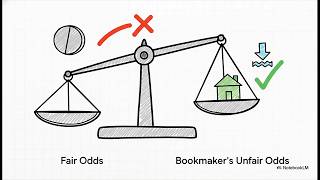
something called arbitrage betting. It's a pretty cool method that uses pure math to lock in a profit no matter who actually wins the game. You've heard this a million times, right? The house always wins. And honestly, we have to
[00:16]
start here because from a mathematical point of view, they're usually correct. Let's see why. Okay, imagine a super simple game, a coin toss. In a totally fair world, heads is 50%, tails is 50%. You add them up, you get a perfect 100%.
[00:31]
The fair payout, simple, you just double your money. But of course, a bookmaker isn't trying to be fair. They're trying to make money. So instead of those fair odds of 2.0, they'll offer you something a little worse. Maybe 1.9 for heads and
[00:46]
1.9 for tails. So what happens when we work backwards and turn those odds back into what we call an implied probability? Well, you just divide one by the odds. So 1 divided by 1.9 and suddenly you get a probability of about
[01:00]
52.6%. And right away you should see the problem here. The bookmakaker's numbers are telling you that heads has a 52.6% chance of happening and that tails also has a 52.6% chance. That just doesn't
[01:14]
make sense. It doesn't fit into the 100% reality of a coin toss. You see, when you add their two probabilities together, you get 105.2%. That extra 5.2%, 2%. It's phantom probability. It doesn't exist. It's like
[01:28]
a hidden fee you pay on every single bet. That's the house edge. That's the vig. And that is precisely why over the long run, the house is mathematically set up to win. But here's the thing, that whole system isn't foolproof.
[01:41]
There's a glitch. And that glitch happens when different bookmakers can't So, for example, you might have bookmaker A who thinks the red team is a huge favorite. So, they give them really low odds. At the same time, bookmaker B
[01:55]
might not be so sure, and they'll offer much better, higher odds for that exact same red team. And that disagreement, that's our opening. So instead of being trapped inside one bookmaker's unfair system, we can go shopping. We can hunt
[02:09]
around and grab the single best price for every possible outcome from a bunch of different bookies. And we use those to build our own new probability pie. So the big question is, how do we know for sure? How do we use math to see if the
[02:23]
new pie we've built actually has one of those profitable gaps in it? Okay, let's use a real world example to make this concrete. We're looking at one soccer match. After shopping around, we found the best odds. Bookie 1 gives us 2.2 for
[02:36]
the home team to win. Bookie 2 has the best price for a draw at 3.60. And Bookie 3 offers a great price of 4.30 for the away team to win. All right, you know the drill by now. First step is to turn each of these odds back into an
[02:49]
implied probability. And we do that by just taking the inverse of each number. So we run those numbers and this is what we get. About 045 for the home win, 28 for the draw, and 23 for the away win. Now all we have to do is add them all
[03:04]
up. And there it is. The total comes out to 0.9647. That's our magic number. Because this total is less than one, it means we found it. We have a confirmed arbitrage opportunity. It basically means we can
[03:17]
buy a dollar's worth of a guaranteed win for just about 96. Okay, so we found our golden ticket. But hold on, because this is where so many people mess up. The gut reaction is to just throw the same amount of money, say hundred bucks, on
[03:31]
each of the three outcomes and call it a day. Let's see why that's a really bad day. Let's see why that's a really bad idea. You've spent $300 total. Now, if the away team wins, great. You've made a nice $130 profit. But look what happens
[03:44]
if the home team wins. The payout is only $220. You spent $300. You only got back $ 220. You just lost 80 bucks. So, you definitely haven't gotten rid of the risk. Let's be really clear about this.
[03:59]
That is not arbitrage because the profit isn't guaranteed. It's really just gambling with a few extra steps. So, to lock in a guaranteed profit, we have to be precise. We have to calculate the exact amount of money to put on each
[04:14]
bet. The formula here makes sure our payout is identical no matter what happens. You take the individual probability for an outcome, you divide it by our magic total, that.9647, and then you multiply that by how much
[04:27]
you want to invest in total. So let's say we want to invest $100 total. We run the numbers through that formula, and this is what it tells us to do. We need to bet these very specific kind of weird amounts. $4710 on the home win, 28.80 on
[04:44]
amounts. $4710 on the home win, 28.80 on the draw, and $2410 on the away win. And this this is the beautiful part. Check it out. If the home team wins, we get paid $10360. If the game is a draw, we get paid
[04:57]
$103.60. And if the away team wins, you guessed And if the away team wins, you guessed it, we still get paid $103.60. the actual result of the game is now completely irrelevant. Our return is
[05:09]
locked in. So, let's recap. We invested exactly $100 spread out across those three specific bets. And in return, we are absolutely guaranteed to get back $1360. That is a completely risk-free,
[05:24]
That is a completely risk-free, mathematically certain profit of $3.60. finding these little glitches in the market where the probabilities add up to less than 100%. And then using math to balance your stakes perfectly, you take
[05:37]
luck completely out of the equation. You're not trying to predict the future. You're not trying to predict the future. You're just calculating