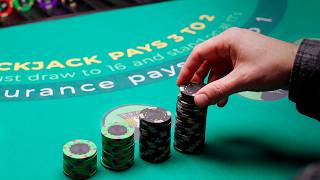

The Real Secret to Card Counting
45sChallenges common misconceptions about card counting, revealing that bet sizing is the true key to success.
▶ Play Clip"Delivers solid, actionable advice on bet spreads, though the title oversells the 'without going broke' promise slightly."
This video explains how card counters can optimize their bet spreads to maximize expected value (EV) while minimizing risk of ruin. It covers the goals of a bet spread, key variables like bankroll and game rules, common mistakes, and the importance of using proper software over generic spreads or AI.
The ability to keep track of cards is not the main skill; knowing how much to bet and when is crucial. Betting too small wastes edge, betting too big risks going broke.
The narrator started with a $2,000 bankroll, grew it to $100,000 in six months, then won $500,000 over two years, and later $3 million with a larger team. He emphasizes that an optimized bet spread was critical to his success.
The primary goal of a bet spread is to generate EV. A card counter acts as the casino, and the bet spread determines how much value can be extracted.
EV is meaningless if you overbet your bankroll. Many counters go bust due to poor bankroll management. Risk of ruin is like Russian roulette with your bankroll.
Small bets when the casino has the edge and larger bets when the player has the edge can be obvious. A well-crafted bet spread can be less noticeable, allowing more hours before being backed off.
The bet spread determines how long it takes to reach the long run (where results converge to EV). A better spread shortens this time.
Many new counters use a 1-8 spread without knowing if it will make money or if it risks their bankroll. 90% of aspiring counters fail due to imperfect game and unoptimized bet spread.
The more money you have, the more you can bet while keeping risk low. Starting small is possible if you reinvest winnings to increase bets and EV.
Game rules like number of decks, deck penetration, and rounds per hour significantly impact EV and risk, thus affecting the optimal bet spread.
Copying bet spreads from YouTube or books can be dangerous because assumptions differ. For example, Stanford Wong's 1:10 spread gives $20/hour but 8% risk with a 10k bankroll.
Books like Burning the Tables in Las Vegas offer spreads that may underperform today. The author's 1-14 spread with win/loss progression has too high risk in modern games.
AI-generated bet spreads were 30-60% less EV, higher risk, and longer long run compared to software-optimized spreads. Only two reputable software: Casino Verite and the narrator's pro betting software.
Start with a basic 1-8 spread, then adjust based on true count. Avoid negative counts (e.g., true -3), check edge at true 1, and consider playing multiple spots at high counts to increase EV while managing risk.
By adjusting the spread, the narrator achieved $20/hour with 1.5% risk of ruin and a manageable long run. Increasing top bet can boost EV but adds complexity.
Rounds per hour, number of players, and knowledge of deviations affect EV and risk. A maximizer accepts more back-offs for higher EV, while an optimizer prioritizes longevity.
An optimized bet spread is essential for a card counter's success, balancing EV, risk, and longevity. Generic spreads or AI are inferior to software-based optimization tailored to your bankroll and game conditions.
What is the primary goal of a bet spread?
To generate expected value (EV).
01:20
What is risk of ruin?
The probability of losing your entire bankroll.
02:02
What are the four goals of a bet spread?
High EV, low risk of ruin, avoiding detection, and reaching the long run sooner.
01:20
What is the biggest mistake new card counters make with bet spreads?
Using a generic spread like 1-8 without knowing if it will make money or risk their bankroll.
03:07
What are the two reputable betting software mentioned?
Casino Verite by QFIT and the narrator's pro betting software.
07:20
How did AI-generated bet spreads compare to software-optimized ones?
AI spreads had 30-60% less EV, higher risk, and a longer long run.
07:05
What is the recommended action at a true count of -3 or below?
Leave the table or avoid playing.
07:47
EV is the primary goal
Establishes the core objective of a bet spread, setting the foundation for all subsequent advice.
01:2090% failure rate
Highlights the importance of bet spread optimization, motivating viewers to take it seriously.
03:07AI underperforms
Provides a concrete comparison showing AI is not yet reliable for this specialized task.
07:05Step-by-step optimization
Offers a practical method for creating a personalized bet spread, directly actionable for viewers.
07:34[00:01] money with card counting is your ability to keep track of the cards. It isn't. The whole point of knowing the count is knowing how much to bet and when. Bet too small at good counts and you waste your edge. Bet too big and you risk
[00:13] >> If I would have known in the beginning of my card counting career the steps teams would have won hundreds of thousands of dollars more if not millions. In this video, we'll cover the goal of your bet spread, the variables
[00:26] right bet spread, and how to optimize it for your specific goals. I started out as a card counter over 20 years ago with a $2,000 bankroll and a dream of growing my bankroll, I teamed up with another card counter and we were able to bet off
[00:41] of a $10,000 bankroll. Six months later, we'd grown it to a $100,000 bankroll. I'd quit my other job and we teamed up with two more card counters. We went on to win about $500,000 over the next two years and then the two of us split off
[00:54] and started a larger team that won about $3 million over its five-year history. However, when I started out with those $7 bets, I had an 80% chance of going bust. If I hadn't gotten lucky and more importantly very quickly learned how to
[01:08] create an optimized bet spread, I would not be here today and certainly wouldn't teams have had. What are the things I wish I would have known? I'll get into that in a second, but first, what are a card counter's goals when creating a bet
[01:20] spread? The number one goal is EV or expected value. While the casino is expecting to get value out of you as their customer, a card counter is casino. And your bet spread determines how much value you can generate. I've
[01:35] counter I know that had a sizable bankroll, a perfect game, but after a break-even, which means he had made no money. That's not normal. After digging in with betting software, I realized the
[01:48] having to do with his bet spread. Six months later, he reached out to me again letting me know he was up over $100,000. EV is important, but it's meaningless if you're overbetting your bankroll. For every successful card counter, I believe
[02:02] there are several others out there who don't manage their bankroll and go bust. suboptimal bet spread I started with, there's no doubt in my mind I would have gone bust and had to head back to substitute teaching or waiting tables at
[02:14] bottomless steak fries, that was not my long-term dream. Risk of ruin is like playing Russian roulette with your bankroll. If the risk is too high, it's that trigger and it's bye-bye bankroll.
[02:27] spread. Small bets when the casino has have the edge. But that also can make it obvious to the casino. Well, it is possible to craft a bet spread that's not so obvious, helping you get in far
[02:40] more hours before the casino figures out what you're up to. The fourth goal of a bet spread is to get to the long run sooner rather than later. Like the stock >> [music] >> If you invested in something that I said
[02:52] could take 3 months or 30 years to get your money back, you'd pause before investing. Your bet spread indicates how long that long run is. All right, Colin, tell me what to bet. I want high EV, low risk, few back-offs, and a quick return
[03:07] on my time and money. Slow your roll. Probably the biggest mistake I see with new card counters when they test out is that they treat the bet spread part of their game far too lightly. They hear something online about using a 1 to 8
[03:19] having any idea if that bet spread is going to make them any money or if they're going to lose their bankroll playing like that. I honestly think 90% of aspiring card counters don't make it because of some combination of an
[03:32] imperfect game and an unoptimized bet spread. Don't be like the 90%. There are far too many variables at play to give you a simple answer like 1 to 8 or a 1 what you want, which is a simple one-size-fits-all bet spread. But what I
[03:46] can give you is even better. I'll tell you the variables at play, then compare options for how to create an optimized bet spread, and then finally show you biggest factor that will impact your bet spread is your bankroll size, and it's
[03:59] kind of obvious. The more money you have, the more you can bet while still For those starting small like I did, take courage. Assuming that you reinvest to be betting more and generating more EV.
[04:12] That's how I went from playing games worth about $10 an hour to playing games worth over $300 an hour in less than a year. The other major factor that impacts your bet spread is the games you have access to. What are the rules of
[04:24] the game? God forbid you're risking any money at a terrible game like 6:5 blackjack or a game with awful deck penetration. But every rule impacts your EV and risk and thus your bet spread. The number of decks has a big impact,
[04:36] how many rounds per hour you're going to be playing, that has a big impact on your EV as well. Okay, you now know the goals of EV, low risk, getting in the hours, and getting to the long run, and you know the variables that are at play.
[04:50] up with a bet spread? We're going to quickly look at the four most common assumes the Hi-Lo count, but the principles apply to all effective card counting systems. We're on YouTube, maybe you've seen someone showing their
[05:03] cameras. Maybe you try to adapt their bet spread to your situation. If it's what you need to know is that he's mostly playing on a team with a massive back-offs. [music] The same principle applies with anyone
[05:18] chips. And as with anything on the internet, you need to be careful. Some of the other people may be more AP wannabe than actual AP. Books on card counting can be great. Heck, I wrote one. They can provide concrete
[05:31] information on how to think like a card counter, how card counting works, things. When I got started with card counting, I read a few books by blackjack Hall of Famers, and I decided I would just follow their bet spreads.
[05:44] For example, Stanford Wong basically recommended a 1:10 unit bet spread, but spread option? I plugged Wong's bet spread into our pro betting software in today's blackjack, and here's what I found. Using a 10k bankroll, we get $20
[05:59] an hour, but a killer 8% risk and a very long long run. pro bank software, I was able to get a bet spread with 30% [music] more EV, closer to a 2% risk of ruin, and a much shorter long run.
[06:13] And it's not that Wong was wrong, it's just that if the assumptions are different, [music] then it's going to have a big impact in your EV, your risk, Andersen's green chipper bet spread from his book Burning the Tables in Las
[06:25] Vegas. He talks a lot about avoiding detection and getting the hours in. To do that, he comes up with a bet spread that he uses that's basically a 1-14 unit spread, but [music] he only increases his bets with a win and only
[06:38] decreases bets after a loss. But in today's average game, it underperforms an optimized bet spread and has way too high of risk. Why the massive difference? Because what works in one scenario doesn't work in
[06:50] with your hard-earned bankroll, [music] you can't trust one generic bet spread. But who needs software when we can use AI to do the math for me? I went to the most powerful version of an AI chatbot, I input all the variables, and asked it
[07:05] It came up with a couple of options, but the AI-generated bet spreads were 30 to 60% less EV, higher risk, and a much longer long run than an optimized bet spread used with real betting software. There are only two pieces of software
[07:20] that are reputable and trustworthy, Casino Verite software by QFIT and our pro betting software. Both Casino Verite software and ours has been rigorously would trust with my hard-earned money. Assuming you don't want to gamble with
[07:34] your bet spread, here's how a serious card counter creates an optimized bet Say you start with the good old 1-8 [music] bet spread. negative counts?
[07:47] maybe you need to get out at a true negative three and below. And a little pro tip for you, if you are going to avoid negative counts, don't just sit at another table or ask a dealer to hold your spot while you go to the bathroom.
[08:01] But next you're what going to want to check your edge at a true one. And we have a very small edge here, so I'm actually not going to raise bets I'm actually not going to raise bets yet.
[08:13] And then I'm just going to manually adjust these. but what if I go to two spots when I'm not heads-up at the higher counts? So,
[08:28] I'm going to do this. Two spots at true three and above. And I care about the top bet because that's often the biggest tip-off to casinos. So, I'm going to keep it from being too high, but you can already see
[08:40] here we're closer to $20 an hour with 1 and 1/2% risk of ruin and a much more manageable long run. If you want to bet more at the top, you can boost that EV
[08:52] and still stay around 2% risk of ruin, but that's going to be more EV, more to think about. But what other factors are impacting my EV? What about rounds per hour? If it's three players, that's going to
[09:06] be less EV than if you're playing with just two players. That went way up. Or full table, that EV is going to go down because the three players.
[09:19] What about deviations? Do you know the standard deviations? If you don't, your is going to go way up. What about if you know the expanded deviations? Well, you're going to get a little bit more EV and a little bit less risk. Also, what
[09:32] are your goals? A maximizer with more back-offs or an optimizer with fewer consider when crafting your bet spread. Blackjack bet spreads, check out this video I created on the science and art
[09:45] video I created on the science and art of bet spreads.
⚡ Saved you 0h 09m reading this? Transcribe any YouTube video for free — no signup needed.