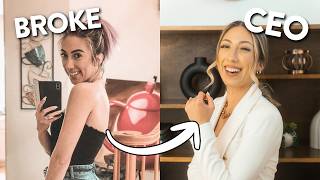

I Went From $3 to a Million-Dollar Creator Business
58sThe dramatic contrast from having $3 to a million-dollar business hooks viewers instantly with an unbelievable success arc.
▶ Play Clip"The title promises a first-person million-dollar creator story and she delivers with concrete numbers, dates, and hard lessons — low fluff, real receipts."
A content creator recounts how she built a seven-figure creator business in five years, starting from a corporate job and a $3 bank account. The video walks through her timeline — the initial commute burnout, a failed website detour, a $33k year of scrappy income streams, a $70k course launch, and an eventual $700k+ year — along with the mindset shifts that helped her scale.
She went from having $3 to running a creator business making over 10 times her corporate income. She is 100% debt-free, supports her family, and took a 4-month maternity leave while still earning passively.
In December 2018, she and John moved to LA for a 6-month mentorship with director Jacob Owens. She kept her San Diego corporate job and commuted 2 hours each way, with in-office days escalating from once a week to four times a week.
After months of no-strategy posting and exhausting commutes, she broke down crying in a drive-thru. She felt trapped because her salary and benefits wouldn't change no matter how hard she worked, and she wanted unlimited income potential.
She set a goal to quit her job by the end of the year and to earn at least half her corporate income through content creation. She stopped measuring success by follower count and started measuring it by money earned.
She joined a free webinar, bought the Influencer Bootcamp by Christina Galbato on a credit card, and completed it in 11 days. The course forced her to niche down, which she had resisted because she loved many topics.
She asked John what she was good at and what people came to her for. He said 'Instagram and organization.' That reframe helped her realize her mundane skills were valuable to others, so she became an influencer coach.
She struggled with charging for her knowledge. A podcast quote — 'There are people less qualified than you doing what you want and getting paid for it' — pushed her to start monetizing.
Using the Course from Scratch by Danielle Leslie, she created a six-week coaching program with live Q&As and feedback. With fewer than 10,000 followers, she got 10 people to join at $597 each on September 26.
After quitting her job on October 4, she stopped working on income-generating tasks. She spent months building a WordPress website from scratch, hated it, and burned out. By January she gave up, and in February 2020 she went back to corporate work.
After being laid off due to COVID, she applied for unemployment and tried many streams: Amazon Influencer Program ($84), one-on-one clients ($3,400), brand collabs ($4,000), YouTube monetization ($9,500), and virtual assistant work ($16,000). Total: $33,000.
She researched common passive income streams and started a Patreon membership, digital products based on audience questions, and a flagship course. She joined a 6-month mastermind with Christina Galbato to build and launch the course.
On July 26, 2021, she launched The Modern Influencer at $697. The first email alone brought sales before she even posted to Instagram. 30 people joined on day one, and the week closed with 100 signups and over $70,000.
Running active and passive income streams simultaneously led to burnout. She had a panic attack, fainted, and spent three months in and out of hospitals. Her doctor concluded the cause was stress.
Amy Porterfield's advice — replace 'I don't have time for X' with 'X isn't important to me' — helped her realize she needed self-care. She made time for rest, walks, and health.
She off-boarded coaching clients, stopped her Patreon, and said no to non-essential opportunities. That year YouTube made $68,000, collabs $145,000, and passive streams $378,000 — totaling $591,000.
In 2023, she doubled down and made over $700,000. Within 5 years of starting in June 2019, her creator business surpassed $1 million in total income.
She wants to simplify her offers, shift from being a hands-on creator to a CEO, embrace profit-and-loss statements and funnel analytics, and continue growing while staying home with her son.
The video proves that a million-dollar creator business is possible by treating content creation as a real business: start with income goals, stay focused on money-making tasks, invest in education, and simplify when needed. The core takeaway is that persistence, reframing limiting beliefs, and strategic simplification can turn a side hustle into seven figures.
Christina Galbato
person
Danielle Leslie
person
Amy Porterfield
person
Julie Solomon
person
Jenna Kutcher
person
Jacob Owens
person
Influencer Bootcamp (course)
service
Course from Scratch
service
The Modern Influencer (course)
service
WordPress
tool
tool
YouTube
tool
Patreon
service
Amazon Influencer Program
service
Influencer Podcast (Julie Solomon)
service
Goal Digger Podcast (Jenna Kutcher)
service
Online Marketing Made Easy (Amy Porterfield)
service
What was her corporate salary she eventually replaced?
$55,000 a year.
26:57
Who taught the Influencer Bootcamp course?
Christina Galbato.
06:39
How many people joined her first coaching program and at what price?
10 people at $597 each.
10:57
What non-income-generating task caused her to burn out after quitting her job?
Building a WordPress website from scratch.
12:04
What three passive income streams did she set up in 2021?
Memberships, digital products, and online courses.
15:39
How much did her first course launch earn in one week?
Over $70,000.
20:12
What were her business income totals for 2020, 2021, 2022, and 2023?
$33,000, $215,000, $591,000, and over $700,000.
20:56
What did her doctor conclude was causing her panic attacks and dizzy spells?
Stress.
23:14
What phrase does Amy Porterfield's advice replace 'I don't have time' with?
'XYZ isn't important to me' or 'It isn't a priority to me.'
23:57
What was the name of her first online course?
The Modern Influencer.
17:34
What was the name of the director John had a 6-month mentorship with?
Jacob Owens.
01:28
How much money did the Amazon Influencer Program make her in 2020?
$84.
14:11
Income-based goals unlock growth
Shifting her success metric from follower count to revenue changed her actions and priorities, a key mindset shift for any creator.
05:41Your mundane strengths are your niche
She discovered a profitable niche by asking her husband what people came to her for — simple feedback that revealed hidden value.
08:20Stop building things that don't make money
Spending months on a website instead of income-generating tasks killed her momentum and shows the danger of perfectionism.
11:37Reframe 'I don't have time' as 'not a priority'
Amy Porterfield's reframe forced her to admit that self-care was a priority, which was essential for recovering from burnout.
23:57Simplification scales revenue
Cutting active income streams and focusing on quality content grew her passive income to $378k in one year — contrary to conventional hustle advice.
25:22[00:01] changed my life. I went from having $3 to my name to now running my own creator business that makes over 10 times my corporate income in under 5 years. My business has helped me become 100% debt-free. I mean, student loans, car
[00:14] loans, credit card debt, fully paid off. It supports me and my family so that my husband and I can both work for this business and stay home with our son. Plus, I was able to take a 4-month maternity leave this year and still make
[00:28] money passively. Now, I say all of this as a testament that being a full-time content creator is possible. And since I've never shared my journey here on my channel, I figured why not now? Why not share how I was able to leave my
[00:43] corporate job within 4 months of deciding to pursue content creation, how my first attempt at being self-employed failed, and how I had to go back to the corporate world, how I was able to make $70,000 in 1 week doing my first ever
[00:58] course launch, and so much more. So, here's my journey of how I've made over 1 million dollars from being a content creator before turning 30. These are goals I have for my business moving forward, and so on. So, let's rewind to
[01:12] forward, and so on. So, let's rewind to December 2018. into motion without me even realizing it at the time. Basically, this is when John and I decided to move to LA. So, John, who was boyfriend at the time, now
[01:28] husband, he had gotten a 6-month mentorship program with Jacob Owens, who's a director and filmmaker. So, we packed up our things and moved into a townhome with four other people. So, six people in townhome. It was great.
[01:42] For me, making the move, I didn't have any sort of like LA dream that I wanted to pursue. So, I planned on still keeping my corporate job that I had in San Diego. When I told my job that I was making the move, they said I could be
[01:55] mostly remote. Originally, they said I only had to go in once a week, which wasn't bad. It's a 2-hour drive to my office, and then it would be a 2-hour drive back home because, you know, LA traffic, it's great, we love. So, I
[02:08] would wake up at like 4:00 a.m. and then leave the house by 5:00, make the drive to get to work by 7:00, and then I'd work 7:00 to 4:00, but I didn't want to sit around and wait in traffic all day, so I would go to my parents, have dinner
[02:21] there, and then leave their house around 5:30 or 6:00 so that by the time I reached LA, most of the traffic was died down. So, I wouldn't get home until like commute days. Now, it started as going into the office once a week, slowly
[02:35] turned into like twice a week, and then three times a week, and then sometimes four times a week. So, that gradually increased over a few months' time. Now, during that time, I was posting to social media, but it was never
[02:47] intentional or strategic. Like, I've always loved creating. I had a YouTube channel with my brother since, oh my gosh, I don't even know, 2008, 2009. We posted there for almost 10 years. I also had like an Instagram modeling account
[03:01] back in the day. That's how I met John. I was an Instagram portrait model. So, and during this time when I'm up in LA, I am just posting like fun lifestyle content, whatever the heck I wanted to. Creation has always been like in my
[03:14] bones, it's always been a piece of me, and part of me has always been interested in social media, hence the YouTube channel when I was like 15, no, 13, I don't know. So, anytime I would do my 2-hour commute, I would be listening
[03:26] to content creator podcasts or influencer podcasts because this is 2018 where like influencer is the term. So, I'd listen to the influencer podcast by Julie Solomon, Goal Digger podcast by Jenna Kutcher, Online Marketing Made
[03:40] Easy by Amy Porterfield, now the Amy Porterfield Show. So, for months, I was just listening and absorbing information just cuz I was interested in the creator space, but I never took action on anything. I think I just didn't believe
[03:53] possible for me because I would hear episodes on my drive where they would would be like, "Oh yeah, I've been in marketing for like 7 years." And I'm "Not me. I have zero experience and I don't have that kind of time. Plus, I
[04:09] already have a job that provides me a lot of safety. So, like, why would I leave this job?" But looking back, I think a part of me still wanted that for myself or still believed it could have been possible even though what I was
[04:22] never happen for me." Otherwise, I wouldn't be listening to those podcasts, I don't think. And I also I was somebody that would just lie awake at night even a.m. the next day, I would just lie awake. Couldn't go to sleep because I
[04:36] just like wanted to create. I was thinking about an Instagram post for the weekend for my lifestyle blog, you know, like I could not sleep because I felt like I needed to do this. Anyhow, January through June, I was posting
[04:48] lifestyle content, no strategy, just for funsies, commuting 2 hours both ways. And this is kind of when everything started to go downhill. Pulling out of that drive-thru, crying my eyes out, was the turning point for me. That's
[05:02] when I decided that something had to change. In that moment, I felt trapped. It felt so frustrating having this corporate job. I was paid salary. I had
[05:14] benefits. But no matter how hard I worked or even if I wanted to work harder and prove myself and show how great of an employee I was, it wouldn't change how much I was paid. I was always going to be getting paid the same. And I
[05:28] didn't like that feeling. I felt trapped and I wanted to be more in control of my income. I wanted to feel like there was no limit, no ceiling on how much I could make. So, that's when I decided I was going to find a way to work for myself.
[05:41] So, the new goal that I set driving home was I'm going to quit my job by the end replace my corporate job by the end of the year. Little did I know it would actually be sooner than that, but we'll get there. This was the game plan. I was
[05:56] going to make at least half of what my corporate job was paying through content creation because I told myself with the extra 40 hours a week plus drive time, I would easily be able to double that. So, I think where things started to shift
[06:10] here when it comes to social media was I stopped having my goal be a follower number and started to have my goal be an income-based goal. At this point, I didn't care about how many followers I had or how many followers I wanted. All
[06:23] I wanted was to set something up that I genuinely loved in a way that would help me make money. So, I did what anyone would do. I joined a free webinar, was pitched a course, and used my credit card to buy said online course. 11 days
[06:39] later, I was finishing my first course on Instagram. This was the Influencer Bootcamp taught Galbato, and I did a complete rebranding of my personal brand. That means I had to do the thing that I was refusing to do, niche down. I
[06:56] always hear people talking about it like on social media, Instagram, YouTube. grow, you have to niche down. Stop doing lifestyle content. Niche down. Me, me, like, not me. I don't have to. I'm going to be a lifestyle creator and I would
[07:09] then I'd be frustrated that I wasn't growing thinking, "Oh, I'm niched down for this course. And because of that, I took it more seriously than anything. I needed it to work. I followed everything that she
[07:25] taught to a T even if I didn't agree with it, which included niching down. I did not know how to niche down at first because I love so many things. I remember like writing down everything that I was interested in and I was like,
[07:38] "Well, I love coffee. I love true crime. I love fashion. I love travel. I love organization. I love YouTube. Like I literally sticky notes of everything that I love and I'm like, I don't see a clear path. I love all these things and
[07:53] What do I do? And how I decided to niche down happened in almost two moments. One was in the back of my mind I had heard advice to niche down or find a niche that was profitable, that you knew would be able to grow a business. So that was
[08:08] looked all these things, I was like, I don't know how any of these are profitable. Like collaborations, yes, I could get paid to travel. Like I kind of glaringly yes, this is how I can make
[08:20] figure anything out, I remember on one of my long commutes John had came with me. He stayed in San Diego and then we drove up together and on the drive home, I asked him, "What are some things that you think I'm really good at? What would
[08:35] you come to me for advice on?" And he gave me two answers. He said, "Instagram and organization." And I remember being like, "Really? That's it?" I was like, "Well, Instagram's not hard. Taking photos isn't hard. Organization, not
[08:50] corporate job and I was like, these things are really easy. What do you mean? And I think it was such a mind-opening moment because sometimes the most mundane things to you is exactly what other people need to grow
[09:05] and to learn from you. So Instagram, taking photos, editing photos, creating all of that was just like, "Oh yeah, that's just what I do." But to other me your ways." And so I was like, "Okay, I will niche down and teach what I know,
[09:21] this could benefit people." So that's when I decided to become an influencer coach. I focused on teaching people how to take cool photos, how to have confidence in front of the camera, different editing
[09:34] tips, and how to like grow on Instagram, brand collaborations, how to plan out and organize your posts, all those things. And I had no problem teaching everything I knew for free. It was the money-making part that was hard for me
[09:48] mentally. This is where there was a lot of imposter syndrome because I would ask myself like, why me? Why would people want to pay me? I'm not an expert. It's just Instagram. It's photo editing. Why should I charge for something like that?
[10:01] I think where it felt uncomfortable was asking for money in general. Like I've never been somebody to ask for money before, but I remember hearing on a podcast, I don't remember which one, but they said something like, "There are
[10:15] people less qualified than you doing what you want and getting paid for it could." And that's when I was like, "All right, bet. Let's make some money." So, I bought another course. This one was Course from Scratch by
[10:30] Danielle Leslie. Basically, this helped me create my own course-like curriculum to launch a six-week coaching program. It would be live, weekly Q&A's, weekly
[10:42] teachings, an exclusive high-ticket program only open to like 10 people. And questions throughout the week and getting feedback on their posts. So, on September 26th with less than 10,000 followers, I got 10 people to join my
[10:57] followers, I got 10 people to join my coaching program for $597 each. I had done it. I made more than my corporate job and decided to quit. So, October 4th was the first day officially of me being self-employed. This is
[11:11] great. This is exciting. This phase of my life, like those first few weeks, great, exciting. I loved working from home. I loved being a content creator, but the victory was unfortunately
[11:23] short-lived because this is also when I made the biggest mistake that caused me to go back to work. I stopped focusing on the income stream building tasks. on the income stream building tasks. During this time, I stopped thinking
[11:37] about like the future for making money. I was just thinking, okay, well, next year, because it was October, January is when I'll launch this big thing. And so, from October through December, I thought in order to launch another coaching
[11:51] group and look professional, I have to build a website. I don't know why, but I convinced myself, in order to be a successful influencer, content creator, so, I bought a course that would teach me how to build my website from scratch
[12:04] and start a blog. That's what I was trying to do. I was trying to build out my own WordPress website from October, November, December. And that's not my zone of genius. I know nothing about website building and doing that felt so
[12:17] draining and frustrating. I hated it so much. By the time January came around, I creator anymore. I don't think I could do this. I don't want to build websites. And so, I quit. I gave up on being a content creator
[12:32] website. And John and I were supposed to get married April 2020. We were trying coming in because I hadn't built my website yet, so I couldn't launch anything else. Don't know why I believed that. But, January is when I was like,
[12:46] for another job. February 2020, I went back to the corporate world, but I need You're about to get a little bit of whiplash. So, 5 days into starting my new job, my dog gets diagnosed with an autoimmune disorder, IMHA. When we take
[13:02] not going to make it. So, we're spending thousands of dollars on blood thousands of dollars on blood transfusions with a insurance credit debt, y'all. I think it was like $10,000. And spoiler alert, she made it.
[13:17] right there. So, she made a full recovery even though the vets literally don't know how she did it. They're like, this is literally a miracle. Oh my gosh, made it. She's fine. But, we went into further debt. And then, 3 weeks into my
[13:31] new job, I get let go because COVID, which ended up kind of being a blessing in disguise because since I got let go from a corporate job, I was able to get an unemployment paycheck or apply for unemployment and I got approved. But,
[13:44] then, 1 week after that, we have to cancel our wedding. The wedding that we had already paid for and put down payments for everything on and still haven't gotten money back from.
[13:58] It's okay. So, now living off my unemployment check, I thought, "You know what? Let's try this whole working for myself thing again." Because now there's but this time I'm not going to make the same mistake. I'm going to actually
[14:11] focus on making money. So, throughout 2020, this was like, "Let me throw spaghetti at the wall." I joined like the Amazon Influencer Program, which the Amazon Influencer Program, which made me $84 that year. I brought on or I
[14:23] made me $84 that year. I brought on or I accepted two one-on-one clients, which helped me make $3,400 that year. I focused on negotiating paid brand free ones. So, that year for brand collabs, I made $4,000. I started
[14:37] posting to YouTube every single week, which ended up getting monetized in about 6 months. And so, YouTube monetization made me $9,500 that year. I had taken on two virtual assistant clients where I would run their social
[14:52] media accounts. So, that year that made me $16,000. So, all in all in 2020 from focusing on money-making tasks, my business or my creator business made me $33,000. This was very exciting, but I noticed I
[15:08] had reached my capacity for output. I was pretty much capped on time. I didn't have any other time to allocate to take on more coaching clients or virtual assistant work because I was already doing so many things. It didn't seem
[15:23] know how I could make more money when I was already running myself down the to the ground. So the goal for 2021 became how can we make passive income? How can I set up streams of income that would help me make money without me working
[15:39] up all the time. So this is when I started to do market research. I started industry to figure out what sort of income streams they had that were passive. And I noticed the three common ones were memberships, digital products,
[15:54] and selling online courses. So I set up all three. Why the heck not? I basically made digital products based off of what my audience was currently asking for. I think at this point I had 50,000 followers on Instagram because in August
[16:08] 2020 through December, I just was like balls to the walls. I don't know if saying it anyway. I just went balls to the walls posting and I think I grew 50,000 followers within like less than a 6-month span. So at this point I had
[16:21] Instagram, and I started creating digital products based off of the most asked questions from my audience. I also launched a Patreon membership so that I could have a more predictable, recurring monthly revenue. If there's 10 members,
[16:36] money per month. And then the big task was to create a course. This one felt a little bit more daunting, but I knew it would be like the gold ticket. And so in order to like do it right, I felt like I needed more help. So in March I invested
[16:51] into a 6-month mastermind led by Christina Galbato. If that name sounds familiar, it's because she's the gal who I took her Instagram course. And then she was launching a exclusive mastermind where she would just bring on some
[17:04] setting. And I was like, yes, that's what I want. So over those 6 months she helped coach me on how to turn what I was doing into in like one-on-one coaching into like a course. And she also helped me create a webinar for
[17:19] launch week and set up my course and then launch my course. So, July 26th, 2021, I launched my very first online course, The Modern Influencer. This course I do not sell anymore. It's actually evolved into the BSP model, but
[17:34] I think this was like that next big mind-blowing moment for me in my creator career because so many things felt possible that week. This was the first time I had made money in my sleep. So, I had been teasing this launch. I had been
[17:47] creating this course with my followers. For months I would ask them, "What do other courses? What do you want to learn? What misconceptions do you have?" followers, building up the hype. And then I was like, "Okay, mark your
[17:59] day." And get on the wait list, get on the wait list. So, people were in my list. And then I remember I scheduled an email to go out first thing in the morning, July 26th. It was like a 5:00 or 6:00 a.m. send out to let people know
[18:12] doors are open. You can now join and purchase The Modern Influencer. The purchase The Modern Influencer. The first 30 people that sign up will get Instagram audits from myself. And my goal that week was to hit 30 people to
[18:24] join my course. I wanted 30 people to join the course. It was priced at $697, I believe, with payment plan options. I remember waking up July 26th, rolling over, checking my phone, and seeing that I had a course sale. Somebody had
[18:38] already bought my course. And I hadn't even gotten dressed for the day, put on makeup. I hadn't even posted it to Instagram that it had launched. My email just automatically sent and people were already buying the course. I think I had
[18:50] three sales from that first email before posting to social media. I remember laying in bed being like, "Oh my gosh, I just made money in my sleep. This is money in their sleep. I just made money in my sleep. Oh my gosh, email lists are
[19:03] so cool." Like I remember freaking out because I did what everybody said, "Oh, you can make money in your sleep." And I had done that. Not only that, but later that day I hosted my first live webinar where you host a webinar and at the end
[19:16] you tell people like, "Hey, this is the course that I have. You could join." On my first day at my 30 sales goal, I hit it. 30 people joined my course. All 30 audits that I was going to offer, gone. Done. I remember this was another
[19:28] moment. John helped me moderate the webinar. He would like screenshot mark comments that were questions so I could answer it at the end. Like he was comment section while I taught. And I remember I was like, "Okay, we're going
[19:42] everybody for coming." And we go off live and John and I jaws on the floor looking at each other like, "Did that just happen?" I think during that call we had like 20-something sales, which meant we had made five figures in an
[19:57] disbelief. We're like, "We need to go celebrate. We need to go celebrate." So, I remember just that feeling and John's like, "We got to do this more often." I'm like, "Yeah, we do." That week, my first course launch, I had 100 people
[20:12] sign up for The Modern Influencer and made over $70,000 in 1 week. So, my income streams that I ended up making in the year of 2021 focusing on like passive income was affiliate marketing made me $2,000.
[20:25] Digital products made me $4,000. I was still doing coaching so I made $23,000 with that. YouTube channel was monetized. It made me $37,000. With collabs I made $34,000. My Patreon membership was $12,000. And
[20:43] then total made for courses that year was $96,000. So, we went from I think the year before was like a $33,000 a year. 2021, my business made $215,000.
[20:56] This is just like year two, y'all, of just like deciding to do it. I think truly believe that every time my business would level up it was because I was investing into it. The best resources that helped me go full-time
[21:11] were always courses and in this case or a mastermind. I'm somebody that felt to figure it out on my own and potentially mess it up. I believed 100%
[21:23] that I would make my money back that I was investing tenfold. It was risky, maybe not the smartest decision. This is not me telling you to do what I did and use credit cards to buy courses, but I for me, I knew I had to invest in my
[21:38] dreams. I knew learning from others was going to be the best way to fast-track my success. So now we're at this point where I had made $215,000 a year, which where I had made $215,000 a year, which is amazing, but with every high of the
[21:52] is amazing, but with every high of the story comes some lows. 2021, I added passive income, which is great, but I added it. It was in addition to active income streams. So I was still grinding on active income and passive income
[22:06] simultaneously. I didn't drop off any of the active income streams. I was still coaching. I was still doing the Patreon. I was still doing collaborations. So unfortunately, being in that like grind mode for over a year of consistently
[22:19] posting every single day, I hit burnout. This was literally the week after I had launched my course. I still to this day don't really remember what happened, but I sat down in front of this camera in our old apartment to record a YouTube
[22:33] video and I think I was trying to get my script ready phone, but the next thing I know, I'm standing in our living room telling John I think I'm fainting and out. I don't remember anything in between, but I just remember just
[22:49] falling to the floor and when I fell and hit the ground, that's when I had my first panic attack and like I couldn't breathe. Like something was wrong. Over the next three months, I was in and out of the hospital trying to figure out
[23:02] what was going on. I was still having these like dizzying spells, panic attacks, going out if I smelled something that was so strong, it would trigger me for some reason. I'd have massive anxiety, I'd get dizzy, I'd need
[23:14] to sit down. I didn't know what was going on, and eventually after going back and forth with my doctor for some time, she came to the conclusion that I was stressed. That's it. All of these health problems that I was having were
[23:27] wrong, and she told me that I had to like basically take care of myself. I never spent time taking care of myself. I never spent time doing self-care. Self-care felt very like woo-woo for me, I don't know. And I thought self-care
[23:42] scrolling on social media. And then for every other form of self-care, like taking a bath or reading, meditating, prayer, going on walks, working out, any myself, I don't really have the time for that. And it wasn't until I heard on Amy
[23:57] something where she said, "Every time you say, 'I don't have the time for you say, 'I don't have the time for XYZ,' you need to replace that with XYZ isn't important to me. It isn't a priority to me." And once I started
[24:11] saying that to myself, I was like, "Oof. Ouch. Taking care of my body isn't important to me? Yes, it is." And so then I had to figure out ways to make time because with burnout, as a creator, your business can't run if you can't. If
[24:25] your business? Nobody could clock in and cover you if you're sick for a shift. Do your business, and if you can't run, your business isn't running. So 2022, the new goal was simplification. Simplify income streams, off-board
[24:41] coaching clients. I actually stopped my Patreon. Basically, any opportunity that wasn't like an absolute, "Oh my gosh, no. So I started saying no to more things. And in '22, through this like
[24:55] simplification and starting to take care of myself, YouTube made me $68,000, of myself, YouTube made me $68,000, collabs made me $145,000, and then affiliates, digital products, and courses, all passive income streams,
[25:10] those made me $378,000, bringing that year's total to $591,000. I think that simplification process worked so well for me because with that
[25:22] clients, and not doing virtual assistant work, not doing my membership, I got to create better quality content that would lead people to my passive income streams. So, in my YouTube videos, I
[25:34] mention digital products. In Instagram reels, I would mention those things. And so, I was able to up-level my content to drive people passively to these other places that made me money. So, 2023, obviously, I was like, "Okay, last year
[25:48] worked really well for me, so let's double down on it." And then in 2023, my business made over $700,000. And the trend just kept going up from there. But from the moment I decided I'm
[26:00] going to be a full-time content creator in June of 2019 to 5 years later, we have surpassed a million dollars. Within 5 years of pursuing content creation, surpassed a million dollars. Now, let me just say I know that not everybody's
[26:16] goal is to make a million dollars, or to run a business, let alone to grow and scale a business. I know that's not everyone's goals. But for me, I enjoy that. I enjoy the scaling part of things, the big vision, the next step. I
[26:30] love having a team and working with people and supporting their families, home and staying with their families. I really love the business side of what I do almost as much as the content creation side. So, scaling and having a
[26:44] business felt just as natural as filming a YouTube video. You don't have to have these like million-dollar goals. You don't have to run a business that's making millions of dollars if you want to simply replace your corporate income.
[26:57] For me, that was $55,000 a year. You can do that. That is possible, and you could sustain that for years if you want to. So, now we're at this point this year. I'm back from maternity leave. I have a baby. What are my goals moving forward
[27:10] baby. What are my goals moving forward with my business? I always thought that after having a baby, I would have to give up this job because that's what what people would say. That's what I would hear. People would be like, "Oh,
[27:22] you have to sacrifice so much when you have a kid, when you grow a family, you up your dreams." And I would just hear lots of like you have to give up So, I was scared that I would just have to give this up. And if anything, I feel
[27:36] like I'm more fired up now than ever before. I'm more excited to grow this goals for the business. Like I just want to keep taking it that step further and to keep taking it that step further and expanding reach, helping more creators
[27:50] me and my family and keep me and my husband home with my son. Being able to experience that, that experience is what I want for so many people who also want that. But moving forward, I want to simplify even more. I have a lot of
[28:04] digital products that I've made over the past few years and a lot of courses that I've made over the past few years, and I want to streamline it, simplify it so that there's just a few key offers and just focus on those key offers. This
[28:18] season, I want to shift from being a content creator and be more of a CEO. And what I mean by that is I want to take on the tasks that I've been scared of, like looking at profit and loss statements, looking at income, expenses,
[28:33] worst sellers, looking into our funnels, seeing how they're converting, asking how can we improve sales pages and landing pages, thank you page like I into those things that I've been so scared to look at. I still will forever
[28:48] business. I don't see that changing because I still love YouTube and I love making videos, but I want to be able to be more in the behind the scenes and work more intimately with my team who is really hands-on with those sort of
[29:02] things. If you made it this far, you're a real one. You really are a real one. You really are to sit here and listen to my story. I really appreciate you taking your time for that. So, be sure to comment this
[29:15] secret emoji in your comment below and I hope this video brought you inspiration if anything and excitement to continue on your journey of being a creator, whether that's learning from me or anybody else out there. Keep pursuing
[29:31] those desires that you have in your gut because those desires were given to you for a reason. The reason being they're meant to come true. So, if you have that my gosh, I want to be a creator. I want to be a YouTuber." Keep going after it.
[29:44] going to be some lows, but if you just keep pushing through, it will always be possible. Thank you so much for watching and I'll see you in the next one. Follow your joy. Bye. Choo.
⚡ Saved you 0h 29m reading this? Transcribe any YouTube video for free — no signup needed.