
AI Summary
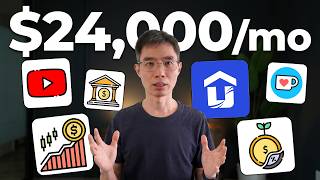
In this video, the creator details eight distinct passive income sources that collectively generate over SGD 24,000 per month in Singapore. He rates each source on ease of starting, earning potential, and passivity, debunking the myth of truly passive income while providing practical insights into each method.
Chapters
Parking money in DBS Multiplier yields 1.8% interest after meeting salary crediting and credit card spending criteria, earning about SGD 20/month. Wise offers 1.01% on SGD and 3.39% on USD balances, earning around USD 250/month on USD.
Lending to Australian property developers via BigFundr yields around 5% interest monthly. Over 2 years, earned close to SGD 2,000, averaging SGD 80/month recently. Platform is MAS-regulated, with deals checked 3 times and 3 layers of protection.
Invested in 5 SSB issues yielding around 3.3%, earning about SGD 200/month. Offers diversification and flexibility with early redemption, though current yields are around 2%.
Singapore stocks and REITs pay SGD 450/year; US stocks and ETFs pay over USD 3,180/year, but after 30% withholding tax, net is about USD 2,250/year. Combined monthly dividend income is roughly SGD 280.
AdSense income averages SGD 2,400/month over the last 6 months. Finance niche earns higher CPM (~$7 per 1,000 views) compared to vlogs/gaming ($1-$5). Requires consistent uploading to maintain income.
Earns about SGD 18,000/month from affiliate commissions, built over 6 years. Risky because vouching for companies can backfire; only promotes products he genuinely uses.
Sells spreadsheets on Ko-fi, mostly priced at SGD 0 (pay-what-you-want). Payouts dropped from SGD 37 to SGD 14/month after neglecting updates. Potential for real money if priced properly.
Sells cash-secured puts, covered calls, and credit spreads, earning around SGD 3,000/month. Previously higher with Tesla but risky; now diversified and more selective. Least passive, requiring constant monitoring.
The creator emphasizes that no income is truly passive; each source requires ongoing effort. Diversifying across multiple streams is key to building substantial passive income, but starting small and understanding each method is crucial.
Mentioned in this Video
Study Flashcards (10)
What is the interest rate on DBS Multiplier after meeting criteria?
easy
Click to reveal answer
What is the interest rate on DBS Multiplier after meeting criteria?
1.8%
00:42
What is the average monthly income from BigFundr?
easy
Click to reveal answer
What is the average monthly income from BigFundr?
Around SGD 80
03:40
What are the three layers of protection on BigFundr?
medium
Click to reveal answer
What are the three layers of protection on BigFundr?
First legal charge on property, borrower's personal guarantee, and buy-back provision from fund manager.
05:39
What is the yield on Singapore Savings Bonds mentioned?
medium
Click to reveal answer
What is the yield on Singapore Savings Bonds mentioned?
Around 3.3% (bought at peak), currently around 2%.
07:33
What is the US withholding tax on dividends?
easy
Click to reveal answer
What is the US withholding tax on dividends?
30%
09:45
How much does the creator earn from YouTube AdSense per month?
easy
Click to reveal answer
How much does the creator earn from YouTube AdSense per month?
About SGD 2,400
12:00
What is the average CPM for finance channels vs vlogs/gaming?
medium
Click to reveal answer
What is the average CPM for finance channels vs vlogs/gaming?
Finance: ~$7 per 1,000 views; vlogs/gaming: $1-$5.
12:44
What is the monthly affiliate income?
easy
Click to reveal answer
What is the monthly affiliate income?
About SGD 18,000
13:38
What is the monthly options income?
easy
Click to reveal answer
What is the monthly options income?
Around SGD 3,000
16:33
Why did options income decrease from previous levels?
medium
Click to reveal answer
Why did options income decrease from previous levels?
Because the portfolio was previously concentrated in Tesla, which was volatile, but now diversified and more selective.
17:01
💡 Key Takeaways
No True Passive Income
Debunks the myth that passive income requires zero work, setting realistic expectations.
00:15Yield on Cost
Explains how dividend growth increases yield on initial investment, a key concept for long-term investors.
10:29Finance Niche CPM Advantage
Highlights why finance content earns more per view, informing content creators about niche selection.
12:44Affiliate Risk
Warns about reputational risk when promoting products, emphasizing trust and due diligence.
14:05Diversification is Key
Concludes that multiple income streams are essential, reinforcing the video's core message.
18:30Full Transcript
[00:00] In this video I'm going to go through 8 different sources of passive income that I have. Together these 8 sources bring me over SGD 24,000 a month in passive income. Now, when people hear the word passive income, they always imagine this magical thing
[00:15] where you build once, and it pays you forever. I hate to pop your bubble because there's no such thing as true passive income. Because as you'll see later, even the most passive of passive income requires you to do some work every once in a while.
[00:29] on a scale of 1 to 5. How easy it is to start, how much you can actually earn from it, and how passive it all really is. So let's not waste any time and let's jump right in.
[00:42] First up, bank interest. For me, I'm parking my money in DBS Multiplier, where after fulfilling the salary crediting and credit card spending criteria, is paying me 1.8% in interest. Though,
[00:55] given how little money I have in my bank account, I usually only earn around SGD 20 in a typical month. It ain't much, but it is still enough to buy me a few plates of cai fan every month. Now, the reason I don't park my money in other high interest savings accounts,
[01:10] despite them technically offering higher interest, is that higher interest only kicks in when the monthly average balance is high. For example, if you have SGD 75,000 or less, both UOB One's 1% interest and OCBC 360's 1.7% interest lose to DBS Multiplier's 1.8%.
[01:28] is that if you and your partner credit your salary into the joint account, it would count towards the total, thus helping to boost both you and your partner's interest.
[01:40] Besides that, since I'm a business owner, I also hold cash in my company's corporate bank account to pay for the running costs of the business, like my subscriptions, freelancers, and taxes. But rather than parking it in a normal corporate account which barely pays me any interest, I park
[01:57] the money in Wise instead. The nice thing about Wise, as compared to most other high interest savings accounts, is that it doesn't require me to jump through hoops to earn the interest. All I gotta do is turn on the Wise Interest feature, and ding, I'll start earning the interest.
[02:12] My SGD balance earns around 1.01%, so on a typical month that only comes up to around SGD 30. The US Dollar balance is a lot better though, at around 3.39%, and that one pays me closer to USD 250 a month.
[02:27] Parking your money in a high interest savings account is definitely the easiest way to earn passive income, and I think everyone should definitely do it, otherwise the inflation is going to nom nom nom eat away your money.
[02:40] On a scale of 1 to 5, this gets a full 5 for how easy it is to start, because you're literally just opening a bank account. As for how much you can earn, that's a 1, because unless you're sitting on a huge pile of cash, you shouldn't expect much to come out of it. But for how passive it is, this
[02:57] is another 5. All you gotta do is choose a bank that gives you the highest interest, and the money just shows up every month. Watch this video to find out which is the best bank account for you. Next, while my day to day cash sits in a bank account, anything I know I won't touch
[03:12] goes somewhere that gives me better interest. This is the money that I don't need today, but might need 1-5 years later, stuff like my yearly insurance premiums, my kid's expenses later on, or even a family trip that I know is coming but not this year.
[03:28] For this I'm using BigFundr. BigFundr is a platform which lets investors lend their money to property developers in Australia, for tenures from anywhere between 6 to 12 months. Then in return,
[03:40] they earn around 5% in interest every month. And over the past 2 years, I've earned close to SGD 2,000, while averaging around SGD 80 in recent months. Now, I know what you might be thinking: lending my money to some property developer all the way
[03:55] in Australia, sounds sketchy leh? That was my fear at first. But BigFundr is licensed and regulated right here in Singapore, by the Monetary Authority of Singapore. So I'm not just handing my money over to some random developer and hoping for the best.
[04:10] But then, how is BigFundr able to give such high returns? Private property lending is actually the norm for small to mid-sized developers in Australia. According to a survey, roughly 72% of them say they fund their projects through private credit
[04:24] rather than the banks, since private credit can approve and release the funds a lot faster than banks, and are also more willing to shape the loan around how the project actually runs. And that higher rate is where my 5% comes from.
[04:41] But of course, just because private lending is normal over there, doesn't mean every deal is a good one. That's why at BigFundr, every deal gets checked 3 times before it even shows up on the platform.
[04:53] First, an established Australian Fund Manager puts the loan together and prices the risk. And these are specialist real estate debt managers who are licensed by Australia's financial services regulator. For example, Pallas Capital, which has managed over AUD 10 billion
[05:08] since 2016, and HMC Capital, which runs around AUD 2.3 billion in property loans. After that, BigFundr's own team assesses every deal that comes through, and looks at whether the borrower can actually pay it back, where the property is,
[05:22] what kind of development it is, and how long the loan runs for. And finally, its parent company Maxi-Cash runs one last independent check through its own credit committee. Though, this still doesn't guarantee that they'll never get a bad deal. So if ever that happens,
[05:39] that's where BigFundr's 3 layers of protection comes in. Layer 1 is a first legal charge on the property, which makes BigFundr investors the senior, first-in-line lender. This is so that in the event a borrower defaults, investors would get repaid before anyone else.
[05:54] On top of that, every loan is secured by real estate, so if a borrower can't repay, that property would get sold to cover what they owe. And to further minimize risk, the loan is typically capped at under 70% of the property's value.
[06:09] Then at Layer 2, there's the borrower's personal guarantee. Now, this isn't just a pinky promise to pay back. It's a personal guarantee, but a binding contract that puts the developer personally on the hook. And lastly, Layer 3 is a buy-back provision from the fund manager behind the deal.
[06:25] and there's definitely risk to this, so it's definitely not for everyone. So if you want to know exactly what's protecting your money and whether it's actually safe,
[06:37] you can check out my video here where I've done a full deep dive on the platform. where users can enjoy extra interest on top of their usual base rate. So if you are interested,
[06:49] On a scale of 1 to 5, I would give this a 4 for how easy it is to start. but do the initial research on how BigFundr works so that you really know what you are investing in.
[07:06] As for how much you can earn, I would give it a 3. The returns are higher as compared to other platforms, but you're taking on more but calculated risk to earn these returns. And for how passive it is, this one gets a 5. Unlike my SSB or my dividends,
[07:21] BigFundr actually pays me a monthly interest, so once you've picked a Deal that you are comfortable with, you don't even have to lift a finger. Next, besides parking my mid-term savings into BigFundr,
[07:33] I bought into many of these when the rates were at their peak. Across 5 different issues, they yield around 3.3%, which works out to about SGD 2,400 a year, or roughly SGD 200 a month.
[07:48] So even though I could get higher returns from BigFundr, the reason I park part of my mid-term savings into SSB is simply because of 2 things, diversification and flexibility. While BigFundr return is good, I think it's just as important to diversify my money to other
[08:03] investments, just in case things go wrong, and in case it takes a while for my money to come back. SSB is also a lot more flexible. While BigFundr requires you to hold the investment till maturity,
[08:15] SSB lets you redeem your money and get it back the following month. This is especially useful if you ever need access to your money quickly. So on one hand it is my mid-term savings, on the other hand, it can also double up as my emergency funds if I ever need the money quickly.
[08:31] Unfortunately you won't get that 3%+ rate today, since bond yields have come down a lot since then. However, even at the current 2% average yield, I would still say it is pretty decent, given that it offers both the flexibility of early redemption, and zero risk.
[08:47] Because of that, I would rate SSB a 5 for how easy it is to start, As for how much you can earn, that's a 2, because while the returns are safe,
[09:00] they're small. And for how passive it is, that's a 5, since there's really nothing to maintain here, they'll just pay you every 6 months automatically over a period of 10 years. Moving on, dividends. Now, some of you might know me as someone who doesn't really focus on dividend
[09:15] stocks, however I do have some stray Singapore bank stocks and REITs here and there. Together, these Singapore stocks currently pay me around SGD 450 in dividends every year, More interestingly, even though I mainly invest into US growth stocks,
[09:33] some of them do pay me dividends, so I guess technically that makes them dividend stocks too? Across my brokers, these US stocks and ETFs pay me a little over USD 3,180 a year.
[09:45] But I don't get to keep all of it, since the US government takes a 30% withholding tax on every dividend before it even reaches me. So what actually lands in my account is closer to USD 2,250 a year, or about SGD 2,900 after currency conversion.
[10:02] So if you combine both my SGD and USD dividends, and spread them across the year, that works out to roughly SGD 280 a month, which is actually not too bad. One thing most people find intimidating about dividend investing is the amount you need before
[10:17] it pays anything meaningful. At a 4% yield, you'd need around SGD 30,000 invested just to get SGD 100 a month. But here's what most people miss. The yield you buy at today isn't the yield that you'll
[10:29] get in the future. That's because a good dividend company will tend to keep raising its dividend overtime, and as that goes up, the yield on your initial invested amount would go up as well. Take my DBS shares for example. Right now, DBS pays around 4.4% in dividend yield.
[10:46] However, because I bought them a few years back at around SGD 30 each, and because DBS has raised its dividend every year since I bought in, today I'm actually getting over 10% in yield. So as long as the company keeps growing its dividend,
[11:01] my yield would keep climbing, even if I never put in another single cent. All in all, on a scale of 1 to 5, I would rank dividends a 3 for how easy it is to start. That's because you can't just anyhow pick random stocks and pray pray that you picked the right one.
[11:16] There's a real risk of losing money if you pick wrongly, so you have to do your research. As for how much you can earn, that's a 3 as well, because you need to be patient and give it time for the dividends to grow into something meaningful. And for how passive it is, I would give it a 4.
[11:32] The dividends land whether you're watching or not, but you do still need to check that the company is doing well, whether it's through their earnings, announcements, or even competitor news. Next, my YouTube AdSense income. Every video that I've ever uploaded to YouTube
[11:47] which pays me even years later, long after I've even forgotten I ever made the thing. For example this video which I've uploaded back in 2022. Even though it has been almost 4 years,
[12:00] Now the thing about AdSense income is that it is never stable, some months it is higher, other months lower. But over the last 6 months, those ads have paid me about SGD 2,400 a month.
[12:15] And as much as I want to make it sound like a true passive income machine, the truth is that the bulk of this AdSense income comes from videos that were uploaded recently, while everything else barely makes anything after that initial pump. So, if you want to continue earning from it,
[12:30] you would need to keep creating videos, otherwise, the whole thing would just collapse. And this is already considered decent. The reason my AdSense income is on the higher side is simply because advertisers pay a lot more to reach a finance audience
[12:44] than they do for a vlog or a gaming channel. Those channels typically earn somewhere between $1 and $5 for every 1,000 views, whereas here, you can see I'm getting around $7 per 1,000 views.
[12:56] Because of that, I would rank YouTube AdSense a 2 for how easy it is to start. It's brutal in the beginning, but if you can push past the initial learning phase, As for how much you can earn, I would rate this a 3. SGD 2,400 a month is real money,
[13:14] but that took me 6 years of uploading to get to. YouTube still pays peanuts, And for how passive it is, I would rate it a 2. It does pay me while I sleep,
[13:26] but only for as long as I keep uploading. The moment I stop, this number would start falling. most online creators also build an affiliate income on top of that.
[13:38] Affiliate income is basically when someone signs up for something through my links, and I get paid a commission for it. Over the last 6 months, that has averaged out to about SGD 18,000 a month. I know this looks high,
[13:51] but this is only because I had spent the last 6 years building this up, one video at a time. While affiliate income sounds like good money, the one lesson that I've learnt over the years is that it's also incredibly risky, because when I put a link in a video,
[14:05] I'm putting my name on a company that I can't control. And if that company turns out bad later, that's on me, since I'm the one who talked about the platform in the first place. That's why I only share the stuff that I actually use, and that I genuinely think is worth it.
[14:20] Getting started on affiliate income is a 2, because you need years to build up your brand and trust before anyone even bothers using your link. But once that audience exists, this becomes the biggest earner on my entire list, so for earnings I would give it a 5.
[14:35] As for how passive it is though, that's only a 2, since most of those clicks come from whatever I've posted recently, so you'll still need to keep uploading to keep the links alive. On top of that, you also have to keep checking that the companies you vouched for
[14:50] are still worth recommending, because that might not stay true forever either. Besides my affiliate income, I also sell digital products on the side. This is Ko-fi, where I put up the spreadsheets that I built while researching my own videos.
[15:03] Things like the best STI ETF, the best bond ETF, and the best Singapore REIT ETF. These are really just the spreadsheets I already made for myself, cleaned up a bit so other people can use them too.
[15:15] And here's the interesting part. For most of these digital products, I just priced them at SGD 0, and let people download them for free, or pay whatever they want. But some people do choose to throw in a few dollars, just to help support the channel, and I'm forever grateful for that.
[15:32] it sold pretty steadily on its own. But I haven't touched the thing in a while now, and as a result, you can see the payout has gone from an average of SGD 37 a month back then, to close to SGD 14 now.
[15:46] Making the digital product isn't hard, especially with AI tools nowadays, so I would put starting this at a 4. As for how much you can earn, mine is only a 1, because what comes back is literally loose change. But that's also because I priced mine
[16:01] at SGD 0 in the first place. But just imagine if you created something that people actually want, like an expense spreadsheet, or a retirement calculator, and actually charged money for it. That's when this stops being pocket money and starts becoming real money.
[16:16] As for how passive it is, I would say that it's a 3. The file does just sit there and keep selling on its own, which is about as passive as it gets. But you saw what happened the moment I stopped touching it, the payouts got cut by more than half. So the work never fully goes away, you
[16:33] still have to refresh it whenever the information gets outdated, and keep pointing people to it. Last but not least, I have Options income. The options strategy that I run on my portfolio is pretty straightforward, I sell cash secured puts, covered calls,
[16:47] as well as credit spreads. And typically, it brings in around SGD 3,000 a month. In the past that used to be a lot higher, and that's because back then my entire portfolio was sitting on one stock, Tesla. And that stock was incredibly volatile,
[17:01] because of that, I was able to collect some pretty fat premiums. I was also selling options pretty indiscriminately back then. I didn't really pay attention to the trends or any news. All I did was just keep selling because the premium looked good.
[17:15] However, over time I realized that this was a bad strategy as the stock could just suddenly shoot up, and my covered calls would cap my gains. Because of that, nowadays I run it very differently. My money is spread across a lot
[17:28] more names, and I don't sell on a stock unless the premium makes sense for the risk that I'm taking. I also actually look at what the stock is doing and what's coming up in the news, In terms of how easy it is to start, I would rank this a 1. This is the hardest one on the
[17:47] entire list to get started with, because you need to properly understand how options work before you sell your first contract, and you need real capital sitting there to back it up. As for the amount that you can earn, I would rate this a 4. The money is genuinely there,
[18:01] But you need a decent amount of capital behind you before the premiums add up to anything meaningful, And for how passive it is, this one is a 1, which makes it the least passive
[18:17] thing on my entire list. You have to constantly scan for opportunities, work out whether the premium is worth the risk, and also decide when to take the profit or cut the loss. If I stopped showing up, this income would stop immediately.
[18:30] So there you have it. Those are the 8 income sources that I earned from. Some of them are easy to earn, others are harder. But if there's anything to take away from this video, so that your salary isn't the only thing paying you.
[18:46] So which of these surprised you the most? Drop it in the comments. If you found this useful, hit the like and subscribe. I post new videos every week, and I'll see you in the next one.