
I Sold My First AI Agent for $1,650 (as a Beginner)
60sThe realistic $1,650 first sale from a beginner proves anyone can start making money with AI agents.
▶ Play Clip"Lives up to the title with four specific case studies and a practical framework; minor final promo keeps it from the top tier."
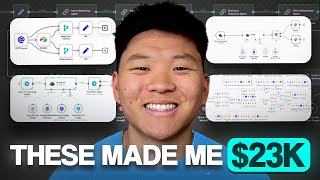
A beginner sold four AI automation agents for a combined $23,000 by focusing on simple tools, ROI-based pricing, and real business problems. The video breaks down each agent, the exact amounts charged, and the seven-step framework used to land clients and scale from freelancer to agency.
The creator earned $23,000 total from four separate businesses and claims they were beginner-level builds using simple automation tools.
System let the client upload a contact list, then generated customized, research-backed outreach messages and stored them in a database. It didn't send messages—just prepared them for plugging into email or DM sequences.
The price was initially random, based on a previous $1,200 project. The creator admits they weren't strategic about ROI-based pricing at that stage.
The client saved 2–3 hours of manual research per week. At $50/hour, that's roughly $5,000 in time saved per year, making the $1,650 investment pay for itself in about 4 months.
The client saw a similar build on YouTube and emailed via a link in the video description. The creator wasn't even positioning as a freelancer—he just put himself out there.
After quitting his job and partnering with Milan and Tyler, the creator launched True Horizon AI and realized they needed a systematic pricing model rather than guessing.
This agent handled customer inquiries, generated quotes, captured lead details, and synced CRM data. The value was cutting manual data entry and letting the business scale without adding headcount.
They forgot to build a case study after delivery and lacked SOPs, so the founder did heavy lifting. This showed the difficulty of moving from freelancer to agency.
An internal assistant that gave quick access to company data, streamlined task management, and automated admin tasks. Priced more on build complexity than long-term value.
Sales agents create a flywheel—more leads → more sales → more growth → more system usage. Admin/personal assistant agents have less clear scaling ROI, which explains the pricing gap.
If you close over 50% of proposals and rarely get pushback, you're underpricing. The market is telling you clients are getting a steal.
A full AI concierge for onboarding, events, guest passes, support, and conversation history. It helped the client launch a new offer without hiring more staff, and incorporated the latest AI tech.
Sell outcomes, not tech. Instead of pitching 'I can build an AI chatbot', promise to cut 15 hours of weekly work or close more deals. Value comes from understanding business pain, not wiring nodes.
Use simple blocks like Naden, vector DBs and AI models. Price via annual savings (hours saved × hourly rate × 4 weeks × 12). Create tiered starter/growth/scale packages and anchor high.
Don't underprice, define scope to prevent creep, avoid chasing small retainers early, and raise rates if close rate is too high. 20–30% close rate is strong for B2B consulting.
Run internal QA with sample and real data, stress-test before showing the client, then give the client one week to QA and provide feedback before iterating.
Treat each project as a starting point. Collect case studies, show measurable ROI, offer ongoing optimization/expansion, and build relationships across the client's org.
Spot the problem, pick simple tools, price based on ROI, package and anchor, avoid traps, prototype, and build partnerships.
Selling AI agents doesn't require advanced technical skills — it requires diagnosing real problems, pricing on ROI, and building trust through prototypes and long-term partnerships.
How much did the creator earn from selling four AI agents?
$23,000 total.
00:01
What was the price of the first personalized outreach agent?
$1,650.
00:55
What was the price of the second sales agent?
$4,000.
03:52
What was the price of the third personal assistant agent?
$6,000.
05:26
What was the price of the fourth AI concierge agent?
$12,000.
08:17
What simple tools does the creator recommend for 90% of AI agent use cases?
Naden (likely n8n), vector databases, and one or two AI models.
10:07
What formula is suggested for ROI-based pricing?
Hours saved per week × hourly rate × 4 weeks = monthly savings; ×12 = annual savings.
10:34
What close-rate signal indicates your prices are too low?
Closing over 50% of proposals with little pushback.
06:32
What is considered a strong close rate for B2B consulting services?
20–30%.
11:43
Who are the co-founders of True Horizon AI and their roles?
Milan (CEO) and Tyler (CTO).
04:07
What was the main value proposition of the sales agent?
It handled inquiries, generated quotes, captured lead details, and updated the CRM, reducing manual data entry and enabling scale without headcount.
03:10
Why is a sales agent's ROI more compelling than a personal assistant agent's?
A sales agent creates a compounding flywheel—more leads lead to more business growth and more system usage—while admin assistant usage doesn't necessarily scale with business growth.
05:51
Simple ROI math sells
Shows a beginner can justify a $1,650 build by calculating how much time it saves, making the purchase an investment rather than an expense.
01:09Compounding ROI of sales vs. admin agents
Explains why one type of automation can justify a higher price through a growth flywheel, a key insight for pricing AI agents.
05:51Close rate is a pricing signal
A 50%+ close rate indicates underpricing; this flips the usual 'success' metric into a warning sign for freelancers.
06:32Sell outcomes, not tech
The shift from 'I can build a chatbot' to 'I can cut 15 hours of weekly work' is the core lesson for moving from builder to business partner.
09:14Strong close rate for B2B consulting is 20–30%
A concrete benchmark that helps consultants calibrate pricing and resist the urge to overserve or undercharge.
11:43[00:01] got paid $23,000 total by four separate businesses, and they weren't anything too complex or advanced. In fact, I actually started selling agents just out. So, I'm confident that you could build and sell something just like them.
[00:14] guys through what each agent actually did, how much we charged per agent, the exact process we followed to sell our agents, and how you can sell your first end because that's when I go through the most expensive agent out of the four.
[00:27] agent I sold, which was a personalized outreach agent. Basically, it let my client drop in a list of contacts, however many he wanted, and the system and their company, then generate a personalized outreach message and
[00:41] didn't actually send the messages or run the campaigns. It simply filled up the database with ready to go, customized, researchbacked messages that he could then plug into an email or DM sequence. Super simple, but insanely valuable. I
[00:55] ended up charging $1,650 for this build. And honestly, that number was pretty random. At the time, I had already sold another agent for 1,200, so that was myself, okay, this one's a bit more. Let's try 1650. I was clearly a
[01:09] about ROI back then. But if you actually do calculate the ROI, it still was a a great deal because he was spending 2 to three hours per week crafting research himself. So, let's say his time was worth 50 bucks an hour. That's
[01:24] instantly got that time back, which means in about four months, he's made that, it's pure ROI. Over the course of a year, that's nearly $5,000 saved. And that doesn't even count the opportunity cost of having those extra hours back
[01:38] every week to actually grow the business instead of writing repetitive outreach. the client found me on YouTube because I had built something similar on my channel just for fun. And he emailed me saying that he wanted something similar.
[01:50] out the build. I told him I could do it. He said yes. It was that simple. The crazy part is at this stage I wasn't positioning myself as a freelancer or happened to have my email address in the description of the videos and I was
[02:03] excited about learning. But because I was putting myself out there, people started reaching out and that's how I was able to close this deal and my other Soon after that, things started moving a lot faster. I'd quit my job. I started
[02:16] realized I couldn't keep doing everything solo. That's when I decided started building what's now our AI a big turning point because up until then, I was just throwing out random
[02:29] numbers for pricing, like that $1,650 outreach agent. But once I had a team, and we realized we needed to get a system for pricing rather than just of guessing, we could actually sit down with a client, break down how much time
[02:43] show them exactly how an automation would save that time or money. and then made sense for both sides. That made selling way easier because clients could see in black and white that it wasn't an expense, it was an investment with a
[02:56] ended up landing the second agent that I'm going to show you guys. So once I partners Milan and Tyler, we launched True Horizon AI. We started getting our one of our first products together. This one was a type of sales agent. The idea
[03:10] The agent could handle customer inquiries, generate quotes, and CRM. It would talk to both the customer and the orders team, generate an important details like name, email, phone number, location, and even a
[03:25] summary of the conversation back into the CRM. The value proposition here was clear. The system would cut down manual data entry, reduce errors, and free up focus on growth rather than repetitive administrative work. And because it
[03:38] a foundation to scale without hiring more staff. And that was a huge deal for could yet afford to do. but he still needed to grow his business. So for this project, we charged $4,000 and the client was happy to pay that because we
[03:52] were removing hours of repetitive work, setting up a system he could scale with, headcount. Now, let's talk about the sales process. It started with me scope things out. From there, I brought in my co-founders, Milan, our CEO, and
[04:07] Tyler, our CTO, to make sure there weren't any crazy technical requirements the bandwidth to actually deliver on this project. After that, Milan and I client and then Milan closed the deal on the third call. Looking back, we
[04:20] definitely didn't have our processes nailed down yet. For example, we forgot couldn't build a strong case study to show the ROI afterward. At the same inbound requests, but didn't have solid SOPs or systems to handle them. So, for
[04:35] ended up doing a lot of the heavy lifting himself and then transitioned into more of an account management role once we brought on a developer to help clear, you don't need a co-founder or a full team to land a $4,000 project. What
[04:49] this really shows is that the jump from freelancer to consultant to trying to growing pains, and even though you might be able to charge more, you'll still be figuring out internal systems along the way. This third agent that we built was
[05:01] business owner and his team. It could provide quick access to internal data sources, streamline task management, and improve team productivity, all directly company lived most of the day. The value prop here was all about productivity,
[05:14] centralizing data retrieval, automating routine admin tasks, and enabling faster tools. Now, when it came to pricing, outreach agents, it's easy to calculate how much time you're saving. But with
[05:26] value is a little more variable because those small admin tasks don't happen on a set cadence. So, it's harder to directly tie them to ROI. So, we ended up charging $6,000 for this project. And even though we tried to back that number
[05:39] with some ROI calculations, the truth is we priced more on complexity of the build rather than the actual long-term value. Valuebased pricing is obviously didn't learn right away. And when you really break it down in terms of value,
[05:51] charged more for the sales agent than we did for this personal assistant agent. usage and leverage of a system actually compounds with a process like a sales agent compared to a personal assistant administrative agent, it becomes very
[06:05] converts those leads, the business grows and as the business grows, more leads grows and this creates like this flywheel where the ROI of the system that's something that's not as clear with a personal assistant because as the
[06:18] business grows, does the personal assistant usage grow? Maybe it does, in the same way. And that's an important lesson because pricing in this space is experience to get it right. Looking back, I know we were pricing too low
[06:32] because our close rate was insanely high. If you're closing over 50% of your realizing that they're getting a steal, and this is the market telling you that you're rarely getting push back on your pricing, which is a strong signal that
[06:45] you're doing it too low. So, anyways, the sales process for this project Milan and I ran the discovery calls. We brought in Tyler, our CTO, to doublech closed the deal. But this is where our growing pains really showed because in
[06:58] order to deliver this build, our CTO ended up being the one in the weeds developing the workflow. And that's not how a CTO should spend their time. He and innovating, which is what Tyler's passionate about and does best, not
[07:11] being stuck in the weeds of a build connecting nodes to an agent. So this scaling a team doesn't automatically make things easier. It actually gives pieces, and more chances for inefficiency. But by the time we got to
[07:24] our next agent, we were in a much better place. We had stronger SOPs, better finally able to charge double what we just charged for this one. Finally, the fourth agent we sold was a full AI concierge. This one was designed to
[07:37] their members with everything they needed. Onboarding, finding and starting events, managing guest passes, offering support, and even keeping a running conversation history across all the members. In other words, it acted like a
[07:49] contact that could handle the day-to-day tasks of guiding users and keeping the the company was launching a new offer, our AI concierge was critical in helping them get it off the ground quickly without hiring more staff. This was also
[08:03] started to become a big deal online and we were able to transition the scope and architect to incorporate this new technology which was another value lever client that we stay bleeding edge and are always looking for the newest
[08:17] more complex systems that we had built up to this point and that's why we charged $12,000. The client could clearly see the value because the agent intern or assistant but at a fraction of the long-term cost of hiring. The good
[08:31] news was by this point our internal systems were finally catching up to the had a dedicated account manager keeping the client communication smooth. Our CEO strategy, operations, and growth. And our CTO was finally managing a team of
[08:45] engineers instead of being stuck building by himself. And for me, I creating YouTube videos and focusing on the front end of the business instead of project wasn't just a win because of the $12,000 price tag. It was proof that we
[09:00] had gone from scrappy freelancers to consultants, then to building a business bigger and more valuable clients, and now looking to scale our operations. All agents that we sold. Now, the question is, how do you actually do this
[09:14] I've followed as a freelancer, then when I built my own agency, and now with my co-founders at True Horizon as we started to move up market. And it's the landing your first real AI automation clients. Step one, diagnose the problem.
[09:29] step is learning to think like a problem solver. The value isn't in the fact that you know how to wire up nodes in your AI workflow. The value is your brain and your ability to understand how a business runs, where it's leaking time
[09:42] or money, and where an automation can fix that. For example, don't pitch, I can build you an AI chatbot. Instead, say your team spends 15 hours a week can build a system that cuts that down
[09:54] more deals. That shift takes you from just being a builder to being a business partner. Number two, pick simple tools. Once you've identified the problem, the tools are just the way you solve it. For 90% of use cases, simple building blocks
[10:07] like Naden, vector databases, and an AI model or two will get the job done. But freelancers underpric because they think in terms of technical effort. Clients don't care if it takes you 2 hours or 20. They care about the outcome. Selling
[10:20] when the space first started up, but if your value is defined by the templates commoditized. You should leverage templates to help you build quicker and able to customize them to fit the client's needs. Step three is to
[10:34] multiply the hours saved by the hourly rate by 4 weeks, and that's how you get to monthly savings, and then just times that by 12 to get to annual savings. So, your offers. Don't just blurt out a number. Try creating tiered packages
[10:47] like a starter plan, a growth plan, and a scale plan so clients can self- select and always lead with the highest anchor. So, for example, our scale package is functionalities, but most clients actually go with the growth package at
[10:59] 12K that has these functionalities. Suddenly, that 12K feels like the smart professional. Anchoring makes your pricing logical, and together they stop clients from comparing you to hourly freelancers. Number five, avoid the
[11:13] killers that you need to watch out for. One of them is underpricing. It attracts the wrong clients and makes it nearly impossible to raise your rates later. to just one more feature without rescoping will destroy your margins and
[11:27] always define exactly what's included and create a change request process for is chasing small retainers too early. One $10,000 project is often more health and business reputation than five $2,000 a month retainers. Stability
[11:43] comes from having a lead pipeline, not from having retainers. And just another quick reminder to raise your rates regularly. If your close rate is way that you're underpricing. For B2B consulting services, a 20 to 30% close
[11:56] rate is considered strong. So, if you're not receiving any friction or push back, you're going down a bad path where your CLV or customer lifetime value is going to be way too low. Number six, we have prototype and QA. Now that you've priced
[12:08] build. But don't overthink it. Prototype test. At True Horizon, we follow a internal QA. We run it through a sample and a real data set. We stress test it
[12:21] before the client sees anything. And then we give the client a week to QA, world, give us feedback, and then we're able to iterate and make those things. One, it protects you from edge case failures, and two, it shows your
[12:36] reliable, and looking out for their business. Number seven, building long-term partnerships. Finally, just remember this. You're not selling relationships. Your early projects position you in the client's mind as
[12:49] strategic AI partner. Long-term value comes from collecting data and case project into multiple by showing measurable ROI, offering ongoing optimization or expansion once trust is established, and building relationships
[13:03] with more than just one person in the customer's organization. When you can clearly demonstrate this system saves you 10 times what you paid me, clients thinking about how else they can work with you. So if you want to follow the
[13:16] same path, here's the road map. Spot the problem, pick simple tools, price based on ROI, package an anchor, avoid the traps, prototype, and build long-term partnerships. That's the exact framework that I've used to find success selling a
[13:28] agents. And it's the same one that we will still use today at True Horizon. So going to have this full resource pack in my free school community if you guys goes over everything that I just talked about here so you can reference that
[13:41] deeper with this kind of stuff and you also want to connect with other people then definitely check out my plus group. The link for that is also down in the watching this, we just dropped a full course called automation to monetization
[13:54] start to monetize your AI skills now that you are not just advanced in edited in AI implementation and becoming a problem solver for these businesses. And need someone to help them out with their AI implementation road maps. If you guys
[14:09] please give it a like. Definitely helps me out a ton. And as always, I of the video. I'll see you on the next one. Thanks everyone.



⚡ Saved you 0h 14m reading this? Transcribe any YouTube video for free — no signup needed.